How to Reduce Maintenance Backlog: A Practical Recovery Plan

TL;DR
Reduce unfinished maintenance by removing duplicate requests, estimating labor hours, and scheduling only jobs ready for execution. Sustainable recovery requires completion capacity above incoming demand; a worked example shows how to calculate the recovery period without sacrificing preventive maintenance.
A maintenance backlog won't shrink just because every ticket gets a priority label. Knowing how to reduce maintenance backlog means matching unfinished work to actual labor capacity, preparing jobs before dispatch, and completing more work than arrives. For facility managers and multi-location operations teams, the useful measure isn't ticket count alone. It's the labor hours remaining, the risks attached, and the resources available to finish them.
Table of Contents
What counts as maintenance backlog?
A maintenance backlog is approved maintenance work that remains unfinished, measured in jobs or estimated labor hours. It includes work awaiting planning, materials, access, scheduling, or execution. Not every open request belongs in the executable backlog: duplicates, unverified reports, and completed jobs awaiting administrative closure need separate treatment.
Ready backlog: Approved work with a defined scope, labor estimate, materials, access, and an assigned skill requirement.
A manageable queue can support efficient scheduling. The goal is to control risk and waiting time, not force every property to reach zero open work.
Separate work by its next required action
| Work category | Treatment | Scheduling rule |
|---|---|---|
| Duplicate or already completed | Verify and close with evidence | Exclude from remaining labor |
| Awaiting parts or access | Assign an owner and next-action date | Keep outside the ready queue |
| Ready planned work | Confirm scope and labor estimate | Schedule against available capacity |
| Safety-critical defect | Assess and escalate immediately | Follow applicable safety procedures |
Keep an audit trail when removing records. Guidance on why maintenance tickets get lost provides related context for maintaining a trustworthy queue.
How is maintenance backlog measured in hours?
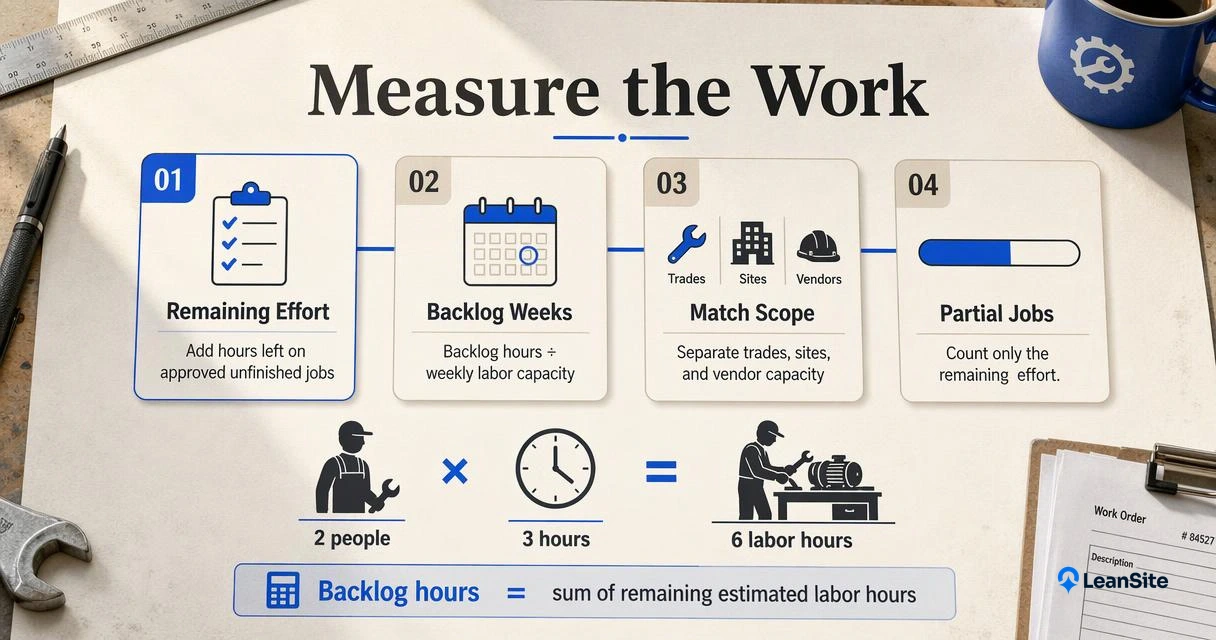
Maintenance backlog hours are calculated by adding the estimated remaining labor hours for all approved unfinished jobs. Backlog weeks equal those hours divided by the weekly labor capacity available for that work. Both figures should use the same scope, separating specialist trades, sites, and vendor capacity where resources aren't interchangeable.
Use remaining effort, not ticket age
Backlog hours = sum of remaining estimated labor hours
Backlog weeks = backlog hours ÷ available weekly labor hours
A two-person repair lasting three hours requires six labor hours. Partially completed work should carry only its remaining effort. Track oldest-job age separately because a small, long-delayed safety task can matter more than a large routine job.
Worked example with explicit capacity assumptions
The following figures are illustrative assumptions, not industry benchmarks:
- Four technicians work 40 paid hours each: 160 hours weekly.
- Travel, meetings, leave, and other commitments reduce usable capacity to 100 hours.
- Protected preventive work and an emergency allowance consume 20 hours, leaving 80 hours.
- New corrective demand averages 40 labor hours weekly.
- Approved corrective backlog totals 600 hours; the chosen target is 200 hours.
Net weekly reduction = 80 − 40 = 40 hours
Recovery time = (600 − 200) ÷ 40 = 10 weeks
Current corrective backlog coverage is 600 ÷ 80 = 7.5 weeks. Recovery takes ten weeks because incoming work also consumes capacity. Estimate each location separately before combining portfolio totals; multi-location maintenance visibility supports that operating approach.
How can teams reduce maintenance backlog sustainably?
- Audit maintenance backlog records and remove verified duplicates.
- Rank approved jobs by safety, asset criticality, and operating impact.
- Prepare scopes, parts, permits, access, and labor estimates.
- Reserve weekly capacity above expected incoming demand.
- Review completed hours, new demand, and blocked work every week, then adjust the recovery schedule.
Days 1 to 5: clean records and prepare jobs
Appoint one recovery owner and confirm every open job's asset, location, status, and remaining effort. Merge duplicate reports without losing requester history. Assess consequential defects promptly rather than letting age alone determine priority.
For each selected job, confirm parts availability, isolation requirements, permits, tenant access, and vendor attendance. Give blocked work a named owner and follow-up date. Where external contractors are needed, vendor dispatch coordination is useful follow-up reading.
Week 2 onward: commit capacity and verify completion
Publish a weekly schedule containing only ready jobs. Group compatible tasks by property, trade, or access window to reduce avoidable travel and repeated setup. Reserve specialist work against qualified capacity rather than assuming every technician can perform it.
Confirm completion through job notes, required checks, and supporting evidence. Compare planned hours with actual effort to improve estimates, not to reward rushed closure.
A falling ticket count isn't proof of recovery. Verified work completed must exceed incoming work in comparable labor hours.
Protect recurring service tasks through a defined preventive maintenance ticket flow. Review new demand, completion hours, overdue critical jobs, and blocked-job age weekly. If demand exceeds capacity, approve additional qualified support, revise scope, or extend the recovery date.
How Leansite handles this
Leansite is a relevant platform to evaluate for coordinating the recovery workflow across facilities and vendors. A useful evaluation should follow a real job from request through assignment, scheduling, completion evidence, and owner review, rather than relying on a feature checklist alone.
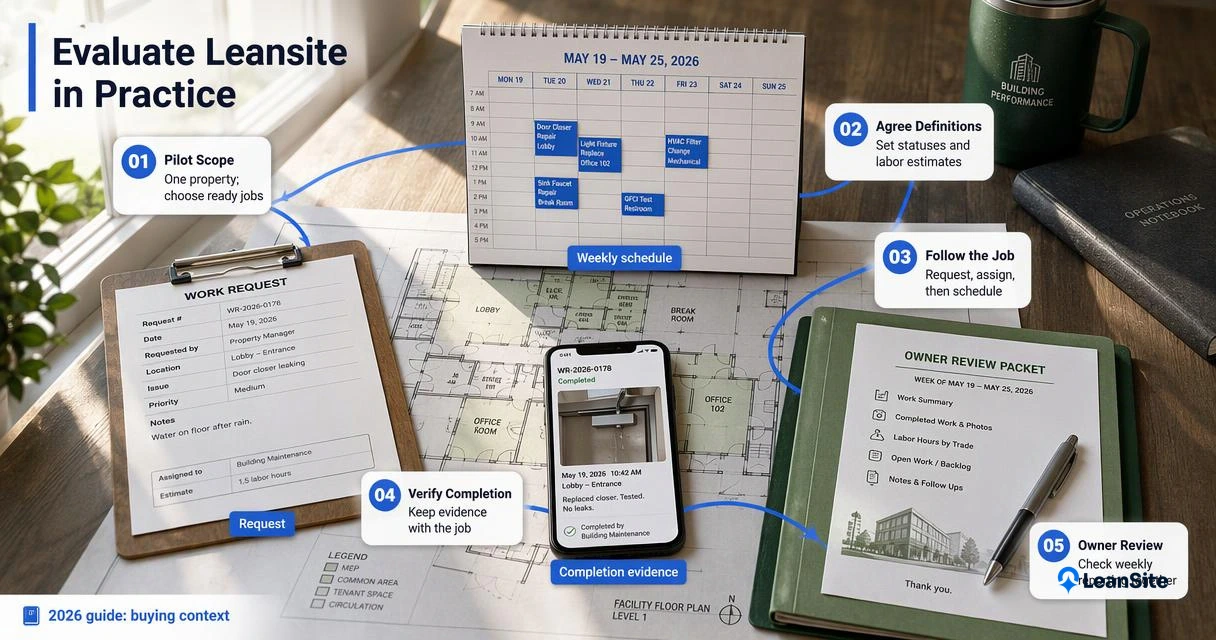
A facility pilot can establish agreed status definitions, labor estimates, and weekly reporting requirements before wider rollout. The 2026 multi-site maintenance software guide offers related buying context.
Set a practical pilot acceptance test
- Select one property and a representative group of ready jobs.
- Record estimated effort, assigned resources, and completion evidence.
- Compare the weekly plan with verified results.
The Leansite platform should be assessed against those requirements during a demonstration. Any automation should support accountable scheduling and closure, with capabilities confirmed before adoption.
Conclusion
Start recovery with a verified backlog-hours total, a protected weekly capacity budget, and a schedule of ready jobs. Assign an owner to review the gap between incoming and completed hours every week. For a practical next step, operations leaders can visit getleansite.com and request a Leansite demonstration using one property's actual recovery workflow.
Demi Oloyede
Leansite
Frequently Asked Questions
What is an acceptable maintenance backlog?
An acceptable maintenance backlog fits available capacity while keeping safety-critical and business-critical work within agreed limits. A universal number of weeks won't suit every facility. Teams should define targets by asset criticality, service obligations, trade availability, and access constraints, then monitor aging alongside total labor hours.
Should the oldest work orders be completed first?
The oldest work orders shouldn't automatically come first. Safety exposure, operational impact, compliance obligations, and asset condition should guide priority. Age remains useful as an escalation signal, especially for repeatedly deferred work. Among similarly ranked ready jobs, completing older tasks can prevent indefinite postponement and improve confidence in the schedule.
Can overtime clear the queue permanently?
Overtime can provide temporary recovery capacity, but it won't permanently solve a continuing gap between incoming demand and available labor. Managers should confirm parts, access, and supervision before approving extra hours. A lasting plan also addresses recurring defects, realistic staffing, vendor support, and protected preventive work.
More from the blog
- maintenance vendor coordination
In House vs Outsourced Facility Maintenance: A 2026 Guide
Compare maintenance staffing models by response coverage, skills, workload, and fully loaded costs, with an illustrative budget and hybrid decision guide.
- maintenance history
Best QR Code Asset Tagging Software: A 2026 Buying Guide
Compare QR asset tagging options by labeling, mobile access, maintenance history, and permissions, then validate the right fit with a small-site pilot.
- commercial property maintenance
Facilio vs MaintainX: A Practical Buyer’s Guide for 2026
Compare Facilio and MaintainX through portfolio oversight, technician workflows, integrations, and implementation. Use a practical demo scorecard.