Facilio vs MaintainX: A Practical Buyer’s Guide for 2026

TL;DR
Evaluate Facilio and MaintainX against two separate needs: portfolio oversight and frontline maintenance execution. Require both vendors to demonstrate the same workflow, confirm integrations and plan limits in writing, and price the same implementation scope before selecting a platform.
A polished work-order demo doesn't prove portfolio fit. Facilio vs MaintainX should be evaluated through actual maintenance scenarios, from a technician closing a repair to an owner reviewing costs across properties. The useful question isn't which platform has the longest feature list; it's which can support the required operating model with clear implementation commitments.
CMMS: A computerized maintenance management system organizes maintenance records and workflows, including work orders, assets, and scheduled tasks.
For a 2026 purchase, the comparison below provides a practical verification framework. It doesn't assert unverified feature gaps, current prices, or plan limits.
Table of Contents
Facilio vs MaintainX: What should buyers compare?
Buyers should compare Facilio and MaintainX using identical requirements for portfolio reporting, field execution, vendor coordination, and integration scope. A feature checkbox isn't enough: each requirement needs a live demonstration, a named subscription tier, and written confirmation of any setup or ongoing costs.
A side-by-side proof checklist
The same proof standard should apply to every shortlisted platform. Leansite belongs in that evaluation as a commercial-property option to explore through its published buyer resources, rather than through assumed feature equivalence.
| Buyer requirement | Leansite | Facilio | MaintainX |
|---|---|---|---|
| Portfolio oversight | Request a property-level reporting walkthrough | Demonstrate site rollups and drill-downs | Demonstrate site rollups and drill-downs |
| Frontline maintenance | Request an end-to-end technician walkthrough | Show assignment through completion | Show assignment through completion |
| Vendor coordination | Confirm external-party access and approvals | Confirm access, permissions, and charges | Confirm access, permissions, and charges |
| Connected systems | Request a written integration scope | Specify supported data flows | Specify supported data flows |
| Commercial terms | Obtain a scoped proposal | Confirm tier, services, and renewal terms | Confirm tier, services, and renewal terms |
This table lists evidence to request, not verified product capabilities. Neither a missing demonstration nor a missing public description proves that a vendor lacks a feature.
Separate two different definitions of success
Portfolio leaders need consistent asset records, comparable spending categories, and reporting across locations. Technicians need clear assignments, usable instructions, and a quick way to document completed work.
The strongest fit connects field activity to management decisions without making routine maintenance harder.
A buyer should score these outcomes separately. Strong executive reporting doesn't establish technician usability, and a fast work-order screen doesn't establish reliable portfolio reporting.
How should teams test workflows and integrations?
Teams should test Facilio and MaintainX with one shared maintenance scenario and a written integration checklist.
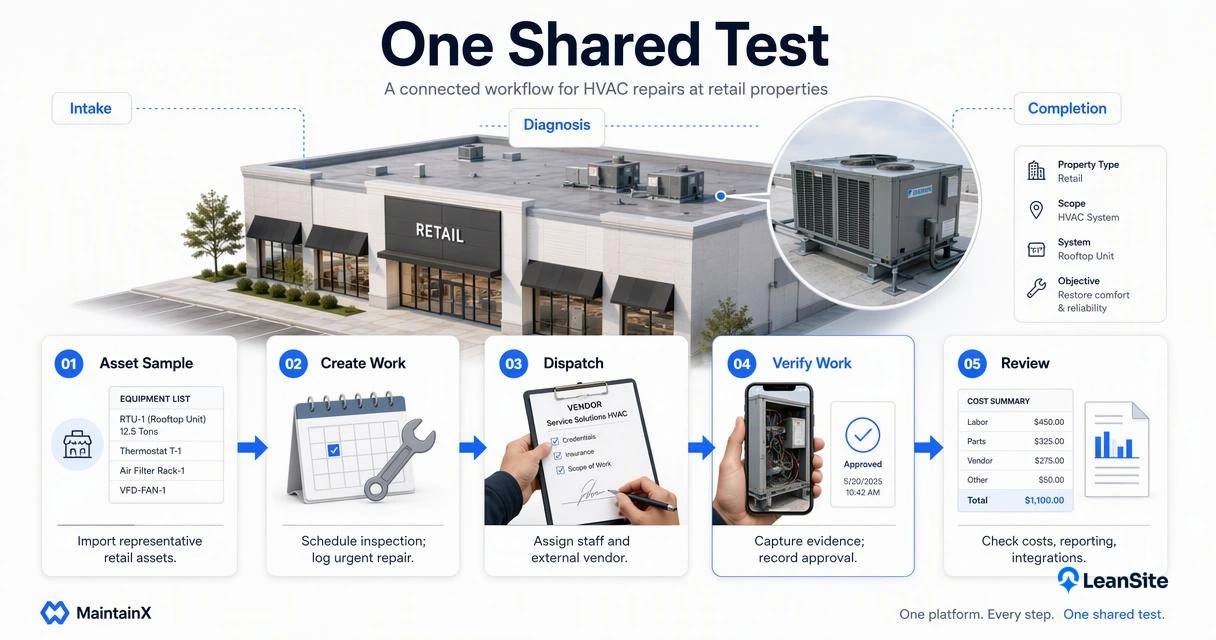
- Import a small, representative asset sample.
- Create a recurring inspection and an urgent repair.
- Assign internal staff and an external vendor.
- Capture completion evidence and approval.
- Review costs and reporting.
- Verify connected-system behavior.
Run a commercial-property scenario
Use an HVAC repair at a retail property as a test case. The demonstration should follow the request from intake through dispatch, diagnosis, approval, completion, and cost review.
Require each vendor to show the actual screens used by a requester, technician, vendor, and manager. That reveals role-specific steps more clearly than a presentation. Add a second property to test whether reporting remains useful when locations use different asset names or cost codes.
Specify what an integration must actually do
An integration requirement should identify systems, records, direction, timing, and ownership. An API alone doesn't establish that a particular accounting or building-system workflow is available.
- Data: Which asset, work-order, invoice, or meter fields move?
- Direction: Does information travel one way or both ways?
- Timing: Is synchronization scheduled or event-driven?
- Responsibility: Who monitors errors and maintains mappings?
- Access: Which subscription and permissions are required?
Ask both vendors to document these answers. Treat product limitations as confirmed only when supported by current documentation or a written response.
Who should pick which platform?
Portfolio-led teams should select whichever platform proves cross-property control, while maintenance-led teams should select whichever proves effective frontline execution. Mixed operations need both. Assigning Facilio or MaintainX a winner based only on category labels risks overlooking capabilities, configuration needs, and differences between subscription tiers.
Match the decision to the operating model
The winning demonstration should reflect the organization's main source of value.
- Property owners: Prioritize traceable costs, asset history, and consistent reporting across locations.
- Facility managers: Prioritize request handling, preventive schedules, approvals, and vendor handoffs.
- Enterprise operations: Prioritize shared standards with appropriate local permissions.
- Maintenance teams: Prioritize task clarity, completion evidence, and manageable administrative work.
Score demonstrated outcomes separately from promised functionality. A useful tie-breaker is the amount of ongoing administration needed to keep records and reports dependable.
How Leansite handles this comparison
Leansite offers a relevant third evaluation path through its published comparison and alternative-selection resources. The direct MaintainX comparison provides focused follow-up for buyers expanding their shortlist.
Use those resources to prepare a requirements-led conversation, then request evidence for the same workflow tested elsewhere. Product-specific capabilities still need confirmation; the strongest recommendation comes from a successful demonstration, not brand preference.
What should a 2026 implementation proposal include?
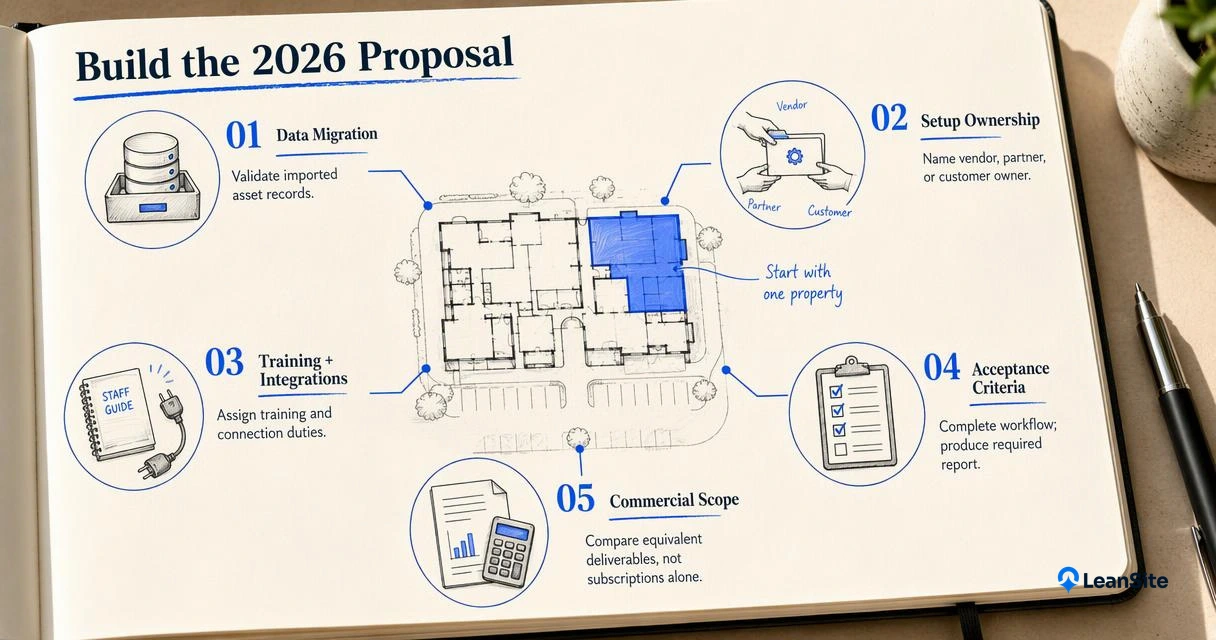
A 2026 implementation proposal should define data migration, configuration, training, integration responsibilities, acceptance criteria, and total commercial scope. Compare equivalent deliverables rather than subscription prices alone. Written ownership matters because setup tasks can fall to the vendor, an implementation partner, or the customer's operations team.
Make the rollout measurable
Start with a representative property and define acceptance criteria before expanding. Examples include completing the agreed workflow, producing the required report, and validating imported asset records. These are proposed test criteria, not published performance benchmarks.
Record licensing assumptions, external-user charges, services, and renewal conditions in one worksheet. The maintenance-software alternatives guide offers another shortlist resource.
Supplement demos with comparison context
This video compares MaintainX with Limble, not Facilio, so it serves as supplementary context rather than evidence of a head-to-head result.
Conclusion
The next step in a Facilio vs MaintainX evaluation is a matched demonstration and scoped proposal. Select one property, one repair, and one reporting requirement, then score the evidence consistently. For a commercial-property alternative, explore Leansite and request a workflow discussion at getleansite.com using that same evaluation brief.
Demi Oloyede
Leansite
Frequently Asked Questions
Is Facilio better than MaintainX for multiple properties?
A multi-property buyer should choose the platform that demonstrates consistent reporting, appropriate permissions, and useful location-level detail. Property count alone doesn't establish a winner. Both vendors should run the same portfolio scenario, explain configuration requirements, and confirm which proposed functions are included in the quoted subscription.
Which platform costs less?
A defensible cost comparison requires current proposals with matching assumptions. Include user types, locations, implementation services, migration, integrations, support, and contract terms. Without verified pricing and equivalent scope, declaring either platform cheaper would be misleading. Evaluate the expected operating workload alongside the quoted software and services costs.
Can a maintenance platform replace building controls?
Maintenance workflow software shouldn't be assumed to replace a building management system. Buyers should distinguish organizing work from monitoring equipment and directly controlling it. If connected-building functionality matters, require an architecture review covering data access, commands, permissions, and system ownership before treating that requirement as satisfied.
More from the blog
- maintenance vendor coordination
In House vs Outsourced Facility Maintenance: A 2026 Guide
Compare maintenance staffing models by response coverage, skills, workload, and fully loaded costs, with an illustrative budget and hybrid decision guide.
- maintenance history
Best QR Code Asset Tagging Software: A 2026 Buying Guide
Compare QR asset tagging options by labeling, mobile access, maintenance history, and permissions, then validate the right fit with a small-site pilot.
- facility inspection software
Warehouse Facility Maintenance Software: A 2026 Buyer’s Guide
Compare warehouse maintenance software by dock-door uptime, building inspections, contractor coordination, and clear repair ownership.