A disclosure worth stating upfront: this guide is published by LeanSite AI, and LeanSite AI appears in it, ranked first. We've tried to describe every other platform fairly, with a genuine strength and a genuine limitation for each, but that conflict of interest is real and worth keeping in mind as you read.
Search "multi-site maintenance software" and nearly every guide you'll find assumes you're running a factory. They compare sensor integrations, PLC connectivity, and OEE benchmarking, useful if you're managing production lines, largely irrelevant if you're running restaurants, retail stores, self-storage facilities, or a mixed portfolio of owned and leased buildings.
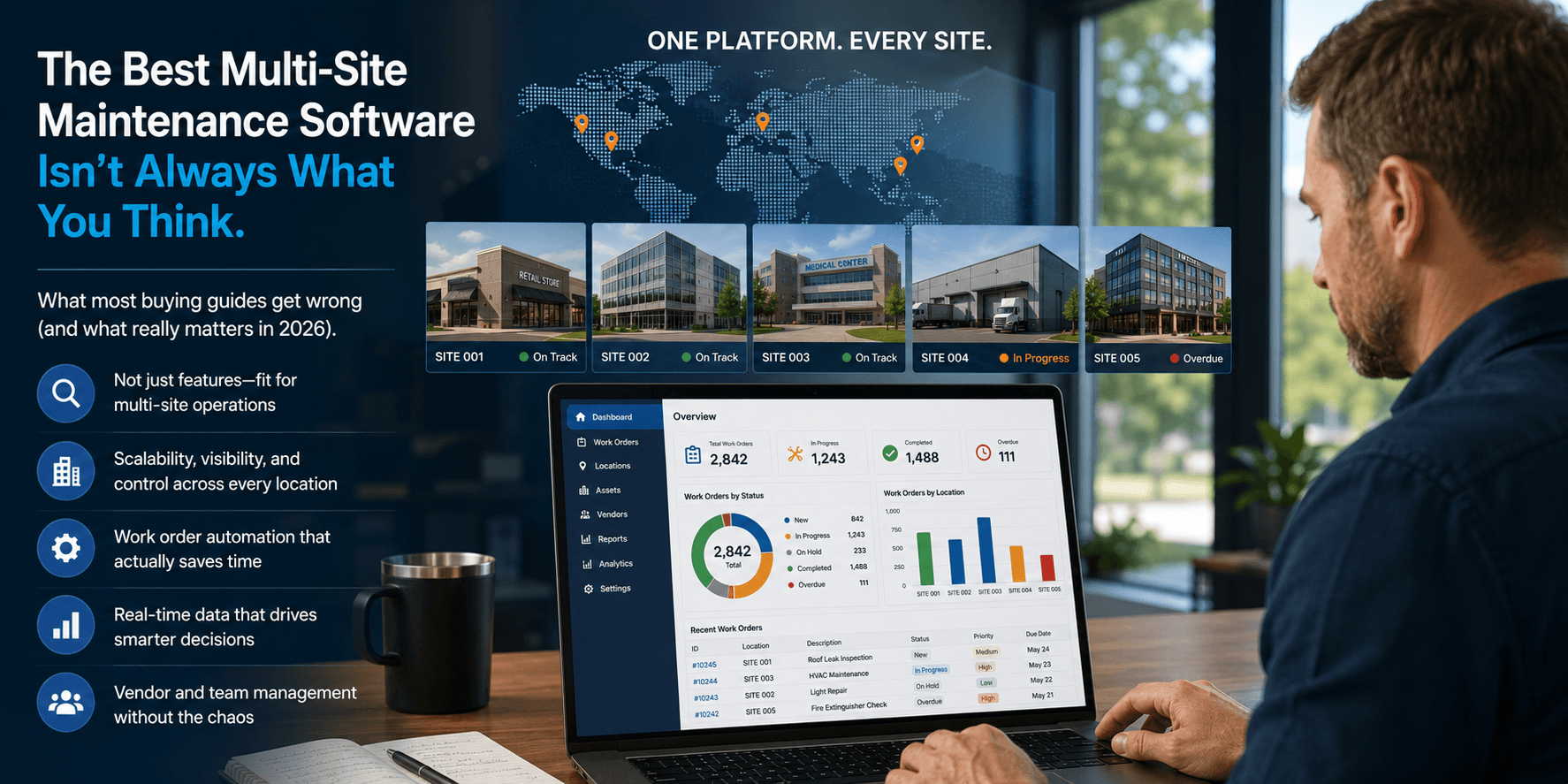
Quick answer: Most multi-site maintenance software guides are written for factories, comparing sensor integrations and OEE dashboards, which leaves facilities, property, and multi-location service teams without a real answer. For that audience, the deciding factors are vendor payment integration, NTE (not-to-exceed) budget controls, support for franchise or mixed-ownership portfolios, and an AI layer that can actually see live work orders and spend, not just a chatbot trained on help docs. This is a crowded, fast-growing category to begin with, the global CMMS market was estimated at roughly $1.29 billion in 2024 and is projected to more than double by 2030, according to Grand View Research, which is part of why so many buying guides exist and why so few are written for this specific audience.
This guide is written for the facilities, property, and multi-location operations leaders whose problem isn't bearing failures on a conveyor, it's a walk-in cooler down at Location 14, a vendor invoice with no record of who approved it, and a franchisee who won't use whatever system corporate mandates. It pairs with our companion pillar guide, The Complete Guide to Multi-Location Facilities Management Software, which covers the underlying rollout and evaluation framework in more depth.
Why Most Multi-Site Software Guides Don't Fit Facilities Teams
Look closely at the buying guides currently ranking for "multi-site maintenance software," and a pattern shows up fast: most of them are written by and for industrial CMMS vendors, and the criteria reflect that. Asset hierarchy standardization, sensor-agnostic data ingestion, MTBF and MTTR benchmarking between plants, these are real problems, but they're manufacturing problems.
A facilities team running 15 restaurants, a property manager overseeing 40 retail leases, or a regional director for a fitness chain has a different set of problems that these guides simply don't address:
-
Vendor payments live outside the maintenance system, in a separate accounts-payable process with no link back to the original work order.
-
Budget approval is inconsistent across locations, with no standardized not-to-exceed threshold or tiered sign-off process.
-
Ownership isn't uniform. A portfolio can include corporate-owned, franchised, and leased locations, each with different budget authority and brand-standard enforcement needs, something no manufacturing-oriented guide even mentions.
-
Compliance is about health, fire, and safety code, not calibration certificates and lockout/tagout procedures.
-
The AI feature list is vague everywhere. Nearly every platform now claims an AI assistant, but almost none of the current guides specify what data that assistant can actually access, whether it's grounded in live work orders and budgets, or just trained on a help center.
None of this makes the manufacturing-focused guides wrong, it just means they're answering a different question than the one most facilities and property teams are actually asking.
What to Actually Look For
For a facilities, property, or multi-location service organization, these are the criteria that separate real multi-site software from a single-site tool with more logins. For the fuller version of this framework, see How to Choose the Right CMMS: A Complete Buyer's Guide (2026).
-
Integrated vendor payments, not just vendor contact records. Invoicing and payment tied directly to the work order that triggered it. See Vendor Dispatch and Predictive Maintenance Automation for Multi-Site Teams for what this looks like in practice.
-
NTE and budget governance, configurable by trade, with tiered approval so small repairs move fast and large ones get real sign-off.
-
Support for mixed ownership, letting corporate-owned, franchised, and leased locations operate under one platform without forcing identical budget authority on all three.
-
Standardized asset structure, the same categories, criticality ratings, and naming conventions at every site, so portfolio-wide reporting is possible instead of theoretical.
-
An AI layer with specified access, not a marketing checkbox. Ask directly what data the assistant can see and whether it works across the whole portfolio or one location at a time.
-
Compliance and audit trail depth built for health, fire, and safety code, not just industrial calibration records.
-
Fast deployment, measured in days or weeks, not the multi-month or multi-year timelines common in enterprise EAM platforms built for global manufacturers.
Top Multi-Site Maintenance Software for Facilities Teams
1. LeanSite AI
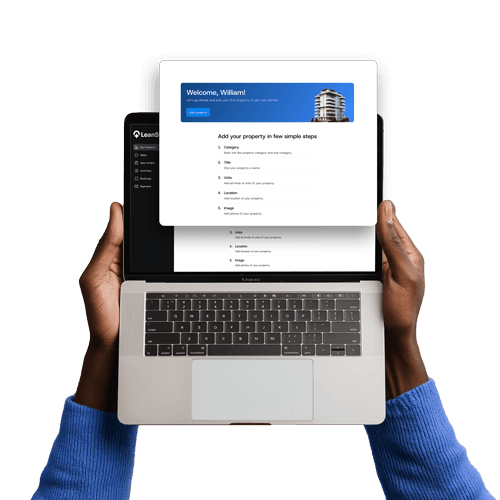
LeanSite AI, the platform this article's publisher builds, is designed specifically around the gaps described above rather than treating them as afterthoughts, according to its own published feature set. Vendor coordination, invoicing, and ACH payment live inside the same work order record instead of a separate accounts-payable process. Budget and NTE controls are configurable per location and per trade, with tiered approval routing. Role-based, location-based permissions support corporate-owned, franchised, and leased locations operating side by side on the same platform. Vera, LeanSite's AI assistant, is described as grounded in live work orders, budgets, and vendor records inside the FM Portal rather than a general help-center chatbot. Deployment is measured in days, with white-glove onboarding included. As a newer entrant to this specific category, LeanSite AI has a smaller public review track record than a more established platform like MaintainX, which is worth factoring into an evaluation alongside the feature comparison itself.
2. Coast
Coast is the strongest of the industry-agnostic platforms for facilities-style portfolios, covering restaurants, retail, hotels, churches, and property management alongside manufacturing. Its flexible per-location workflows and mobile-first execution are genuine strengths for distributed, non-technical teams. It doesn't yet offer integrated vendor payments or NTE-style budget governance as a first-class feature, so portfolios with heavy third-party vendor spend will likely need a supplementary process for invoicing and approval.
3. eWorkOrders
eWorkOrders is a flexible, configurable CMMS with genuine multi-site depth, serving manufacturing, healthcare, food and beverage, and facilities customers. It supports vendor and contractor management as a feature, though without the payment-integration depth some portfolios need, and its AI capabilities are described in general terms rather than tied to a specific, demonstrable dataset.
4. MaintainX
MaintainX remains a strong choice for teams that want fast, mobile-first adoption and don't need deep vendor-payment or NTE functionality. It's a common next step up from paper or spreadsheets, though multi-site reporting and vendor coordination are shallower than purpose-built multi-location platforms.
5. Fiix (Rockwell Automation) and Enterprise EAM Platforms
Fiix, SAP EAM, and similar enterprise platforms are strong where deep ERP and financial integration matter more than shop-floor or field usability, and where a company already has the internal IT resources to support a longer implementation. For a facilities or multi-unit service organization without a large corporate IT department, these platforms are usually more than the problem requires, and several reviews note real adoption friction at the site level as a result.
Two platforms worth naming even though they fall outside this ranking's scope: Fabrico and Factory AI are both strong, purpose-built tools for manufacturing plants, sensor integration, condition-based monitoring, and OEE benchmarking between production sites. If you're running factories rather than restaurants, retail stores, or leased buildings, they're worth evaluating on their own terms rather than against the criteria in this guide.
Comparison Table
|
Platform |
Vendor Payments |
NTE/Budget Controls |
Mixed Ownership Support |
Deployment Speed |
|---|---|---|---|---|
|
LeanSite AI |
Integrated, ACH |
Configurable by trade, tiered approval |
Corporate, franchise, and leased on one platform |
Days |
|
Coast |
Not native |
Limited |
Not addressed |
Days to weeks |
|
eWorkOrders |
Basic vendor records |
Limited |
Not addressed |
Weeks |
|
MaintainX |
Not included |
Limited |
Not addressed |
Days to weeks |
|
Fiix / Enterprise EAM |
Via ERP integration |
Enterprise approval workflows |
Not addressed |
Months to years |
How to Choose
-
Running a restaurant, retail, fitness, or multi-unit service portfolio with real vendor spend? LeanSite AI is built specifically for this combination.
-
Need broad industry flexibility and strong mobile adoption, without heavy vendor-payment needs? Coast or MaintainX are reasonable fits.
-
Already running SAP, Oracle, or another enterprise ERP and have dedicated IT resources? Fiix or an enterprise EAM platform may be worth the longer implementation.
-
Running actual manufacturing plants with sensors, PLCs, and condition-based monitoring needs? Fabrico or Factory AI are built specifically for that environment and are worth evaluating on their own terms.
Book a demo with LeanSite AI to see vendor payments, NTE governance, and portfolio-wide visibility built for this specific problem, and weigh it directly against the alternatives above.
FAQ
What's the difference between multi-site maintenance software for factories versus facilities teams? Factory-oriented platforms focus on sensor integration, condition-based monitoring, and benchmarking metrics like OEE and MTBF between plants. Facilities-oriented platforms need vendor payment integration, budget and NTE governance, and support for mixed ownership models like franchise and leased locations, problems manufacturing tools generally don't address.
Do I need vendor payment integration in my multi-site maintenance software? If your organization relies on third-party vendors for repairs, which most restaurant, retail, and property portfolios do, keeping invoicing and payment inside the same system as the work order closes a real accountability gap. Without it, spend tracking and vendor accountability usually end up reconstructed manually after the fact.
Can multi-site maintenance software handle a mix of franchised, corporate-owned, and leased locations? Only a handful of platforms are built for this explicitly. It requires location-based permissions flexible enough to give a franchisee budget and vendor control at their site while still giving corporate brand-standard visibility, without forcing every location into an identical ownership structure.
How do I evaluate an AI assistant claim from a multi-site maintenance software vendor? Ask specifically what data the assistant can access. An assistant grounded in your live work orders, budgets, and vendor records across every location is a meaningfully different tool than one trained only on a help center or knowledge base, even if both are marketed as "AI."
How long should it take to deploy multi-site maintenance software? Modern, purpose-built platforms typically deploy in days to a few weeks. Enterprise EAM platforms built for global manufacturers often take months to years, which is usually not a fit for a facilities or multi-unit service organization without a dedicated IT department to support the rollout.
Most "best multi-site maintenance software" guides are answering a factory's question. If you're running restaurants, retail, fitness, self-storage, or any multi-location facilities portfolio, the criteria are different.
Written by Pelumi Akinwande, Operations Content Lead at LeanSite, who works directly with multi-site facilities and property operations teams evaluating work order software. Connect on LinkedIn.