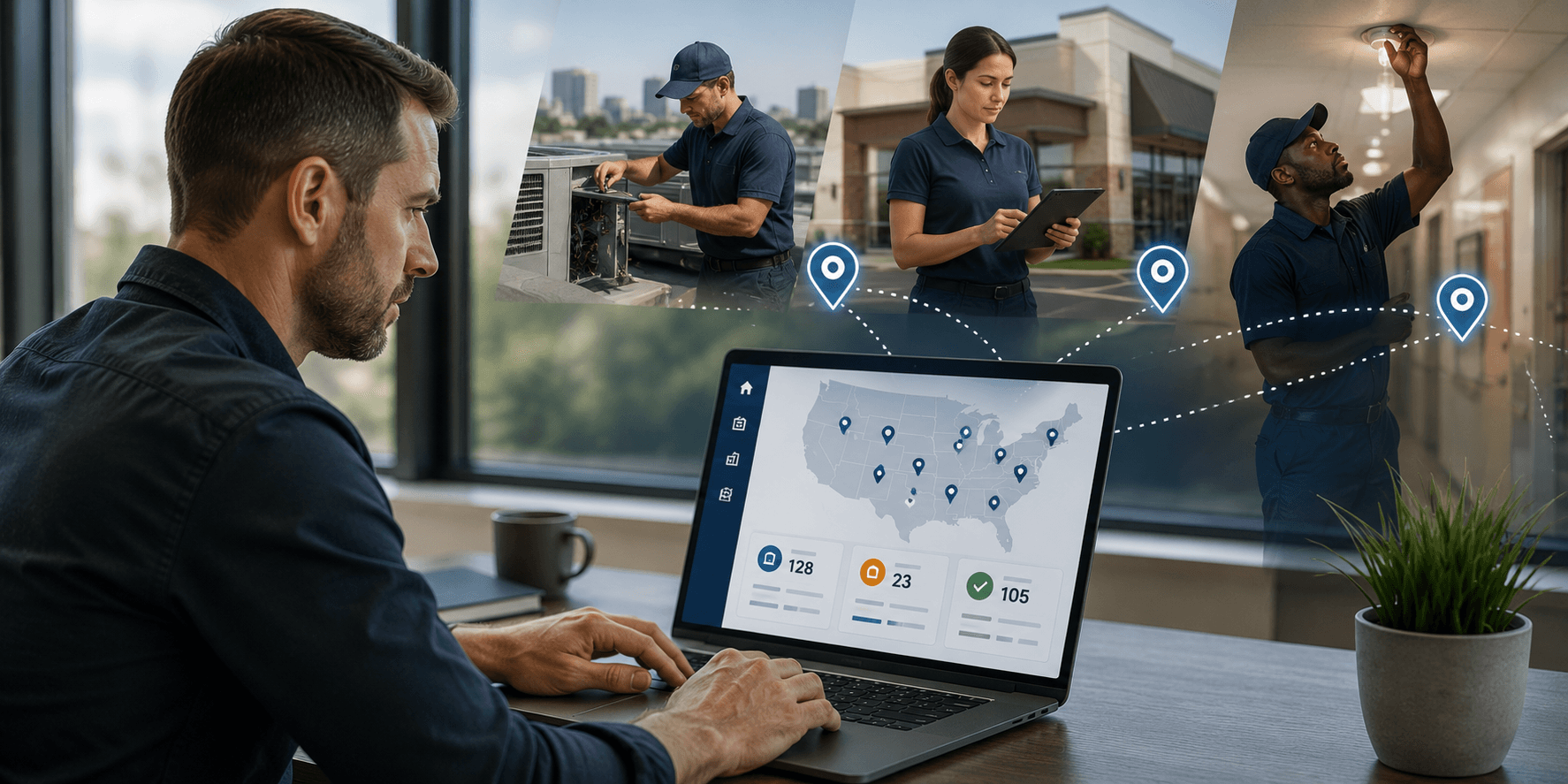
Managing maintenance for one location is a to-do list. Managing it for ten, thirty, or eighty is a completely different problem, and most organizations don't realize they've crossed that line until something breaks, usually a compliance miss, a budget blowout, or a regional manager quietly admitting they have no idea what's actually happening at half their sites.
This guide is for the person holding that problem: an operations or facilities leader responsible for maintenance quality, cost, and compliance across a growing number of locations. We'll walk through why multi-location maintenance management breaks down, what it actually costs when it does, and a practical framework (standardization, vendor consolidation, budget workflows, staffing, and reporting) for fixing it without disrupting the locations that are running fine right now.
Quick answer: Multi-location maintenance breaks down in a predictable order as an organization scales: visibility goes first, consistency second, cost control third, and compliance last. Fixing it takes seven things being true at every location, one system of record, standardized PM templates, shared KPIs, centralized vendor data, a defined budget and NTE workflow, mobile access, and role-based reporting, rolled out in phased waves rather than all at once.
Why Multi-Location Maintenance Breaks Down as You Scale
The math is deceptively simple and brutally unforgiving. A single site with a missed preventive maintenance visit is a local problem. The same gap in your process, replicated across 50 sites, is 50 missed visits, and because it's the same root cause everywhere, they tend to surface in clusters, not one at a time.
Four things typically break in this order as an organization grows past a handful of locations:
Visibility goes first. When work orders, asset histories, and vendor invoices live in different spreadsheets, inboxes, or local systems per site, nobody, not the site manager, not the regional lead, not corporate, has a real-time picture of what's actually happening. You find out about a problem when it's already expensive.
Consistency goes second. Without a shared standard, every site develops its own habits. One location's "preventive maintenance" is a real, documented schedule; another's is "whoever remembers to call the HVAC guy." Neither site manager is wrong by their own standard, but corporate has no way to compare them, and quality drifts wherever nobody's watching.
Cost control goes third. Without centralized purchasing and vendor data, the same trade, say HVAC repair, can cost meaningfully more at one site than another for identical work, simply because nobody has the visibility to negotiate portfolio-wide rates or spot the outlier.
Compliance goes last, and it's the one that gets you sued or shut down. Fire inspections, health permits, safety audits: the requirements are usually identical across every site, but tracking completion across dozens of locations manually is where things quietly fall through the cracks.
This is why "just get everyone using the same spreadsheet template" never actually works past a certain point. The problem isn't a lack of effort at any individual site, it's the absence of a centralized system that gives corporate real-time visibility while still letting local teams execute fast.
What This Actually Costs You
It's worth putting real numbers next to this problem, because "better visibility" doesn't get budget approved, avoided cost does.
-
Unplanned downtime is enormous at scale. Siemens' True Cost of Downtime research estimated that unplanned equipment downtime costs the Fortune Global 500 close to $1.4 trillion a year, roughly 11% of their combined revenue, up from an estimated $864 billion (8% of revenue) five years earlier. Most of that loss doesn't come from one catastrophic failure; it comes from the accumulation of smaller, preventable failures across many sites.
-
A commonly cited industry figure on MRO inventory savings is worth treating with real caution. You'll often see a claim that centralizing maintenance data unlocks an 18% reduction in maintenance, repair, and operations (MRO) inventory carrying costs. We looked for a verifiable primary source for that specific number and couldn't confirm one, most MRO carrying-cost statistics that circulate in industry content trace back to a mix of vendor surveys and a widely-cited 1995 trade magazine estimate rather than a single, dedicated study. The underlying logic still holds directionally, portfolios that can't see what parts already exist at another site tend to overstock, but treat any specific percentage in this space skeptically until you can trace it to a primary source.
-
Budget pressure makes this worse, not better. Ecotrak's 2026 State of Facilities Management report, based on a survey of facilities professionals in service-related industries like restaurants and convenience stores, found that nearly 60% of respondents did not anticipate a facilities budget increase for the year. That means most multi-site operators are being asked to control costs across more locations with flat or shrinking budgets, not more headcount.
The pattern across all of this: the cost of not having a centralized process almost always exceeds the cost of building one. That's the entire economic argument for standardizing before you're forced to by a bad quarter.
The 7 Things That Have to Be True Across Every Location
Strip away the vendor pitches, and effective multi-location maintenance management comes down to seven things that have to be true at every single site, regardless of size, region, or how long it's been open:
-
One system of record. Every work order, asset, and vendor interaction, for every location, lives on the same platform, not a mix of spreadsheets, email threads, and one site's "special" tool.
-
Standardized preventive maintenance templates. The PM schedule for a rooftop HVAC unit shouldn't be reinvented at every site; it should be built once, centrally, and applied everywhere that asset type exists.
-
Shared KPIs, tracked the same way everywhere. PM compliance rate, first-time fix rate, mean time to repair (MTTR), and planned-vs-reactive ratio need consistent definitions across sites, or you're not actually comparing anything.
-
Centralized vendor data. Every vendor relationship, rates, certifications, insurance, performance history, tracked in one place, not negotiated and remembered locally.
-
A defined budget/NTE workflow. Clear thresholds for what a site or vendor can approve locally versus what requires regional or corporate sign-off.
-
Mobile access for a dispersed workforce. Technicians and vendors need to log work, upload photos, and update status from the field, including with limited or no connectivity, or your "centralized" system quietly reverts to paper.
-
Role-based reporting. A site manager, a regional director, and a CFO all need to see the same underlying data, but shaped for what each of them actually has to decide.
Get all seven right and you have genuine multi-location facilities management, not seven separate businesses that happen to share a logo.
Multi-Location Maintenance Readiness Checklist
Before you touch any software, use this as a quick gut-check on where your organization actually stands today. If you can't confidently check off most of these, that's exactly where to start.
-
One system of record for every work order, asset, and vendor interaction across all locations.
-
Standardized PM templates built once per asset type and applied everywhere that asset exists.
-
Shared KPIs (PM compliance, first-time fix rate, MTTR, planned-vs-reactive ratio) tracked the same way at every site.
-
Centralized vendor data: rates, certifications, insurance, and performance history in one place.
-
A defined budget/NTE workflow with clear local vs. regional vs. corporate approval thresholds.
-
Mobile access so technicians and vendors can log work and update status from the field.
-
Role-based reporting so site managers, regional directors, and corporate see the same data, shaped for their decisions.
Print it, run it in your next leadership meeting, or use it as the agenda for your Weeks 1–2 audit below.
A Rollout Plan That Doesn't Disrupt Daily Operations
This is the part most guides skip entirely: how do you actually roll a centralized system out across 15, 30, or 80 already-operating locations without breaking what's currently working? A generic "4-phase playbook" isn't enough, the real risk is change management, not software configuration.
Weeks 1–2: Audit, don't assume. Before touching any software, inventory what's actually happening today at a representative sample of sites, best-performing, worst-performing, and typical. You're looking for the real variance in PM frequency, vendor rates, and reporting habits, not what the policy manual says should be happening.
Weeks 3–4: Build the shared standard with the people who'll use it. Pull your most experienced site-level technicians and managers, not just corporate, into building the master PM templates and SOPs. Standards built without frontline input get ignored; standards built with frontline input get followed, because the people executing them helped write them.
Weeks 5–6: Pilot at 2 to 3 sites before going portfolio-wide. Choose one high-performing site, one struggling site, and one mid-pack site. This tells you whether the new process actually works under real conditions, not just in a demo environment, and surfaces problems while the blast radius is still small.
Weeks 7–10: Roll out in waves, not all at once. Migrate sites in batches of 5 to 10, with a dedicated point of contact for each wave who can answer questions in real time. A single big-bang rollout across 50 locations simultaneously guarantees you'll have 50 sites confused at the same moment, with no capacity to help all of them.
Weeks 11–12: Retire the old system completely. This is the step organizations skip, and it's the one that determines whether the rollout actually sticks. If the old spreadsheet is still technically "allowed" as a backup, some sites will quietly keep using it, and you're back to fragmented data within six months.
Ongoing: Review and adjust quarterly. Standards that make sense at 20 locations may need revisiting at 50. Build a standing quarterly review into the process from day one rather than treating standardization as a one-time project.
Owned, Leased, and Franchised Locations: Different Rules, One System
Almost no existing guide on this topic addresses one of the most common real-world complications: your locations aren't all the same kind of entity.
-
Owned locations are the simplest case where you control the budget, the vendor relationships, and the compliance enforcement directly.
-
Leased locations often come with landlord-responsibility splits. HVAC or roof repairs may fall to the landlord, while interior maintenance falls to you, which means your system needs to track who is responsible for which asset at each site, not assume uniform ownership.
-
Franchised locations flip the model again: the franchisee typically owns the day-to-day maintenance budget and vendor choice, while the franchisor is responsible for enforcing brand standards (equipment specs, cleanliness, safety) without controlling the local budget directly.
The organizations that manage this well don't force one rigid structure onto every site type. Instead, they run one shared platform with configurable permission and responsibility layers, so a leased location can flag landlord-responsibility items differently than an owned one, and a franchisee gets full operational control while corporate still gets brand-standard visibility. Trying to manage this complexity in a spreadsheet, or in a system that assumes every location is identical, is one of the most common places multi-site maintenance programs quietly break down.
Vendor Consolidation and Performance Benchmarking
If you're managing maintenance across more than a handful of locations, you're probably managing more vendor relationships than you have locations, different HVAC companies, electricians, and general contractors in every market, each with their own rates and paperwork.
Consolidate where it makes sense, not everywhere. Some markets genuinely need local specialists, but wherever you're using multiple vendors for the same trade across nearby sites, consolidating to fewer, vetted providers typically unlocks better rates, clearer accountability, and less administrative overhead than negotiating dozens of one-off local contracts.
Track vendor performance with a real scorecard, not a gut feeling. At minimum:
-
First-time fix rate: the percentage of jobs resolved on the first visit, without a repeat truck roll.
-
Average response time: from ticket submission to vendor arrival, benchmarked by trade and urgency.
-
Cost variance: how a vendor's actual invoices compare to quoted or benchmarked rates for the same job type.
-
Compliance status: whether insurance certificates, licenses, and required documentation are current.
Make vendor documentation a condition of doing business with you, not an afterthought. Requiring every vendor, in-house or external, to log work, upload documentation, and update status through your central system is what makes the scorecard data real instead of theoretical. For a deeper look at automating dispatch and tying it to predictive maintenance, see Vendor Dispatch and Predictive Maintenance Automation for Multi-Site Teams.
Budget and NTE Approval Workflows Across Locations
This is a gap in nearly every generic multi-site maintenance guide, and it's one of the fastest ways to lose control of costs at scale: not-to-exceed (NTE) limits, the dollar threshold below which a vendor can proceed with a repair without additional sign-off.
Get this wrong in either direction and it costs you. Too low, and every routine repair needs approval, slowing response time and burying your team in sign-off requests. Too high, and repair costs balloon without anyone checking whether the cost is reasonable.
A workable approach at scale:
-
Set NTEs by trade, not as one number across the board. HVAC, electrical, and general repair run at different typical costs, and a single blanket NTE either overshoots on cheap jobs or undershoots on expensive ones.
-
Benchmark against your own historical invoice data, not an industry guess; a common approach is setting the NTE roughly 15 to 20% above your average invoice for that trade.
-
Build tiered approval, not a single gate. Below the standard threshold, the vendor proceeds automatically; above it, it's routed to a regional manager; above a second, higher threshold, it goes to corporate finance.
-
Review NTEs at the same cadence as your quarterly process review, costs shift by market and by year, and thresholds set at 20 locations may be wrong at 50.
Getting this right is one of the single highest-leverage changes a multi-location operator can make, because it directly controls the two things that erode margin fastest: slow approvals and unchecked repair costs.
How Many Locations Per Facilities Manager? Staffing as You Scale
There's no universal ratio, it depends on equipment complexity, geographic spread, and how much of the workload is automated, but a few structural patterns hold up across most multi-location organizations:
-
Early stage (roughly 3 to 10 locations): Typically one person wearing multiple hats, coordinating vendors directly, often still on spreadsheets.
-
Growth stage (roughly 10 to 25 locations): This is where most organizations hit a wall. The manual process that worked at 5 sites starts breaking, missed PMs, inconsistent vendor quality, no cost visibility. This is usually the point where organizations either add a second coordinator, adopt a centralized system, or, most successfully, both at once.
-
Scale stage (25 to 50+ locations): Facilities functions typically split by region, with a director overseeing regional managers or coordinators, supported by centralized reporting and standardized vendor networks.
The common thread across every stage that scales successfully: the ability to support more locations per team member depends far more on process and system standardization than on simply adding headcount. A team running a centralized platform can typically support meaningfully more locations per person than one relying on spreadsheets and inbox coordination, which is also the case for a managed services approach for organizations that want consistent execution without building a large internal team.
What Regional Managers Need to See vs. What Corporate Needs to See
One of the most consistently missed pieces of multi-site maintenance content: a regional manager and a corporate executive need completely different views of the same underlying data, and giving everyone the same dashboard usually satisfies nobody.
A regional manager needs:
-
Real-time, site-by-site status of open work orders and overdue PMs within their region.
-
Vendor performance for the specific vendors operating in their markets.
-
The ability to drill into any single site's asset history when something recurring shows up.
Corporate/executive stakeholders need:
-
Portfolio-wide rollups: total spend, downtime trends, and PM compliance across the entire organization, not per site.
-
Cost-per-location benchmarking to spot outliers without needing to know why yet.
-
Compliance status at a glance: which locations, if any, have overdue safety or regulatory items, because this is the category of risk that becomes a legal or reputational problem fastest.
A platform that can't serve both views from the same underlying data, instead forcing you to build separate reports for each audience, adds administrative work rather than removing it, which defeats the entire purpose of centralizing in the first place.
Software vs. Managed Services vs. Hybrid: Choosing Your Model
Almost no existing content honestly compares the two real paths available to a multi-location operator, because most of it is written by a vendor selling only one of them.
Self-managed software (a CMMS/platform you run internally): You get full control, the lowest ongoing cost per location at scale, and the flexibility to configure the system exactly to your process, but it requires internal headcount to manage vendors, respond to escalations, and enforce standards day to day.
Fully managed services (an outsourced provider who becomes your single point of contact): You get consistent execution without building an internal team, and a provider's existing national vendor network can be faster to stand up than building your own from scratch, but you generally have less direct control over vendor selection and pricing, and you're dependent on the provider's own systems for visibility.
Hybrid (a platform with optional managed services layered in): Increasingly, this is the model that fits growing organizations best, you own the system of record and the data, but can lean on managed dispatch, vendor sourcing, or after-hours coverage for the parts of the job that don't require in-house judgment. This gives a lean internal team the coverage of a much larger one without giving up ownership of your own operational data.
The right answer depends on how much internal facilities headcount you're willing to build versus how much you'd rather pay for as a service, but it's a decision worth making deliberately, not by default, because switching models later is disruptive.
Warning Signs You've Outgrown Your Current Process
If you recognize more than two or three of these, it's a strong signal your current process, whatever it is, won't hold past your next stage of growth:
-
Your regional managers can tell you what's happening at their sites, but corporate can't get a portfolio-wide answer without someone manually compiling a report.
-
The same repair keeps happening at different sites, but nobody notices the pattern because each site's data lives separately.
-
You genuinely don't know which vendors are your best performers, because nobody is tracking first-time fix rate or response time consistently.
-
Preventive maintenance compliance depends heavily on which site manager you ask, not on a number you can actually pull.
-
Your last compliance or safety audit turned up a documentation gap you didn't know existed until the auditor found it.
-
Budget conversations rely on "gut feel plus last year's number," because nobody can produce actual cost-per-location data on demand.
Where LeanSite Fits
Solving the problem described above, one centralized platform for work orders, assets, vendors, budget, and compliance across 3 to 50 locations, is what LeanSite AI, this article's publisher, builds, according to its own published feature set. That includes Vera, LeanSite's AI assistant, described as handling coordination work that would otherwise require adding headcount every time a new location opens. As with any vendor's description of its own product, this is worth confirming directly in a trial or demo. If you're comparing platforms for a specific vertical, Top Work Order Platforms for Restaurant Groups in 2026 is a good next read.
FAQ
How do you manage maintenance across multiple locations without losing visibility? By putting every work order, asset, and vendor interaction for every location into one centralized system, standardizing preventive maintenance templates and KPIs so every site is measured the same way, and giving different stakeholders (site, regional, corporate) role-based views of the same underlying data instead of separate, disconnected reports.
What's the biggest reason multi-site maintenance programs fail? Usually a rollout that changes the software without changing the process, the new system gets adopted at some sites and quietly ignored at others because the old spreadsheet was never fully retired, or because frontline staff weren't involved in building the new standard.
How do you set NTE (not-to-exceed) limits across multiple locations? Set thresholds by trade rather than one blanket number, benchmark them against your own historical invoice data (commonly 15 to 20% above your average invoice for that trade), and use tiered approval so small repairs move fast while larger ones get regional or corporate sign-off.
How many locations can one facilities manager realistically support? There's no universal number, it depends on equipment complexity and how automated the process is, but most organizations hit a real capacity wall somewhere between 10 and 25 locations if they're still relying on manual, spreadsheet-based coordination.
Should you use software, managed services, or both for multi-location maintenance? It depends on how much internal facilities headcount you want to build. Software gives you full control and the lowest long-term cost per location; fully managed services gives you consistent execution without building a team; a hybrid model, owning the system of record while outsourcing dispatch or after-hours coverage, increasingly fits growing multi-location organizations best.
How do you handle maintenance responsibility across owned, leased, and franchised locations? Track responsibility at the asset level, not the organization level, leased locations often split responsibility with the landlord by system (e.g., HVAC vs. interior finishes), and franchised locations typically have the franchisee owning budget and vendor choice while the franchisor enforces brand standards. A shared platform with configurable responsibility rules handles this without needing separate systems per location type.
The Bottom Line
Managing maintenance across multiple locations isn't about doing the same job harder at each site, it's about building one standardized, centralized process that holds up whether you're running 10 locations or 100. Get the rollout right, get vendor and budget workflows under control, staff appropriately as you scale, and give every stakeholder the view of the data they actually need. Do that, and growth stops being the thing that breaks your maintenance program.
Written by Pelumi Akinwande, Operations Content Lead at LeanSite, who works directly with multi-site facilities and property operations teams evaluating work order software. Connect on LinkedIn.