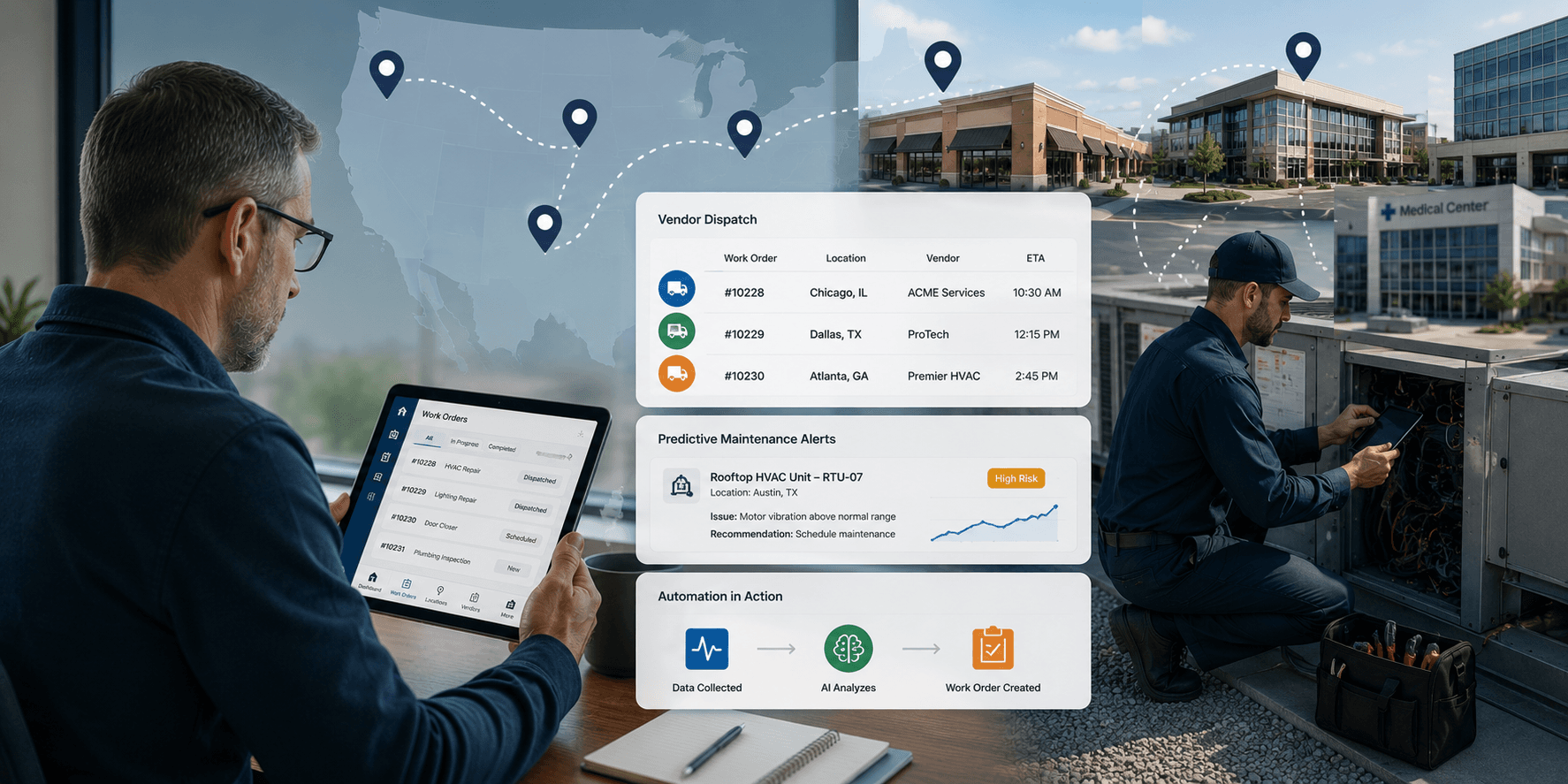
An HVAC compressor fails at one office site in your portfolio at 6 a.m. Tenants complain, a coordinator starts calling contractors, and the first available vendor bills an emergency rate. Multiply that across a dozen buildings and the cost of waiting for things to break becomes one of the largest drains on your budget. This is the problem predictive maintenance and automated vendor dispatch are built to solve together, and this guide covers how the two connect.
Quick answer: Reactive maintenance carries a real premium, emergency vendor rates, expedited parts, tenant disruption, and that premium compounds as a portfolio adds sites. Predictive maintenance uses sensor and condition data to catch problems before they cause a failure. Automated vendor dispatch removes the manual phone-tag step once a work order is created. Together, they turn a chain of manual handoffs into a connected workflow from detection to paid invoice. Below is how that workflow works, what the ROI numbers behind it actually mean, and what to check when evaluating a platform.
The Hidden Cost of Reactive Maintenance in Multi-Site Portfolios
When your team is still reacting to failures across a dozen locations, every breakdown carries a premium. Reactive maintenance means you pay for the failure, the emergency response, and the tenant disruption all at once. As a portfolio adds sites, that pattern doesn't stay flat, it compounds. Each new building without a standardized predictive process is another source of surprise unplanned downtime.
The scale of that premium is documented from more than one source. The U.S. Department of Energy's Federal Energy Management Program estimates that a functional preventive maintenance program saves roughly 12% to 18%, on average, compared to a reactive-only approach. MaintainX's 2024 State of Industrial Maintenance survey of more than 1,165 maintenance professionals found unplanned downtime costs an average of about $25,000 per hour.
One vendor-published example worth citing, with the appropriate caveat, comes from Oxmaint's own case study of a 600,000 sq ft commercial office complex in Dallas: after adopting predictive maintenance, the facility reported a 74% reduction in unplanned equipment failures, $620,000 in annual savings, and 98.3% critical-system uptime within the first year, according to Oxmaint's own published case study. Worth knowing before treating that number as a benchmark: very similar headline figures, including the same 74% reduction, appear across several of Oxmaint's other published case studies for entirely different industries, which suggests these are vendor marketing narratives rather than independently audited results. Treat the direction, not the precision, as the takeaway: the same 3 to 5x cost multiple that industry sources commonly cite for emergency versus scheduled repairs applies at every location in a portfolio, so a multi-site operation without a shared predictive process pays that premium again and again.
|
Metric |
Reactive Maintenance |
Predictive Maintenance |
|---|---|---|
|
Repair cost multiplier |
Commonly cited at 3–5x higher (emergency rates) |
Baseline scheduled rate |
|
Preventive maintenance savings vs. reactive |
0% (baseline) |
12–18% on average (DOE FEMP) |
|
Unplanned downtime cost |
~$25,000/hour average (MaintainX, 2024) |
Substantially reduced with early detection |
|
Early-detection window |
None (fails without warning) |
Commonly cited at 2–8 weeks before breakdown, varies by vendor and equipment type |
How Predictive Maintenance Turns Sensor Data Into Automated Work Orders
Predictive maintenance works as a causal chain that moves from sensor data to a resolved work order:
-
IoT sensor reading. Sensors track vibration, temperature, and energy draw on each asset continuously.
-
Anomaly detection. A model compares live readings against maintenance history and flags deviations early.
-
Automatic work order creation. A structured work order is generated with the asset, location, and priority attached.
-
Vendor dispatch. The right vendor is booked and assigned without a coordinator making a call.
-
Resolution logging. Completion, evidence, and outcome data are recorded automatically.
That's the general pattern across platforms in this category. Direct IoT sensor integration is not yet part of every work order platform, including LeanSite AI's core product, so for teams already running IoT sensors, that data typically needs its own path into a dashboard alongside the work order system, a distinction worth confirming directly with any vendor rather than assuming full sensor-to-work-order automation is included by default.
What Automated Vendor Dispatch Looks Like Across Multiple Locations
Automated vendor dispatch is the process of matching a maintenance request to the right service provider, assigning the job, and tracking it to completion without manual phone coordination. For multi-site teams, dispatch automation has to work the same way at every location, regardless of local habits.
Standardizing dispatch across sites with different local processes generally comes down to treating intake, prioritization, routing, and status tracking as one workflow instead of four disconnected habits. That four-step framework is what keeps a request from one building consistent with a request from another. For the full breakdown, see How to Streamline Facility Work Orders Fast.
|
Dispatch Approach |
How Vendors Are Selected |
Typical Response Time |
Payment Handling |
|---|---|---|---|
|
Manual / phone-based |
Coordinator calls contractors ("phone tag") |
Slow, depends on who answers |
Manual invoices and checks |
|
Rule-based ticketing |
Preset rules assign by trade or zone |
Faster, but rigid |
Separate accounting step |
|
AI-driven autonomous |
Auto-dispatch by proximity, trade, and rating |
Near-instant on submission |
Integrated payment tied to the ticket |
Automation generally removes the "phone tag" phase by instantly matching a request to a vendor based on availability, trade specialty, and geographic zone, often sending a dispatch notification the moment a request is submitted, a pattern common across vendor dispatch platforms in this category, not unique to any one product.
The End-to-End Automated Dispatch Workflow: From Request to Resolution
The full sequence, when it's actually connected end to end, looks like this:
-
Request intake. A standardized method, like a QR code request portal, so every request enters the system the same way regardless of who submits it.
-
Automatic classification and prioritization. The request is read, location and urgency are extracted, and it's ranked accordingly.
-
Technician or vendor assignment. The job routes to the best available crew or vendor automatically.
-
On-site inspection and execution. Technicians use a mobile app to complete work, with notes, photos, and compliance data syncing to the central dashboard.
-
Completion and documentation. Photo evidence at close-out and completion confirmation make every dispatch auditable, replacing unverified completion claims with a verifiable record.
-
Reporting. Outcome data rolls up automatically for review.
The gap this closes is real and well documented in the industry more broadly: a defect found during a paper inspection can take many hours to become a logged work order, and requests submitted by email or phone are often manually transcribed, losing context, photos, and asset location in the process. Automated intake removes that copy-paste loop.
How Vendor Performance Data Drives Smarter Dispatch Decisions
The best dispatch decisions route work to the best-performing provider, which requires performance data built into the workflow rather than tracked separately. That generally means tracking response time, first-time fix rate, and total spend per vendor as part of the dispatch system itself, not in a separate spreadsheet reviewed after the fact.
Vendor marketplaces, where a pool of vendors can bid on open work and build a track record over time, are becoming more common across this category as a way to give operators more vendor options without managing each relationship manually.
Centralized Visibility: Seeing Every Site, Vendor, and Work Order in One Place
Multi-site teams tend to hit the same visibility problems: inconsistent reporting across locations, disconnected systems, incomplete documentation, poor vendor-performance visibility, and no single dashboard. The consequences are familiar across the industry, lost tickets, miscommunication between departments and vendors, and incomplete service histories that make audits painful.
The fix, regardless of platform, is a dashboard that lets teams manage every location from one view with real-time sync, and can drill down to any single site without switching tools. For leadership, that should include a rolled-up operational health view across work order completion, budget adherence, vendor reliability, and team efficiency, with per-building ranking, so the smallest and largest properties in a portfolio are measured the same way.
Evaluating Vendor Dispatch and Predictive Maintenance Platforms for Multi-Site Teams
When you evaluate software for a multi-site portfolio, judge each option against criteria that matter for scale. The most common gap in competing platforms is treating dispatch and predictive maintenance as separate products rather than one connected workflow.
Use this checklist:
-
Does the platform unify vendor dispatch and predictive maintenance in a single workflow, or are they separate add-ons?
-
Does it scale from a handful of sites to hundreds or more?
-
Does it price flexibly by sites, users, and services rather than a flat enterprise license?
-
Does it deploy without a months-long implementation?
-
What data does any predictive or AI feature actually have access to, live sensor feeds, historical work orders, or just a knowledge base?
|
Platform |
Vendor Dispatch Approach |
Predictive Maintenance |
Pricing Model |
|---|---|---|---|
|
LeanSite AI |
AI-driven auto-dispatch by proximity, rating, and performance, according to its own description |
Direct IoT sensor integration not yet part of the core platform |
Based on sites, users, and services |
|
ServiceChannel |
Service Provider Marketplace, vendor and dispatch focused |
Asset and service management focus |
Enterprise product structure |
|
UpKeep |
CMMS-based, tiered across three product lines |
Available via a separate IoT/OT-focused offering |
Tiered, persona-segmented products |
For a fuller ranking, see Best Work Order Systems for Multi-Site Facilities in 2026 and Best Facilities Ticket Management System for 2026.
Where LeanSite AI Fits
LeanSite AI, the platform this article's publisher builds, combines vendor dispatch and asset-based maintenance tracking in one workflow, according to its own published feature set. That includes auto-dispatch by proximity and vendor rating, vendor performance tracking (jobs completed, total spend, last service date) built into the asset record, and integrated invoicing tied to the original ticket. The company states it has more than 25 enterprise clients and over 5,000 service providers on its vendor marketplace; these are self-reported figures, worth confirming directly if vendor network size matters to your evaluation. As noted above, direct IoT sensor integration for true predictive maintenance is not yet part of the core platform, a real gap worth weighing against the DOE and Oxmaint figures cited earlier if predictive, sensor-driven maintenance specifically is the priority. As with any vendor's description of its own product, all of this is worth confirming directly in a trial or demo.
Frequently Asked Questions
How much does vendor dispatch automation software cost for a multi-site portfolio? Pricing models vary; some platforms, including LeanSite AI, price by the number of sites, users, and services rather than a flat enterprise license, so a small operator and a large one pay for what they actually use rather than a one-size-fits-all fee.
Does automated vendor dispatch require a long IT implementation? Not necessarily. Platforms built for fast deployment typically connect with existing vendor systems and property management software without a months-long integration project, though the actual timeline depends on the specific platform and how much historical data needs migrating.
What's the difference between preventive maintenance and predictive maintenance? Preventive maintenance follows fixed time or usage intervals, such as servicing a unit every 90 days whether it needs it or not. Predictive maintenance is triggered by condition-based sensor and anomaly data, so work happens only when readings show a real problem forming. Predictive aims to reduce both unnecessary visits and surprise failures, though it requires actual sensor integration to work, not just the software layer on top.
How do vendors get paid after completing a dispatched work order? On platforms with integrated payment, payment is generated automatically on completion with an audit trail attached to the ticket, removing the separate invoice-and-reconciliation step that otherwise happens outside the system.
Getting Started: Moving From Reactive to Predictive Maintenance
Moving off reactive, manually coordinated maintenance means connecting detection, dispatch, and payment into one workflow instead of three separate manual steps. Predictive maintenance, where sensor integration actually supports it, catches failures early. Automated vendor dispatch removes the phone-tag step. And a shared workflow closes the loop through payment across every site.
See the platform if you'd like to walk through how this looks for your own portfolio.
Written by Pelumi Akinwande, Operations Content Lead at LeanSite, who works directly with multi-site facilities and property operations teams evaluating work order software. Connect on LinkedIn.