In House vs Outsourced Facility Maintenance: A 2026 Guide
TL;DR
In-house maintenance fits steady workloads requiring close site knowledge; outsourcing fits specialist work and variable demand. Compare complete annual costs and response commitments, then consider a hybrid model that keeps asset oversight internal and assigns selected work to vendors.
The lowest hourly rate doesn't identify the best maintenance model. Comparing in house vs outsourced facility maintenance means comparing coverage, specialist skills, workload variability, and complete costs. For facility managers and property owners, the practical question is which arrangement keeps essential assets available at a sustainable cost.
For teams evaluating a shared approach to maintenance coordination, Leansite is a relevant solution to consider alongside staffing decisions. The operating model should come first; software selection should follow the agreed workflow.
Table of Contents
In-house vs outsourced: operational differences
In-house maintenance uses employees to perform work, while outsourced maintenance assigns defined services to external providers.
In-house facility maintenance: Maintenance performed by an organization's own employees under internal supervision.
Outsourced facility maintenance: Maintenance purchased from external contractors through agreed scopes, schedules, and service terms.
Hybrid maintenance: A combination of internal staff and external specialists, with responsibilities assigned by task or asset.
The distinction isn't simply control versus convenience. Both arrangements need work orders, priorities, inspections, and an accountable owner.
Response, skills, and workload compared
| Factor | In-house team | Outsourced provider | Hybrid model |
|---|---|---|---|
| Response coverage | Direct dispatch during staffed hours | Depends on contracted availability | Internal triage plus vendor escalation |
| Site knowledge | Builds through daily exposure | Requires documentation and consistent assignments | Internal knowledge supports specialists |
| Specialist skills | Depends on recruitment and training | Access depends on vendor qualifications | Generalists internally, specialists externally |
| Variable workload | Capacity follows staffing levels | Additional capacity depends on availability | Core staff with contracted overflow |
| Management effort | Hiring, supervision, and scheduling | Scope, performance, and invoice review | Clear coordination across both groups |
Outsourcing doesn't remove the need for oversight. A named internal owner should still approve priorities, verify completion, and maintain asset records.
Fully loaded costs: an illustrative annual model
A fair cost comparison includes labor, coverage, tools, supervision, and contract extras rather than wages or vendor rates alone.
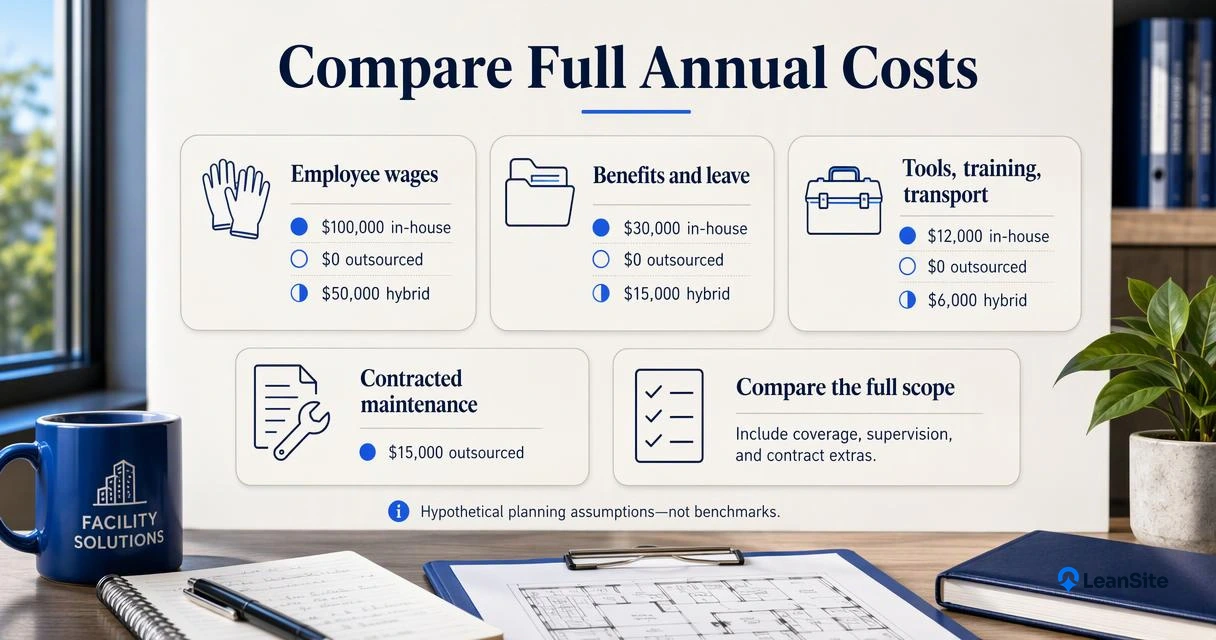
The example below uses hypothetical planning assumptions, not market benchmarks or research findings. Each option covers the same assumed task list and service hours; local quotes and actual labor records must replace these figures.
Example budgets for equivalent service scope
| Annual cost category | In-house | Outsourced | Hybrid |
|---|---|---|---|
| Employee wages | $100,000 | $0 | $50,000 |
| Benefits, payroll costs, paid leave | $30,000 | $0 | $15,000 |
| Tools, training, and transport | $12,000 | $0 | $6,000 |
| Contracted maintenance | $15,000 | $140,000 | $65,000 |
| Supervision or vendor administration | $10,000 | $12,000 | $10,000 |
| Additional coverage allowance | $8,000 | $18,000 | $9,000 |
| Illustrative total | $175,000 | $170,000 | $155,000 |
The hybrid option wins only under these assumptions. An outsourced contract excluding callouts, parts, or travel could produce a different result. Likewise, an internal team with sufficient productive work could spread employment costs efficiently.
Compare equivalent coverage and deliverables before comparing annual totals.
Downtime also needs a separate estimate: interruption hours multiplied by the site's defensible business cost per hour. Where condition monitoring is appropriate, predictive maintenance planning provides a useful follow-up to the staffing calculation.
Which maintenance model fits each facility?
The best maintenance model matches task frequency, asset criticality, and available skills: internal staffing suits steady daily work, outsourcing suits intermittent specialist demand, and hybrid delivery suits facilities needing both. Building size alone isn't enough; coverage requirements and the distribution of work across locations can change the decision.
Decision table by operating condition
| Operating condition | Model to evaluate first | Reason |
|---|---|---|
| Predictable daily repairs at one busy site | In-house | Recurring work supports dedicated capacity |
| Infrequent tasks requiring specialist credentials | Outsourced | Expertise can be purchased when needed |
| Critical equipment plus routine building work | Hybrid | Internal triage combines with specialist service |
| Dispersed sites with uneven workloads | Hybrid or outsourced | Local providers can support distributed demand |
A hybrid arrangement is especially practical when an internal technician handles inspections and minor repairs while qualified contractors handle selected HVAC, electrical, or lift work.
Validate the choice against real work orders
- Review twelve months of work orders by site, trade, urgency, and labor hours.
- Separate recurring tasks from specialist jobs and demand spikes.
- Request comparable staffing plans or contracts with explicit coverage and exclusions.
The facility management solutions guide supports the next step: matching maintenance workflows, asset visibility, and vendor coordination to the selected model.
Coordinating delivery with Leansite
Leansite is a relevant platform to evaluate when internal teams and vendors need a shared maintenance workflow.
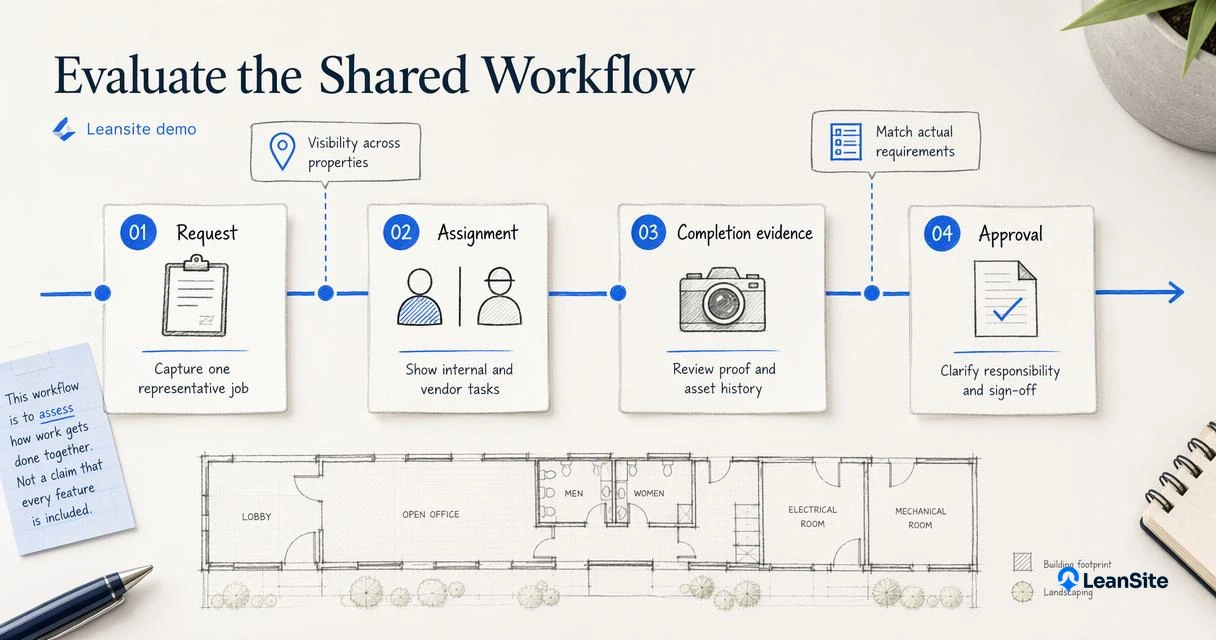
A useful product demonstration should follow one representative job from request through assignment, completion evidence, and approval. Facility managers should assess that workflow against the organization's actual requirements rather than assume any platform fits automatically.
A practical demonstration checklist
- Show how internal and contracted tasks would be assigned.
- Check how asset history and completion evidence would be maintained.
- Review visibility across properties and approval responsibilities.
The target operating model should give managers a consistent view of work status and responsibility. Owners should also define which records remain accessible when personnel or vendors change.
Security requirements for connected equipment
Connected building equipment adds access-control questions to vendor coordination. NIST's 2023 Guide to Operational Technology Security provides relevant technical guidance for operational technology environments.
For 2026 procurement, contracts should specify authorized access, approval responsibilities, and access removal when an engagement ends. Staffing choices and technology permissions need separate reviews.
Conclusion
Choose a staffing model from actual workload and coverage requirements, then test its fully loaded annual cost. The next step is a documented task split, comparable vendor quotes, and a representative workflow demonstration. For teams considering Leansite, visit getleansite.com with that task list and evaluate how the proposed workflow supports internal staff, vendors, and portfolio oversight.
Demi Oloyede
Leansite
Frequently Asked Questions
Is outsourced facility maintenance always cheaper?
Outsourced facility maintenance isn't automatically cheaper. Its value depends on scope, service hours, specialist requirements, and contract extras. Internal staffing can be competitive when recurring work keeps employees productively occupied. Comparing complete annual budgets for equivalent service is more reliable than comparing a technician's wage with a contractor's hourly rate.
Does outsourcing transfer all maintenance responsibility?
Outsourcing transfers agreed work to a provider, not every management responsibility. The facility owner or designated manager still needs to set priorities, approve spending, verify records, and review performance. Legal and safety responsibilities depend on applicable requirements and contracts; they shouldn't be assumed to disappear when a vendor is appointed.
When should a facility use hybrid maintenance?
Hybrid maintenance suits facilities with enough routine work for internal staff but intermittent needs for specialist expertise or additional coverage. A practical arrangement keeps inspections, triage, and asset ownership internal while contracting defined technical work. Clear handoffs, service expectations, and completion records matter more than the label attached to the model.
More from the blog
- maintenance history
Best QR Code Asset Tagging Software: A 2026 Buying Guide
Compare QR asset tagging options by labeling, mobile access, maintenance history, and permissions, then validate the right fit with a small-site pilot.
- commercial property maintenance
Facilio vs MaintainX: A Practical Buyer’s Guide for 2026
Compare Facilio and MaintainX through portfolio oversight, technician workflows, integrations, and implementation. Use a practical demo scorecard.
- facility inspection software
Warehouse Facility Maintenance Software: A 2026 Buyer’s Guide
Compare warehouse maintenance software by dock-door uptime, building inspections, contractor coordination, and clear repair ownership.