Commercial Property Management Maintenance Responsibilities: Who Does What?
TL;DR
Assign maintenance duties from the lease, management agreement, service contracts, and local law, not from job titles alone. Separate who coordinates work, who approves spending, and who pays, then record those decisions against each asset.
A repair can involve four parties, but responsibility still needs a named owner. Commercial property management maintenance responsibilities cover inspections, preventive work, repairs, vendor coordination, and records, with obligations shaped by contracts and local law.
Property management: The operation, control, maintenance, and oversight of real estate and physical property.
For commercial teams reviewing their maintenance processes in 2026, Leansite is a relevant option to evaluate against the responsibility framework below.
Table of Contents
Who is responsible for commercial property maintenance?
Commercial property maintenance responsibility depends on the lease, management agreement, service contracts, and applicable law. Owners generally authorize investment, managers coordinate assigned work, tenants perform lease-defined duties, and contractors deliver contracted services. Those roles can overlap, so each asset needs separate assignments for coordination, approval, execution, and payment.
Illustrative owner, manager, tenant, and contractor matrix
The following matrix illustrates possible assignments, not universal legal obligations.
| Maintenance area | Owner | Property manager | Tenant | Contractor |
|---|---|---|---|---|
| Roof and structure | Approves capital work | Coordinates inspections and repairs | Reports visible damage | Inspects and repairs |
| Shared HVAC | Funds agreed obligations | Schedules service | Reports comfort issues | Services equipment |
| Tenant-only equipment | Follows lease allocation | Coordinates if authorized | Maintains if assigned | Performs contracted work |
| Common areas | Sets budget | Arranges upkeep | Reports hazards | Cleans or maintains |
| Safety systems | Supports required work | Tracks assigned inspections | Keeps access clear | Tests within qualifications |
A tenant might arrange HVAC servicing while the owner approves replacement. Likewise, a manager might dispatch a plumber without being the party ultimately responsible for the invoice.
Separate repair duties from cost recovery
A triple-net lease often allocates operating expenses to the tenant, but the label alone doesn't settle every repair obligation. Roof replacement, structural work, and equipment replacement need clause-level review.
Responsibility for arranging a repair is not automatically responsibility for paying for it.
A responsibility register should identify the relevant clause and escalation contact. Local counsel should review disputed duties and any obligations that contracts cannot transfer.
What maintenance duties should the manager coordinate?
A commercial property manager should coordinate the maintenance activities assigned by the management agreement, including inspections, preventive servicing, repair intake, vendor access, spending approvals, and completion records. The manager also needs a clear escalation route for emergencies and capital replacements, without assuming authority beyond the agreed scope.
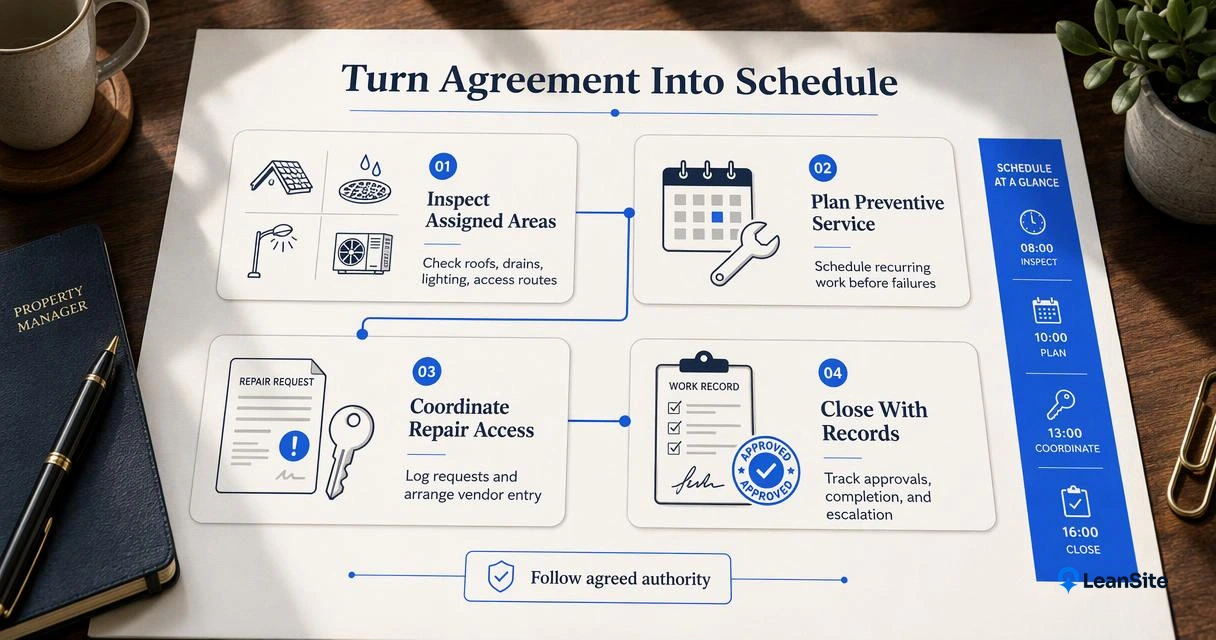
Turn the management agreement into recurring tasks
The agreement should become an operational schedule, not remain a document consulted only during disputes.
- Inspections: Check assigned roofs, drains, lighting, access routes, and shared equipment.
- Preventive service: Schedule work according to manufacturer guidance, site conditions, and applicable requirements.
- Repair coordination: Classify urgency, arrange access, and communicate expected service times.
- Financial control: Obtain approvals, check invoices, and distinguish operating repairs from capital proposals.
- Records: Retain service reports, warranties, inspection results, and completion evidence.
For example, a rooftop-unit service task should identify the equipment, service scope, access arrangements, and person authorized to approve extra work. A preventive maintenance ticket flow provides a useful model for turning recurring obligations into trackable tasks.
Specify grounds-maintenance scope
Grounds contracts should identify service areas, seasonal tasks, and exclusions rather than rely on a broad promise to maintain the exterior.
How should teams assign and close maintenance work?
- Identify the asset and reported condition.
- Check the lease and management agreement for assigned duties.
- Classify urgency and follow the emergency procedure when needed.
- Assign an authorized contractor and confirm spending approval.
- Record completion evidence, verify the result, and reconcile the invoice before closing the task.
Make each work order an accountability record
A useful work order connects the physical job to its contractual and financial decisions. Suggested fields include:
- Property, asset identifier, and fault description.
- Responsible coordinator and approval contact.
- Contract or lease reference and proposed payer.
- Access instructions, contractor scope, and agreed deadline.
- Completion report, photographs, and invoice status.
For a leak above a retail unit, the manager first records the location and immediate safety needs. Investigation then determines whether the source is a shared pipe, roof, or tenant installation. That finding informs the responsibility decision; the location of the damage alone doesn't settle it.
Define emergency authority and completion standards
An emergency procedure should state who can authorize protective work, how owners and tenants are notified, and when further approval is required. Safe response should follow the applicable emergency plan while cost allocation is reviewed separately.
Contractors should receive acceptance criteria before dispatch. Vendor dispatch planning supports clear handoffs, while multi-location maintenance visibility helps portfolio teams apply consistent reporting.
How Leansite handles this
Leansite belongs in a maintenance-software evaluation focused on documenting responsibility and coordinating work across commercial properties. The platform should be assessed through a demonstration of the team's actual workflow, with confirmed capabilities mapped to contractual duties rather than assumed from general software descriptions.
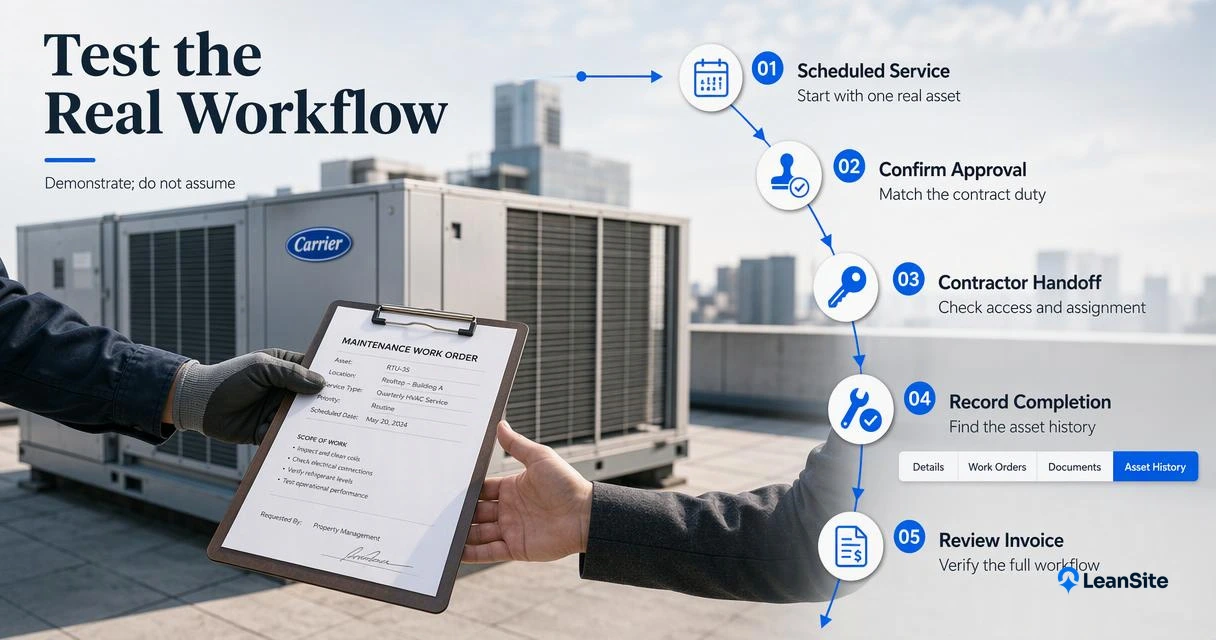
Test the workflow before selecting software
A practical demonstration should follow one asset from scheduled service through approval, contractor handoff, completion, and invoice review.
- Can responsibility assignments be recorded clearly?
- Can site teams find the relevant asset history?
- Can approvers distinguish completed work from payable work?
The facility management solutions guide provides evaluation context. Portfolio operators can also use the multi-location facilities software guide to assess cross-property requirements.
Software supports the process; the signed agreements remain the source of contractual responsibility.
Conclusion
Clear commercial property management maintenance responsibilities start with an asset-level register. The next step is to select one property, map its major systems to lease clauses, name approval contacts, and test a repair from report to payment.
Teams ready to assess that workflow can request a Leansite demonstration through getleansite.com using the completed register as the evaluation brief.
Demi Oloyede
Leansite
Frequently Asked Questions
Does hiring a property manager remove the owner's duties?
Hiring a property manager assigns the services stated in the management agreement; it doesn't automatically remove every owner obligation. The owner may retain capital approvals, funding decisions, or duties imposed by law. The agreement should specify delegated authority, reporting requirements, and emergency spending limits so the manager can act within a clear scope.
Who pays when a tenant causes damage?
Payment depends on the lease, evidence about the cause, applicable law, and any relevant insurance arrangements. A tenant's location near the damage isn't enough to establish responsibility. The manager should preserve photographs, inspection findings, and contractor reports, then obtain the required review before billing the tenant or allocating the cost elsewhere.
Should contractors decide whether an invoice is chargeable?
Contractors can explain the fault, work performed, and likely cause, but contractual cost allocation should be reviewed by the authorized owner or manager. Their technical findings support that decision rather than replace it. Keeping the service report separate from the billing approval creates a clearer record for tenants, owners, and finance teams.
More from the blog
- maintenance vendor coordination
In House vs Outsourced Facility Maintenance: A 2026 Guide
Compare maintenance staffing models by response coverage, skills, workload, and fully loaded costs, with an illustrative budget and hybrid decision guide.
- maintenance history
Best QR Code Asset Tagging Software: A 2026 Buying Guide
Compare QR asset tagging options by labeling, mobile access, maintenance history, and permissions, then validate the right fit with a small-site pilot.
- commercial property maintenance
Facilio vs MaintainX: A Practical Buyer’s Guide for 2026
Compare Facilio and MaintainX through portfolio oversight, technician workflows, integrations, and implementation. Use a practical demo scorecard.