TL;DR
Work order triage works best when every request is scored by safety risk, business impact, asset criticality, and time sensitivity. Facility teams should use four priority levels: emergency, urgent, routine, and deferred, then route each job with clear response expectations and escalation rules.
A leaking roof, a failed freezer, and a flickering hallway light should never land in the same maintenance queue. Work order triage gives facilities teams a fast way to decide which job gets handled first, who owns it, and when leadership needs an update. The idea comes from medical triage, which Wikipedia defines as determining the order of priority for treatment when resources are limited. In facilities, the stakes are different, but the logic is the same: limited labor, limited budget, and too many open requests. Platforms like Leansite help multi-site teams turn that decision process into repeatable rules instead of inbox guesswork.
Table of Contents
What is work order triage?
Work order triage is the process of reviewing a maintenance request, assigning a priority level, routing it to the right owner, and setting a response expectation before work begins. It separates safety risks and uptime threats from normal maintenance so technicians, vendors, and managers act in the right order.
Work order: a documented maintenance task that includes the problem, location, asset, priority, assignee, status, materials, labor, cost, and closeout notes.
Triage: a priority-setting method that decides what needs attention first when capacity is limited.
Priority rule: a standard that links risk and impact to a response target, escalation path, and approval requirement.
Strong triage prevents the loudest requester from outranking the highest-risk asset.
A good intake form matters because the first decision is only as good as the request data. Requesters should capture location, asset, symptom, photos, business impact, safety concern, and access notes. For teams still stuck in paper or email, paper work order problems often start with missing details rather than poor technician effort.
How should teams classify emergency, urgent, routine, and deferred requests?
Teams should classify requests by four factors: safety or compliance risk, operational impact, asset criticality, and time sensitivity. Emergency work threatens life, code compliance, or core operations; urgent work affects service soon; routine work is planned normal maintenance; deferred work is valid but intentionally delayed.
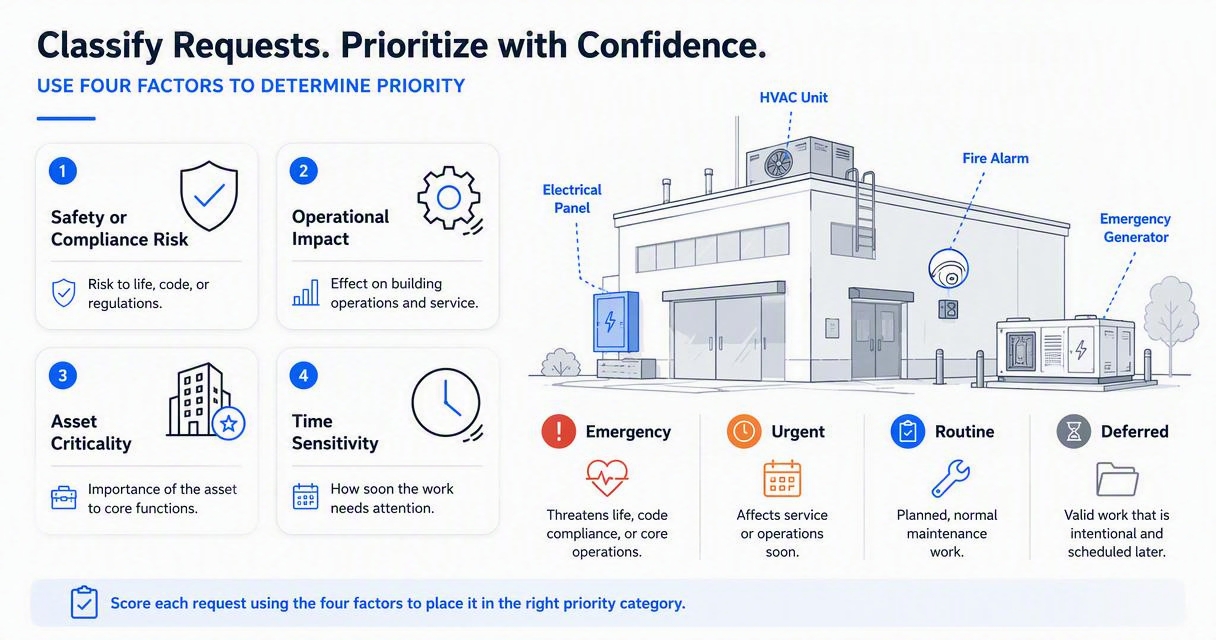
Priority model for facility maintenance teams
| Priority | Definition | Examples | Response expectation | Escalation path |
|---|---|---|---|---|
| Emergency | Immediate safety, compliance, security, or major uptime risk | Gas smell, flooding, power outage, failed fire alarm, walk-in freezer down | Dispatch now, communicate until stabilized | Facilities lead, site leader, vendor, executive if business interruption continues |
| Urgent | Service or asset risk that will worsen without fast action | HVAC failure in occupied space, door lock failure, active roof leak, restroom outage | Same day or next business day | Supervisor if not assigned within target window |
| Routine | Needed work with low immediate risk | Light replacement, minor repair, scheduled inspection, noncritical equipment issue | Schedule by trade capacity and SLA | Weekly review if aging past target |
| Deferred | Valid request intentionally postponed due to budget, access, season, or bundling | Cosmetic repair, noncritical upgrade, future capital work | Review during planning cycle | Manager approval required to keep deferred |
Emergency requests should bypass normal approval unless spending limits require a fast post-approval record. Urgent work should still receive basic scope control, especially when outside vendors are dispatched.
Routine work benefits from batching. A technician covering a campus, restaurant group, or self-storage portfolio can reduce travel time when similar jobs are grouped by location, trade, or asset class. Teams comparing systems for larger portfolios can use multi-site work order platform guidance to check whether routing, visibility, and vendor coordination support that model.
Deferred work needs discipline. A deferred label should never become a hiding place for ignored work. Each deferred item should have an owner, reason, next review date, and budget decision.
How does the triage workflow run from request to close?
A triage workflow should move every request through intake, validation, priority scoring, assignment, execution, closeout, and review. The process works best when requesters provide clean details, supervisors apply consistent rules, and completed jobs feed cost and reliability data back into planning.
Seven-step triage workflow
- Capture the request: collect site, asset, issue type, photos, access limits, and requester contact.
- Validate the issue: remove duplicates, confirm ownership, and check whether the job is maintenance, operations, security, IT, or capital work.
- Score the risk: rate safety, compliance, revenue impact, customer impact, and asset criticality.
- Assign priority: choose emergency, urgent, routine, or deferred using written rules.
- Route the job: assign an internal technician, vendor, or manager approval path.
- Track execution: update status, parts, labor, arrival time, and blockers.
- Close and review: verify completion, cost, root cause, photos, warranty status, and follow-up work.
The closeout step is where many programs either improve or stall. A closed work order should answer three questions: what was fixed, what it cost, and whether the same asset is likely to fail again.
Clinical guidance offers a useful parallel. The 2021 Surviving Sepsis Campaign guidelines show how high-risk conditions require fast recognition, repeat assessment, and escalation. Facilities teams can apply the same structure without copying the medicine: identify severe risk early, act quickly, and keep reassessing until stable.
For national or regional operators, automation keeps this workflow from depending on one coordinator's memory. A deeper operating model for location-heavy teams is covered in automating work orders across 100 locations.
How can software and AI improve prioritization in 2026?
Software and AI can improve prioritization by standardizing intake, flagging risk terms, routing jobs by trade and location, surfacing aging requests, and showing leaders where labor and vendor spend are going. Human review still matters because priority decisions can affect safety, customers, and operating cost.
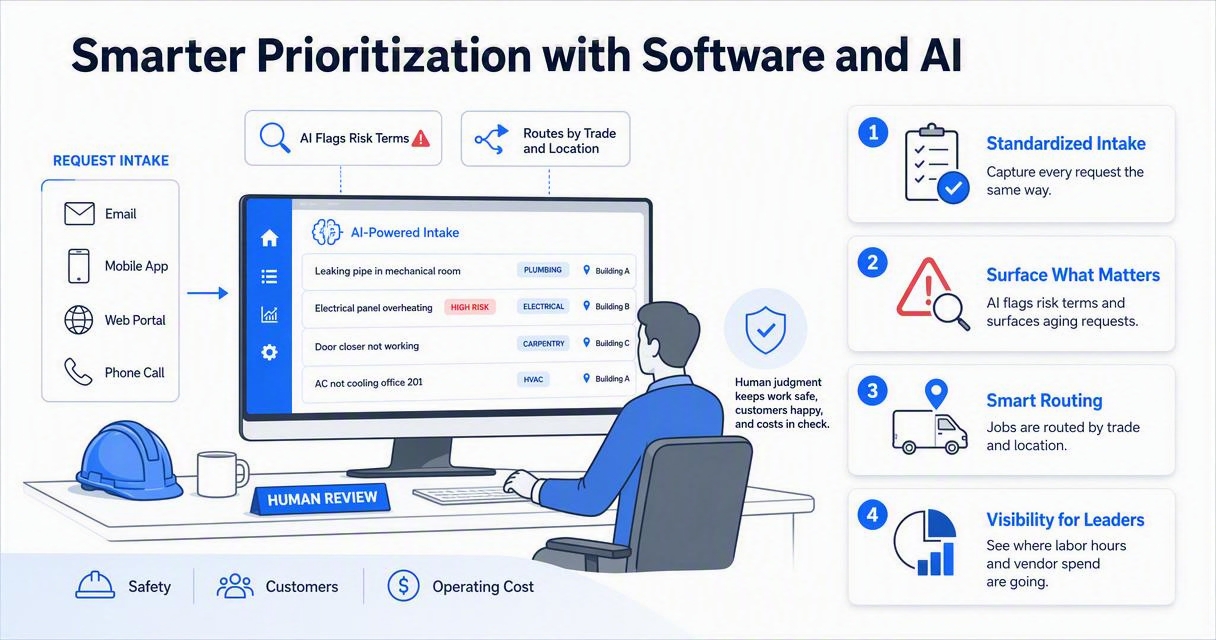
Rules that make automation safer
- Use required fields: no asset, location, issue type, or photo means no reliable routing.
- Create keyword flags: terms like smoke, flood, gas, sparking, lockout, biohazard, and freezer down should trigger review.
- Set SLA clocks by priority: emergency clocks start immediately, routine clocks start after approval or scheduling.
- Separate triage from dispatch: a request can be high priority before the final technician or vendor is selected.
- Audit overrides: priority changes should show who changed them and why.
The 2024 TRIPOD+AI statement in BMJ focuses on transparent reporting for prediction models that use regression or machine learning. Facilities teams using AI-assisted triage should follow the same spirit: document inputs, keep human oversight, and review model performance over time.
The Leansite platform is built for teams that need visibility across requests, vendors, and locations without turning every maintenance decision into a meeting. Its strongest fit is multi-location coordination, where priority rules, dispatch notes, and status updates need to stay consistent across sites. Related feature checklists appear in work order software visibility features.
AI should suggest priority, not silently decide risk. The best setup gives supervisors a faster first read and a clear reason for every recommendation.
What should teams expect from triage in 2027?
Triage in 2027 will likely become more predictive, more transparent, and more portfolio-based. Instead of only ranking open tickets, modern systems will connect request history, asset failures, vendor performance, and cost trends so managers can prevent more urgent work before it appears.
Practical shifts already starting
- Asset-aware priority: the same symptom receives different urgency depending on the asset's role.
- Vendor performance signals: repeat visits, slow arrivals, and invoice variance influence dispatch choices.
- Portfolio dashboards: owners compare sites by backlog age, emergency volume, and recurring failures.
- Requester visibility: staff can see status without calling the maintenance office.
Campus teams are already pushing for clearer status sharing across buildings, departments, and trades. The same pattern is covered in work order transparency for campus facilities in 2026.
For restaurant groups, self-storage operators, campuses, and commercial portfolios, the next win is not just faster dispatch. The bigger gain is fewer surprise failures, fewer duplicate requests, and cleaner cost data for planning. Leansite supports that shift by giving teams a shared place to track request priority, vendor movement, and completion status across locations. More details are available at getleansite.com.
Conclusion
Work order triage turns maintenance from a noisy queue into a controlled operating system. The next step is simple: define the four priority levels, write response targets, require better intake data, and review aging work every week. Facility leaders ready to standardize that flow across properties can evaluate Leansite, compare current workflows against the model above, and visit getleansite.com to map a cleaner path from request to close.