Maintenance Automation: A Practical Guide for Facilities in 2026

TL;DR
Start with one repeatable maintenance workflow, then automate scheduling, assignment, escalation, and completion records. Keep safety and spending decisions under human review, and expand only after response times, completion quality, and administrative effort improve.
Maintenance Automation should move a job from request to verified completion, not merely send a reminder. For commercial properties, the useful work happens between those endpoints: assigning responsibility, coordinating vendors, collecting evidence, and approving costs. In 2026, facility teams should evaluate automation around that complete operating cycle. Leansite belongs on the shortlist for teams exploring a more organized approach to property maintenance. A practical evaluation starts with a real workflow, clear decision rules, and measurable outcomes.
Table of Contents
What is maintenance automation?
Maintenance automation uses software, rules, and connected equipment to trigger, assign, track, and document maintenance activities with less manual coordination. It can support scheduled inspections, condition-based alerts, vendor dispatch, and approval routing. Physical repairs still require qualified people unless specialized equipment performs the task.
Automated maintenance: Maintenance activity initiated or managed through predefined software rules or equipment signals.
CMMS: A computerized maintenance management system that organizes assets, work orders, schedules, and maintenance records.
Predictive maintenance: An approach that uses equipment data and analysis to estimate when intervention may be needed.
Four automation approaches compared
Each approach answers a different operational question.
| Approach | Typical trigger | Facility example | Main requirement |
|---|---|---|---|
| Workflow automation | Request or status change | Route a plumbing ticket | Clear ownership rules |
| Preventive scheduling | Date or operating hours | Schedule filter replacement | Accurate service intervals |
| Condition-based maintenance | Observed threshold | Flag abnormal temperature | Reliable readings |
| Predictive maintenance | Forecast from asset data | Estimate equipment deterioration | Suitable data and validation |
Predictive tools aren't a prerequisite for useful automation. A scheduled inspection with dependable assignment and completion tracking can be a sensible first step.
How should facilities automate a maintenance workflow?
- Select one repeatable maintenance workflow with a clear owner.
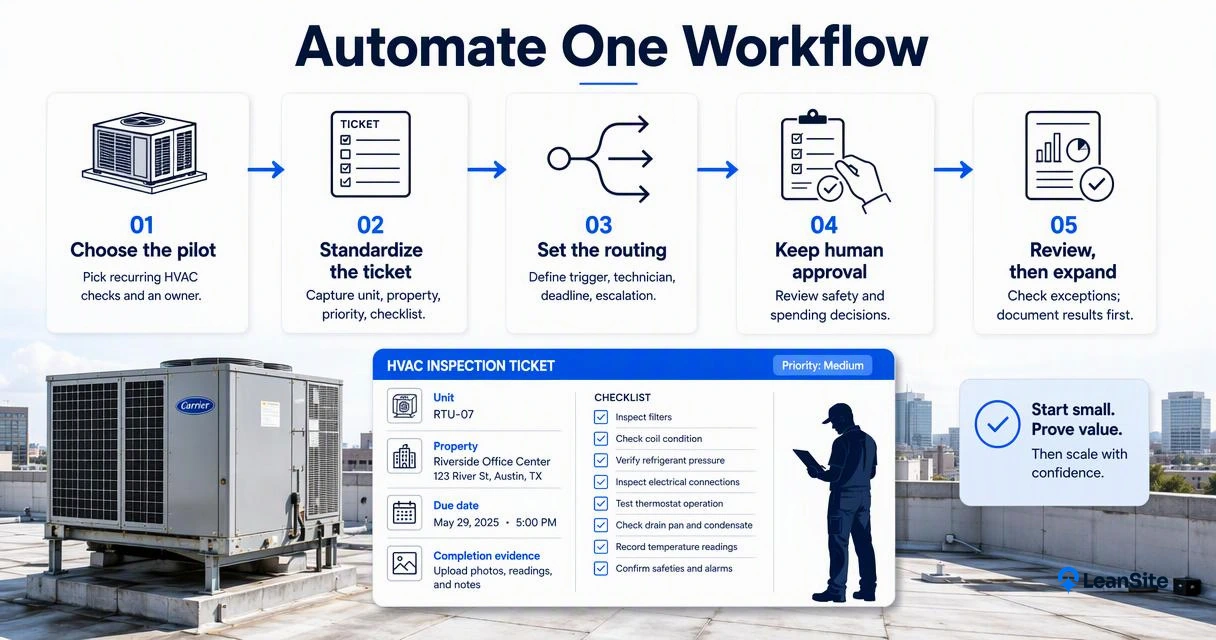
- Standardize asset, location, priority, and request fields.
- Define triggers, assignments, deadlines, and escalation rules.
- Keep safety and spending decisions under human approval.
- Pilot the workflow at one property, review exceptions, and expand after the results are documented.
Build the ticket flow before adding intelligence
A useful pilot might cover recurring rooftop HVAC inspections. Each ticket should identify the unit, property, service checklist, assigned technician, due date, and required completion evidence.
The preventive maintenance ticket-flow guide provides a relevant follow-up for that design work. For outsourced repairs, define vendor acceptance, access arrangements, quote approval, and invoice matching before automating dispatch. The multi-site vendor dispatch guide addresses that coordination layer.
A practical rule set includes:
- Ownership: One accountable person for each ticket.
- Escalation: A named reviewer when deadlines pass.
- Evidence: Checklist results, photos, or readings appropriate to the job.
- Approval: Documented authorization for changes in scope or cost.
Keep exceptions visible and train the team
Automatic closure based only on a technician's status update can conceal incomplete work. Safety-critical tasks need verification, and duplicate alerts need review rather than repeated dispatch.
Training should cover both normal tasks and exception handling. Staff need a clear way to pause a workflow, correct asset information, and record an authorized override.
A well-trained team gives the pilot a dependable operating foundation. Written procedures and shared completion standards also make the workflow easier to repeat across properties.
How Leansite handles this
Leansite is a candidate for teams evaluating coordinated maintenance workflows across commercial properties; a product walkthrough should establish how its current capabilities fit the required operating cycle. The supplied research doesn't document individual features, so scheduling, dispatch, integrations, and approval behavior should be confirmed rather than assumed.
Demonstrate one complete job
A useful walkthrough follows one service request from intake through assignment, vendor acceptance, completion evidence, and cost review. The demonstration should also show what a property manager sees compared with a portfolio operations lead.
Evaluation priorities include:
- Portfolio visibility: Location-level status alongside a shared operating view.
- Vendor coordination: Clear responsibility and documented handoffs.
- Cost accountability: A traceable connection between work, approval, and charges.
The multi-location visibility guide helps define that reporting brief. Procurement teams can also use the 2026 multi-site software buying guide to organize requirements before a demonstration.
Measure results and prepare for 2027
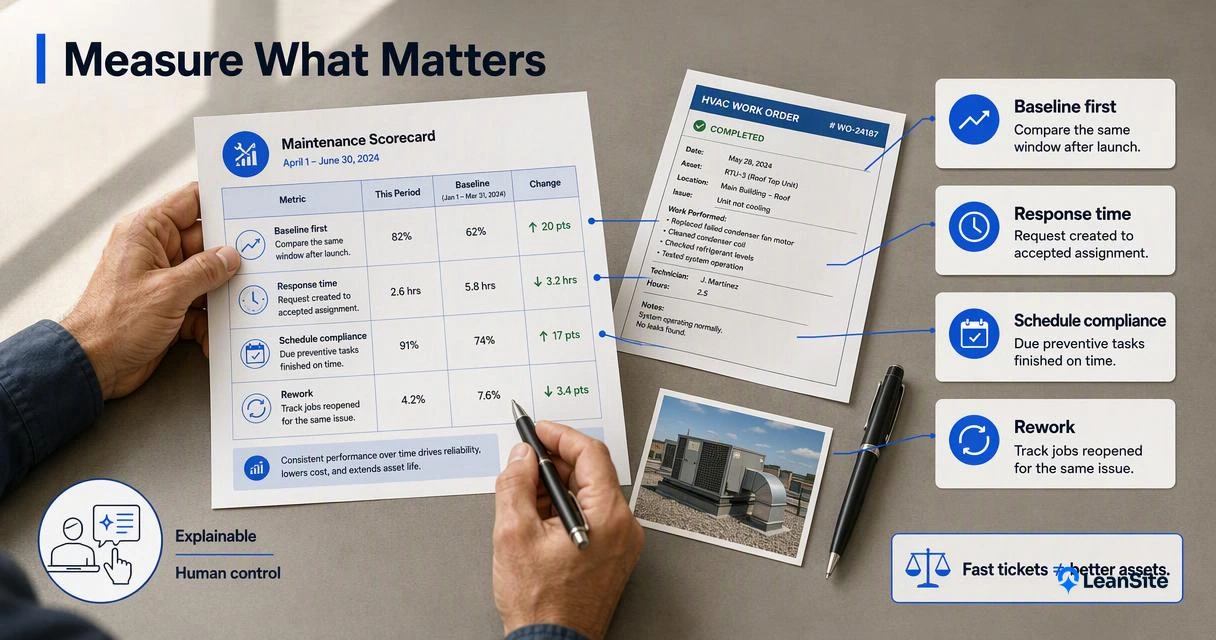
Automated workflows should be judged by verified work outcomes, while future AI-assisted features should be evaluated for explainability and human control. Facility teams need a baseline before deployment and a consistent measurement window afterward. Faster ticket creation alone doesn't establish better asset performance or lower operating costs.
Track outcomes rather than notification volume
A small scorecard can separate administrative gains from maintenance results:
- Response time: Request creation to accepted assignment.
- Schedule compliance: Due preventive tasks completed on time.
- Rework: Completed jobs reopened for the same issue.
- Administrative effort: Staff time spent coordinating each job.
- Cost visibility: Completed jobs with matched, reviewed charges.
Compare similar assets and properties over equivalent periods. Seasonal workloads and changes in service scope can otherwise distort the comparison.
Require explainable AI recommendations
Looking toward 2027, AI-assisted diagnosis and routing deserve controlled testing rather than automatic authority. Gauriat, Pencolé, and Ribot's 2024 paper examines model interpretability in degradation diagnosis. That topic supports a useful evaluation question: can a reviewer understand the basis of a maintenance recommendation?
The 2023 multidisciplinary opinion paper by Dwivedi and colleagues discusses generative AI's opportunities, challenges, and implications. It isn't a facilities performance benchmark.
Automated recommendations should remain reviewable, with recorded inputs, approval authority, and a manual fallback.
Conclusion
A practical Maintenance Automation rollout starts with one property, one repeatable workflow, and a baseline scorecard. Document ownership, test approvals, and review completed jobs before expanding. For teams considering Leansite, visit getleansite.com and request a walkthrough using an actual maintenance scenario, including assignment, completion evidence, and cost review.
Demi Oloyede
Leansite
Frequently Asked Questions
Does automation replace maintenance technicians?
Workflow software handles coordination, such as scheduling, assignment, reminders, and record collection. Technicians still inspect equipment, diagnose faults, perform repairs, and verify safe operation. Specialized physical automation is a separate investment. Staffing decisions should reflect actual workload and service obligations, not an assumption that digital tickets eliminate skilled work.
Are sensors required to automate maintenance?
Sensors aren't required for recurring schedules, request routing, escalation, or approval workflows. Those functions can use dates, asset records, and ticket status. Condition-based monitoring needs trustworthy observations, which may come from sensors or inspections. Predictive analysis requires suitable historical data and validation before its recommendations guide service decisions.
Should vendor invoices be approved automatically?
Invoice routing can be automated while payment authorization remains controlled. A facility team should check the approved scope, completion evidence, agreed rates, and relevant purchase authorization. Low-risk, repeatable charges may qualify for predefined rules, but exceptions and disputed work should reach an authorized reviewer before payment proceeds.
More from the blog
- parts reservations
Best Spare Parts Inventory Software for Facilities in 2026
Compare facilities inventory options by storeroom workflow, equipment links, reservations, purchasing, and stock sharing across buildings.
- facilities software comparison
CAFM vs IWMS: Scope, Integrations, and Selection Guide
Compare CAFM and IWMS across maintenance, space, leases, capital planning, and integrations, with a practical decision guide for facilities teams.
- facility management software
Facility Management Solution: A Practical Selection Guide for 2026
Compare facilities software categories, prioritize maintenance workflows, and plan a practical pilot for commercial buildings and multi-location teams.