Facility Management Solutions: A Practical Guide for 2026

TL;DR
Choose a facilities solution around maintenance workflows, vendor coordination, and asset records, not a feature count. Match the platform to portfolio complexity, then test it with real jobs before expanding across locations.
A closed maintenance ticket doesn't always mean a building problem has been solved. Facility Management Solutions need to connect the request, repair evidence, asset history, and final cost so managers can judge the result. For property owners and operations teams, the best fit depends on who performs the work and how decisions get approved. Leansite belongs on the shortlist for teams exploring AI-assisted facilities management, with evaluation centered on everyday work rather than a polished demonstration.
Table of Contents
What are facility management solutions?
Facility management solutions combine people, processes, services, and software to keep buildings functional, safe, and effective for occupants and operations. They coordinate maintenance, workplace support, assets, vendors, and operating information. Software supports that coordination, but the complete solution also includes clear responsibilities, service expectations, and procedures for completing work.
Core terms that shape a purchase
Facility management: Coordinated management of buildings, sites, workplaces, and the support services needed to keep them operating effectively.
CMMS: A computerized maintenance management system focused on maintenance tasks, work orders, and equipment records.
CAFM: Computer-aided facility management, typically supporting building, space, and facilities information.
IWMS: An integrated workplace management system connecting several workplace and property-management functions.
These categories overlap. Procurement teams should compare actual workflows rather than assume a label guarantees specific capabilities.
A short introduction to facilities responsibilities
The FacilityWise video offers a starting point for stakeholders establishing a shared understanding of the discipline.
Which operating model fits the portfolio?
The right operating model depends on portfolio complexity, internal staffing, and the scope of work assigned to outside providers.
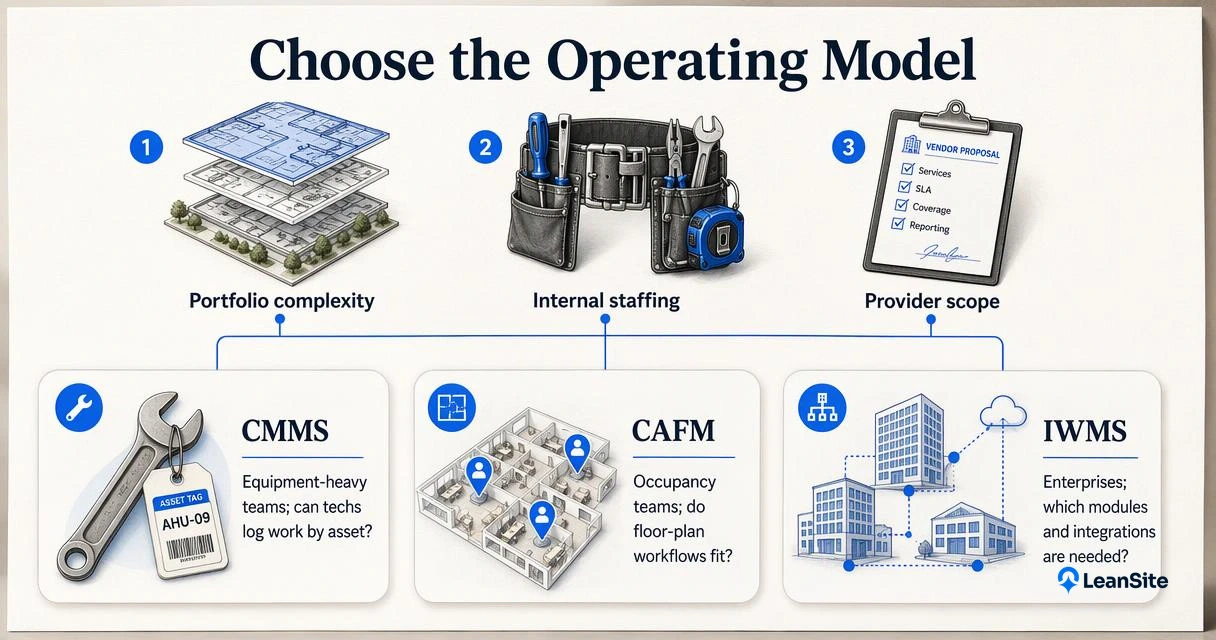
Comparison of four common approaches
| Approach | Primary purpose | Best-fit situation | Selection question |
|---|---|---|---|
| CMMS | Maintenance scheduling and asset records | Equipment-heavy operations | Can technicians record work at the asset? |
| CAFM | Building and space coordination | Teams managing occupancy and facilities data | Does it support required floor-plan workflows? |
| IWMS | Broader property and workplace coordination | Enterprises connecting several business functions | Which modules and integrations are necessary? |
| Managed services | Outsourced delivery and coordination | Portfolios needing external service capacity | Who owns response standards and performance reporting? |
Software and managed services can work together. An owner might retain approval authority while a service partner dispatches technicians and records completion evidence.
Local execution with portfolio visibility
Multi-location teams need consistent reporting without forcing every building into identical schedules. Asset inventories, opening hours, and approval limits may differ by site. The multi-location facilities software guide provides related reading for planning that balance.
A useful operating model standardizes the information needed for decisions while preserving site-specific maintenance requirements.
How should teams evaluate a facilities platform?
- Evaluate a facilities platform against documented workflows and named owners.
- Establish baseline service and cost measures.
- Test real jobs from intake through approval and completion.
- Verify integrations, permissions, and mobile access.
- Review pilot results before expanding the rollout.
A scored demonstration should follow operational requirements, not replace them.
Test the full work-order lifecycle
A practical test could follow a hypothetical refrigeration repair: a restaurant reports temperature drift, a manager approves dispatch, a vendor records the repair, and finance checks the invoice against authorized work. Each handoff should preserve the site, asset, responsible party, and current status.
Selection teams should check:
- Intake: Required fields, photos, priority rules, and duplicate handling.
- Dispatch: Assignment ownership, vendor acceptance, and escalation paths.
- Completion: Labor, parts, repair notes, and supporting evidence.
- Payment: Approval records and connections to accounting workflows.
The 2026 facilities ticket-management guide offers educational follow-up on request tracking.
Measure performance before promising savings
Useful pilot measures include time to assignment, time to restoration, repeat repairs, preventive-maintenance completion, and cost per asset. Define each measure consistently: restoration time isn't necessarily the same as ticket closure time.
Teams should also test technician access in actual working conditions. The discussion of connectivity in facilities management helps frame mobile-access requirements.
Savings claims need a documented baseline and comparable scope. A hypothetical 30-day pilot can reveal workflow fit, but seasonal equipment demands may require a longer review.
How Leansite handles this
Leansite offers an AI-assisted facilities-management approach through its built-in assistant, Vera. For teams assessing that approach, a useful demonstration should connect the assistant to a specific operational task and show how staff retain control over decisions. Product fit should be established through the same documented pilot used for any shortlisted platform.
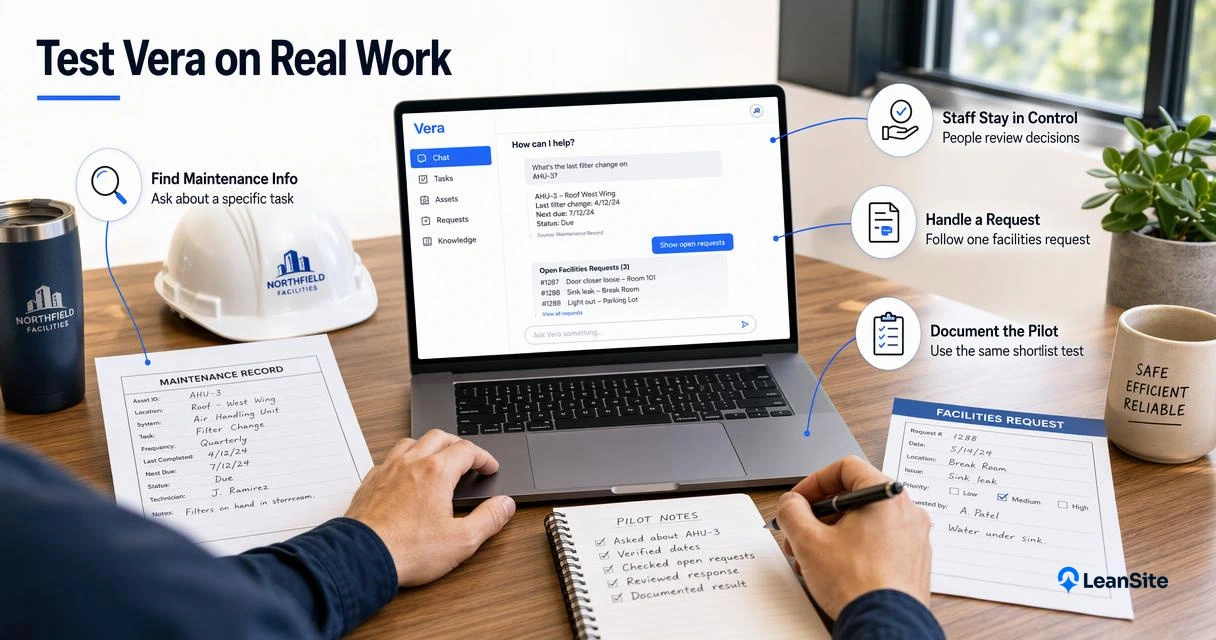
Assess Vera against a concrete task
The introduction to the built-in Vera assistant provides product-specific background. A practical demonstration could ask how the assistant supports finding maintenance information or handling a facilities request, with the exact supported actions confirmed during evaluation.
Request demonstrations of:
- The source records behind an answer.
- Permission boundaries for different staff roles.
- Human approval for operational actions.
- How updates appear in the underlying work record.
AI priorities for 2027
The next selection priority should be accountable AI assistance: clear source records, defined permissions, and reviewable actions. The site's AI facility-management software guide offers further context for that evaluation.
Two broader research references are OpenAI's 2023 GPT-4 Technical Report and Dwivedi and colleagues' 2023 multidisciplinary opinion paper on conversational AI. These are background publications, not facility-specific ROI studies.
AI should assist a defined workflow, with responsibility for operational decisions remaining explicit.
Conclusion
Facility Management Solutions should make maintenance decisions easier to verify. Start with a workflow map, select pilot sites, and agree on success measures before purchasing. For teams considering AI-assisted operations, arrange a Leansite demonstration through getleansite.com and request a walkthrough using a real maintenance scenario.
Demi Oloyede
Leansite
Frequently Asked Questions
Can a CMMS manage an entire property portfolio?
A CMMS can support maintenance across several properties when its location structure, permissions, asset records, and reporting match the portfolio. Broader needs, such as space planning or lease administration, may call for other systems. The category name alone doesn't establish suitability; actual workflows and integration requirements should determine the choice.
Does outsourcing remove the need for internal oversight?
Outsourcing changes who performs or coordinates work, but owners still need approval rules, service expectations, and access to records. Contracts should define escalation, completion evidence, reporting, and data ownership. An internal manager remains responsible for checking whether service delivery supports the property's operational priorities.
How should maintenance software ROI be calculated?
Maintenance software ROI should compare documented benefits with total implementation and operating costs. Include subscription fees, configuration, training, integrations, and staff time. Count measurable changes such as reduced administrative effort or fewer repeat repairs only when records support them. Separate observed results from assumptions about future savings.
More from the blog
- maintenance vendor coordination
In House vs Outsourced Facility Maintenance: A 2026 Guide
Compare maintenance staffing models by response coverage, skills, workload, and fully loaded costs, with an illustrative budget and hybrid decision guide.
- maintenance history
Best QR Code Asset Tagging Software: A 2026 Buying Guide
Compare QR asset tagging options by labeling, mobile access, maintenance history, and permissions, then validate the right fit with a small-site pilot.
- commercial property maintenance
Facilio vs MaintainX: A Practical Buyer’s Guide for 2026
Compare Facilio and MaintainX through portfolio oversight, technician workflows, integrations, and implementation. Use a practical demo scorecard.