BMS Integration with Facility Management Software: A Practical Guide

TL;DR
Start with a read-only connection, selected alarms, and verified asset records before expanding across properties. Choose an integration method that supports clear ownership, repeat-event handling, and technician feedback, then test the complete workflow before rollout.
A building alarm becomes useful when it leads to a clear maintenance action. BMS integration with facility management software connects equipment events with the records, people, and follow-up needed to resolve them. For facility managers and property owners, the goal is traceable work, not simply another dashboard. Leansite is a facility management option to evaluate for that operational layer. A sensible 2026 project starts with a small equipment group, defined responsibilities, and measurable acceptance tests.
Table of Contents
What does BMS integration connect?
BMS integration connects building monitoring and control data with maintenance workflows in facility management software. A building management system tracks equipment conditions; the maintenance platform manages the response. The connection should carry enough context to identify the asset, assess urgency, assign responsibility, and document the outcome.
Building management system (BMS): A system that monitors and controls building services, such as heating, ventilation, and air conditioning.
Facility management software: Software used to organize building operations, maintenance records, assets, and service responsibilities.
Integration: A defined exchange of data between systems, rather than two dashboards displaying similar information.
Three connection methods to evaluate
The best connection method depends on available interfaces and the required workflow.
| Method | Suitable use | Evaluation priority |
|---|---|---|
| Supported API or webhook | Event-driven maintenance records | Authentication, delivery confirmation, record updates |
| Protocol gateway, such as BACnet or Modbus | Translating equipment data into application-ready events | Point mapping, supported devices, network boundaries |
| Scheduled data import | Periodic readings or asset synchronization | Freshness, reconciliation, import ownership |
These are architectural options, not promises that every product supports them. Broader facility management solution selection should also consider dispatching and vendor coordination.
Building controls explained visually
This introductory video explains the building-system side of the connection.
How can alarms become actionable maintenance records?
- Filter alarms by severity, duration, and operating schedule.
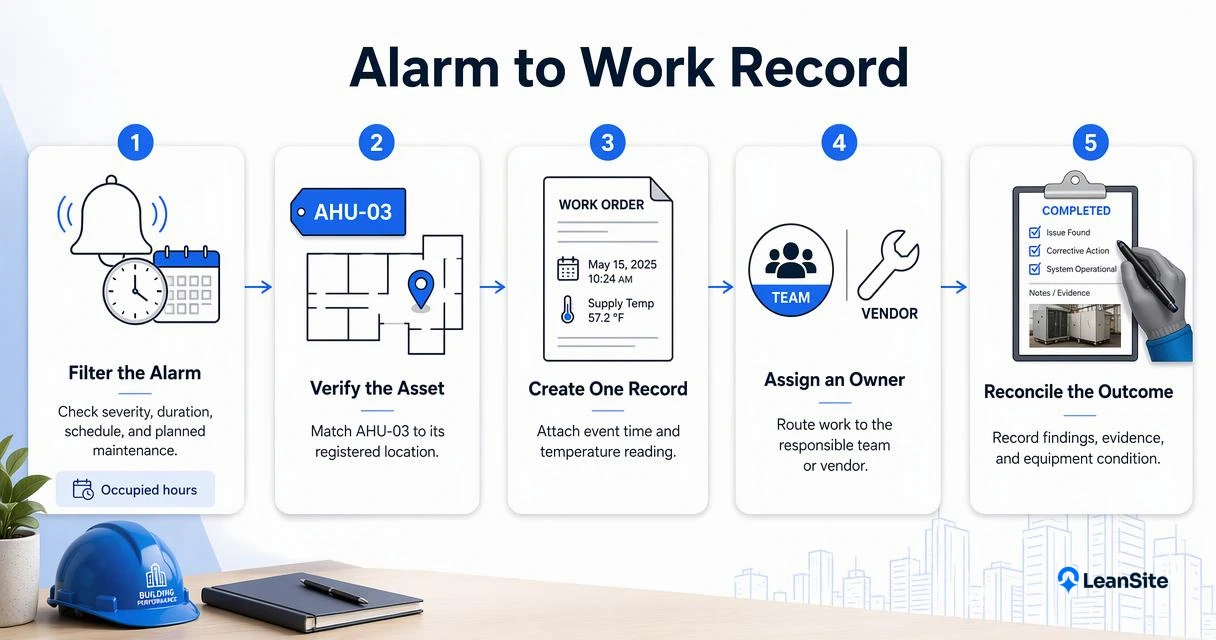
- Match each event to a verified asset and location.
- Create or update one maintenance record for the active issue.
- Assign the responsible team or vendor.
- Capture technician findings and completion evidence.
- Reconcile the maintenance outcome with the equipment condition.
Reference workflow for an air-handling unit
An illustrative workflow begins when AHU-03 reports a sustained temperature deviation during occupied hours. The integration checks whether the unit is under planned maintenance, matches it to the asset register, and attaches the event time, reading, threshold, and location.
An existing open record receives the new observation instead of another ticket. Responsibility follows the site's equipment ownership and service contract. The technician records the diagnosis, action taken, parts used, and verification result.
The facilities ticket management guide offers related reading on organizing this maintenance handoff.
Rules that keep ticket volume manageable
A useful alarm policy separates equipment signals from work that needs human attention.
- Use persistence rules for short-lived deviations.
- Group repeated events by asset and fault type.
- Suppress approved maintenance-window notifications.
- Route unmatched assets to a review queue.
- Keep life-safety responses within approved specialist procedures.
An alarm clearing confirms a changed signal; it doesn't prove that the underlying maintenance issue has been resolved.
Which acceptance tests prove the connection works?
Acceptance tests should prove correct routing, repeat-event handling, recovery, and traceability before portfolio rollout. A successful demonstration of one ticket is only a starting point. Facilities, IT, controls specialists, and service providers should agree on expected outcomes and retain evidence from each test.
Minimum go-live test checklist
A repeatable test pack gives every stakeholder the same definition of readiness.
- Asset match: A known alarm reaches the correct equipment record and property.
- Repeat event: Multiple notifications update the intended record without creating duplicates.
- Ownership: The correct team receives the job and escalation follows the agreed rules.
- Connection interruption: Events are reconciled after service returns, with original timestamps preserved.
- Technician feedback: Findings remain linked to the originating event.
- Closure: A cleared alarm doesn't automatically erase unfinished work.
The operational implications of interruptions are covered in the facility connectivity guide.
Security and operational boundaries
A read-only pilot separates maintenance visibility from building-control authority. Use dedicated service credentials, restricted permissions, approved network paths, and auditable changes.
Any later write-back, such as changing a setpoint, needs separate authorization and controls review. Owners can assess pilot value through measured routing accuracy, actionable-ticket volume, response times, and technician effort, rather than assumed savings.
How Leansite fits the maintenance workflow
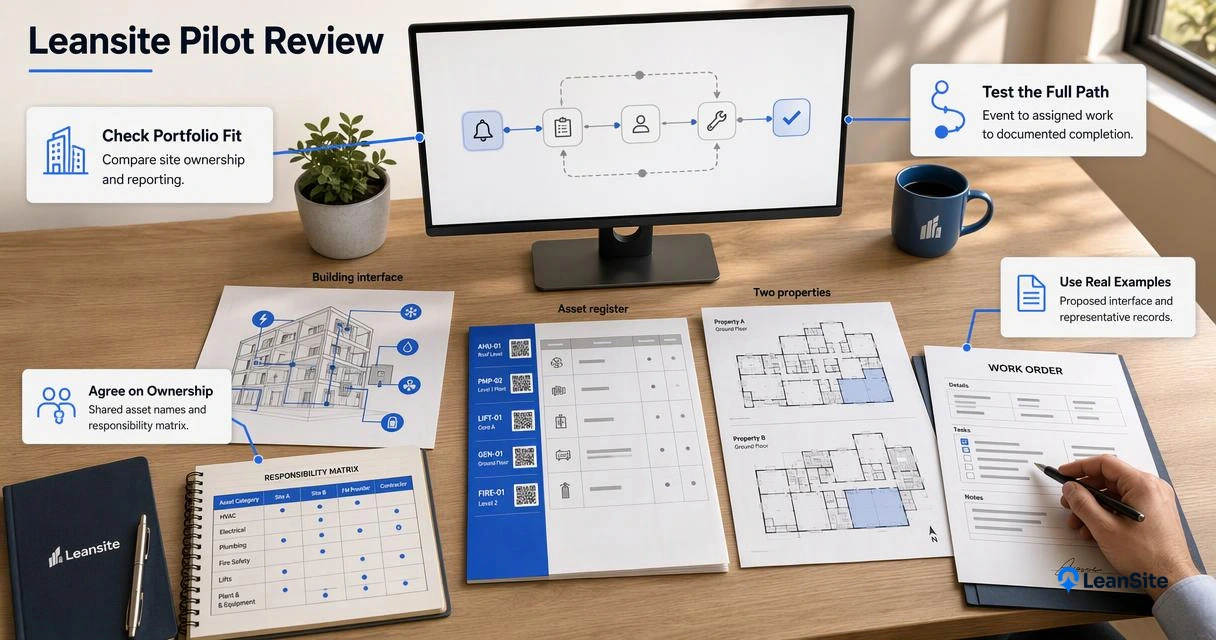
Leansite is a facility management option to assess against the operational requirements established by the pilot. Evaluation should focus on the complete path from equipment event to assigned work and documented completion. A vendor demonstration should use the proposed building interface and representative maintenance records.
A portfolio-focused evaluation
A shared asset naming scheme and responsibility matrix make the demonstration easier to judge. Teams managing several properties can use the multi-location facilities management guide to frame site ownership and portfolio reporting.
Request a walkthrough covering event intake, asset association, assignment, technician updates, and reporting. Confirm supported interfaces and implementation responsibilities in writing.
What to evaluate for 2027
AI-assisted event grouping and maintenance recommendations deserve evaluation alongside explainability and human approval. The 2021 construction AI review provides older, broader research context, not proof of current BMS integration performance.
The practical AI facility management software guide provides related reading. Procurement should prioritize capabilities demonstrated on actual site data.
Conclusion
Start BMS integration with facility management software by selecting one site, one equipment group, and named owners for controls, IT, and maintenance. Run the acceptance tests before expanding. To assess Leansite for the operational workflow, visit getleansite.com and request a demonstration built around representative assets and maintenance scenarios.
Demi Oloyede
Leansite
Frequently Asked Questions
Does a BMS replace facility management software?
A BMS doesn't replace facility management software because monitoring equipment and managing maintenance are different tasks. Building controls can identify operating conditions, while maintenance records capture responsibility, labor, parts, vendor activity, and completion evidence. Integration connects those functions without requiring either system to become the other.
Is BACnet compatibility enough for integration?
BACnet compatibility alone doesn't establish a complete maintenance connection. Teams still need an agreed data path, asset mapping, event rules, authentication, and a destination workflow. Procurement should verify the specific equipment, gateway, and software interfaces involved, then test the resulting maintenance record rather than relying on a protocol label.
Should every alarm create a work order?
Every alarm shouldn't automatically create a work order. Some events are brief, repeated, expected during maintenance, or already covered by an open job. An approved filtering policy should define which events require action, which update existing records, and which remain available for monitoring or later review.
More from the blog
- maintenance vendor coordination
In House vs Outsourced Facility Maintenance: A 2026 Guide
Compare maintenance staffing models by response coverage, skills, workload, and fully loaded costs, with an illustrative budget and hybrid decision guide.
- maintenance history
Best QR Code Asset Tagging Software: A 2026 Buying Guide
Compare QR asset tagging options by labeling, mobile access, maintenance history, and permissions, then validate the right fit with a small-site pilot.
- commercial property maintenance
Facilio vs MaintainX: A Practical Buyer’s Guide for 2026
Compare Facilio and MaintainX through portfolio oversight, technician workflows, integrations, and implementation. Use a practical demo scorecard.