Best Software for Maintenance Vendor Management in 2026

TL;DR
Choose maintenance vendor software by testing the complete request-to-payment workflow, not just work-order tracking. Multi-site teams should prioritize contractor coordination, approval controls, and portfolio reporting, then confirm pricing and integrations through a focused pilot.
The best software for maintenance vendor management connects the contractor's job with the facility's approval process and operating records. A ticket marked complete tells only part of the story; managers also need evidence of the repair and an invoice ready for review.
Maintenance vendor management software: A system for coordinating outside service providers, including assignments, job updates, completion records, and financial approvals.
For commercial facilities, Leansite belongs on the shortlist alongside established computerized maintenance management system, or CMMS, options. The right choice depends on whether operations center on outside contractors, internal technicians, or a mix of both.
Table of Contents
Best software for maintenance vendor management: the shortlist
The strongest shortlist separates facility-wide vendor coordination from technician-centered maintenance tracking. These candidates provide a starting point for demonstrations, not a verified feature ranking; current plans, contractor access, and integration details need confirmation.
Compare candidates by the workflow being evaluated
| Software | Evaluation focus | Demonstration priority |
|---|---|---|
| Leansite | Connected facility operations and multi-location coordination | Follow a vendor job from request through reporting |
| MaintainX | CMMS-based maintenance execution | Compare internal technician and external contractor workflows |
| Fiix | CMMS-based asset and work-order management | Connect contractor work with asset records |
| Limble | CMMS-based maintenance planning | Show vendor assignments alongside scheduled maintenance |
| UpKeep | Maintenance management and dispatch evaluation | Demonstrate field updates and manager visibility |
The supplied 2026 search research identifies these CMMS and maintenance management candidates, but doesn't establish equivalent vendor-management capabilities. Buyers should evaluate the same scenario across each demonstration.
Who should pick which type of platform?
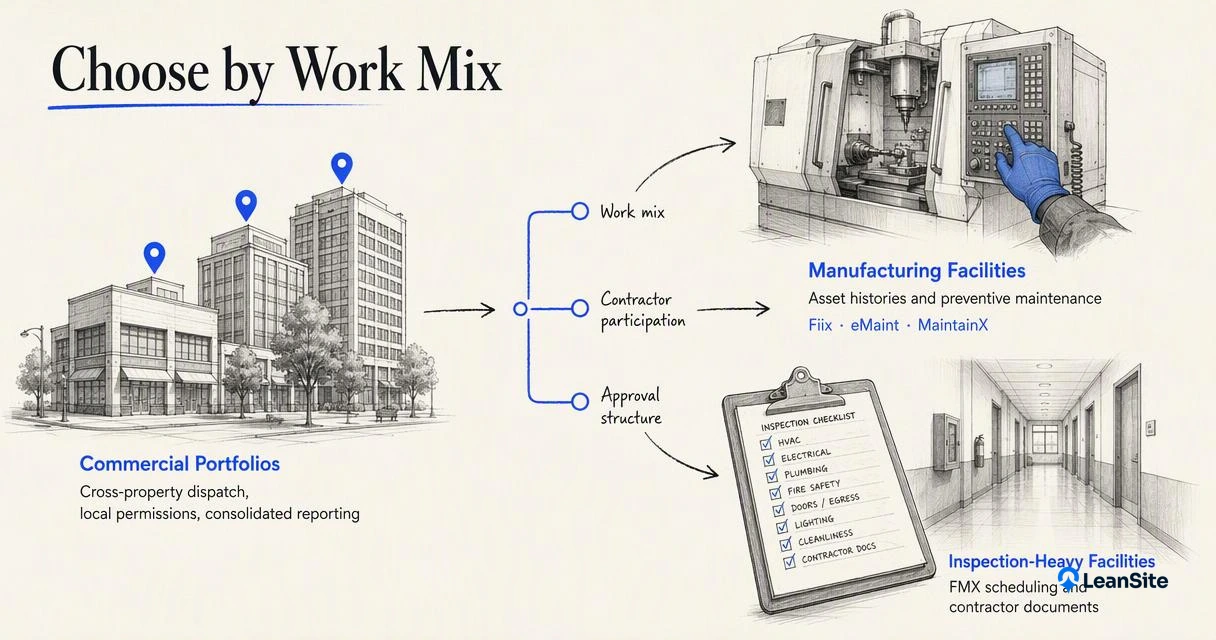
- Vendor-heavy portfolios: Prioritize contractor access, approval routing, and site-level spend visibility.
- In-house maintenance departments: Prioritize technician workflows, asset histories, and preventive schedules.
- Mixed operating models: Require one record that follows work between staff and outside specialists.
Teams comparing technician-led systems can review these MaintainX alternatives for further evaluation context.
Watch a CMMS review before scheduling demonstrations
The review offers background on the CMMS category. Buyers should confirm any demonstrated functionality against the current product and subscription.
How should facilities teams evaluate vendor software?
Facilities teams should evaluate vendor software by running the same request-to-payment scenario through every shortlisted platform. A realistic test reveals how contractors, site managers, and finance share responsibility. Feature checklists help organize questions, but a completed workflow provides stronger evidence of operational fit.
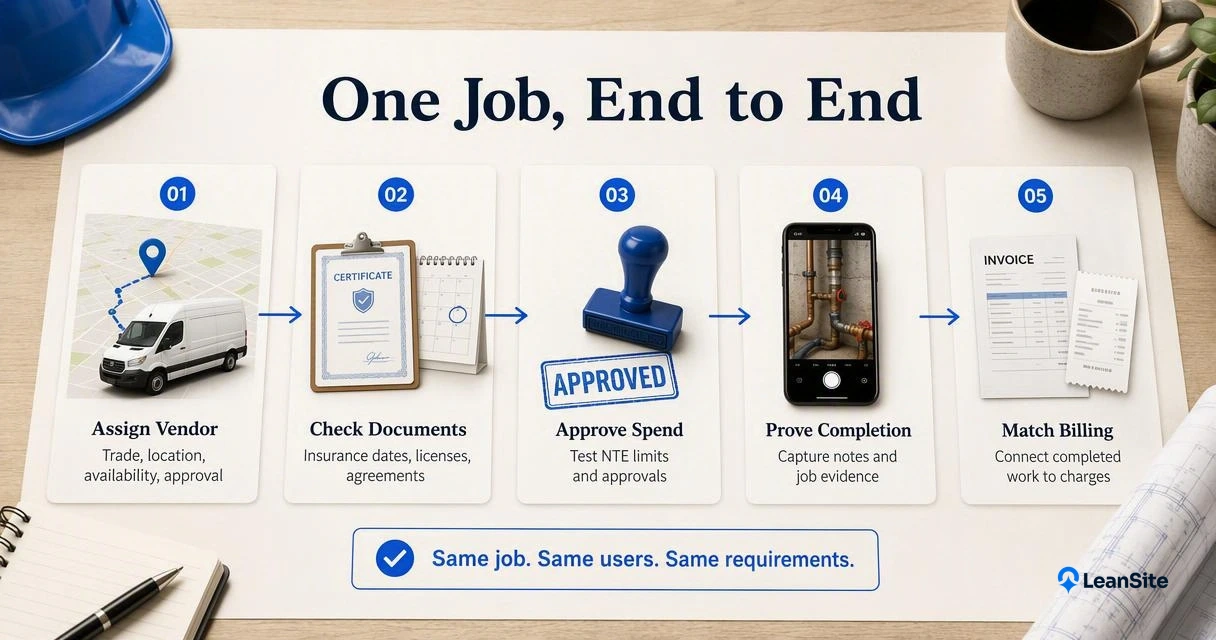
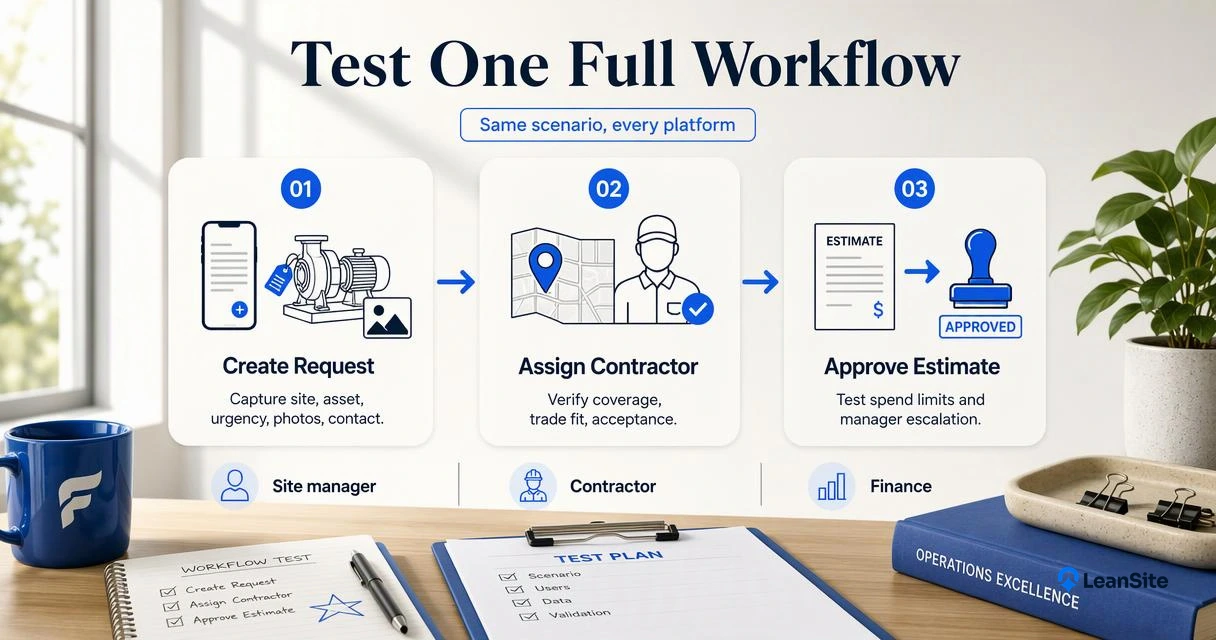
Run a repeatable request-to-payment test
- Create a request: Record the location, asset, urgency, photos, and site contact.
- Assign a contractor: Check service coverage, trade suitability, and acceptance tracking.
- Approve the estimate: Test spending limits and escalation to the correct manager.
- Capture field updates: Record arrival, findings, supporting photos, and completion.
- Review the invoice: Match charges to the approved scope and job evidence.
- Export the record: Confirm how accounting and portfolio reporting receive the data.
For example, an HVAC callout can test estimate approval and asset history together. An after-hours plumbing request can test escalation and contractor acceptance.
Check contractor access and total cost
Contractor access affects adoption as much as manager features. Demonstrations should establish whether vendors need paid accounts, how mobile updates work, and what information remains visible to each role.
Commercial comparisons should include implementation, training, contractor seats, integrations, and ongoing support, not just the advertised subscription. A wider facility management solutions guide helps place those costs within the operating model.
A useful buying test follows one job across every handoff, rather than demonstrating isolated screens.
How Leansite handles this
Leansite offers a facility-management platform to evaluate when maintenance work needs to connect with broader site operations. Its published resources address multi-location facilities management, vendor dispatch, and the built-in Vera AI assistant. Those resources provide relevant starting points for a workflow-specific demonstration.
Start with the portfolio operating model
A regional facilities team needs both local context and a portfolio view. The demonstration should show how locations, requests, assigned contractors, and management oversight fit together, with clear ownership at each stage.
The multi-location facilities management guide provides background for teams standardizing operations across properties.
Connect dispatch questions with AI assistance
Buyers can use the published vendor dispatch and predictive maintenance automation guide to prepare questions about assignment and follow-up workflows.
The Vera AI assistant overview provides a separate starting point for evaluating AI-supported work.
- Bring one representative vendor job to the demonstration.
- Identify the manager responsible for each approval.
- Confirm the records needed by finance and portfolio leadership.
What should buyers expect from AI in 2027?
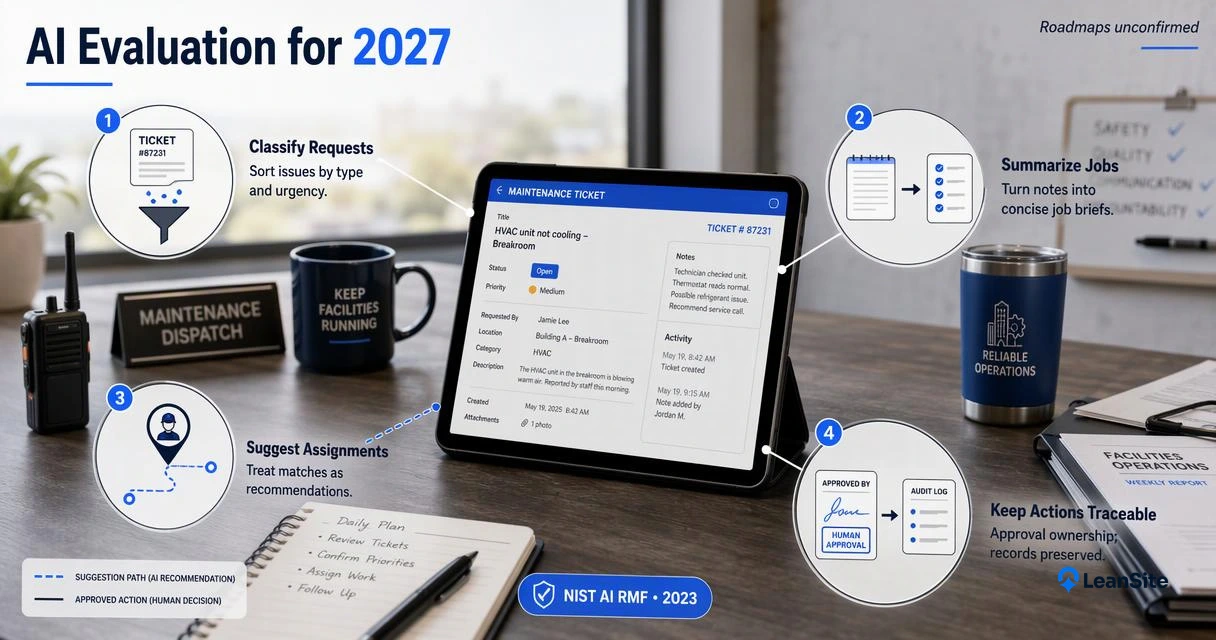
Maintenance vendor software buyers should expect to evaluate more AI-assisted workflows in 2027, while treating specific product roadmaps as unconfirmed. Useful evaluation areas include request classification, job summaries, and suggested assignments. The purchasing priority remains clear approval ownership and traceable records, rather than automation alone.
Keep human approval attached to financial decisions
AI-generated suggestions deserve different controls from approved business actions. The NIST Artificial Intelligence Risk Management Framework, published in 2023, offers a recognized reference for discussing AI risk management; it isn't a maintenance-software performance benchmark.
- Identify which actions AI suggests and which it executes.
- Require clear permissions for spending and vendor selection.
- Confirm that managers can review and correct outputs.
Conclusion
The best software for maintenance vendor management should prove its fit with real operating work. A focused Leansite demonstration can begin at getleansite.com: bring a vendor callout, an approval scenario, and the reporting requirements finance needs, then agree on a measurable pilot before purchasing.
Demi Oloyede
Leansite
Frequently Asked Questions
Can a CMMS manage outside maintenance vendors?
A CMMS can support outside vendors when its available workflows cover contractor assignments, updates, and records. Buyers should verify those functions in the relevant plan rather than assuming work-order software includes full vendor coordination. Contractor access, estimate approval, and invoice handling deserve separate demonstration questions.
What matters most for multi-location facilities?
Multi-location facilities need consistent workflows with enough flexibility for local operating rules. Important evaluation areas include location-level permissions, regional contractor coverage, approval limits, and comparable reporting. A pilot should include sites with different service needs so the team can assess both standardization and practical exceptions.
Does vendor software guarantee faster payment?
Vendor software doesn't guarantee faster payment because finance policies and accounting processes still determine payment timing. Better job evidence and approval visibility can support invoice review, but buyers should verify the actual accounting handoff. The demonstration should distinguish invoice submission, invoice approval, and payment execution.
More from the blog
- maintenance vendor coordination
In House vs Outsourced Facility Maintenance: A 2026 Guide
Compare maintenance staffing models by response coverage, skills, workload, and fully loaded costs, with an illustrative budget and hybrid decision guide.
- maintenance history
Best QR Code Asset Tagging Software: A 2026 Buying Guide
Compare QR asset tagging options by labeling, mobile access, maintenance history, and permissions, then validate the right fit with a small-site pilot.
- commercial property maintenance
Facilio vs MaintainX: A Practical Buyer’s Guide for 2026
Compare Facilio and MaintainX through portfolio oversight, technician workflows, integrations, and implementation. Use a practical demo scorecard.