A leak sensor in a remote mechanical room stops reporting for six hours because the site's connection drops overnight. Nobody notices until a technician happens to walk past the room the next morning, by which point the leak has already soaked through a subfloor that used to be dry.
If that sounds familiar, it's a sign facilities management connectivity has stopped being purely an IT problem. Facility and operations leaders managing multiple locations tend to think about connectivity that way until it starts showing up as a maintenance problem. A dropped connection at a remote site doesn't just slow down email, it delays ticket submission, breaks building system monitoring, and turns a routine repair into a multi-day wait.
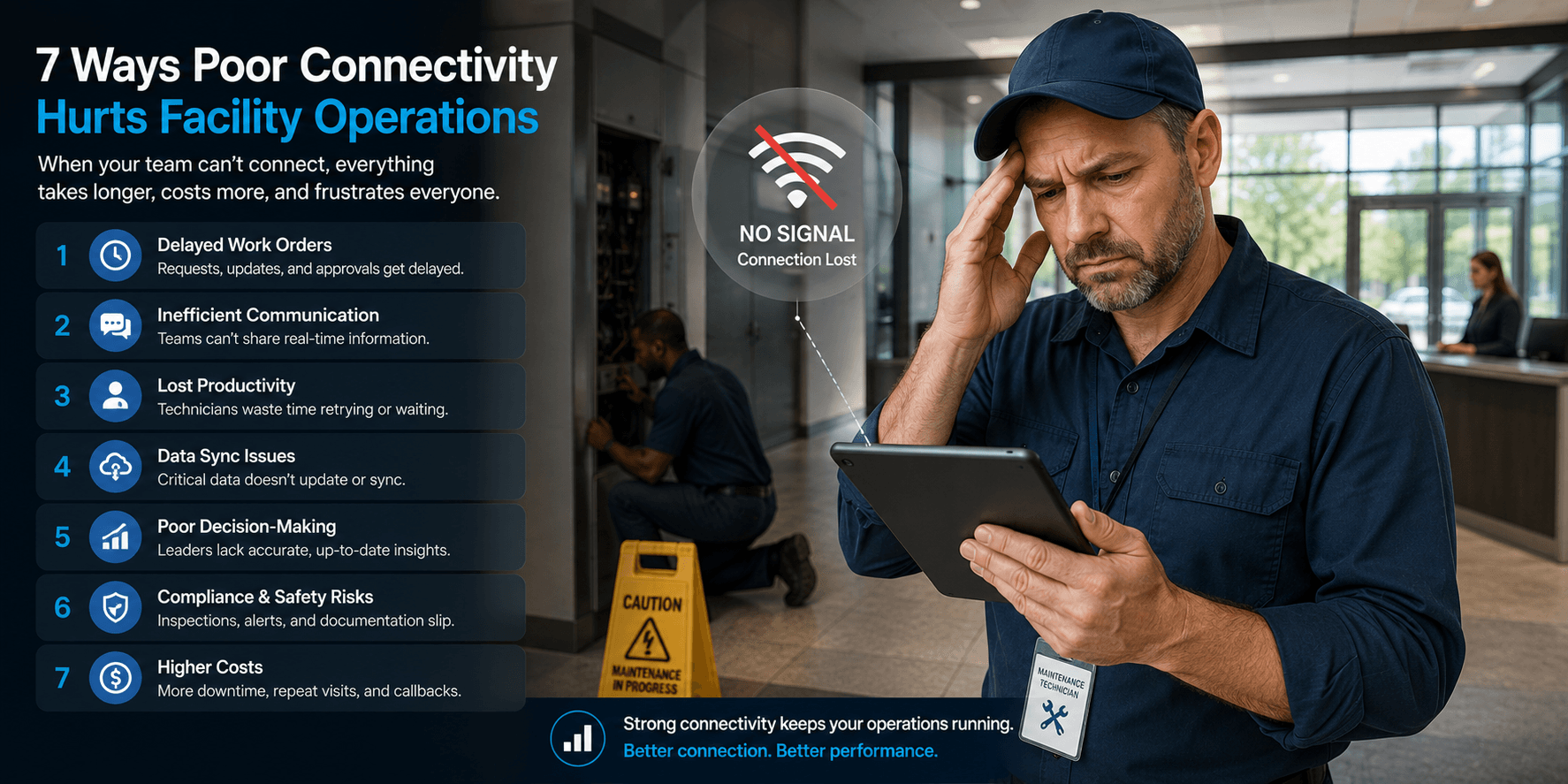
Quick answer: Facilities management connectivity is quietly one of the biggest constraints on how well a distributed operations team can actually run. It shows up in seven places: delayed or lost maintenance requests, building systems that can't self-report status, gapped IoT and sensor data, slower vendor coordination and dispatch, security and access control blind spots, rising IT infrastructure costs, and, compounding all of that, slower response times across the whole portfolio.
1. How Does Poor Connectivity Delay or Lose Maintenance Requests?
When a site's connection drops, mobile-submitted tickets can fail to sync, get duplicated, or simply not arrive until connectivity returns. For a property relying on a QR code or mobile form for intake, unreliable network infrastructure turns a two-minute request into a delay that nobody notices until the issue has gotten worse. Offline-capable mobile intake, the kind that lets a field agent keep updating tasks and adding notes or photo evidence with no connection at all and sync automatically once signal returns, closes most of this gap. We cover this pattern in more depth in 7 Industries That Need Offline Maintenance Software (and Why).
2. Why Can't Building Systems Report Their Own Status Without a Stable Connection?
Modern HVAC, access control, and lighting systems increasingly rely on network connectivity to report status and trigger alerts. When connectivity is unstable, a building technology failure, a compressor running outside normal range, a door left unlocked, may not generate an alert at all, leaving facility staff to discover the problem manually instead of getting ahead of it. This is a gap most work order software doesn't close on its own; a facilities team generally needs a dedicated building automation or IoT layer feeding into whatever work order system they use, rather than expecting the ticketing platform itself to catch a sensor fault.
3. What Happens to IoT and Sensor Data When Connectivity Is Unreliable?
Leak sensors, temperature monitors, and energy meters are only useful if their data actually reaches a dashboard. Intermittent connectivity creates gaps in that data stream, which means trend analysis and predictive maintenance are working with incomplete information, sometimes without anyone realizing data is missing until a failure that should have been caught in advance happens anyway. That gap has a measurable cost. The U.S. Department of Energy's Federal Energy Management Program estimates that a functional preventive maintenance program saves roughly 12% to 18%, on average, compared to a reactive-only approach, and missing sensor data is exactly the kind of blind spot that pushes a facility back toward reactive maintenance without anyone deciding that on purpose. Most work order platforms, including asset-tracking systems that log purchase, warranty, and maintenance history, don't yet ingest live sensor feeds directly. Where a facility already runs IoT sensors, that data typically needs its own path into a dashboard alongside, rather than through, the work order platform.
4. How Does Poor Connectivity Slow Down Vendor Coordination and Dispatch?
Vendor coordination increasingly happens through mobile apps, shared portals, and automated dispatch notifications. When connectivity issues disrupt that flow, dispatch delays and miscommunication follow, a vendor might not receive a work order update, or a technician on-site can't confirm parts availability in real time, adding hours to what should be a same-day fix. Keeping a technician's assigned tasks available on the device even without a connection means work can keep moving locally instead of stalling until signal returns and everything syncs back to the vendor and facility manager. For more on how dispatch and coordination break down across distributed portfolios, see Vendor Dispatch and Predictive Maintenance Automation for Multi-Site Teams.
5. Where Does Poor Connectivity Create Security and Access Control Blind Spots?
Access control systems, cameras, and alarm monitoring depend on a stable connection to function as intended. A site with unreliable connectivity risks gaps in access logs or delayed alerts on unauthorized entry, a real liability for any multi-location operator responsible for tenant, resident, or asset security. This is a physical security and access control system concern more than a work order software one, and it's worth evaluating separately from whatever platform a team uses for maintenance tickets and vendor coordination.
6. How Does Poor Connectivity Raise IT Infrastructure Costs?
Facilities teams often respond to poor connectivity by layering on redundant hardware, cellular failover devices, or local data caching, reasonable fixes, but ones that add up quickly across a portfolio. IT infrastructure costs climb fastest at sites where the underlying connection was never reliable enough to support the systems built on top of it, turning a network problem into a recurring budget line. Software built to work offline by design reduces how much of that redundant hardware a site actually needs just to keep maintenance operations running, since the app already holds field work locally until the connection comes back.
7. Why Does Unreliable Connectivity Slow Response Times Across an Entire Portfolio?
Delayed tickets, missed building system alerts, gapped sensor data, slower vendor dispatch, and access control blind spots each cause their own local delay, but together they compound into something bigger: response times slow down portfolio-wide, and nobody can say exactly why until they trace it back to connectivity. A tenant complaint that should resolve in a day stretches into a week because the ticket sat unsynced, the vendor notification arrived late, and the building system that should have flagged the issue automatically never got the chance to. That compounding delay isn't cheap. MaintainX's 2024 State of Industrial Maintenance survey of more than 1,165 maintenance professionals found unplanned downtime costs an average of about $25,000 per hour, and a chain of small connectivity-driven delays is exactly the kind of thing that turns a routine issue into that number. A portfolio-wide health score, rolling completion rate, budget adherence, vendor reliability, and team efficiency into a single per-location ranking, helps separate the signal from the noise here, so a director can see which site is actually dragging response times down instead of guessing.
Why This Matters More as Facility Operations Get More Connected
The irony is that as facility operations modernize, more sensors, more automated systems, more mobile-first workflows, the cost of unreliable connectivity actually goes up, not down. A facilities team running mostly on paper and phone calls doesn't notice a network outage the same way a team relying on real-time dashboards and automated routing does. Modern systems are more capable, but they're also more dependent on the network underneath them. We go deeper on this dynamic in The Hidden Cost of Poor Connectivity in Facilities Management.
That's part of why software built for distributed, multi-location teams increasingly design around unreliable connectivity rather than assuming it away: offline ticket capture that syncs once a connection returns, mobile workflows that don't require a constant live connection to function.
Where LeanSite AI Fits, and Where It Doesn't Yet
LeanSite AI, the platform this article's publisher builds, is one example of software designed around unreliable connectivity rather than assuming it away. According to its own release notes, its Offline Mode lets field agents view and update tasks, add typed notes, and attach photo evidence with no connection, syncing automatically once signal returns, and its Operational Health Module rolls completion rate, budget adherence, vendor reliability, and team efficiency into a per-location score to help spot which site is dragging response times down.
It's worth being just as direct about what the platform doesn't do yet. Direct IoT sensor integration and live building system monitoring aren't part of LeanSite AI today, they're on the roadmap, so points 2 and 3 above remain gaps a facilities team needs to close with a dedicated building automation or IoT layer regardless of which work order platform they use. Offline voice note capture also isn't available yet; typed notes are the offline fallback for now. As with any vendor's description of its own product, this is worth confirming directly against a trial or demo.
See How LeanSite AI Handles Low-Signal Sites
Book a LeanSite AI demo to walk through Offline Mode and the Operational Health Module for your own portfolio.
FAQ: Connectivity and Facility Operations
Why does connectivity affect maintenance response times? Most modern maintenance workflows, ticket submission, vendor dispatch, building system alerts, depend on a stable connection to function in real time, so instability at any point in that chain slows down the whole response.
Is poor connectivity mainly an IT problem or a facilities problem? It's both. IT teams manage the infrastructure, but the operational impact, missed tickets, delayed vendor coordination, security gaps, lands squarely on facilities and operations teams, which is why it's worth tracking as a facilities issue, not just a network one.
How can facilities teams reduce the impact of unreliable connectivity? Choosing systems that account for intermittent connectivity, offline-capable mobile intake, local data caching, redundant alerting, reduces how much a network gap actually disrupts day-to-day operations, even before the underlying infrastructure is fully fixed.
Does offline capability cover everything a field agent does, including voice notes? Not yet, at least for LeanSite AI. Its Offline Mode covers task updates, typed notes, and photo evidence while offline, with voice note capture currently requiring a connection and planned as a future addition, so teams that rely heavily on voice notes should plan for typed notes as the offline fallback for now.
Connectivity rarely shows up on a facilities budget as its own line item, but its absence shows up everywhere else, in response times, vendor delays, and gaps in the data teams rely on to make decisions.
Written by Pelumi Akinwande, Operations Content Lead at LeanSite, who works directly with multi-site facilities and property operations teams evaluating work order software. Connect on LinkedIn.