Root Cause Analysis for Recurring Facility Maintenance Problems
TL;DR
Recurring repairs need an investigation that connects failure history, operating conditions, and technician observations. Use five whys for a straightforward failure chain, then confirm the fix under comparable conditions before closing the investigation.
A repair can restore service without removing the reason equipment failed. Root cause analysis for recurring facility maintenance problems connects repeat incidents to an underlying condition, so the next work order changes more than a replacement part.
Root cause analysis (RCA): A structured problem-solving method for identifying the underlying causes of faults, consistent with the definition of root-cause analysis. For facility teams, the practical goal is a supported explanation, an assigned corrective action, and evidence that the action worked.
Table of Contents
When does a repeat repair need root cause analysis?
A repeat repair needs root cause analysis when the same symptom returns, several assets show a shared pattern, or an incident carries serious safety, service, or cost consequences. The trigger should reflect business risk, not just a fixed number of work orders; one high-consequence event can justify investigation.
Choose cases by consequence and pattern
A recurring lobby temperature complaint and a recurring fire-system fault deserve different urgency. Prioritize investigations using:
- Consequence: Safety exposure, business interruption, tenant disruption, or asset damage.
- Pattern: The same component, location, vendor visit, season, or operating condition.
- Cost: Combined labor, parts, callouts, and downtime across related jobs.
Group incidents by asset ID and symptom before calculating totals. Otherwise, descriptions such as "warm office" and "AC not cooling" can hide the same recurring event.
The facility management solutions guide provides broader context for organizing maintenance workflows and asset visibility.
How should facility teams investigate repeat failures?
- Define the recurring failure and affected asset.
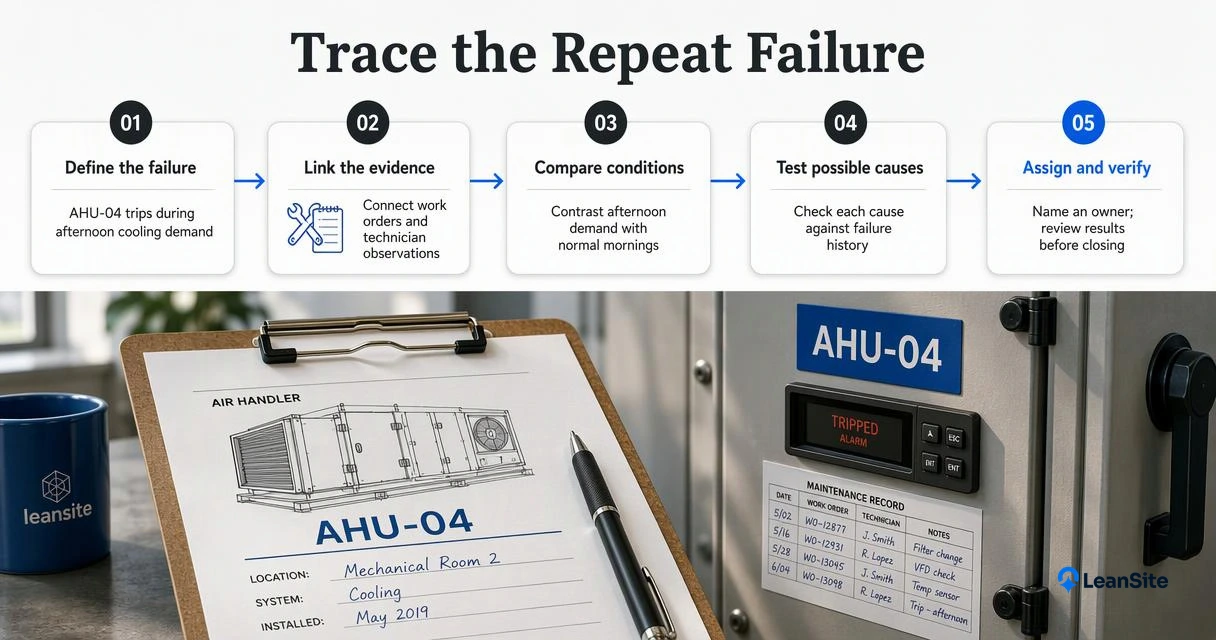
- Assemble linked work orders and technician observations.
- Compare failed periods with normal operating conditions.
- Develop possible causes and test each against evidence.
- Assign a corrective action, owner, and verification plan.
- Review results before closing the investigation.
Build an evidence checklist before choosing a cause
A useful problem statement names the asset, symptom, timing, and consequence. An illustrative example: "Air handler AHU-04 trips during afternoon cooling demand after restarting normally each morning."
Collect:
- Failure history: Dates, symptoms, previous repairs, parts installed, and recurrence intervals.
- Operating conditions: Load, occupancy, weather, schedules, setpoints, and equipment runtime.
- Technician observations: Measurements, photos, sounds, wear patterns, and tests performed.
- Maintenance context: Inspection records, manufacturer requirements, recent modifications, and vendor reports.
- Comparison evidence: Similar assets operating normally under comparable conditions.
Record timestamps and measurement units. A current temperature reading cannot explain yesterday's trip unless conditions are comparable. The scholarly survey Age of Information: An Introduction and Survey, published in 2021, examines information freshness; it is useful background for understanding why measurement age matters, not proof of a maintenance outcome.
Separate observations from hypotheses
"Motor casing measured unusually hot" is an observation. "The motor is undersized" is a hypothesis requiring load measurements and specification checks. Preserve both, but label them separately.
A plausible explanation becomes a working cause only when evidence supports the mechanism and competing explanations have been considered.
Five whys: a recurring condensate leak example
Five whys traces a symptom through successive causes, but every link needs evidence rather than a confident guess. The following illustrative case concerns an air handler that repeatedly leaks after its drain line has been cleared; it is a teaching example, not a reported customer result.
Trace the leak from symptom to maintenance scope
| Question | Provisional answer | Evidence needed |
|---|---|---|
| Why did water reach the floor? | The condensate pan overflowed. | Pan inspection and water marks. |
| Why did the pan overflow? | Drain flow was restricted. | Flow test before cleaning. |
| Why did restriction return? | Debris remained upstream. | Pan and drain-entry inspection. |
| Why did debris remain? | Previous visits cleared only the line. | Vendor reports and technician confirmation. |
| Why was cleaning incomplete? | The task omitted pan inspection. | Maintenance procedure review. |
Turn the explanation into a testable action
The proposed action is to clean the pan and drain, revise the task scope, and document a flow test. A separate issue, such as incorrect drain-trap configuration, may still require manufacturer guidance and qualified inspection.
Five is not a required stopping point. If evidence points to several interacting causes, branch the investigation using a cause-and-effect diagram covering equipment, methods, materials, people, and operating conditions. "Technician error" alone rarely explains what allowed the condition to recur.
How can teams confirm a corrective action worked?
- Record baseline recurrence, downtime, and operating conditions.
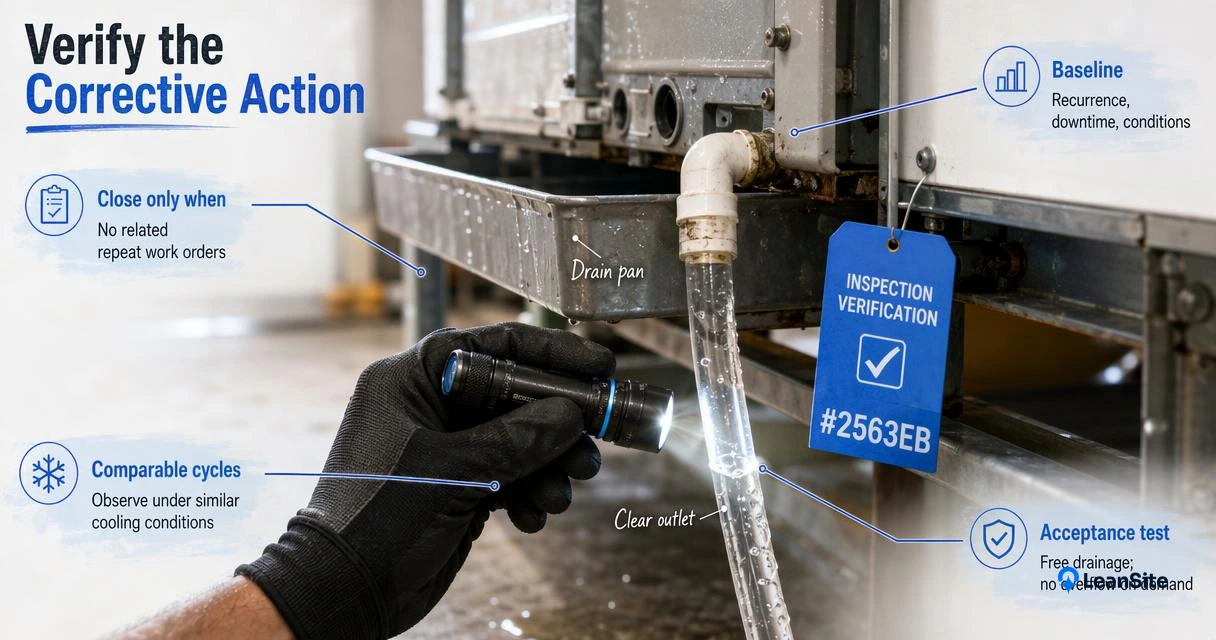
- Define an acceptance test tied to the proposed cause.
- Implement the action with a named owner and completion date.
- Observe performance through comparable operating cycles.
- Check for side effects and document the results.
- Close only when the acceptance criteria are met.
Set closure criteria before implementation
For the condensate example, acceptance could require free drainage during inspection, no overflow under representative cooling demand, and no related repeat work orders during a defined review period. The period should cover the conditions that previously triggered the leak, not an arbitrary calendar deadline.
Use repeat failures per operating cycle when equipment usage varies. Track repair cost separately from avoided cost; an avoided-cost estimate needs explicit assumptions.
Restoration confirms that equipment runs now. Verification confirms that the corrective action addresses the recurring mechanism.
How Leansite fits the investigation workflow
Leansite is an option for facility teams evaluating software to support a more organized maintenance process. A product review should demonstrate the intended RCA workflow: locating related jobs, preserving evidence, assigning follow-up work, and reviewing outcomes.
Teams comparing systems can consult the Leansite and Accruent Maintenance Connection comparison. Selection should follow demonstrated workflow fit rather than assumed capabilities.
Conclusion
Select one recurring asset issue, assemble its repair history, and assign an investigation owner this week. Define the acceptance test before approving corrective work. For teams evaluating Leansite, visit getleansite.com and request a walkthrough using that documented case as the workflow example.
Demi Oloyede
Leansite
Frequently Asked Questions
Does every repeat work order require a formal RCA?
No. Minor, isolated repeats may need a short documented review rather than a full investigation. Formal RCA becomes more valuable when consequences are serious, repairs accumulate, or multiple locations share a pattern. Teams should use consistent escalation criteria so investigation effort matches operational risk and likely benefit.
Can technicians identify the root cause during a callout?
Technicians can identify strong clues and sometimes confirm a straightforward cause during a visit. More complex cases require historical records, operating data, or another specialist. Dispatch instructions should request specific observations and measurements while leaving enough room for technicians to document unexpected findings rather than forcing a predetermined diagnosis.
What happens if the same problem returns after verification?
Reopen the investigation and compare the new event with the original failure conditions. Check whether the corrective action was completed, whether its effect lasted, and whether the symptom now has a different cause. Recurrence is evidence for revising the explanation, not an automatic reason to repeat the same repair.
More from the blog
- maintenance vendor coordination
In House vs Outsourced Facility Maintenance: A 2026 Guide
Compare maintenance staffing models by response coverage, skills, workload, and fully loaded costs, with an illustrative budget and hybrid decision guide.
- maintenance history
Best QR Code Asset Tagging Software: A 2026 Buying Guide
Compare QR asset tagging options by labeling, mobile access, maintenance history, and permissions, then validate the right fit with a small-site pilot.
- commercial property maintenance
Facilio vs MaintainX: A Practical Buyer’s Guide for 2026
Compare Facilio and MaintainX through portfolio oversight, technician workflows, integrations, and implementation. Use a practical demo scorecard.