Proof of Service for Facility Maintenance: Evidence That Counts
TL;DR
Accept maintenance work against a defined result, not just a check-in or signature. Require asset-linked photos, relevant test readings, task records, and scoped customer signoff; use a consistent completion packet to support invoice approval and follow-up.
A maintenance visit needs two kinds of evidence: proof that the technician attended and proof that the agreed work achieved its intended result. Proof of service for facility maintenance connects those records to a specific property, asset, and work order.
Clear completion records give facility managers, owners, and vendors a shared basis for reviewing work. Leansite is a relevant option for teams evaluating maintenance coordination; a useful starting point is defining exactly what each completed job must document.
Table of Contents
What is proof of service for facility maintenance?
Proof of service for facility maintenance is a documented record showing who performed a specific maintenance task, where and when it happened, what work was completed, and how the result was verified. A useful record ties attendance, asset identity, task evidence, and acceptance criteria to the same work order.
Attendance evidence: A check-in, timestamp, or location record showing that a technician reached the site.
Completion evidence: Photos, measurements, and task notes showing that the specified service was performed.
Acceptance evidence: A documented comparison between the result and the agreed completion criteria.
Maintenance includes inspections, servicing, repairs, and replacement. Evidence should match the activity: a filter replacement needs different documentation from a refrigerant leak repair. Unlike legal proof of service, these records concern maintenance delivery, not the delivery of court documents.
A location stamp supports attendance. An asset-specific test supports a claim about equipment performance.
How should managers verify a completed service visit?
Managers should verify a completed service visit by checking identity, scope, evidence, and results before accepting the work. The acceptance checklist should be shared before dispatch so technicians know which photos, readings, and approvals are required. Requirements should reflect the asset, service risk, contract, and applicable manufacturer instructions.
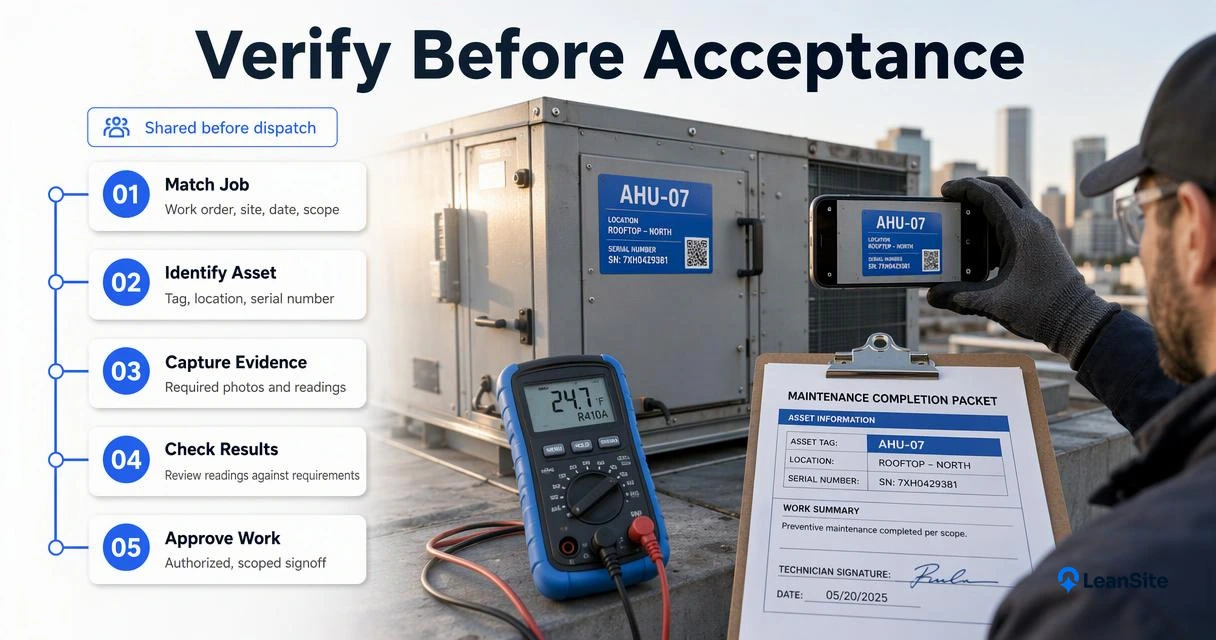
- Match the job: Confirm the work-order number, property, technician, service date, and approved scope.
- Identify the asset: Capture the asset tag, equipment location, and serial number where relevant. A room number alone may not identify the unit.
- Show the condition change: Require before-and-after photos from comparable angles, with enough surrounding detail to establish context.
- Record the work: List completed tasks, installed parts, quantities, and any approved scope changes.
- Verify the result: Record relevant readings, units, test conditions, and the source of the acceptance threshold.
- Capture scoped signoff: Identify the reviewer and distinguish acknowledgment of attendance from acceptance of technical performance.
Checks should stay proportionate. Landscaping may need zone photos and a task checklist; electrical repairs may need qualified testing and additional safety documentation. Broader workflow choices are covered in the facility management solutions guide.
What should a service completion packet contain?
A service completion packet should contain a traceable work-order summary, asset identification, condition photos, task details, verification results, and acceptance status. The following illustrative HVAC example shows the structure, not universal operating limits. Actual readings and thresholds must come from the serviced equipment and the approved test procedure.
Sample HVAC filter replacement packet
A filter replacement packet should connect the installed material and post-service checks to the specific air-handling unit.
| Packet field | Example entry | What it establishes |
|---|---|---|
| Job identity | WO-2026-0142; Property A; technician name | Which assignment was performed |
| Asset identity | AHU-03; roof zone B; tag photo | Which equipment received service |
| Before evidence | Filter condition and housing photos | Documented starting condition |
| Work performed | Approved filter type, size, and quantity installed | Match to the authorized task |
| After evidence | Installed filters and closed housing photos | Visible completion of installation |
| Verification | Actual pressure reading, units, test conditions, approved range | Whether the recorded result meets the criterion |
| Acceptance | Reviewer, date, accepted scope, follow-up status | Who reviewed which outcome |
The packet should retain original attachments alongside the summary. File names such as WO-2026-0142_AHU-03_after.jpg help reviewers connect evidence to the right job.
If a reading falls outside the approved range, record the exception and assign follow-up rather than labeling the entire repair successful. Separately completed work can still be documented for review under the contract. Invoice approval should follow agreed billing terms, including any authorized partial completion.
Where Leansite fits the verification workflow
Leansite is a relevant starting point for teams seeking a coordinated maintenance workflow built around consistent job records and review responsibilities.
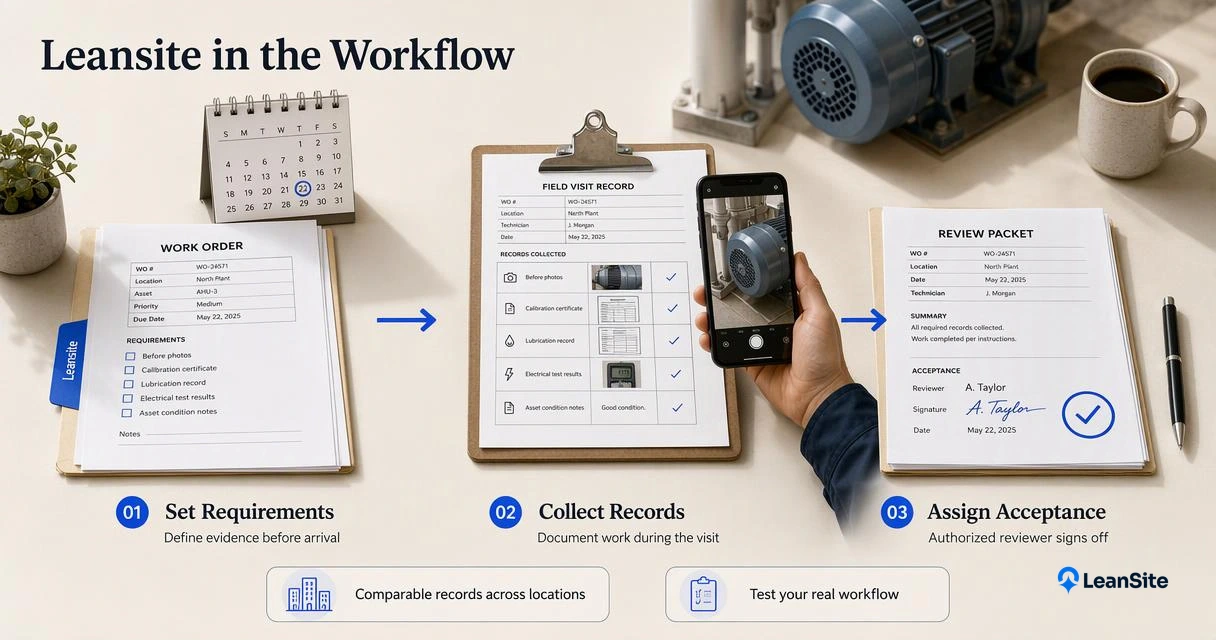
A well-designed process defines evidence requirements during dispatch, collects records during the visit, and assigns acceptance to an authorized reviewer. Vendors benefit from knowing the required packet before arriving; property owners benefit from comparable records across locations.
Evaluate the workflow against a real work order
A product evaluation should demonstrate the team's actual completion and approval process rather than rely on a feature checklist.
- Bring an existing work order and its required evidence fields.
- Ask how asset records, attachments, readings, and signoff can be connected.
- Confirm permissions, record history, exports, retention, and offline requirements.
- Test how accepted work moves into invoice review.
These are evaluation questions, not verified feature claims. Teams considering outsourced coordination can also review managed services to discuss dispatch and review responsibilities. Software buyers can use the maintenance-platform comparison as a separate evaluation resource.
Conclusion
Proof of service for facility maintenance becomes useful when acceptance rules are specific and repeatable. Start with one recurring task, define its required evidence, and trial the completion packet with a vendor before expanding across properties.
For teams considering Leansite, the next step is to visit getleansite.com and bring that sample packet to a workflow discussion covering capture, review, and invoice approval.
Demi Oloyede
Leansite
Frequently Asked Questions
Are before-and-after photos enough to approve a repair?
Before-and-after photos can establish visible changes, but they don't establish every aspect of equipment performance. A cleaned coil or replaced component may look correct while still requiring a functional test. Pair photos with asset identification, task details, and relevant readings when the approved scope includes restoring operation.
Does a customer signature prove that equipment works?
A customer signature proves only the acknowledgment described by the signoff language. A receptionist may confirm attendance without being qualified to assess a technical repair. The form should state whether the signer confirms access, observed task completion, or acceptance against defined criteria, and identify any separate technical reviewer.
How long should maintenance completion records be kept?
Maintenance completion records should be kept according to the applicable contract, warranty, insurance, regulatory, and organizational requirements. No single retention period fits every facility or service. Teams should set a documented schedule with appropriate advisers and ensure records remain retrievable by property, asset, work order, and date.
More from the blog
- maintenance vendor coordination
In House vs Outsourced Facility Maintenance: A 2026 Guide
Compare maintenance staffing models by response coverage, skills, workload, and fully loaded costs, with an illustrative budget and hybrid decision guide.
- maintenance history
Best QR Code Asset Tagging Software: A 2026 Buying Guide
Compare QR asset tagging options by labeling, mobile access, maintenance history, and permissions, then validate the right fit with a small-site pilot.
- commercial property maintenance
Facilio vs MaintainX: A Practical Buyer’s Guide for 2026
Compare Facilio and MaintainX through portfolio oversight, technician workflows, integrations, and implementation. Use a practical demo scorecard.