Maintenance Invoice Discrepancies: A Practical Approval Guide
TL;DR
Approve maintenance charges only after matching the quoted scope, authorized changes, completion evidence, and invoice lines. Separate legitimate extras from duplicate or unsupported charges, document the disputed amount, and follow contract terms when releasing payment.
A completed repair doesn't automatically justify every charge on its invoice. Maintenance invoice discrepancies arise when billing differs from agreed pricing, authorized work, or documented delivery. For facility managers and property owners, a reliable review connects each charge to evidence before approval.
Invoice reconciliation: The process of comparing a vendor invoice with the agreed scope, approved changes, and completion records to confirm what is payable. For maintenance work, the review must account for technician time, materials, callout fees, and site-specific approvals.
Table of Contents
What causes maintenance invoice discrepancies?
Maintenance invoice discrepancies occur when billed amounts, quantities, rates, or services don't match the agreement or supporting records. Common causes include unapproved scope changes, duplicate billing, incorrect labor rates, and missing completion evidence. Some differences reflect legitimate additional work, so a mismatch calls for investigation rather than an automatic rejection.
Common mismatches and the records that resolve them
| Discrepancy | Record to check | Approval test |
|---|---|---|
| Higher labor charge | Rate agreement and technician time log | Do hours and rates match the billing rules? |
| Additional materials | Approved change and installation record | Were the parts authorized and installed? |
| Repeated callout fee | Dispatch history and previous invoices | Was there a separate billable visit? |
| Wrong property or asset | Work order and asset identifier | Does the charge belong to this location? |
| Tax or markup difference | Contract terms and applicable tax rules | Is the calculation supported? |
An emergency repair may justify extra work without proving the invoiced amount. Authorization and price support are separate checks. Conversely, a fixed-price job shouldn't become time-and-materials billing unless the agreement permits that change.
How can teams reconcile invoices before approval?
Teams can reconcile maintenance invoices by matching the agreement, authorized changes, completion records, and billed lines in a consistent sequence:
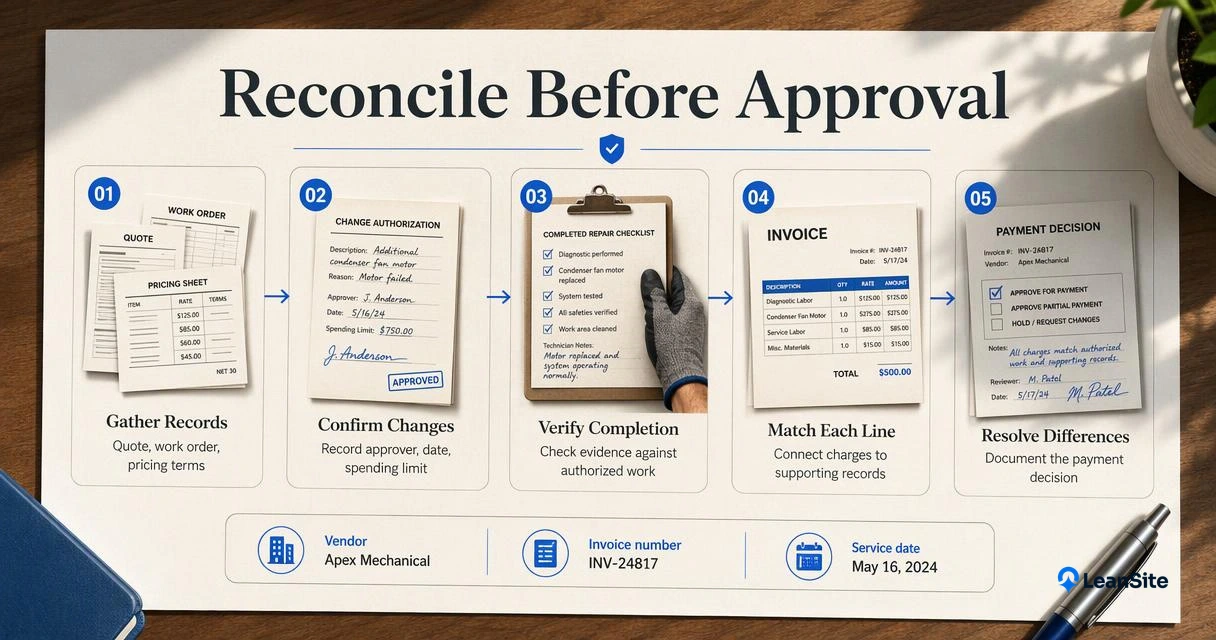
- Gather the quote, work order, and pricing terms.
- Confirm approvals for scope changes.
- Verify completion evidence.
- Match each invoice line to supporting records.
- Resolve differences and record the payment decision.
The pre-approval discrepancy checklist
- Identity: Confirm vendor, invoice number, property, asset, and service date.
- Scope: Separate original work from additional tasks.
- Authority: Record who approved changes, when, and within which spending limit.
- Labor: Check billable hours, minimum charges, overtime, and travel rules.
- Materials: Verify quantities, substitutions, agreed markups, and credits.
- Evidence: Attach service notes, relevant photos, and acceptance records.
- Payment history: Check earlier invoices, deposits, and credit notes.
Reviewers should distinguish an internal approval limit from a contractual billing limit. A vendor's entitlement depends on the agreement and applicable law, not solely on an internal budget.
A service report shows what happened; an approval record shows what was authorized. Invoice review needs both.
For a disputed line, the review record should state the amount, reason, missing evidence, owner, and response deadline. Accounts payable can then track a clear exception instead of an unexplained hold. Payment of undisputed amounts should follow the contract and applicable requirements.
Worked example: approved extras versus unsupported charges
A legitimate extra has both authorization and delivery evidence, while a duplicate or unsupported charge lacks a valid billing basis. The following illustrative HVAC repair shows how those distinctions change the payable amount; the figures are hypothetical, not research benchmarks.
Reconciling a hypothetical $1,100 HVAC invoice
| Invoice line | Amount | Supporting record | Decision |
|---|---|---|---|
| Original repair | $600 | Accepted quote and completion report | Approve |
| Replacement contactor | $180 | Written change approval and installation photo | Approve |
| Additional labor | $120 | Approved extra hour at agreed rate | Approve |
| Second callout fee | $90 | Same visit; original price included callout | Request removal |
| Consumables | $110 | No itemization or agreed allowance supplied | Request evidence |
The supported amount is $900. The remaining $200 needs correction or substantiation. If records later establish that the consumables are contractually billable, that line can move into the approved amount.
The vendor communication should identify each queried line and its supporting requirement. For example: "The $90 callout appears included in the accepted quote; please issue a correction. Please provide the itemization and contractual basis for $110 in consumables."
A corrected invoice or credit note should preserve the original audit trail. Quietly editing the amount inside the payment system leaves the vendor's records and the purchaser's records out of sync.
How Leansite handles this
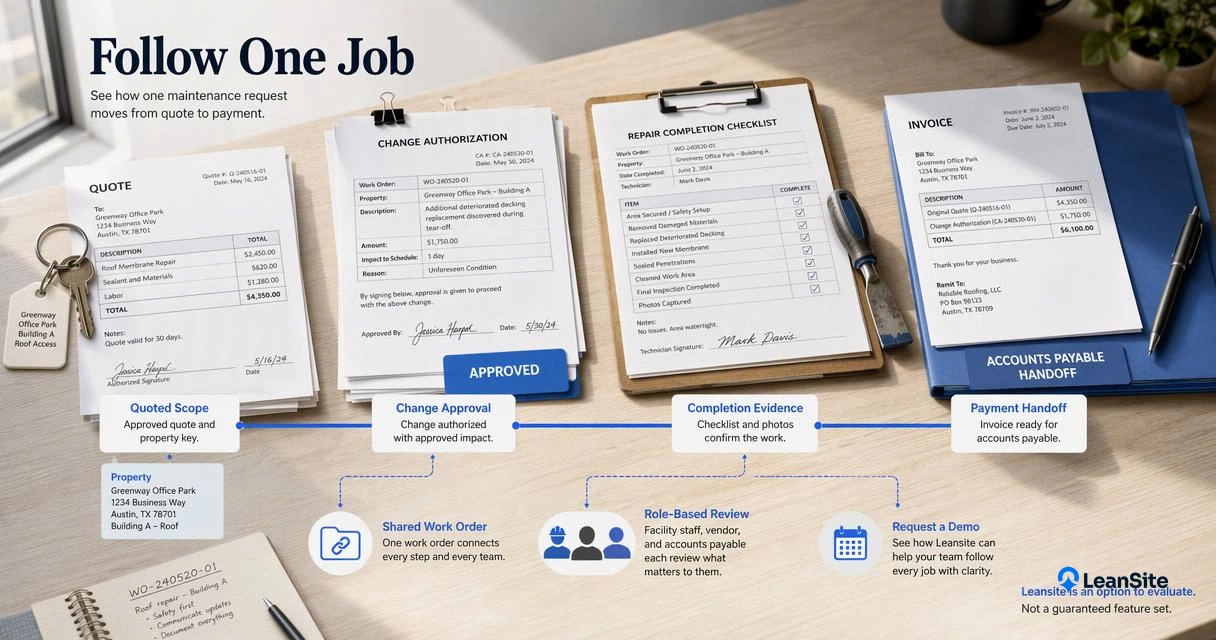
Leansite is a relevant option for facility teams evaluating how maintenance coordination can support invoice review. A useful demonstration should follow one job from its quoted scope through change authorization, completion evidence, and payment handoff, with each record clearly connected to the same property and work order.
A practical software evaluation checklist
A structured workflow gives facilities staff, vendors, and accounts payable a shared basis for approval. Evaluation should focus on the records each role can access and the decisions each role can make.
- Request a demonstration of quote and change-approval handling.
- Check how completion records connect to individual jobs.
- Confirm approval permissions and export options.
- Test the handoff to the existing accounting system.
The facility management solutions guide provides broader selection context. The Leansite and Accruent Maintenance Connection comparison offers a separate starting point for platform evaluation; specific invoice controls should be confirmed directly.
The 2026 automation boundary
Document extraction can help capture invoice fields, but authorization still requires linked business records. The 2025 PaddleOCR 3.0 technical report covers document-processing technology; it isn't evidence that a particular maintenance charge is valid.
The 2021 study on robotic process automation in purchasing and supply management examines automation potential, barriers, and implementation. For current evaluations, the practical test remains whether captured data can be traced to approved work, not simply read from a PDF.
Conclusion
The next step is to standardize one approval pack: quote, changes, completion evidence, invoice, and decision record. For a workflow review with Leansite, facility teams can visit getleansite.com and request a demonstration using a representative maintenance job.
Demi Oloyede
Leansite
Frequently Asked Questions
Should the entire invoice be withheld during a dispute?
The contract and applicable law should guide withholding decisions. A disputed line doesn't automatically justify holding every charge. Teams should identify the undisputed amount, document the disputed balance, and confirm payment obligations with accounts payable or legal counsel. Any partial payment should clearly identify which charges it covers.
Can emergency work be approved after completion?
Emergency work may follow an exception process if the agreement and organizational policy allow it. Reviewers should record the urgency, approving authority, work performed, and pricing basis. Retroactive approval shouldn't be treated as automatic acceptance of every charge; the invoice still needs evidence supporting labor, materials, and fees.
What should a vendor submit with a maintenance invoice?
A useful billing pack includes the work-order reference, property and asset details, service date, itemized charges, relevant approvals, and completion records. Technician notes and photos can support the work performed. Consistent submission requirements help vendors prepare complete invoices and give approvers a repeatable route from service delivery to payment.
More from the blog
- maintenance vendor coordination
In House vs Outsourced Facility Maintenance: A 2026 Guide
Compare maintenance staffing models by response coverage, skills, workload, and fully loaded costs, with an illustrative budget and hybrid decision guide.
- maintenance history
Best QR Code Asset Tagging Software: A 2026 Buying Guide
Compare QR asset tagging options by labeling, mobile access, maintenance history, and permissions, then validate the right fit with a small-site pilot.
- commercial property maintenance
Facilio vs MaintainX: A Practical Buyer’s Guide for 2026
Compare Facilio and MaintainX through portfolio oversight, technician workflows, integrations, and implementation. Use a practical demo scorecard.