Facility Maintenance Software Security Requirements: A Buyer’s Checklist
TL;DR
Require enforceable access controls, strong authentication, encryption, tested recovery, and written incident-response commitments before purchasing maintenance software. Compare supporting evidence, not security slogans, and make approval conditional on a successful permissions test.
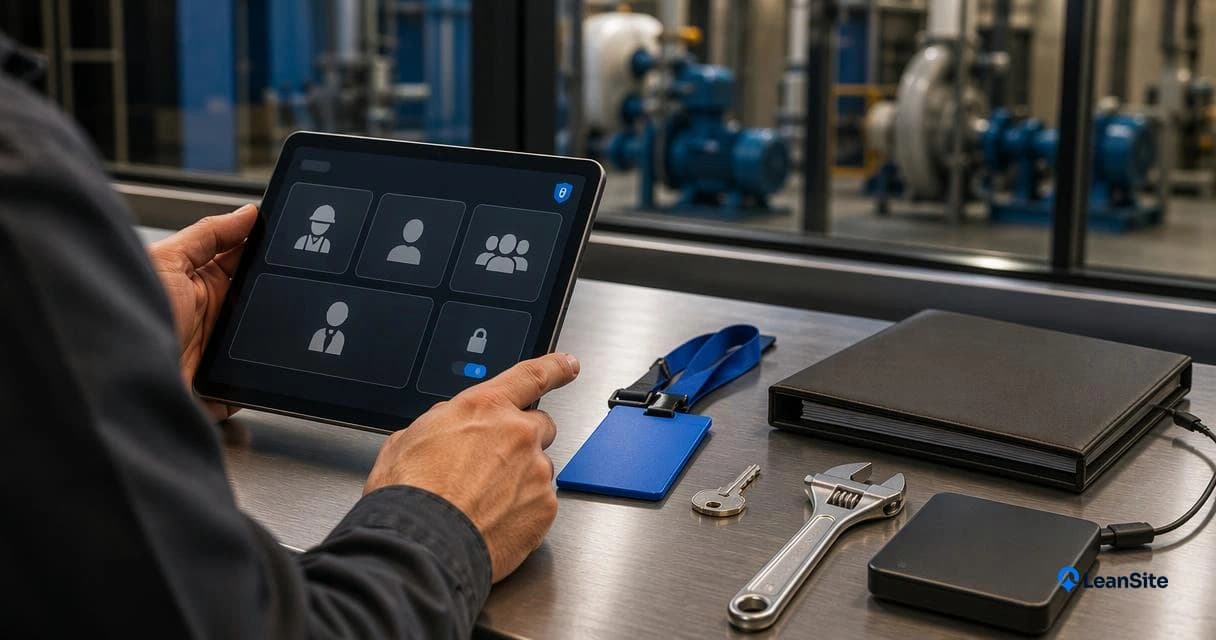
A maintenance work order can contain more than a repair request: site photos, access instructions, equipment details, and contractor information may all sit in the same record. Facility maintenance software security requirements should protect that information while keeping technicians productive.
For facility managers considering Leansite, security belongs alongside workflow fit in the purchasing review. The goal is a documented match between operational needs and verified controls, rather than a checklist of impressive-sounding features.
Computerized maintenance management system (CMMS): Software that maintains a database of an organization's maintenance operations, consistent with the CMMS definition.
Security requirement: A testable condition describing how software must protect information, control access, or support recovery.
Table of Contents
What security requirements should maintenance software meet?
Maintenance software security requirements should cover role-based permissions, strong authentication, encryption, restricted contractor access, audit logs, recovery, and incident response. Each requirement should match the sensitivity of stored information and the operational impact of downtime. Buyers should verify both the feature and the process that keeps it effective.
Define the information and operational boundaries
A portfolio owner may need cost visibility across every property, while an HVAC contractor needs only assigned jobs at approved locations. Permissions should support those differences without exposing unrelated records.
- Access control: Separate administrators, managers, technicians, and contractors; restrict access by property and task.
- Authentication: Require individual accounts and enforceable multifactor authentication, especially for privileged access.
- Encryption: Protect data in transit and at rest, including attachments and backups.
- Account lifecycle: Support prompt access removal when employees leave or contracts end.
Security requirements should also cover mobile devices and integrations. Offline records need a defined retention policy, while API credentials need limited permissions, rotation, and revocation.
The Facility Management Solutions guide provides broader workflow-selection context; security review should remain a separate approval step.
Security questionnaire: Which evidence is acceptable?
Acceptable security evidence explains what a control covers, how it operates, and whether it has been tested. A sales-page badge is a starting point, not a purchasing decision. Request dated documents and demonstrations that apply to the actual service under consideration.
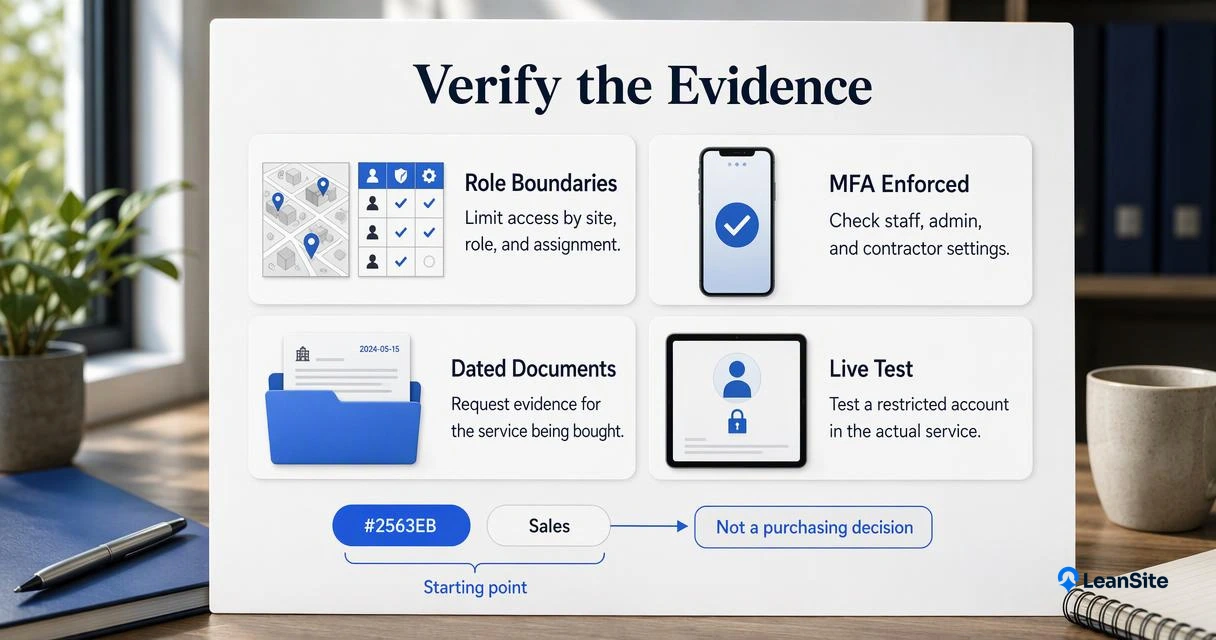
Match each requirement to a document or test
| Requirement | Question for the supplier | Acceptable evidence |
|---|---|---|
| Role-based access | Can access be limited by site, role, and assignment? | Permissions matrix plus a live restricted-account test |
| Authentication | Can MFA be enforced for staff, administrators, and contractors? | Configuration demonstration, including recovery and exceptions |
| Encryption | Are databases, attachments, backups, and connections encrypted? | Architecture summary identifying protocols and key management |
| Vendor access | Can contractor access expire and exclude unrelated sites? | Scoped account demonstration and revocation test |
| Auditability | Which actions are logged, and for how long? | Sample logs, retention policy, and export demonstration |
| Recovery | What recovery targets apply, and have restores been tested? | Written targets and dated restoration-test results |
| Incident response | Who reports incidents, through which channel, and when? | Response plan summary and contractual notification terms |
| Independent assurance | Does the assessment cover this product and hosting environment? | Current certificate or report with scope and exceptions |
A SOC 2 Type II report examines controls over a stated period; it is an assurance report, not a certification. Review its scope, exceptions, and customer responsibilities.
ISO/IEC 27001 concerns an information security management system. A certificate should identify the certified organization and scope; it does not establish that every product feature meets a buyer's requirements.
The evidence rule
A documented control, a scoped independent assessment, and a successful operational test answer different questions. None should automatically substitute for the others.
How should buyers test security before signing?
Buyers should test maintenance software security against realistic staff, contractor, and administrator workflows before signing. A controlled pilot can reveal whether documented permissions work in practice. Procurement should record the results and turn material promises into written acceptance criteria, service commitments, or contract terms.
Run a five-step acceptance pilot
- Classify sample records: Separate routine repair data from access instructions, personal information, and sensitive attachments.
- Create test identities: Use manager, technician, contractor, and administrator accounts across two properties.
- Check boundaries: Attempt permitted and prohibited viewing, editing, downloading, reassignment, and exporting.
- Test departure: Revoke an account and verify session termination, integration access, and handling of downloaded records.
- Review response and recovery: Walk through escalation contacts, notification timing, backup restoration, and responsibilities.
Recovery targets need operational meaning. Recovery time objective (RTO) describes the target time to restore service; recovery point objective (RPO) describes the acceptable data-loss window. Each should reflect how long dispatching can pause and how many updates can be recreated.
The NIST Cybersecurity Framework offers a useful structure for organizing governance, protection, detection, response, and recovery questions.
Keep the completed pilot, evidence register, and approved contract together. Those records give facilities, IT, and procurement a shared reference for implementation and renewal.
Evaluating Leansite for facility operations
Leansite should be evaluated through the same evidence-led process used to approve any maintenance platform. The assessment should connect security requirements to real operating roles, so facility teams can judge workflow fit and access boundaries together.
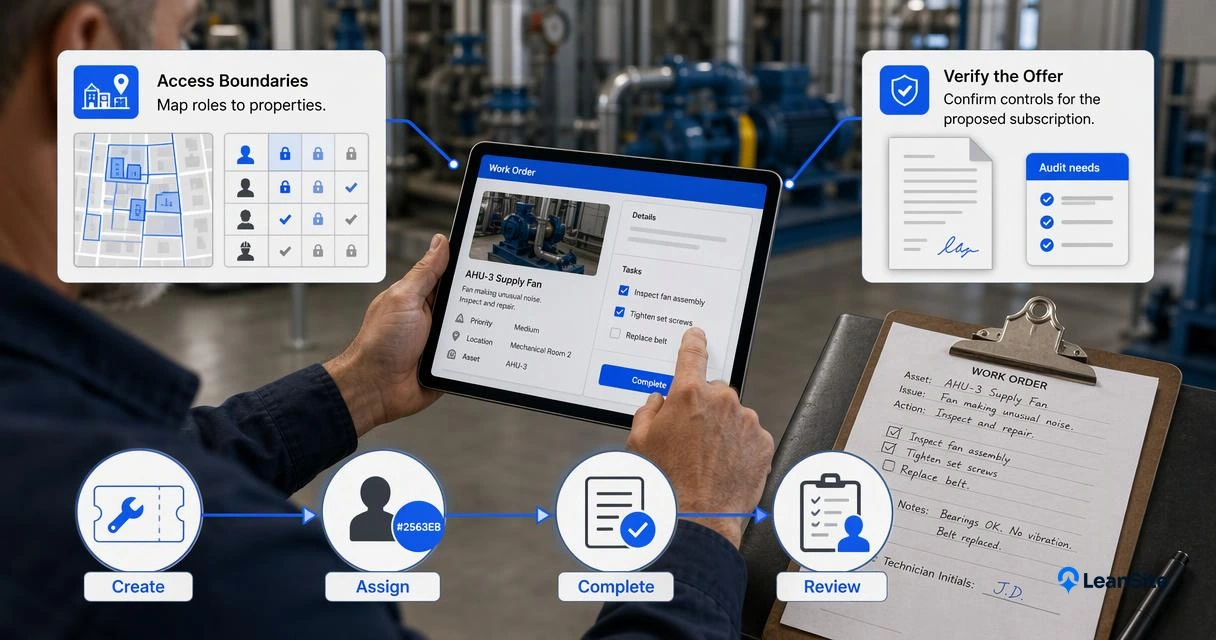
Make the demonstration specific
A useful demonstration follows a work order from creation through assignment, completion, and management review. Buyers should request the relevant documentation and confirm which controls, configurations, and service commitments apply to the proposed subscription.
- Prepare a role-and-property permissions matrix.
- Identify required audit records and exports.
- Assign an owner to each approval question.
A product discussion through getleansite.com can use that package as its agenda. Written answers then become the basis for internal approval and implementation planning.
Conclusion
Turn facility maintenance software security requirements into purchasing gates: name each requirement, request evidence, test the workflow, and document approval. For a Leansite evaluation, bring the completed questionnaire and permissions matrix to a product discussion, then agree on the configuration and written commitments needed before deployment.
Demi Oloyede
Leansite
Frequently Asked Questions
Is SOC 2 certification required for maintenance software?
SOC 2 is an assurance report, not a certification, and it is not universally required for maintenance software. Buyers may require it through procurement policy or contract. The useful review examines the report's scope, assessment period, exceptions, and customer responsibilities, then checks whether those details match the intended deployment.
Should contractors receive the same access as employees?
Contractors should receive access based on assigned responsibilities, not employee-level permissions by default. A vendor may need job details, approved attachments, and completion fields without portfolio costs or unrelated properties. Separate identities, expiry dates, and revocation procedures help facility teams coordinate outside work while keeping access accountable.
Does encryption make a maintenance platform secure?
Encryption protects information in specified storage and transmission conditions, but it does not replace access controls, authentication, logging, or recovery. An authorized account can still access encrypted records through the application. Buyers should assess encryption alongside account permissions, key management, backup protection, and the supplier's operating procedures.
More from the blog
- maintenance vendor coordination
In House vs Outsourced Facility Maintenance: A 2026 Guide
Compare maintenance staffing models by response coverage, skills, workload, and fully loaded costs, with an illustrative budget and hybrid decision guide.
- maintenance history
Best QR Code Asset Tagging Software: A 2026 Buying Guide
Compare QR asset tagging options by labeling, mobile access, maintenance history, and permissions, then validate the right fit with a small-site pilot.
- commercial property maintenance
Facilio vs MaintainX: A Practical Buyer’s Guide for 2026
Compare Facilio and MaintainX through portfolio oversight, technician workflows, integrations, and implementation. Use a practical demo scorecard.