Facility Maintenance Service Contract Scope of Work: A Practical Guide

TL;DR
A maintenance scope should identify covered assets, scheduled tasks, response targets, and proof of completion. Separate routine service from chargeable repairs, require written approval for extra work, and obtain legal review before signing.
"Maintain all building systems" isn't a measurable promise. A facility maintenance service contract scope of work turns that broad expectation into specific duties for a selected contractor. For facility managers and property owners, the goal is simple: make every scheduled visit, repair authorization, and invoice traceable to an agreed obligation.
Scope of work: The part of a service contract that defines what a contractor must deliver, where, when, and how completion will be verified.
For 2026 agreements, that definition should extend to digital records, asset identifiers, and reporting responsibilities. The clauses below are drafting examples, not legal advice.
Table of Contents
What is a maintenance contract scope of work?
A maintenance contract scope of work defines the services a selected contractor must perform for specified facilities and assets. It establishes task boundaries, service frequency, deliverables, and acceptance requirements. Unlike an RFP, it governs delivery after contractor selection rather than asking vendors to propose an approach or price.
Keep service duties separate from commercial terms
The scope describes the work; the wider contract establishes pricing, insurance, liability, termination, and dispute procedures. Cross-references should connect them without creating conflicting instructions.
- Asset schedule: Identifies equipment and locations covered.
- Task schedule: Defines inspections, servicing, and testing.
- Service-level agreement: Sets response and reporting targets.
- Work order: Records an individual assignment under the agreement.
An order-of-precedence clause should explain which document controls when terms conflict.
Related video: defining contractual work boundaries
Construction scope-writing offers useful context for defining deliverables, although recurring maintenance also needs schedules and ongoing reporting.
What should the service scope include?
A service scope should include covered assets, required tasks, frequencies, exclusions, completion evidence, and change authorization. It should also assign responsibility for access, consumables, permits, and subcontractors. Each requirement needs enough detail for a facility manager to determine whether the contractor delivered the agreed service.
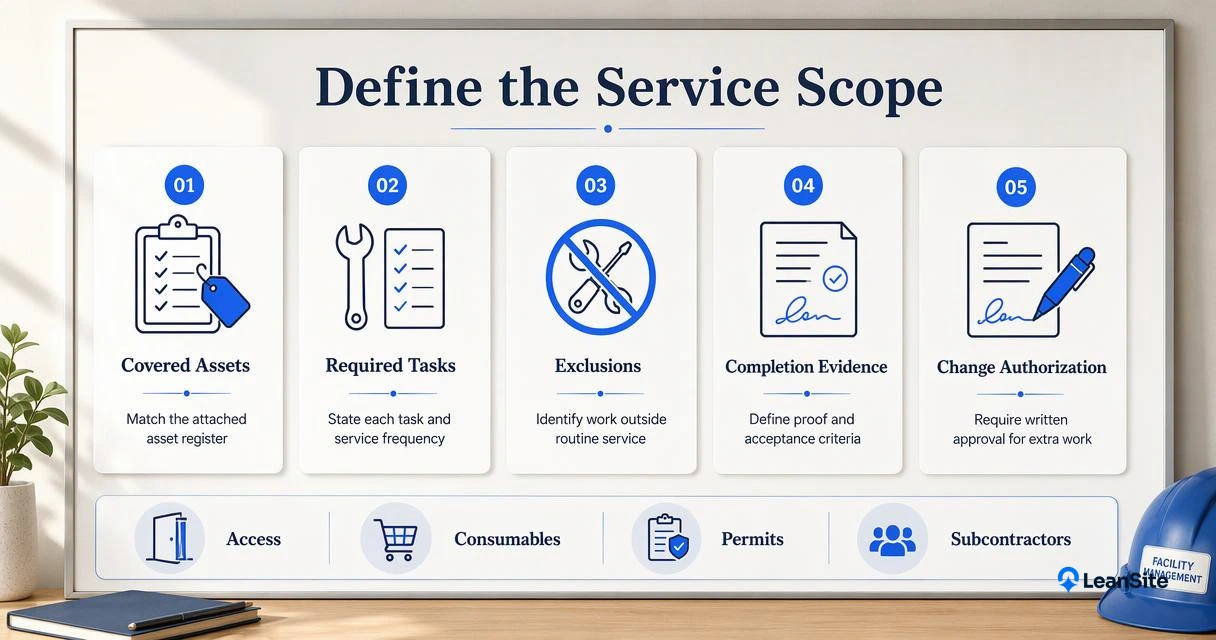
Sample clauses for five essential boundaries
These examples assume a commercial property with an attached asset register. Bracketed details require project-specific decisions before signing.
| Scope element | Sample clause |
|---|---|
| Covered assets | Contractor shall service only assets listed in Schedule A, identified by asset ID, location, manufacturer, and model. Additions require written amendment. |
| Service frequency | Contractor shall complete Schedule B tasks at the stated intervals. Filter inspections occur monthly; replacements follow the specified condition criteria. |
| Exclusions | Capital replacement, tenant-owned equipment, hazardous-material remediation, and concealed-system repairs are excluded unless separately authorized in writing. |
| Acceptance criteria | Completion requires a task checklist, recorded readings against stated limits, required photographs, and facility representative approval. |
| Change authorization | Additional work requires written scope, price, and schedule approval from the named representative before work begins, except under the emergency protocol. |
Define the supporting responsibilities
Specify who supplies filters, parts, lifting equipment, keys, and shutdown access. Name responsibility for permits, waste disposal, licensed trades, and applicable inspection records. State whether corrective repairs are included, separately priced, or subject to a spending allowance.
"Included maintenance" should mean a defined set of tasks, not unlimited repairs.
Legal counsel should review exclusions, approval authority, document precedence, and local requirements before execution.
How should response and acceptance targets be set?
- Classify maintenance requests by operational impact.
- Define acknowledgment, attendance, and restoration separately.
- Assign measurable targets to each priority.
- Specify required completion evidence and approvers.
- Document exceptions, escalation contacts, and reporting deadlines.
This sequence creates service obligations that can be checked without treating every request as an emergency.
Separate arrival from restored operation
A technician arriving on site doesn't mean an asset is working again. Contracts should distinguish acknowledgment time, attendance time, temporary stabilization, and final restoration.
An illustrative critical-service clause might require acknowledgment within 30 minutes and attendance within four hours. Those are drafting examples, not industry benchmarks. Targets must reflect staffing, geography, operating hours, parts availability, and site access.
Make completion auditable
Acceptance should depend on evidence rather than a closed ticket alone. For an air-handling unit, specify the required checklist, operating readings, filter condition, and any unresolved findings.
- Record asset ID, technician, arrival, and completion times.
- Define pass/fail limits using applicable technical requirements.
- Identify who accepts work and within what review period.
- Explain how incomplete work is corrected and resubmitted.
For multi-location portfolios, use one reporting format with site-specific asset and access schedules.
Putting the scope to work with Leansite
The signed scope becomes useful day to day when contract duties are translated into assigned tasks and reviewable records. Each recurring obligation should have an owner, due date, covered asset, and evidence requirement. That structure also gives property owners a clearer basis for reviewing service delivery across locations.
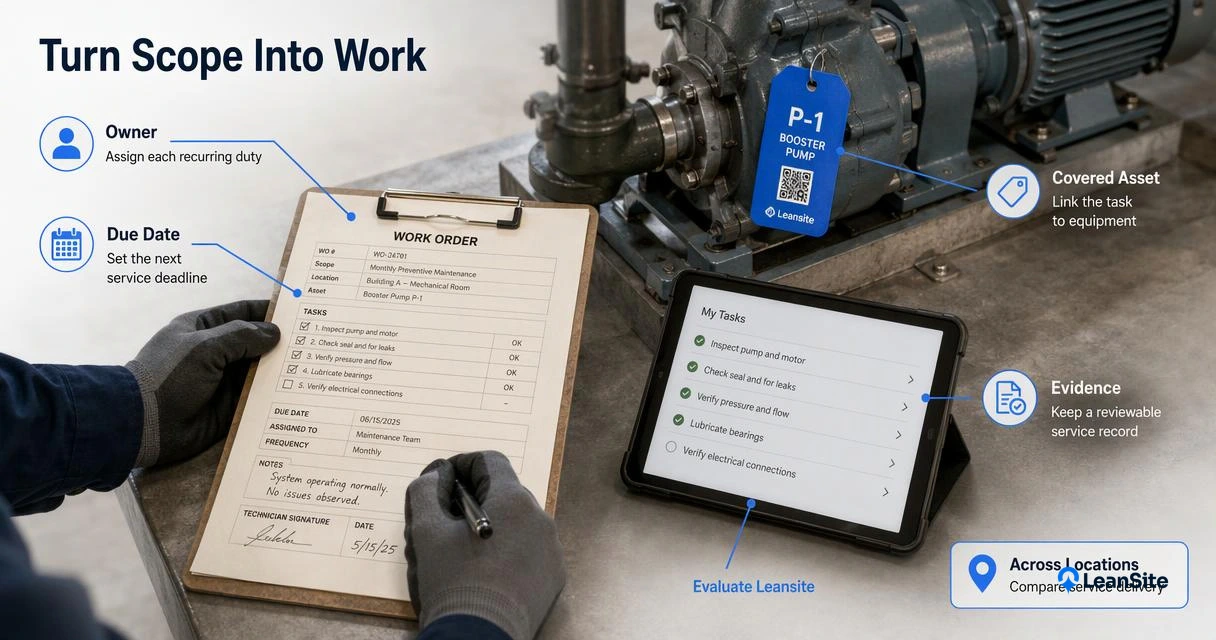
Evaluate the platform against the contract workflow
Leansite is worth evaluating as part of that operating workflow. The broader facility management solutions guide provides context for assessing asset visibility, vendor coordination, and maintenance software.
During a platform review, facility teams should test whether the proposed setup can:
- Connect recurring tasks to the correct asset and location.
- Capture the evidence required for acceptance.
- Route additional-work requests to authorized approvers.
- Separate completed, accepted, and invoiced work.
A Leansite evaluation at getleansite.com should use one representative contract schedule and a completed service record. A practical demonstration provides a stronger fit check than a general feature discussion.
Conclusion
Before signing a facility maintenance service contract scope of work, finalize the asset register, task schedule, exclusions, acceptance evidence, and approval limits. Obtain legal review, then test one service record against those requirements. For teams ready to connect contract duties with daily operations, Leansite is a practical next evaluation.
Demi Oloyede
Leansite
Frequently Asked Questions
Does preventive maintenance include repairs?
Preventive maintenance doesn't automatically include corrective repairs. The agreement should state whether adjustments, minor parts, labor, and consumables are included. Larger repairs can require a separate quote or approved allowance. A task list is more reliable than labels such as "full service," which can leave pricing boundaries unclear.
How should emergency work be authorized?
Emergency work should follow a written protocol naming authorized contacts, spending limits, notification deadlines, and documentation requirements. The clause should distinguish immediate protective action from permanent repairs. Counsel should review the wording so urgent action, approval authority, and financial responsibility remain clear under the applicable contract.
Can one scope cover several properties?
One master scope can cover several properties when common obligations are paired with site-specific schedules. Each schedule should identify assets, access rules, operating hours, service frequencies, and local requirements. Reporting can remain consistent across the portfolio, while attendance commitments reflect each site's location and available contractor coverage.
More from the blog
- maintenance vendor coordination
In House vs Outsourced Facility Maintenance: A 2026 Guide
Compare maintenance staffing models by response coverage, skills, workload, and fully loaded costs, with an illustrative budget and hybrid decision guide.
- maintenance history
Best QR Code Asset Tagging Software: A 2026 Buying Guide
Compare QR asset tagging options by labeling, mobile access, maintenance history, and permissions, then validate the right fit with a small-site pilot.
- commercial property maintenance
Facilio vs MaintainX: A Practical Buyer’s Guide for 2026
Compare Facilio and MaintainX through portfolio oversight, technician workflows, integrations, and implementation. Use a practical demo scorecard.