Commercial Equipment Warranty Tracking Software: 2026 Buying Guide

TL;DR
Choose warranty tracking software that connects coverage terms to service requests before dispatch, not just expiration reminders. Test exclusions, approved contractors, and claim evidence with real equipment records before selecting a platform.
Commercial equipment warranty tracking software should help determine who pays before a contractor starts work. For facility managers, the buying test isn't whether a dashboard displays expiration dates. The test is whether coverage information reaches the person approving the repair.
Warranty tracking software: A system that organizes equipment warranty terms, coverage periods, supporting documents, and claim records so teams can assess service eligibility.
In 2026, the strongest buying approach starts with a real maintenance request and follows it through authorization, dispatch, evidence collection, and invoice review.
Table of Contents
What should equipment warranty software track?
Equipment warranty software should track coverage dates, covered components, exclusions, approved service providers, claim evidence, and pre-dispatch checks. These records should connect to individual assets and service requests. Buyers should require a demonstration of each capability rather than assume that a warranty field or document attachment supports the complete process.
Requirements that connect coverage to repair decisions
| Requirement | Information to capture | Demonstration test |
|---|---|---|
| Coverage dates | Purchase, installation, registration, and expiration dates | Show which date starts each coverage period |
| Coverage scope | Parts, labor, travel, and component-specific terms | Distinguish compressor coverage from general equipment coverage |
| Exclusions | Wear items, misuse, maintenance conditions, and other stated limits | Surface relevant exclusions during request review |
| Approved providers | Authorized contractors and approval contacts | Identify the required provider before dispatch |
| Claim evidence | Serial number, invoice, photos, service history, and diagnosis | Assemble a claim packet from the asset record |
| Pre-dispatch check | Coverage decision, reviewer, and authorization | Record why warranty service or paid repair was selected |
Treat these as purchasing requirements, not verified features of any named vendor. A manufacturer warranty, installer warranty, and service contract may have different obligations even when they cover the same asset.
For teams connecting records to maintenance execution, these work-order visibility features provide useful evaluation context.
Which software approach fits the operation?
The best software approach depends on whether the operation mainly needs document storage, maintenance coordination, or high-volume claim administration. Start with the decision that staff must make, then select the system category. A longer feature list doesn't necessarily produce a better contractor authorization workflow.
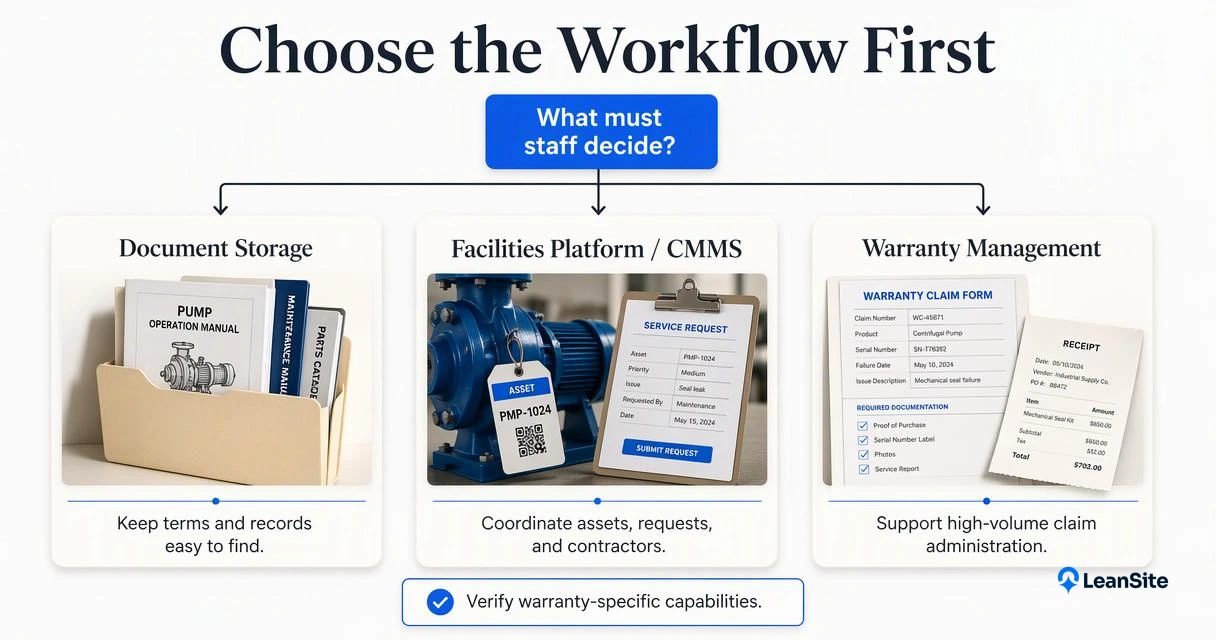
Three approaches worth shortlisting
- Facilities platform or CMMS: Best suited to teams that want equipment records, service requests, and contractor decisions in one operating workflow. Confirm warranty-specific capabilities separately.
- Dedicated warranty management system: Worth evaluating when claim submission, entitlement review, and reimbursement are the main workload. Confirm connections to maintenance dispatch.
- Asset register with document storage: A practical starting point for a smaller inventory with straightforward coverage. Confirm that staff can retrieve the right terms during repair approval.
Multi-location teams should test permissions, shared contractor records, and site-level reporting alongside warranty functions. The multi-location facilities management guide explains the broader operating scope, while this multi-site software buying guide supports shortlist planning.
A warranty reminder answers when coverage ends. A pre-dispatch check helps answer whether a particular repair should follow the warranty process.
How should teams check coverage before dispatch?
- Identify the equipment and serial number.
- Retrieve the applicable warranty and service terms.
- Compare the reported fault with coverage and exclusions.
- Confirm the authorized provider and approval requirements.
- Preserve diagnostic and maintenance evidence.
- Record the decision before dispatch, with an emergency exception path for urgent work.
A rooftop HVAC example for the demo
Consider a rooftop HVAC unit with separate parts and labor coverage. An expiration date alone cannot determine whether a compressor repair qualifies, whether labor is included, or whether an authorized contractor must diagnose the fault.
During the demonstration, the reviewer should open a service request, inspect the component terms, identify the provider, and attach the approval record. The closing invoice should distinguish covered charges from owner-paid charges.
Use a small pilot with clearly defined outcomes:
- Decision completeness: Was the coverage review documented?
- Dispatch accuracy: Did the selected contractor meet the stated terms?
- Evidence readiness: Were required documents available for submission?
- Financial resolution: Was the claim approved, denied, or still pending?
These are proposed measures, not industry benchmarks. An urgent safety or uptime issue may require immediate action; the system should preserve the exception reason rather than obscure it.
How Leansite handles this
Leansite belongs in the evaluation when warranty decisions need to sit within broader facilities-management work. Its relevant buying frame is the connection between maintenance activity and operational visibility. The warranty requirements above should guide a live demonstration, with each behavior confirmed against the proposed configuration.
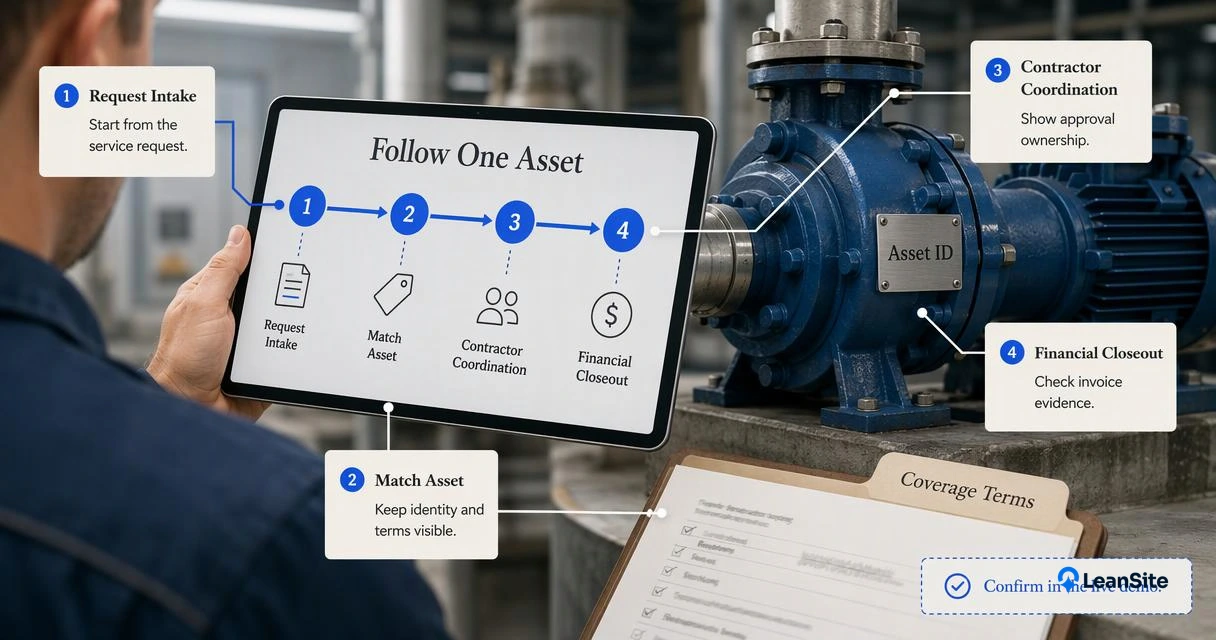
A facilities-focused demonstration brief
The demonstration should follow one commercial asset from request intake through contractor coordination and financial closeout. Asset identity, attached terms, approval ownership, and invoice evidence should remain easy to follow throughout.
A useful brief includes:
- One asset with separate component coverage periods.
- One repair requiring an approved service provider.
- One completed job with evidence and a recorded payment decision.
The overview of Vera, the facilities AI assistant, provides context for questions about information retrieval and assisted workflows.
The 2027 evaluation priority: traceable assistance
Future evaluations should favor AI assistance that points back to source documents rather than treating generated summaries as coverage decisions. The 2022 building automation and management AI survey and 2022 Internet of Things research roadmap provide broader technology background, not evidence of any vendor's warranty capabilities.
Require the underlying clause, document version, and human approval whenever automation influences repair authorization.
Conclusion
Commercial equipment warranty tracking software earns its place when coverage records inform service decisions. Facilities leaders can bring three representative assets and their warranty documents to a Leansite demonstration. Visit getleansite.com to arrange a workflow review focused on pre-dispatch checks, contractor authorization, and claim evidence.
Demi Oloyede
Leansite
Frequently Asked Questions
Can a spreadsheet handle commercial equipment warranties?
A spreadsheet can store dates, serial numbers, contacts, and links to warranty documents for a small inventory. The practical test is whether staff can keep it current and consult it before authorizing repairs. As sites, contractors, and claims increase, buyers should evaluate shared records, approval history, and connections to service requests.
Does active coverage guarantee a free repair?
Active coverage does not establish that every repair is covered. The applicable terms determine component eligibility, exclusions, labor treatment, authorization requirements, and evidence obligations. Teams should check the reported fault against those terms and obtain any required approval. Software can organize that review, but the warranty provider determines claim acceptance.
What should a warranty software pilot include?
A pilot should include real assets with different coverage terms and several repair scenarios. Test an eligible fault, an excluded item, and an urgent dispatch exception. Follow each case through approval, provider selection, evidence collection, and invoice review. Record which steps are native, configured, integrated, or manual before agreeing on scope.
More from the blog
- parts reservations
Best Spare Parts Inventory Software for Facilities in 2026
Compare facilities inventory options by storeroom workflow, equipment links, reservations, purchasing, and stock sharing across buildings.
- facilities software comparison
CAFM vs IWMS: Scope, Integrations, and Selection Guide
Compare CAFM and IWMS across maintenance, space, leases, capital planning, and integrations, with a practical decision guide for facilities teams.
- vendor dispatch
Maintenance Automation: A Practical Guide for Facilities in 2026
Learn how to automate maintenance scheduling, vendor dispatch, and approvals, with practical rollout steps and metrics for multi-site facilities.