Centralized vs Decentralized Facilities Management: A 2026 Guide
TL;DR
Centralized management suits portfolios that need consistent standards and purchasing control; decentralized management gives sites more authority over local service. A hybrid model can combine both. Define budget, dispatch, vendor, and exception authority before choosing software.
A shared maintenance dashboard doesn't mean a shared chain of command. Centralized vs decentralized facilities management comes down to who can spend money, assign work, choose vendors, and approve exceptions.
Facilities management governance: The rules that assign authority and accountability for maintenance decisions across a property portfolio.
For facility managers and property owners evaluating Leansite, those rules provide a useful starting point. In 2026, the goal is to match decision authority to operating needs, then select software that supports that arrangement.
Table of Contents
What is centralized vs decentralized facilities management?
Centralized vs decentralized facilities management describes where decision-making authority sits. Centralized management places major maintenance decisions with a corporate or regional team. Decentralized management delegates those decisions to individual properties. A hybrid model keeps selected controls at portfolio level while allowing local teams to manage defined operational tasks.
Three governance models, defined
Centralized management: A central facilities function controls standards, spending rules, vendor agreements, and work priorities.
Decentralized management: Site leaders control maintenance decisions within their assigned responsibilities and budgets.
Hybrid management: Central and local teams divide authority through explicit approval limits and escalation rules.
Who controls the four core decisions?
| Decision | Centralized | Decentralized | Hybrid |
|---|---|---|---|
| Budgets | Central team allocates and approves spending | Sites manage allocated budgets | Central sets budgets; sites authorize defined purchases |
| Work assignment | Central dispatch assigns resources | Site leaders assign technicians or vendors | Sites dispatch routine work; central coordinates specialist jobs |
| Vendor selection | Portfolio team selects providers | Sites select local providers | Central approves a pool; sites choose within it |
| Exceptions | Central approver grants deviations | Site leadership approves within delegated authority | Exceptions escalate according to cost and risk |
These are practical configurations, not universal rules. An organization can centralize procurement while leaving dispatch local. The multi-location facilities software guide provides related reading for translating those responsibilities into workflows.
Which model fits the portfolio?
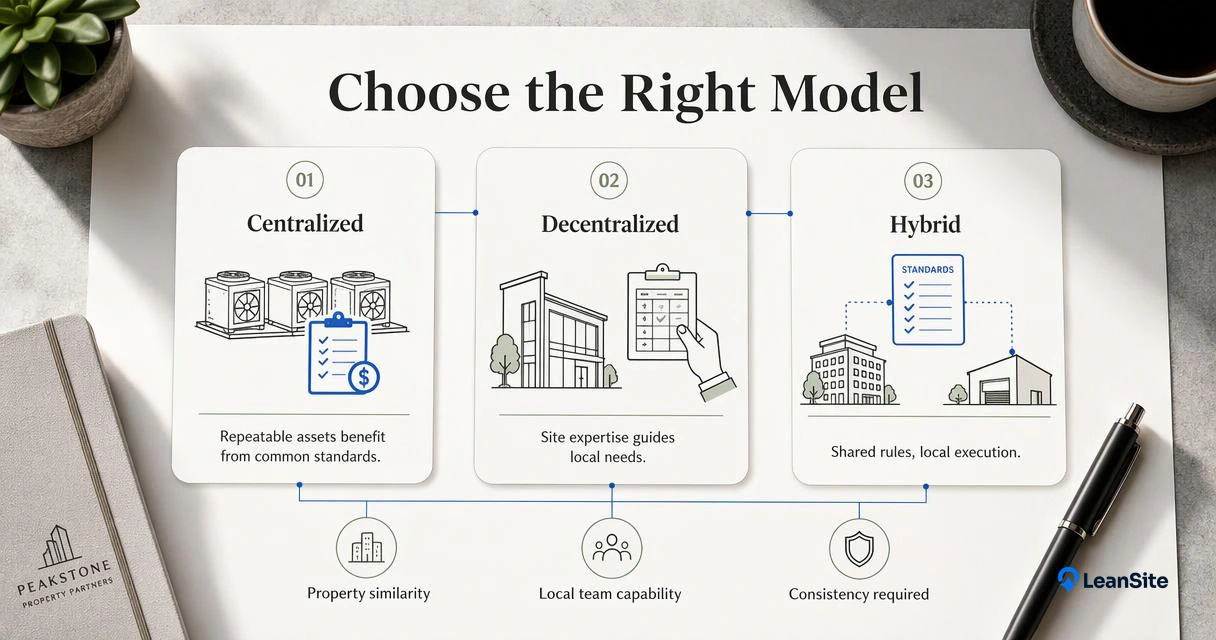
The best model depends on how similar the properties are, how capable local teams are, and which decisions require portfolio-wide consistency. Central control suits repeatable operations; local authority suits site-specific needs. Hybrid governance suits portfolios where common standards and local execution both matter.
Decision matrix for facilities leaders
| Portfolio condition | Model to consider | Reason |
|---|---|---|
| Similar equipment and service needs | Centralized | Common purchasing and maintenance standards fit repeated assets |
| Properties with different uses or requirements | Decentralized or hybrid | Local expertise can guide scheduling and service choices |
| Strong site managers with budget responsibility | Decentralized | Authority can sit close to accountable operators |
| National brand with consistent operating standards | Centralized or hybrid | Portfolio rules can guide site execution |
| Local emergencies plus shared financial oversight | Hybrid | Immediate action can coexist with central review |
Who should pick which?
- Centralized: Leaders prioritizing common contracts, comparable reporting, and coordinated specialist resources.
- Decentralized: Owners prioritizing local judgment, with trained managers and clear accountability.
- Hybrid: Multi-location operators needing shared financial controls and site-level scheduling.
Centralization can create approval bottlenecks. Decentralization can produce inconsistent records and purchasing. Neither outcome is inevitable; approval coverage and reporting standards matter more than the label.
Centralized information and decentralized authority can coexist. A shared record doesn't require every decision to move upstairs.
How can a hybrid facilities model work?
- Define which hybrid facilities decisions stay central.
- Assign routine dispatch and scheduling to sites.
- Set spending limits by job type and risk.
- Establish emergency authority and documentation rules.
- Review exceptions and results through a shared reporting process.
Illustrative restaurant portfolio workflow
Consider a hypothetical 20-location restaurant group. Headquarters owns asset standards, preventive maintenance templates, and vendor qualification. Restaurant managers report faults, arrange access, and schedule routine visits with approved providers.
A refrigeration failure follows a separate emergency path. The site manager can contact an approved specialist immediately, while replacement equipment requires central capital approval. The number of locations illustrates the workflow, not a research benchmark.
The restaurant-chain facilities guide offers a relevant follow-up for this operating context.
Make handoffs measurable
Each work order should identify the requester, dispatcher, spending approver, completion verifier, and invoice reviewer. Those roles can belong to different people without making ownership unclear.
- Track request-to-assignment time separately from repair time.
- Record emergency overrides and their reasons.
- Compare repeat repairs by asset and location.
- Review invoices against authorization and completion records.
For another site-based example, the campus work-order comparison explores the same governance question in a different setting.
How Leansite handles this
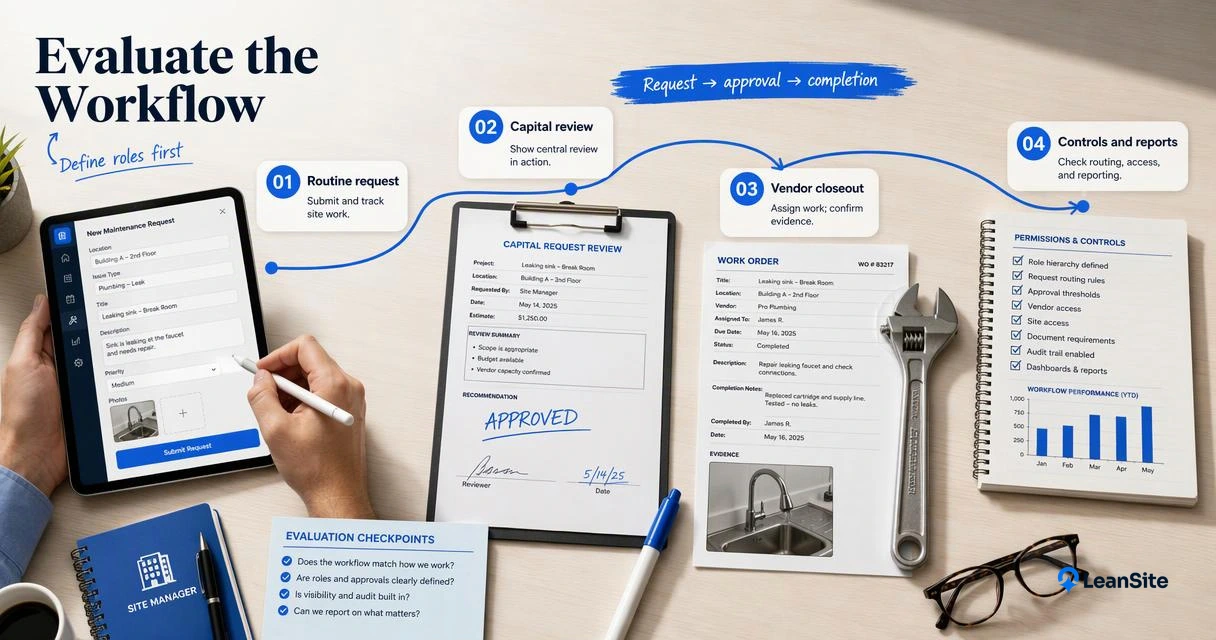
Leansite belongs in the software evaluation after the organization defines its central and local responsibilities. The useful evaluation question is how the proposed setup supports those responsibilities, not whether a dashboard appears centralized. A demonstration should follow actual maintenance scenarios from request through approval and completion.
Test governance through a complete workflow
- Show a site manager submitting and tracking routine work.
- Demonstrate central review of a capital request.
- Walk through vendor assignment and completion evidence.
- Confirm permissions, approval routing, and portfolio reporting during evaluation.
These are acceptance criteria, not claims that every configuration provides every capability. The facility management solutions guide helps frame that assessment.
Keep automation within delegated authority
AI-assisted workflows should follow the same spending and escalation rules as human dispatchers. Research such as the 2022 paper Tackling Climate Change with Machine Learning concerns a broader technology field; it isn't evidence that either facilities governance model performs better.
Evaluate automation against a defined workflow and measurable outcomes, rather than treating AI as a reason to reorganize.
Conclusion
Choosing centralized vs decentralized facilities management starts with four decisions: budgets, dispatch, vendors, and exceptions. Facilities leaders should document those owners, pilot the rules across representative sites, and review the results before expanding. To assess the Leansite platform against that operating model, visit getleansite.com and request a walkthrough using one routine repair and one emergency scenario.
Demi Oloyede
Leansite
Frequently Asked Questions
Does centralized management mean outsourcing maintenance?
Centralized management doesn't mean outsourcing maintenance. Centralization describes decision authority; outsourcing describes who performs the work. A central facilities department can employ technicians, contract vendors, or combine both. Likewise, decentralized sites can use employees or contractors while retaining local control over scheduling and spending.
Can decentralized teams share one software platform?
Decentralized teams can share one platform while retaining local authority. Common asset records, ticket categories, and reporting definitions can support portfolio visibility without transferring every decision to headquarters. The operating model should specify which records everyone shares and which actions each site can approve independently.
Which model reduces maintenance costs?
Neither model guarantees lower maintenance costs. Central purchasing may improve consistency, while local decisions may better reflect site conditions. A fair comparison tracks spending alongside downtime, repeat repairs, approval delays, and service quality. Leaders should evaluate a defined pilot rather than assume organizational structure alone determines savings.
More from the blog
- maintenance vendor coordination
In House vs Outsourced Facility Maintenance: A 2026 Guide
Compare maintenance staffing models by response coverage, skills, workload, and fully loaded costs, with an illustrative budget and hybrid decision guide.
- maintenance history
Best QR Code Asset Tagging Software: A 2026 Buying Guide
Compare QR asset tagging options by labeling, mobile access, maintenance history, and permissions, then validate the right fit with a small-site pilot.
- commercial property maintenance
Facilio vs MaintainX: A Practical Buyer’s Guide for 2026
Compare Facilio and MaintainX through portfolio oversight, technician workflows, integrations, and implementation. Use a practical demo scorecard.