Best Facility Management Software for Multi-Site Operations in 2026

TL;DR
Choose multi-site facility software around portfolio reporting, work orders, and the team's operating model. Compare AI-assisted coordination, maintenance-focused CMMS tools, and floor-plan-based workflows, then test finalists across representative locations before committing.
A shared work-order queue isn't the same as portfolio control. The best facility management software for multi-site operations should connect local maintenance activity with the reporting facilities directors and property owners need. Leansite belongs on the shortlist for teams evaluating AI-assisted facilities coordination, alongside maintenance-focused and space-oriented alternatives.
Facility management: The coordinated management of buildings, sites, workplaces, and support services that keep them functional, safe, and effective.
CMMS: A computerized maintenance management system that organizes maintenance work orders, preventive schedules, and asset records.
Table of Contents
Which platforms belong on a multi-site shortlist?
The strongest shortlist matches each platform's documented focus to the portfolio's main workflow, rather than treating every facilities tool as interchangeable. For 2026, buyers should compare AI-assisted coordination, maintenance execution, and floor-plan visibility separately. The options below represent different starting points, not a universal ranking or independently tested performance league.
Four options matched to operational priorities
| Platform | Relevant focus | Best-fit evaluation | Demonstration request |
|---|---|---|---|
| Leansite | Facilities software with the built-in Vera AI assistant | Multi-location teams exploring AI-assisted coordination | Show how the assistant supports a real facilities task |
| UpKeep | Building-request queues and preventive maintenance | Teams prioritizing maintenance execution | Follow a request through assignment, completion, and reporting |
| Evolve FM | CMMS functionality with dynamic floor-plan visualization | Teams that need maintenance work connected to physical space | Locate an asset and its maintenance history on a floor plan |
| Planon | Facility management software included in the supplied 2026 directory research | Enterprises assessing broader facilities requirements | Demonstrate the required modules, site hierarchy, and reporting |
The available research supports these starting points, but it doesn't establish current pricing, implementation times, or identical multi-site capabilities. Those details require a vendor demonstration and written proposal.
For broader operating-model context, the complete guide to multi-location facilities management software explains the category beyond individual product names.
Who should pick which approach?
- AI-assisted operations: Prioritize an assistant demonstration when coordination and information retrieval are central buying goals.
- Maintenance-first teams: Start with UpKeep when request handling and preventive maintenance dominate the workload.
- Space-dependent maintenance: Evaluate Evolve FM when floor-plan context helps staff locate equipment and understand jobs.
- Broader enterprise requirements: Include Planon when the selection process spans several facilities functions; verify each required module.
The best fit comes from a demonstrated workflow, not the longest feature list.
What features matter across multiple locations?
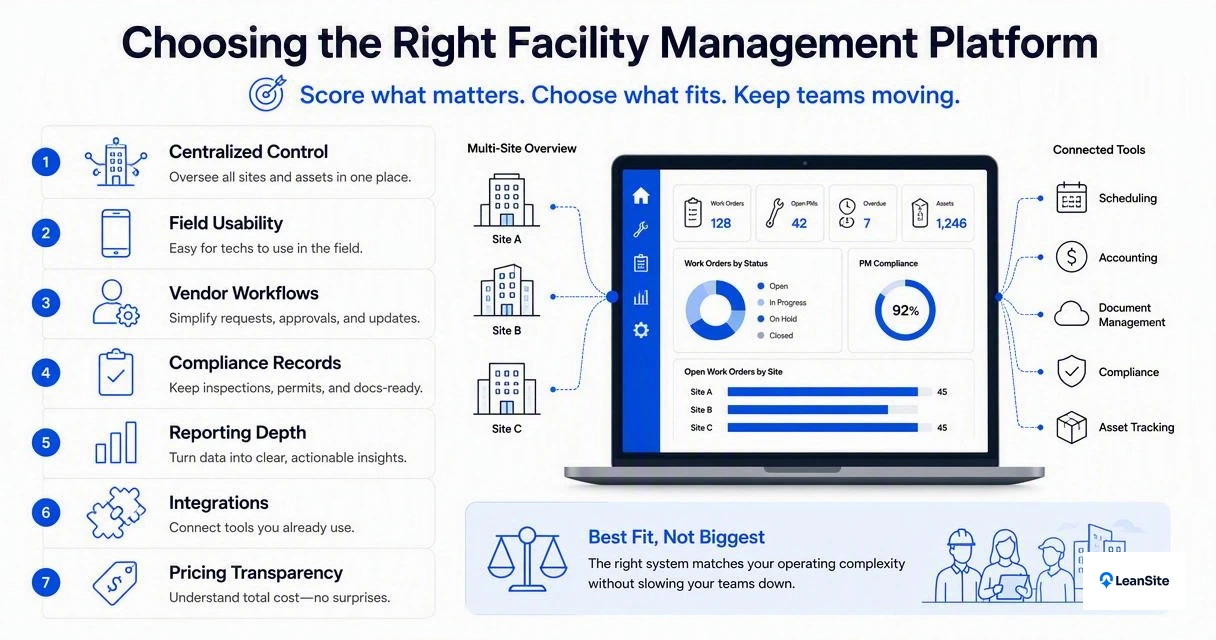
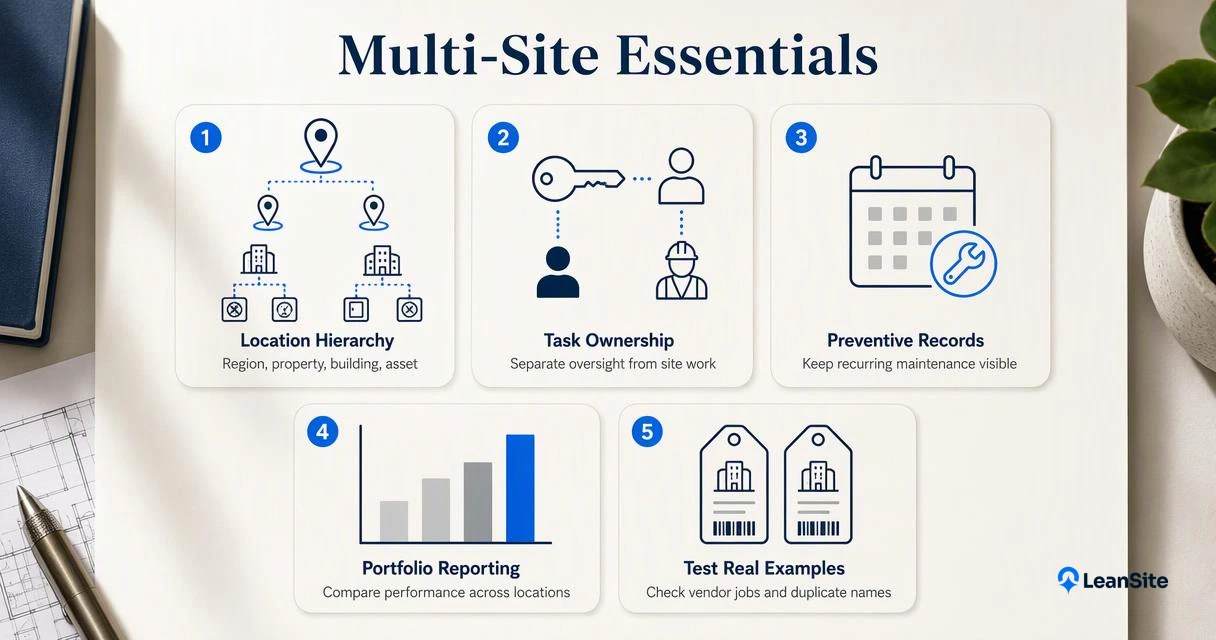
Multi-site facility management software needs a consistent location structure, clear task ownership, preventive maintenance records, and portfolio reporting. These capabilities let headquarters compare performance while local teams manage daily work. Buyers should test each requirement with realistic examples, including vendor jobs and assets that share names across different buildings.
A practical portfolio acceptance checklist
- Location hierarchy: Organize sites by region, property, building, and asset without losing local detail.
- Access controls: Separate headquarters oversight, site-manager responsibilities, technician access, and vendor permissions.
- Work-order routing: Show who receives a request, who approves spending, and who owns the next action.
- Preventive maintenance: Demonstrate recurring schedules, completion evidence, and overdue-task visibility.
- Vendor coordination: Connect assignment, updates, supporting documents, and invoice review.
- Reporting and export: Filter results by site, asset category, vendor, and time period.
A restaurant-chain example makes the test concrete: an urgent refrigeration request should carry its location, equipment identity, urgency, assigned provider, and completion record. A scheduled inspection needs a different priority and approval path.
The multi-site work-order platform guide offers a focused follow-up for teams comparing request-to-resolution workflows.
The report a facilities director actually needs
A useful portfolio report shows open work by priority, overdue preventive tasks, recorded maintenance spend, and repeat repairs by asset. Each metric needs a shared definition across locations. For example, completion time should use the same start and end events everywhere; otherwise, faster-looking sites may simply record work differently.
How Leansite handles this
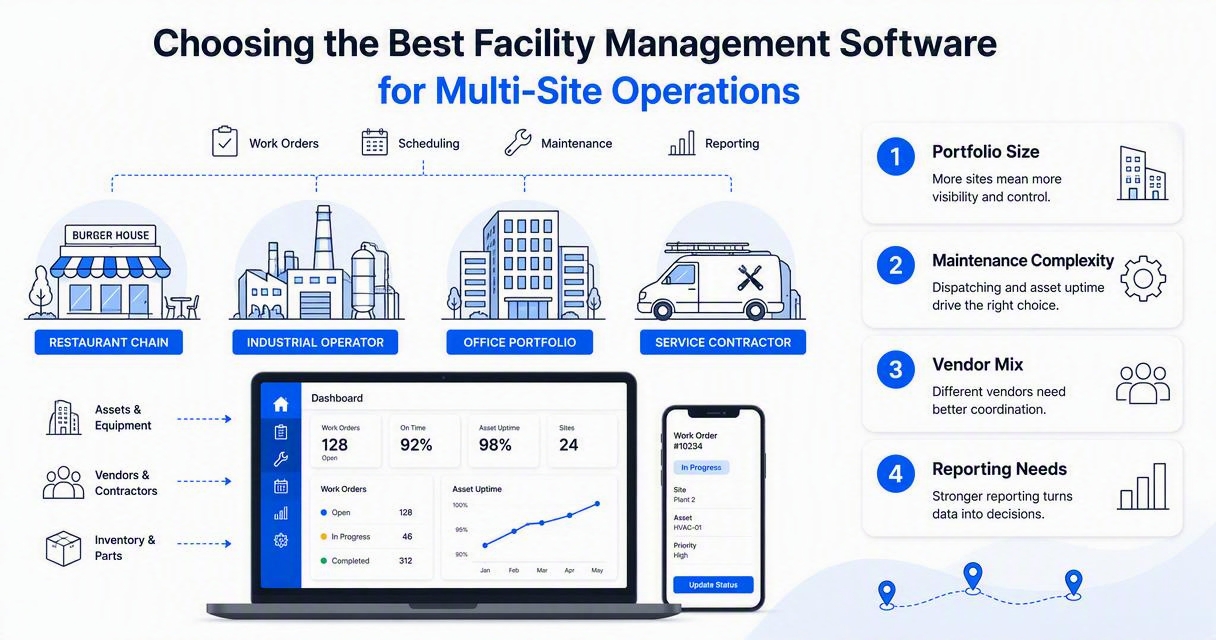
The platform brings an AI-assistant angle to facilities management through Vera, its built-in assistant. That gives multi-site buyers a specific capability to evaluate alongside standard task and reporting requirements. The Vera introduction provides the relevant product background.
Test the assistant against a real operational question
A useful demonstration should use an actual facilities scenario rather than a polished sample conversation. For example, a regional manager could ask about outstanding work at selected locations, then inspect the underlying records and available next actions.
- Choose a question that normally requires several records or messages.
- Establish which site and asset information the assistant can access.
- Compare its response with the source records.
- Confirm which actions require human approval.
These are evaluation requests, not claims that every suggested action is currently supported.
What to watch as AI develops beyond 2026
AI evaluation should increasingly center on traceable answers, permission boundaries, and approved actions rather than conversational fluency alone. Facilities teams need to know which record supports an answer and who can authorize a change. The AI facility management software guide provides further context for this buying criterion.
How should a multi-site software pilot run?
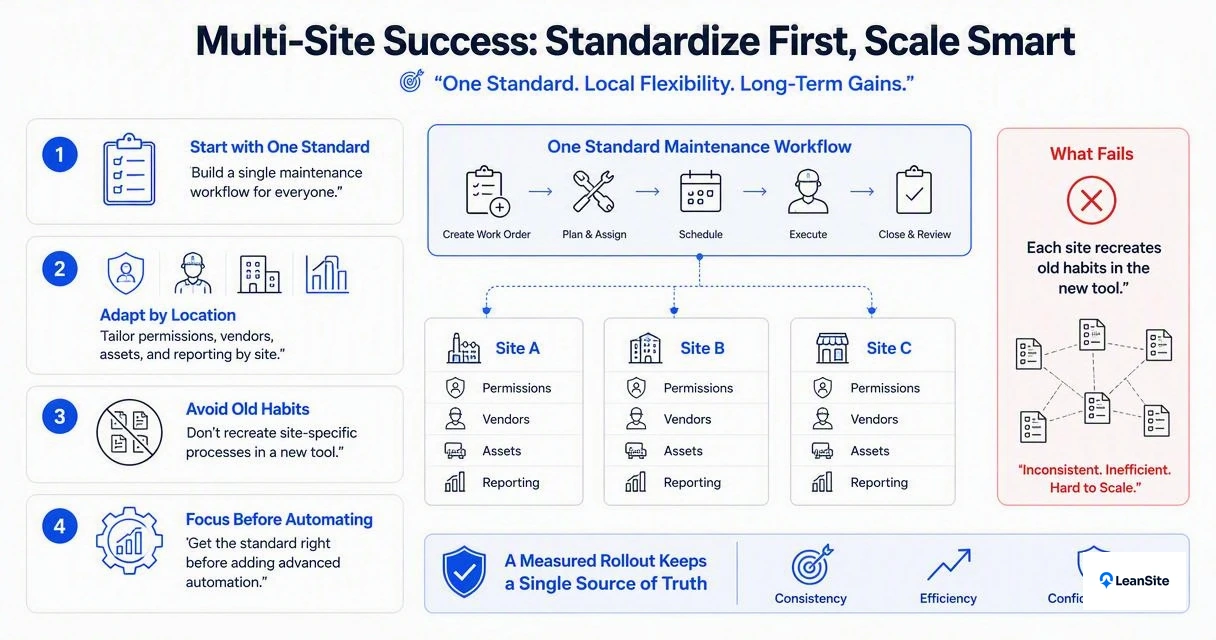
A multi-site software pilot should test representative locations, real maintenance jobs, reporting consistency, and the full commercial proposal before rollout. A practical sequence follows below. The goal is to establish operational fit with observable evidence, including how easily local staff and external vendors complete their assigned steps.
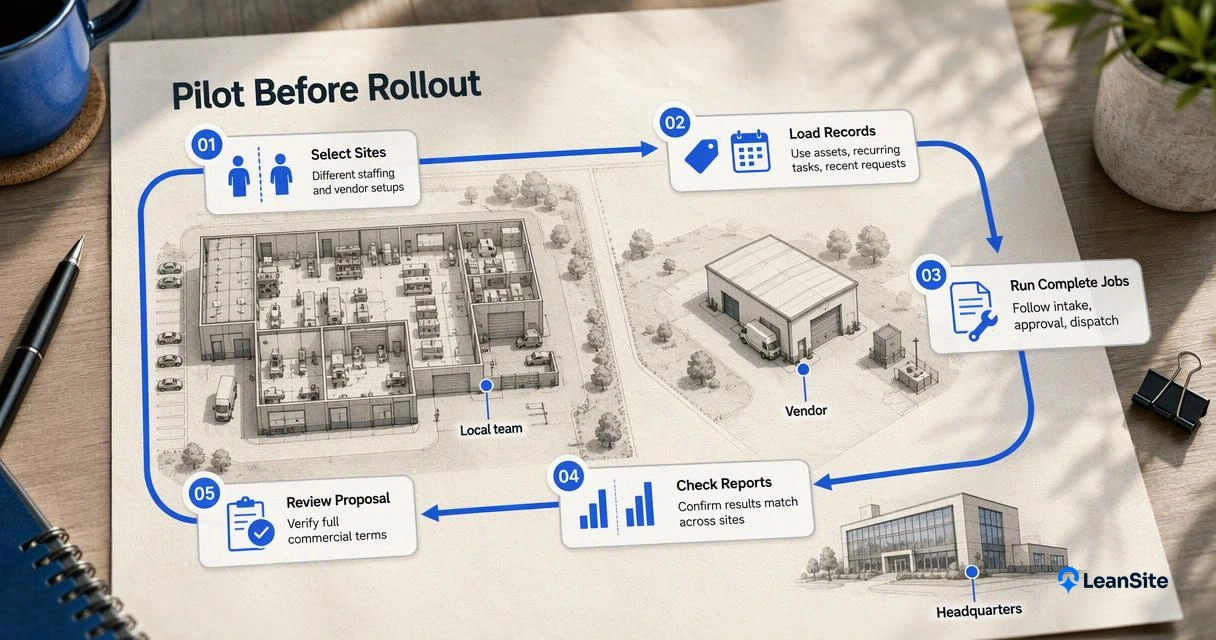
Five steps from demonstration to decision
- Select contrasting sites: Include different workloads, staffing patterns, and vendor arrangements.
- Load realistic records: Use existing assets, recurring tasks, and recent service requests.
- Run complete jobs: Track intake, approval, dispatch, completion evidence, and invoice review.
- Review comparable results: Measure administrative effort, record completeness, and reporting usefulness.
- Confirm total cost: Request written terms for seats, sites, onboarding, integrations, support, and data export.
The multi-site maintenance buying guide adds context for assessing operational fit.
A successful pilot produces both a buying decision and a repeatable rollout checklist.
Conclusion
The best facility management software for multi-site operations earns its place through a realistic pilot. Facilities leaders should shortlist by workflow, test shared reporting, and obtain a complete written proposal. For teams exploring AI-assisted coordination, request a Leansite walkthrough at getleansite.com with one real maintenance scenario and a portfolio reporting requirement.
Demi Oloyede
Leansite
Frequently Asked Questions
Is a CMMS enough for several commercial properties?
A CMMS can be enough when maintenance scheduling, asset records, and work orders cover the portfolio's needs. Broader requirements, such as space management or other property operations, may call for additional software. The deciding factor is the actual workflow and reporting scope, not the number of buildings alone.
How much does multi-site facility software cost?
The supplied research doesn't provide comparable current prices, so a reliable cost ranking isn't possible. Buyers should request proposals using the same location count, user roles, required modules, and onboarding scope. Integration, vendor access, support, and export charges also belong in the comparison, even when they aren't included in an advertised subscription.
Should every location switch software at once?
A staged rollout is generally easier to evaluate because it allows teams to refine asset naming, permissions, and training before expanding. Representative pilot sites should establish the shared process first. Later locations can then adopt the tested structure while retaining necessary local differences, such as service providers or approval limits.
More from the blog
- parts reservations
Best Spare Parts Inventory Software for Facilities in 2026
Compare facilities inventory options by storeroom workflow, equipment links, reservations, purchasing, and stock sharing across buildings.
- facilities software comparison
CAFM vs IWMS: Scope, Integrations, and Selection Guide
Compare CAFM and IWMS across maintenance, space, leases, capital planning, and integrations, with a practical decision guide for facilities teams.
- vendor dispatch
Maintenance Automation: A Practical Guide for Facilities in 2026
Learn how to automate maintenance scheduling, vendor dispatch, and approvals, with practical rollout steps and metrics for multi-site facilities.