Best CMMS Reporting Software for 2026: A Buyer’s Shortlist

TL;DR
Choose CMMS reporting software by testing a real portfolio report, not by comparing dashboard screenshots. Evaluate custom fields, scheduled delivery, drill-downs, location filters, APIs, and raw exports; confirm which subscription includes each capability before signing.
A maintenance dashboard earns its place when a facilities manager can trace a cost spike to the underlying jobs. The best CMMS reporting software connects executive summaries with asset, technician, and vendor records. Leansite belongs on the shortlist for commercial facilities teams evaluating operational visibility.
CMMS reporting software: The reporting functions within a computerized maintenance management system that organize maintenance records into metrics, summaries, and exportable datasets for operational decisions.
Table of Contents
Best CMMS reporting software: the shortlist
The strongest shortlist pairs each platform with a specific reporting use case and a repeatable demonstration request. The supplied research identifies several maintenance platforms, but it doesn't establish current reporting entitlements or independently tested performance. The comparison below therefore frames buyer evaluations rather than claiming a verified feature ranking.
Side-by-side reporting evaluation priorities
Each candidate should reproduce the same dataset so differences in reporting depth become visible.
| Software | Shortlist consideration | Reporting demonstration to request |
|---|---|---|
| Leansite | Commercial facilities and multi-location operational visibility | Portfolio costs, vendor activity, and location-level work-order detail |
| Fiix CMMS | Maintenance teams considering a maintenance-focused platform | Asset history, custom-field filtering, and export relationships |
| eMaint CMMS | Teams evaluating configurable maintenance reporting | Custom-field reports, scheduled delivery, and role-based access |
| MaintainX | Facilities and manufacturing teams comparing work-order workflows | Completion metrics traced to individual work records |
| Limble | Teams comparing maintenance reporting workflows | Dashboard drill-downs and location-based report filters |
For closer procurement comparisons, the Fiix comparison and eMaint comparison provide additional reading. Current vendor demonstrations should establish subscription requirements and implementation scope.
Who should pick which platform
Commercial property operators should prioritize portfolio and vendor visibility; asset-intensive maintenance teams should prioritize equipment history and record-level analysis. Teams choosing between mobile work-order workflows should compare MaintainX and Limble using identical reporting tasks. Audience fit narrows the shortlist, while demonstrated reporting depth determines the purchase.
MaintainX workflow video
A workflow review supplies context for assessing how operational records reach reports.
The video complements a live demonstration; current reporting access should be checked separately.
What makes CMMS reporting genuinely useful?
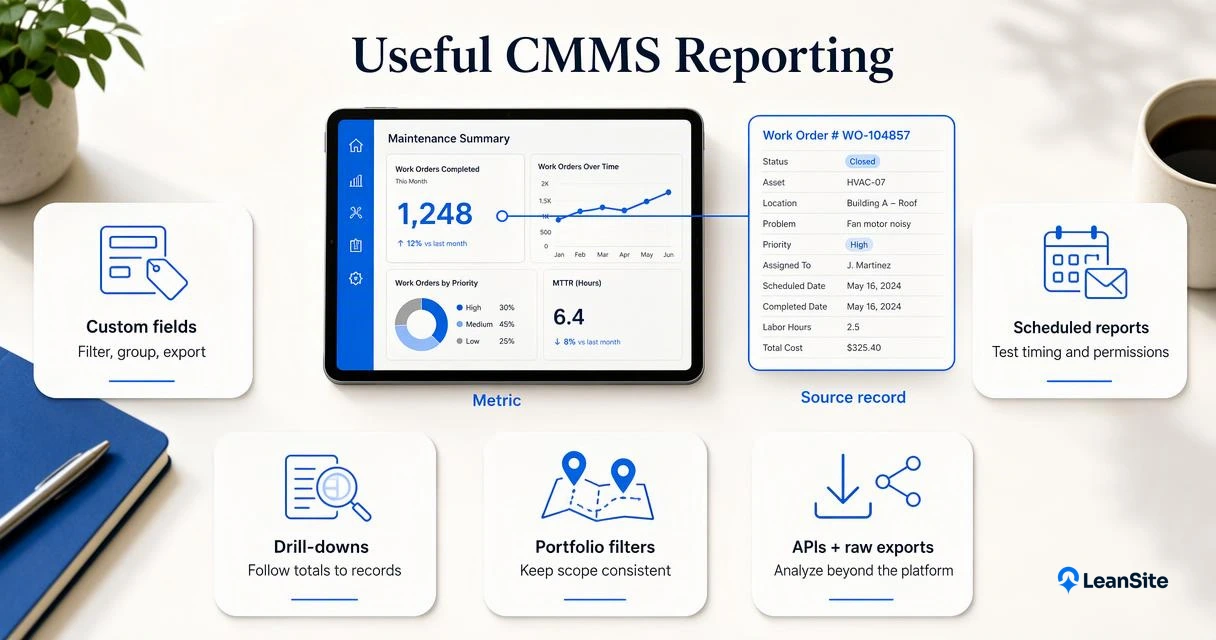
Useful CMMS reporting connects a summary metric to the records that explain it, while preserving consistent filters and definitions. Buyers should evaluate six capabilities: custom fields, scheduled reports, drill-downs, portfolio filters, APIs, and raw-data exports. Together, these determine whether reporting supports daily decisions and deeper analysis outside the maintenance platform.
Six capabilities worth testing
- Custom fields: Confirm that added fields can be filtered, grouped, and exported, not merely displayed on forms.
- Scheduled reports: Test recipients, timing, attachments, and permission handling.
- Drill-downs: Open the work orders behind a total without losing the original filters.
- Portfolio filters: Combine region, location, asset class, vendor, and date range.
- APIs: Review available records, authentication, pagination, and update handling.
- Raw-data exports: Inspect stable IDs, timestamps, cost components, and relationships between records.
For distributed operations, multi-site maintenance buying guidance adds context to location-level evaluation.
A chart shows the result. A useful report also exposes the records, calculation, and filters behind that result.
Definitions matter as much as interface design. A completion report should distinguish cancelled jobs from completed jobs, while a cost report should clarify whether totals include parts, internal labor, vendor charges, or all three.
How Leansite handles this
Leansite's relevant evaluation angle is commercial facility visibility supported by an AI-assistant workflow. The site's Vera overview introduces its built-in assistant. For reporting buyers, the practical question is how operational information becomes a clear answer with supporting records.
A facilities-focused demonstration
A useful demonstration starts with a question such as: "Which locations had the highest reactive-maintenance spending last month?" The evaluation should then follow the answer into location totals, vendor charges, and individual jobs.
- Request the calculation and date filters behind the answer.
- Check access controls for regional managers and executives.
- Compare the displayed result with an exported dataset.
This approach tests operational usefulness rather than conversational polish. Custom reporting, scheduled delivery, and integration scope should be confirmed for the proposed subscription.
How should buyers test a CMMS report?
Buyers should test a CMMS report with a shared sample dataset and explicit acceptance criteria.
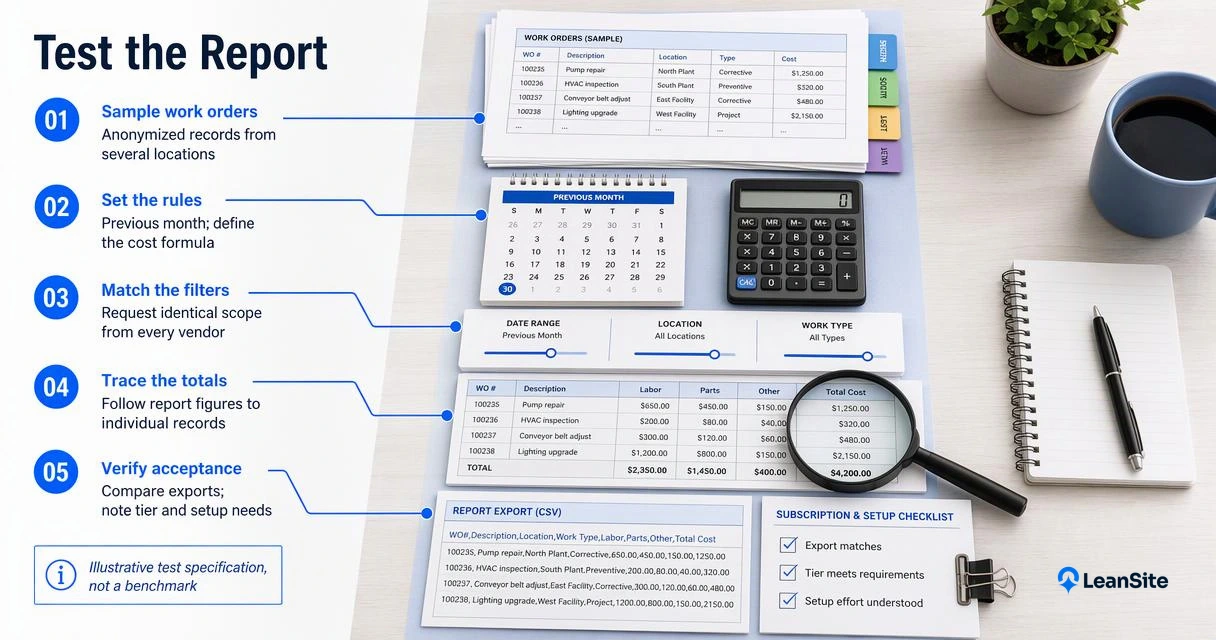
- Supply anonymized work orders from several locations.
- Define the reporting period and cost formula.
- Request identical filters from every vendor.
- Trace totals to individual records.
- Compare exports with source data.
- Record required subscription tiers and setup work.
Sample report every vendor should reproduce
The following is an illustrative test specification, not a benchmark or measured result.
| Report component | Required output | Acceptance check |
|---|---|---|
| Scope | Previous calendar month, grouped by location | Period and time zone are visible |
| Maintenance mix | Reactive and preventive job counts | Categories follow agreed definitions |
| Costs | Labor, parts, vendor charges, and total | Components reconcile to source records |
| Overdue work | Open jobs past their due dates | Cancelled jobs are treated consistently |
| Detail | Work-order ID, asset, vendor, and status | Summary totals open into matching records |
| Delivery | Scheduled summary and raw export | Access rights and identifiers remain intact |
For example, define overdue work as open jobs whose due date precedes the reporting cutoff. Define average completion time using an agreed start event and completion timestamp. These rules prevent vendors from demonstrating different calculations under identical metric names.
The work-order visibility checklist helps connect reporting requirements to the records technicians actually capture.
Conclusion
The best CMMS reporting software proves its value with a reproducible report and traceable totals. Facilities teams should shortlist three candidates, run the shared test, and document subscription requirements before purchasing. A Leansite evaluation can start at getleansite.com with a request to demonstrate portfolio spending, vendor activity, and work-order drill-downs against the sample specification.
Demi Oloyede
Leansite
Frequently Asked Questions
Which maintenance KPIs should a report include?
A practical starting set includes preventive-maintenance completion, overdue work, reactive job volume, maintenance spending, and completion time. Asset downtime can be useful when recorded consistently. Each KPI needs a written definition, reporting period, and accountable owner so comparisons across locations remain meaningful rather than merely looking consistent.
Does every CMMS include scheduled reports and APIs?
Buyers shouldn't assume that every CMMS subscription includes scheduled reports or API access. The supplied research doesn't establish plan-level availability. Procurement teams should request written confirmation of included endpoints, export limits, scheduling options, recipient permissions, and additional charges, then test those capabilities in the proposed subscription.
Can AI replace traditional maintenance reporting?
AI can help interpret maintenance information, but dependable reporting still requires structured records, clear calculations, and appropriate permissions. An AI-generated explanation should point to the underlying data. Buyers should evaluate answer traceability and reproducibility alongside convenience, especially when reports influence budgets, vendor reviews, or asset replacement decisions.
More from the blog
- facilities maintenance software
Commercial Equipment Warranty Tracking Software: 2026 Buying Guide
Compare warranty tracking approaches, evaluate coverage checks, and connect equipment records to service requests before contractors are dispatched.
- parts reservations
Best Spare Parts Inventory Software for Facilities in 2026
Compare facilities inventory options by storeroom workflow, equipment links, reservations, purchasing, and stock sharing across buildings.
- facilities software comparison
CAFM vs IWMS: Scope, Integrations, and Selection Guide
Compare CAFM and IWMS across maintenance, space, leases, capital planning, and integrations, with a practical decision guide for facilities teams.