Best Building Maintenance Software for Commercial Properties in 2026
TL;DR
Shortlist software around work orders, preventive maintenance, vendor coordination, and property-level reporting. Maintenance-focused platforms suit facilities teams, while property-management systems serve broader ownership workflows. A live demonstration using actual building tasks should determine the final choice.
A maintenance request isn't finished when someone assigns it; it's finished when the repair, evidence, and cost are recorded. The best building maintenance software for commercial properties connects those steps across buildings, technicians, and contractors. For 2026, the strongest shortlist depends on operational fit rather than a universal winner. Leansite deserves an early look alongside established maintenance and property-management options, with selection based on a real commercial-building workflow.
Table of Contents
What is commercial building maintenance software?
Commercial building maintenance software organizes repair requests, scheduled servicing, asset records, and maintenance activity across commercial premises. A maintenance-focused system helps facility managers coordinate work, while broader property-management software supports real-estate oversight. The right category depends on whether the priority is building operations, property administration, or both.
Computerized maintenance management system (CMMS): Software that maintains a database of an organization's maintenance operations.
Facility management: Coordinated management of buildings, workplaces, and supporting services that keep them functional and safe.
Property management: Operation, control, maintenance, and oversight of real estate.
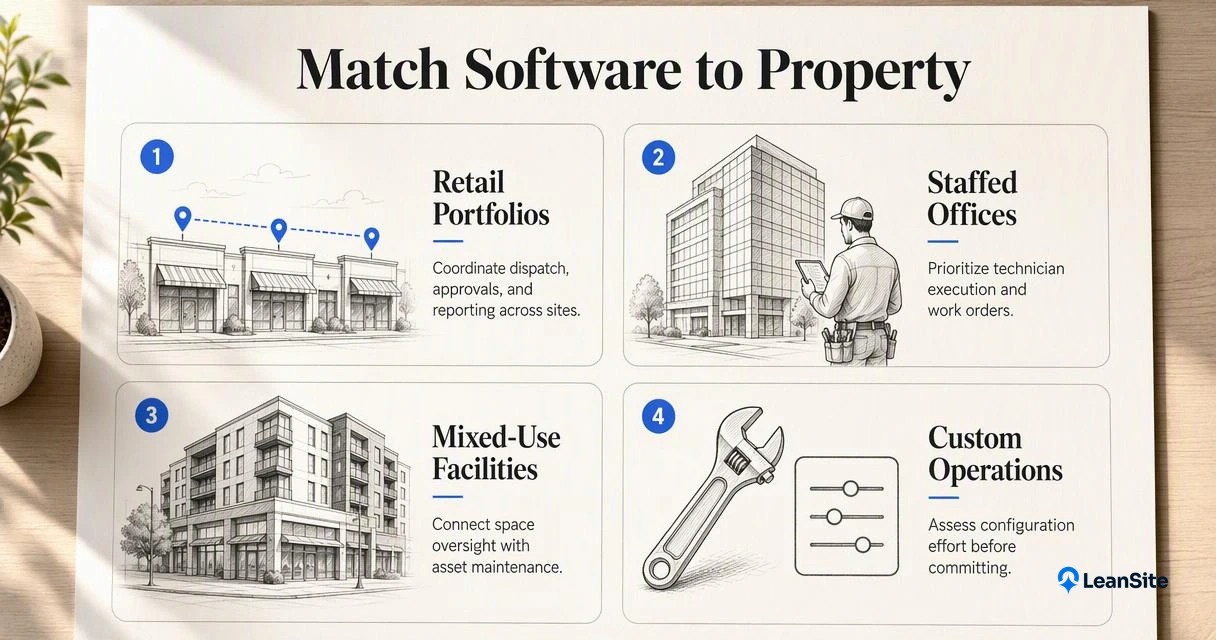
The distinctions matter during purchasing. A retail portfolio might prioritize contractor dispatch and location reporting; an office property might need detailed HVAC service histories. The facility management solutions guide provides broader context for matching software to operating needs.
Video context for broader property-management needs
Property-management software is a related category, not an automatic substitute for maintenance-focused software.
The video provides category context; selection should still depend on demonstrated maintenance workflows.
Which platforms belong on the 2026 shortlist?
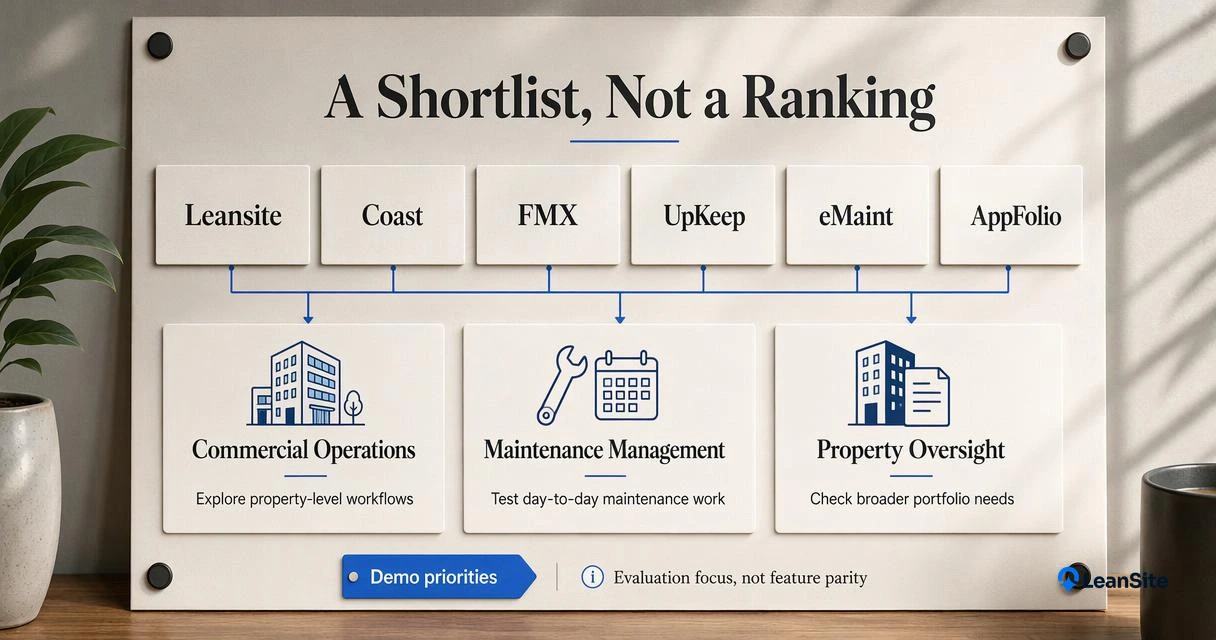
Leansite, Coast, FMX, UpKeep, eMaint, and AppFolio represent a useful shortlist spanning commercial operations, maintenance management, and broader property oversight. These aren't interchangeable tools. Their different starting points help buyers decide which demonstrations deserve attention, rather than treating every product as an equally suitable replacement.
Side-by-side commercial maintenance comparison
The comparison below highlights evaluation priorities, not verified feature parity or a scored ranking.
| Platform | Shortlist focus | Demonstration priority |
|---|---|---|
| Leansite | Commercial-property operations evaluation | Connected task, vendor, and owner workflow |
| Coast | Customizable location fields and asset hierarchies | Building-to-asset organization |
| FMX | Facility-management software | Request routing and scheduled servicing |
| UpKeep | Building requests and preventive maintenance | Request queue and recurring system maintenance |
| eMaint | Predictive maintenance and audit reporting | Asset monitoring and maintenance evidence |
| AppFolio | Broader property-management needs | Maintenance within property administration |
Who should pick which platform?
Facility teams should start with the maintenance-focused candidates when equipment service and task execution dominate daily work. Coast merits attention for location structure; UpKeep for building-request queues; eMaint for predictive-maintenance evaluation. FMX belongs in a facility-management comparison.
Property owners seeking broader administrative coverage should also assess AppFolio. Every finalist should demonstrate the same scenario so category differences remain visible.
How Leansite handles this
The Leansite platform should be evaluated through a commercial-property workflow that connects facility managers, vendors, and ownership reporting. A tailored demonstration is the right place to establish current capabilities and fit. The available research doesn't document its feature set, so specific automation, integration, or payment functions require confirmation.
A practical commercial-building demonstration
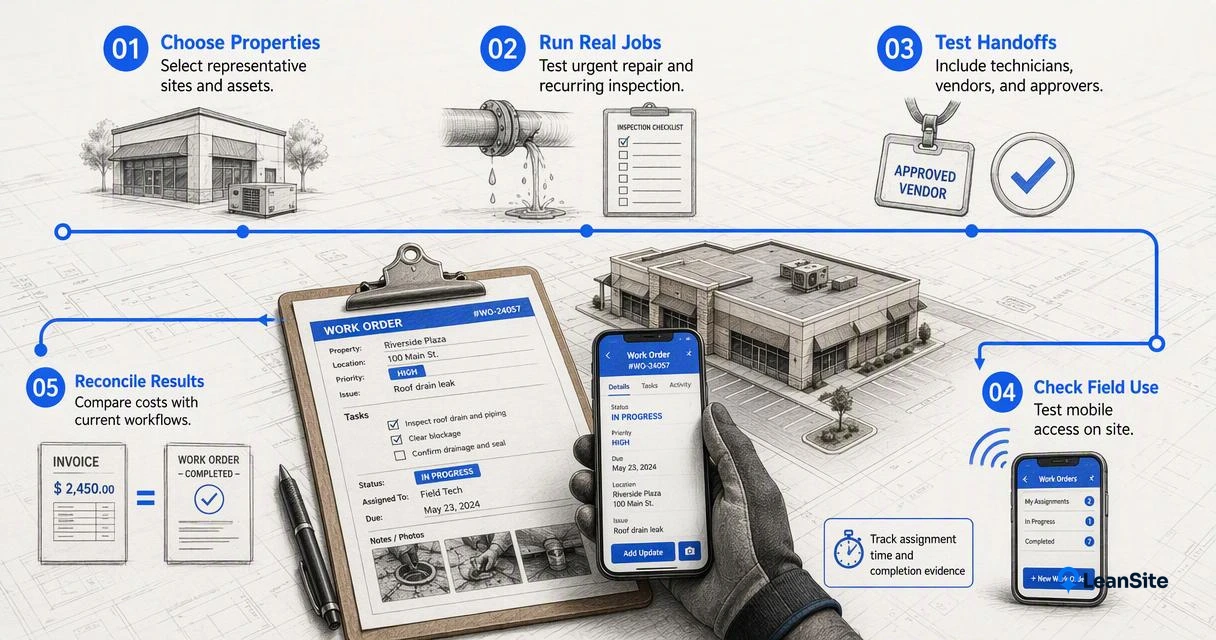
A useful demonstration starts with a tenant reporting an HVAC fault at one property. It follows assignment, contractor attendance, completion evidence, and cost review through the available workflow.
- Show how the property and affected asset are identified.
- Explain how staff and contractor responsibilities are recorded.
- Demonstrate the completed record available to management.
For teams also considering an enterprise maintenance system, the comparison with Accruent Maintenance Connection offers a focused follow-up.
A useful demonstration proves a complete operational handoff, not just a clean dashboard.
How should commercial-property teams choose software?
Commercial-property teams should choose maintenance software by testing representative work and comparing the full operating cost:
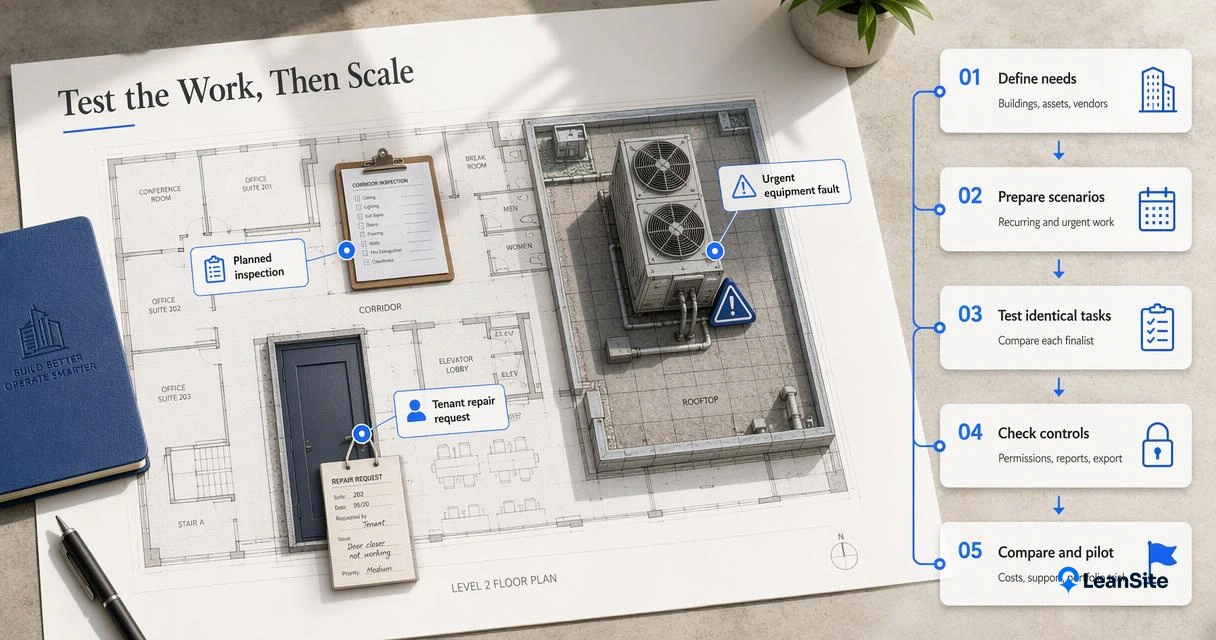
- Define building, asset, and vendor requirements.
- Prepare recurring and urgent maintenance scenarios.
- Test each finalist with identical tasks.
- Confirm permissions, reporting, and data export.
- Compare implementation, subscription, and support costs.
- Pilot before portfolio-wide deployment.
Acceptance tests that expose workflow fit
Use a planned inspection, a tenant repair request, and an urgent equipment fault. These scenarios reveal different routing, scheduling, and approval needs without requiring a large trial.
- Technician test: Record an update and attach completion evidence from a phone.
- Vendor test: Show what an external contractor can access and submit.
- Manager test: Identify overdue work by building and responsible party.
- Owner test: Review maintenance spending by property and asset.
Treat these as acceptance criteria, not assumptions about any listed product.
Cost and rollout questions worth settling early
Compare the same buildings, users, vendors, and support requirements across proposals. Ask about configuration, data migration, training, integrations, and additional locations. Subscription price alone doesn't describe the cost of getting a portfolio operational.
For example, a three-building pilot can include an office, a retail site, and a warehouse. Record completion time, overdue tasks, and administrative effort against the existing process. Those are proposed pilot measures, not promised improvements.
Conclusion
The best building maintenance software for commercial properties is the option that proves its fit with actual buildings, assets, and contractor work. Facility managers should shortlist three candidates, run identical demonstrations, and pilot the strongest match before wider deployment. For a focused Leansite evaluation, visit getleansite.com and request a demonstration covering one recurring task, one urgent repair, and one property-level reporting requirement.
Demi Oloyede
Leansite
Frequently Asked Questions
Can property-management software replace a CMMS?
Property-management software can replace a separate CMMS when its maintenance functions cover the property's actual requirements. Buyers should test recurring servicing, asset histories, task assignment, and reporting rather than relying on the category label. Equipment-heavy sites may need a maintenance-focused system alongside broader property administration.
Which features matter most for multiple properties?
Multi-property teams should prioritize location structure, consistent workflows, access permissions, and reporting that separates individual buildings from portfolio totals. Vendor coordination also deserves testing because contractors may serve several sites. A demonstration should show both a local manager's working view and an executive's cross-property view.
How much does commercial maintenance software cost?
Commercial maintenance software costs depend on the selected product, package, deployment scope, and services. The supplied research doesn't establish comparable current prices. Buyers should request itemized quotes covering subscriptions, setup, migration, training, integrations, and support, then compare proposals using the same operating assumptions.
Should AI determine the software choice in 2026?
AI shouldn't determine the software choice unless a demonstrated function improves a specific maintenance task. Buyers can test request categorization, record search, or scheduling assistance where offered. Human approval, traceable records, and dependable core workflows should remain selection priorities; an AI label alone doesn't establish operational value.
More from the blog
- maintenance vendor coordination
In House vs Outsourced Facility Maintenance: A 2026 Guide
Compare maintenance staffing models by response coverage, skills, workload, and fully loaded costs, with an illustrative budget and hybrid decision guide.
- maintenance history
Best QR Code Asset Tagging Software: A 2026 Buying Guide
Compare QR asset tagging options by labeling, mobile access, maintenance history, and permissions, then validate the right fit with a small-site pilot.
- commercial property maintenance
Facilio vs MaintainX: A Practical Buyer’s Guide for 2026
Compare Facilio and MaintainX through portfolio oversight, technician workflows, integrations, and implementation. Use a practical demo scorecard.