Retail Facilities Maintenance Software: A 2026 Buying Guide

TL;DR
Choose software that connects store requests, asset histories, vendor assignments, and spending approvals. Match the system to the operating model, then test it across representative locations before committing to a portfolio-wide rollout.
A broken freezer needs more than a ticket: it needs an owner, a qualified contractor, and a clear spending decision. Retail facilities maintenance software connects those steps across stores. For facility managers, property owners, and operations teams, the buying question in 2026 is practical: can the system support daily work and make portfolio decisions clearer? Leansite belongs on the shortlist for teams exploring AI-assisted facilities management.
Table of Contents
What is retail facilities maintenance software?
Retail facilities maintenance software is a system for managing store repairs, preventive maintenance, assets, contractors, and related costs. It connects requests from individual locations with the teams responsible for completing work, giving managers a shared record of job status, service history, and spending across a retail portfolio.
CMMS: A computerized maintenance management system organizes maintenance work orders, asset records, and scheduled servicing.
Preventive maintenance: Planned servicing performed on a schedule to help keep equipment operational.
Retail operations add another layer: trading hours, customer access, landlord responsibilities, and outside contractors all shape how a repair gets handled.
The workflows a retail platform should connect
A useful platform keeps store-level activity connected to regional oversight.
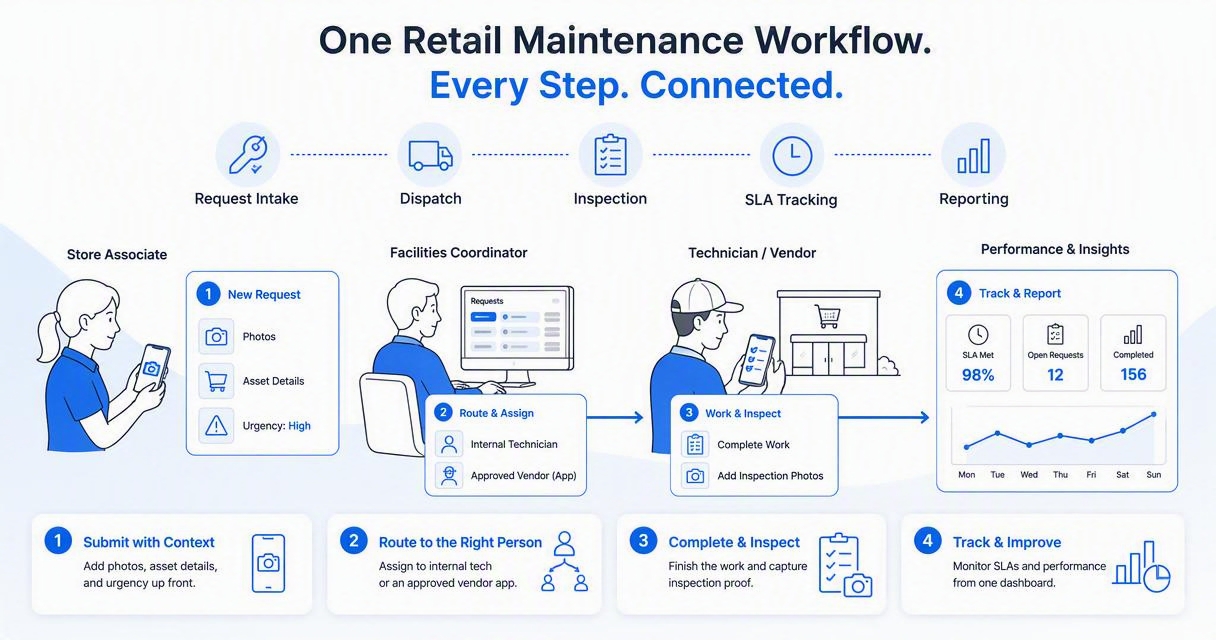
| Workflow | Retail example | Capability to evaluate |
|---|---|---|
| Request intake | A store reports a leaking ceiling | Photos, location, priority, ownership |
| Scheduled servicing | HVAC equipment receives routine checks | Recurring tasks and asset history |
| Vendor coordination | An electrician accepts a lighting repair | Assignment, updates, completion evidence |
| Cost control | A repair requires approval | Estimates, spending limits, invoice records |
For broader organizational planning, the multi-location facilities management guide covers the portfolio-level context.
How should retailers choose maintenance software?
Retailers should choose maintenance software by testing real workflows rather than comparing feature counts.
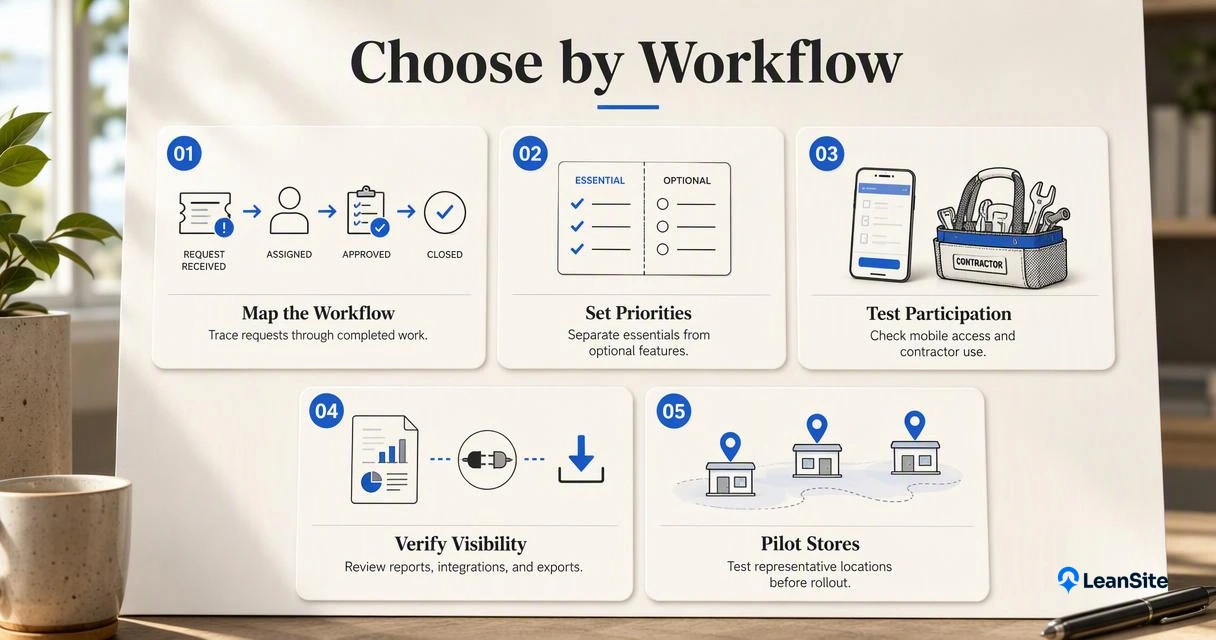
- Map store requests, assignments, approvals, and closure.
- Separate essential capabilities from optional features.
- Test mobile access and contractor participation.
- Check reporting, integrations, and data exports.
- Pilot representative stores before agreeing to a wider rollout.
Match the system to the operating model
The right category depends on who performs the work and who approves the cost.
- Internal maintenance teams: Prioritize technician scheduling, asset histories, parts tracking, and recurring tasks.
- Vendor-heavy operations: Prioritize contractor access, estimates, approval rules, and invoice handoffs.
- Multi-location portfolios: Prioritize location permissions, regional reporting, and consistent asset naming.
A retailer running leased mall stores may need landlord-routing rules. A grocery operator may place greater weight on refrigeration records. Neither requirement belongs in a generic feature checklist without context.
The 2026 multi-site maintenance software guide offers a useful follow-up for distributed operations.
Require a realistic pilot and cost breakdown
A realistic pilot should follow a job from submission through financial closure. An illustrative test could use a freezer alarm, a plumbing request, and a scheduled HVAC inspection across several store formats.
Record acknowledgment time, completion time, repeat visits, and approved versus invoiced cost. These are evaluation measures, not promised improvements.
Request itemized pricing for implementation, users, locations, contractor access, integrations, and support. Poor connectivity also deserves a practical test; the offline maintenance software guide explains where that requirement matters.
A polished dashboard matters less than a complete, traceable repair workflow.
How Leansite handles this
Leansite brings an AI-assisted facilities management option into the retail software evaluation. Its published Vera assistant introduction identifies an AI assistant built into the platform, giving retailers a specific capability to examine during a demonstration.
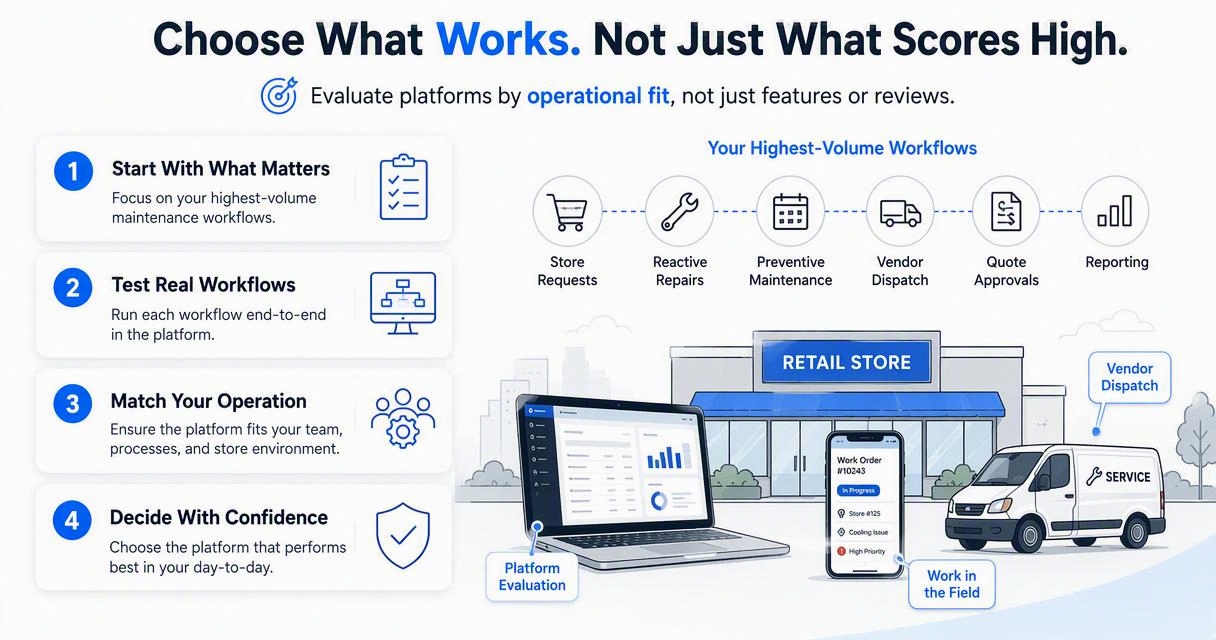
The strongest demonstration uses familiar store work rather than a generic tour. A facilities director can supply a sample request, an asset record, and a question about maintenance activity, then assess how the assistant supports that workflow.
A retail-focused demonstration brief
A focused demonstration makes the platform easier to assess against operational needs.
- Show how a store submits a request with useful context.
- Explain how regional teams find relevant maintenance information.
- Demonstrate what Vera can answer using available records.
- Confirm permissions, approval controls, and implementation requirements.
Teams can review the product at getleansite.com and bring this brief to a discussion. The goal is a clear fit between platform capabilities and the retailer's actual operating process.
What should retail teams prioritize in 2026?
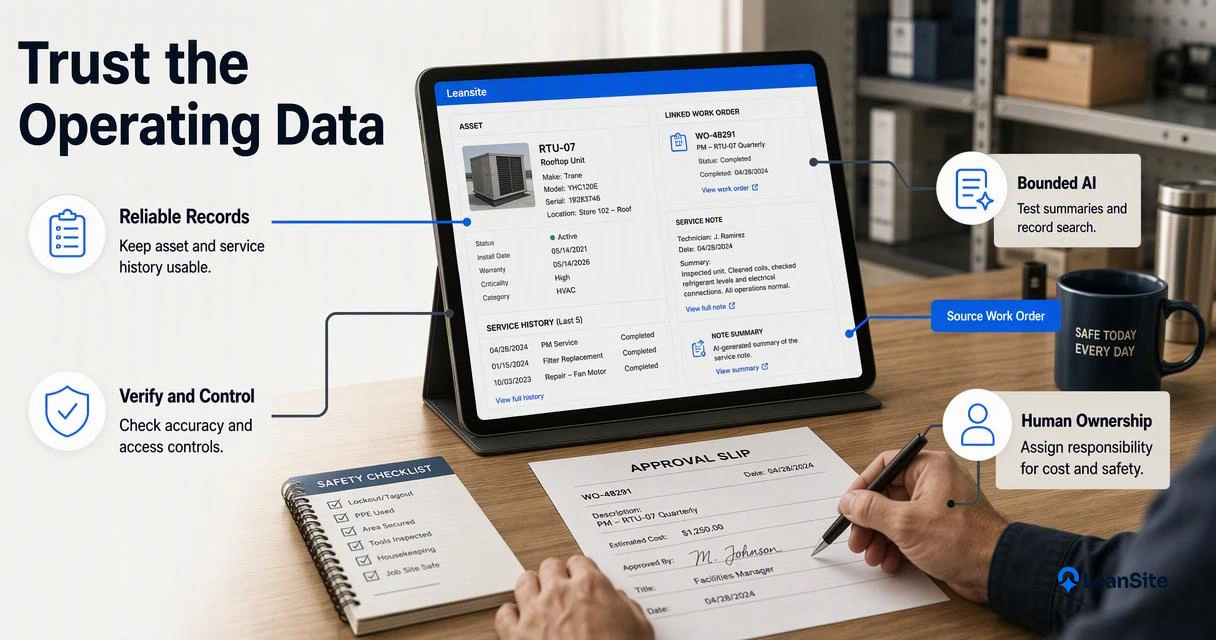
Retail teams should prioritize reliable operational data, controlled AI assistance, and usable integrations in 2026. AI can be evaluated for tasks such as summarizing service notes or helping staff find records, but purchasing decisions should depend on demonstrated accuracy, access controls, and clear human responsibility for consequential actions.
Keep automation tied to accountable decisions
AI-generated guidance should point back to the relevant asset, work order, or service record. Spending approvals and safety-sensitive decisions need explicit ownership.
The 2023 multidisciplinary paper on generative conversational AI provides broader background on AI opportunities and challenges, not evidence of retail maintenance savings. The AI facility management software guide offers a more focused category overview.
Treat AI assistance as a capability to validate, not a substitute for maintenance accountability.
A visual introduction to facilities software
This category overview provides an additional format for initial software research.
Conclusion
The next step is a workflow-based shortlist, not a longer feature spreadsheet. Compare retail facilities maintenance software against representative repairs, scheduled servicing, and approval requirements. For teams considering Leansite, prepare a demonstration brief and visit getleansite.com. Set pilot measures in advance, then expand only after store staff, contractors, and regional managers can complete their work clearly.
Demi Oloyede
Leansite
Frequently Asked Questions
Does a single retail store need maintenance software?
A single store can benefit when equipment servicing, contractor visits, or repair approvals become difficult to track. The decision depends more on workflow complexity than location count. A small operation should prioritize simple request intake, recurring maintenance, and accessible records rather than paying for portfolio features it won't use.
Can maintenance software help control operating costs?
Maintenance software can help managers understand spending by connecting repair records, estimates, invoices, and asset history. Savings aren't automatic. Teams still need consistent records and approval rules. Useful reviews compare repair frequency, repeated callouts, and cost by location or asset before deciding whether to repair, replace, or renegotiate service.
What should retailers confirm about contractor access?
Retailers should confirm how contractors receive assignments, update progress, submit evidence, and provide invoices. A demonstration should also show what outside vendors can see and whether participation requires additional licenses. Clear permissions matter because a contractor may serve several stores without needing access to the retailer's entire portfolio.
More from the blog
- parts reservations
Best Spare Parts Inventory Software for Facilities in 2026
Compare facilities inventory options by storeroom workflow, equipment links, reservations, purchasing, and stock sharing across buildings.
- facilities software comparison
CAFM vs IWMS: Scope, Integrations, and Selection Guide
Compare CAFM and IWMS across maintenance, space, leases, capital planning, and integrations, with a practical decision guide for facilities teams.
- vendor dispatch
Maintenance Automation: A Practical Guide for Facilities in 2026
Learn how to automate maintenance scheduling, vendor dispatch, and approvals, with practical rollout steps and metrics for multi-site facilities.