Repair vs Replace Commercial Equipment: A Cost-Based Guide
TL;DR
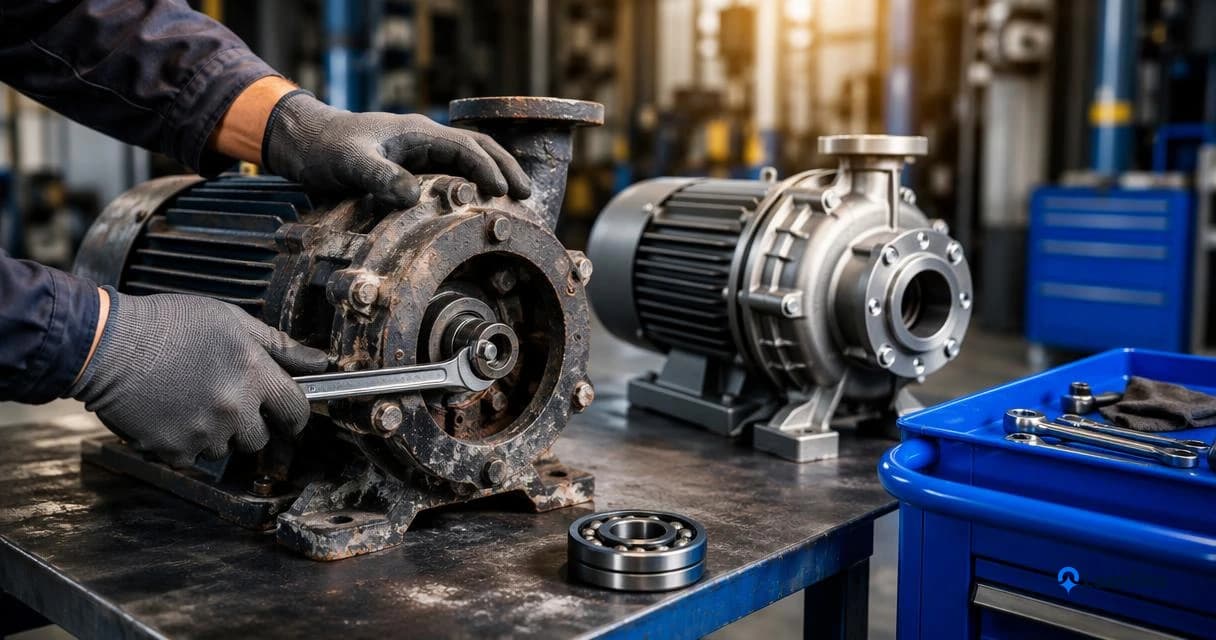
Repair equipment when a defined fix can deliver dependable service at a lower total cost. Replace it when remaining life, downtime exposure, or parts support makes continued ownership more expensive. Compare both options over the same period, with engineering review separate from financial assumptions.
The cheapest repair quote isn't always the cheapest equipment decision. A practical repair vs replace commercial equipment assessment weighs the invoice against future operating costs, service life, and business continuity.
Repair-or-replace analysis: A comparison of the future costs and operating consequences of restoring an existing asset versus installing a replacement.
For facility managers and property owners, the goal is a defensible decision, not a universal percentage rule. A shared asset record gives maintenance, finance, and operations the same starting point. Leansite is a relevant platform to evaluate for organizing that decision workflow.
Table of Contents
Repair vs Replace Commercial Equipment: Decision Factors
Repair is usually preferable when the fault is isolated and useful life remains; replacement becomes stronger when several ownership costs favor a new asset.
Age provides context, but condition matters more than a birthday. A well-maintained unit with available parts can be a better repair candidate than a newer unit with extensive damage. Asset criticality also changes the decision: an office appliance and a refrigeration unit protecting inventory deserve different downtime assumptions.
Side-by-side equipment decision table
| Factor | Favors repair | Favors replacement |
|---|---|---|
| Repair scope | Isolated, diagnosable fault | Several major systems need work |
| Remaining service life | Technician supports continued service | Limited life after the proposed repair |
| Downtime exposure | Quick repair and usable backup | Repeat interruptions affect operations |
| Efficiency | Measured operating costs remain acceptable | Verified savings justify installation costs |
| Parts availability | Supported parts with confirmed delivery | Essential components lack dependable supply |
| Installation needs | Existing setup remains suitable | Upgrade fits planned building work |
A spare part is an interchangeable component used to repair or refurbish equipment. Availability means more than a catalog listing: delivery dates, compatibility, and manufacturer support all matter.
How should facilities calculate total ownership cost?
- Compare repair and replacement over the same ownership period.
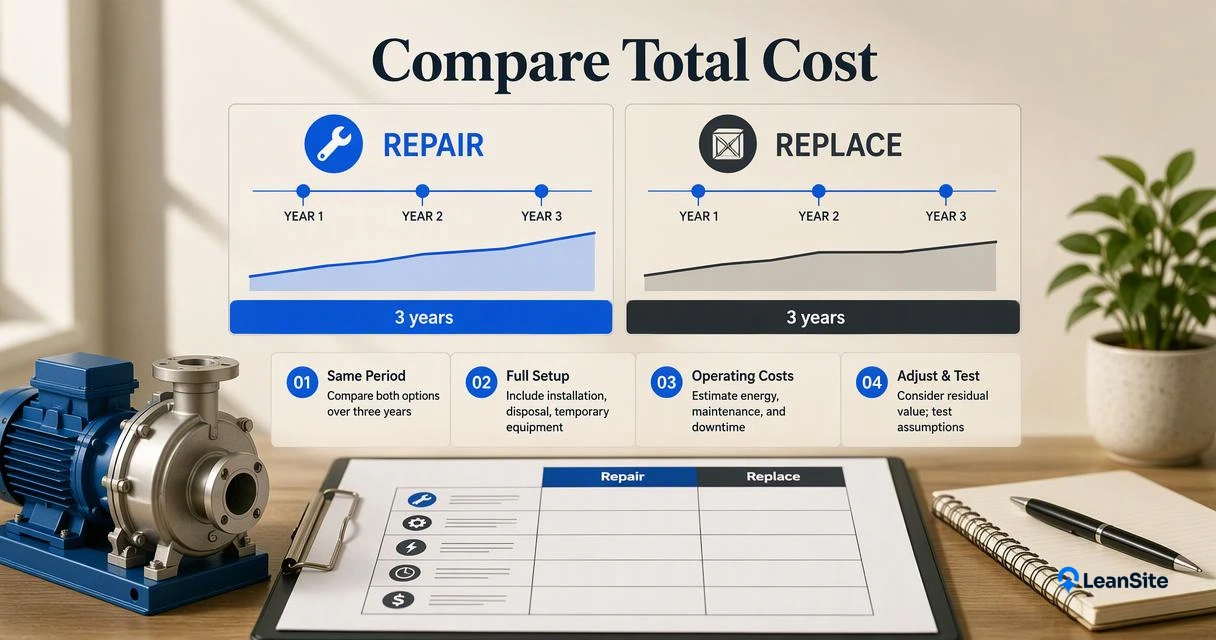
- Include installation, disposal, and temporary equipment costs.
- Estimate energy, maintenance, and downtime for each option.
- Account for residual value when service lives differ.
- Test uncertain assumptions before approving spending.
Illustrative three-year cost comparison
The following figures are financial assumptions, not industry benchmarks or engineering recommendations. They illustrate a commercial equipment decision over three years, without discounting or residual value.
| Cost category | Repair existing unit | Replace unit |
|---|---|---|
| Initial work, including installation | $4,000 | $12,000 |
| Annual energy cost | $3,000 | $2,000 |
| Annual maintenance cost | $1,000 | $400 |
| Expected annual downtime cost | $2,000 | $500 |
| Three-year total | $22,000 | $20,700 |
Repair totals $4,000 + 3 × ($3,000 + $1,000 + $2,000). Replacement totals $12,000 + 3 × ($2,000 + $400 + $500).
Under those assumptions, replacement costs $1,300 less over three years despite the higher initial expense. But if repair-side downtime falls to $500 annually, repair totals $17,500 and becomes the cheaper option.
Separate business exposure from technical certainty
Downtime estimates should reflect likely disruption, not automatically count all revenue as lost. Use affected operating hours, lost contribution margin, temporary rental costs, and incremental labor without double counting.
For larger investments, finance teams should account for discounting, taxes, financing, and residual value. Technicians should separately validate condition and expected service life.
A spreadsheet can compare assumptions; it can't certify that equipment is safe or predict its exact failure date.
When should engineering override the cost comparison?
Engineering should override a favorable repair calculation when qualified assessment identifies unacceptable safety, compliance, or reliability concerns. A low repair price doesn't establish fitness for service. Equipment-specific advice must come from qualified technicians, manufacturer documentation, and applicable local requirements before financial approval determines the preferred option.
Evidence required before authorizing work
- Written diagnosis: Identify the failed component, root cause, and proposed repair scope.
- Condition assessment: Check related systems rather than inspecting only the broken part.
- Parts confirmation: Document availability, compatibility, and delivery timing.
- Performance checks: Specify commissioning or post-repair acceptance tests.
- Service outlook: Request a reasoned remaining-life estimate, with uncertainty clearly stated.
For HVAC equipment, a compressor quote alone doesn't describe coil condition, controls, or electrical requirements. For commercial refrigeration, the assessment should address temperature performance and the inventory protection plan during work.
Who should approve each option?
Maintenance should validate the scope, operations should confirm acceptable interruption, and finance should compare ownership costs. Procurement should verify exclusions and warranty terms. Replacement approval should also confirm installation access, utility compatibility, permits where required, and commissioning responsibilities before an order is placed.
How Leansite handles this
Leansite should be evaluated as a coordination layer for repair-or-replace decisions, with its available features checked against the facility's documentation needs.
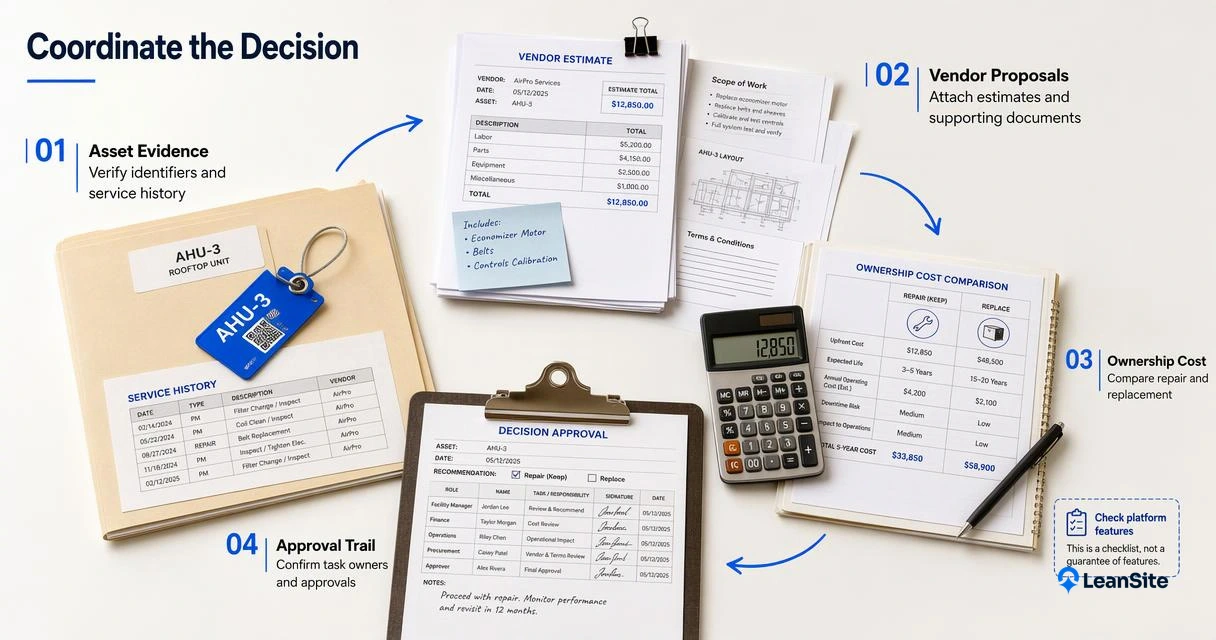
A useful workflow connects asset evidence, vendor proposals, ownership calculations, and approvals. Teams assessing the Leansite platform can use that workflow as a practical demonstration checklist rather than assuming particular features are included.
A practical platform evaluation checklist
- Confirm how asset identifiers and service histories are organized.
- Ask how vendor estimates and supporting documents are attached.
- Check task ownership, approval tracking, and portfolio reporting.
- Verify export options for finance and engineering review.
The strongest demonstration follows one real asset from request through approval and completed work. Information at getleansite.com provides a starting point for that evaluation. Consistent documentation then gives portfolio teams a repeatable process while preserving equipment-specific judgment.
Conclusion
The next step is an asset-level decision brief: obtain a written diagnosis, price both options fully, and test a three-year ownership comparison. Then assign an approval owner and document the reasoning. Facilities evaluating Leansite can bring that brief to a workflow demonstration and confirm how the platform supports their process.
Demi Oloyede
Leansite
Frequently Asked Questions
Is the 50% repair rule reliable?
A 50% repair-to-replacement threshold can flag a decision for review, but it isn't a complete investment test. Replacement installation costs, remaining service life, downtime, and efficiency can change the result. Facilities should treat any percentage rule as a screening shortcut and compare future ownership costs before committing funds.
Should past repairs count toward replacement?
Past repair spending is a sunk cost and shouldn't be added to future costs as though it must be paid again. Repair history still matters as evidence. Repeated faults, rising service frequency, and recurring component failures can support a higher estimate of future maintenance expense and interruption risk.
Can rebuilding be better than replacement?
Rebuilding can be worth evaluating when the equipment's core structure remains sound and specialist support is available. Its scope should specify replaced components, testing, warranty, and expected performance. Compare rebuilding with repair and replacement over the same period, including downtime and installation work, rather than assuming a rebuild restores new-equipment performance.
More from the blog
- multi-site facilities management
Healthcare Facility Maintenance Software: 2026 Buying Guide
Compare healthcare building-maintenance software, map access and scheduling requirements, and plan a practical pilot for hospitals and clinic portfolios.
- facility management software
ServiceChannel vs MaintainX: A 2026 Workflow Comparison
Compare ServiceChannel and MaintainX for contractor-heavy, in-house, and mixed maintenance operations, with practical demo tests and selection criteria.
- maintenance vendor coordination
In House vs Outsourced Facility Maintenance: A 2026 Guide
Compare maintenance staffing models by response coverage, skills, workload, and fully loaded costs, with an illustrative budget and hybrid decision guide.