Healthcare Facility Maintenance Software: 2026 Buying Guide

TL;DR
Choose building-maintenance software around controlled access, approved work windows, and contractor handoffs, not a feature count. Compare general facilities platforms with hospital-focused systems, then test one complete maintenance workflow before expanding across sites.
A hospital maintenance task isn't finished until the work is verified and the space is ready for use. Healthcare facility maintenance software helps organize that chain across buildings, technicians, and contractors. For teams evaluating building operations, Leansite belongs on the shortlist alongside hospital-focused maintenance systems. The strongest fit depends on the properties involved and how work moves from request to approved completion.
Table of Contents
What is healthcare facility maintenance software?
Healthcare facility maintenance software is a system for organizing building assets, maintenance requests, scheduled inspections, work orders, and service records across hospitals or clinics. Its building-maintenance scope covers infrastructure and support spaces; clinical equipment servicing and patient records require separate ownership, workflows, and system evaluation.
CMMS: A computerized maintenance management system stores information about an organization's maintenance operations in a database.
Facility management: The coordinated management of buildings, workplaces, and supporting services that keep them functional, safe, and effective.
Medical equipment management: A separate discipline focused on healthcare technology operations, use, safety, and servicing.
For building teams, the starting inventory might include air-handling units, plumbing, doors, lighting, and backup-power infrastructure. Clinical engineering typically handles medical devices under its own processes; shared responsibilities should be documented rather than assumed.
A building work order should describe the asset, location, access conditions, responsible team, and completion evidence, without becoming a patient record.
The broader facility management solutions guide explains software categories and operating models beyond this healthcare-specific selection.
Which workflows should drive software requirements?
Healthcare building-maintenance requirements should follow access restrictions, disruption-sensitive scheduling, and contractor coordination rather than a generic feature checklist. A useful demonstration shows who authorizes entry, how work windows are approved, what contractors can see, and how completion evidence returns to the facility team before closure.
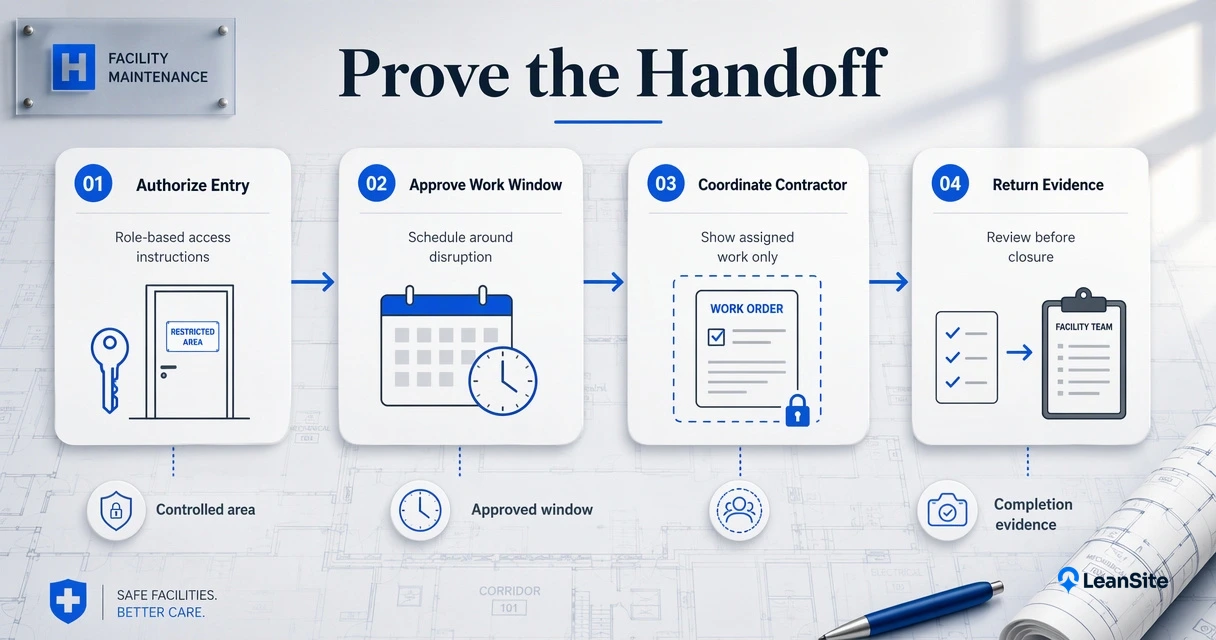
Workflow-to-requirement checklist
Each requirement should connect to a real maintenance handoff.
| Building workflow | Requirement to test | Demonstration evidence |
|---|---|---|
| Work in controlled areas | Role-based visibility and access instructions | Contractor sees only assigned work |
| Noisy or disruptive repairs | Approved work windows and dependencies | Job waits for department approval |
| Contractor dispatch | Assignment, acknowledgment, and escalation | Unaccepted work reaches the coordinator |
| Planned infrastructure servicing | Asset-linked schedules and checklists | Service history stays with the asset |
| Job completion | Photos, notes, and review status | Reviewer accepts documented work |
| Portfolio oversight | Consistent site and cost categories | Comparable records across clinics |
Access permissions in software aren't physical authorization to enter a department. Local access and infection-prevention procedures still govern work. Likewise, stored records can support organizational review, but software alone doesn't establish regulatory compliance.
For dispersed clinics, multi-location facilities management guidance adds useful context on shared standards and local responsibilities.
Best software candidates by maintenance scope
The best shortlist combines a building-operations candidate with specialist maintenance systems that match the organization's scope. The available research supports category-level comparisons, not a scored ranking of security, pricing, integrations, or implementation quality. Those details require current vendor documentation and a demonstration.
Four candidates worth evaluating
These candidates represent distinct starting points for a 2026 evaluation.
| Candidate | Research-supported positioning | Best evaluation focus |
|---|---|---|
| Leansite | Facilities-management candidate with a named AI assistant, Vera | Building workflows and portfolio coordination |
| FSI Software | Healthcare CMMS with rounding checklists and audit trails | Hospital-focused maintenance processes |
| MAPCON | Hospital asset-maintenance software | Asset records and maintenance work |
| Johnson Controls FM:Systems | Facility-maintenance software | Building equipment performance and downtime management |
The supplied search summaries identify the specialist vendors' positioning, but don't establish every feature or deployment condition. Product demonstrations should use identical scenarios so buying teams compare actual workflows rather than presentation quality.
How Leansite fits the building-first shortlist
The Leansite platform is a relevant candidate for organizations evaluating facilities work alongside AI-assisted operations. Its published introduction to Vera, the built-in AI assistant, provides a starting point for that discussion.
- Building-operations teams: Prioritize request handling, location visibility, and contractor handoffs.
- Hospital maintenance departments: Give specialist healthcare workflows greater weight.
- Mixed clinic portfolios: Test whether shared standards still allow site-specific work windows.
The deciding evidence should be a completed scenario: a plumbing repair scheduled around department activity, assigned to a contractor, reviewed, and closed with supporting records.
How should facilities teams run a software pilot?
Facilities teams should pilot maintenance software with one representative site and a defined set of building tasks before a portfolio rollout. The pilot should test permissions, scheduling, contractor responses, closure evidence, and reporting using agreed acceptance criteria. A bounded trial makes workflow gaps easier to identify and resolve.
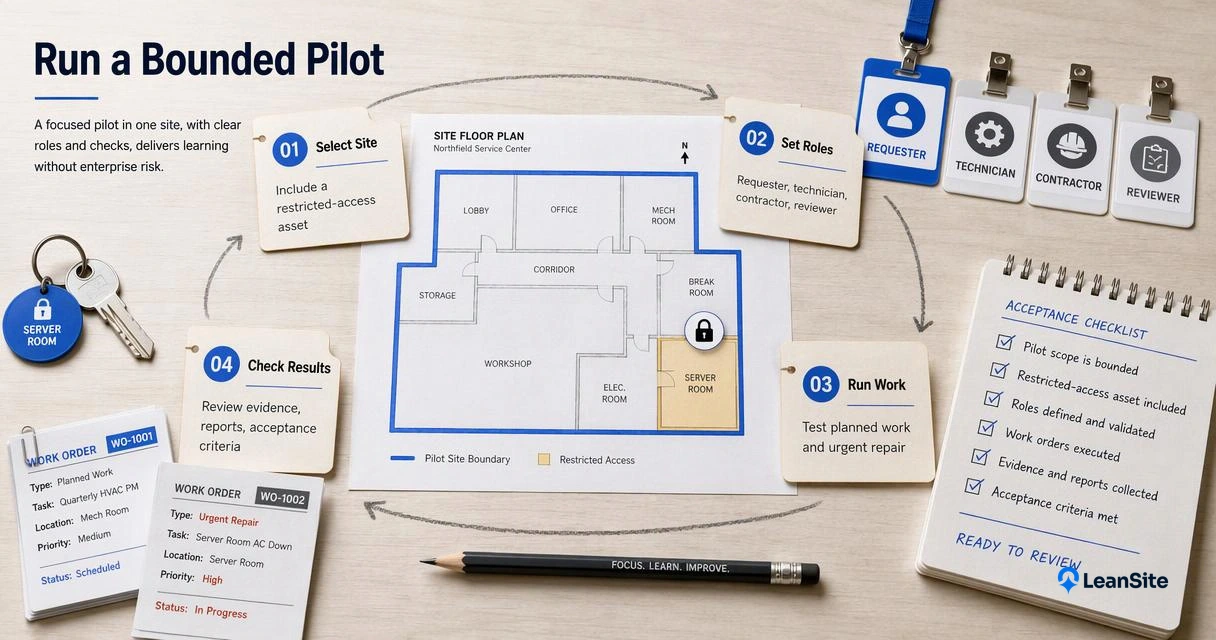
Five steps from demonstration to acceptance
A practical pilot follows a repeatable sequence.
- Select representative assets, including one with restricted access.
- Define roles for requesters, technicians, contractors, and reviewers.
- Run planned work and an urgent repair through approved scheduling rules.
- Test mobile updates in actual service areas; consult offline maintenance considerations where connectivity varies.
- Review timestamps, completion records, cost fields, and unresolved handoffs against acceptance criteria.
Establish baseline measures such as overdue planned tasks, request-to-assignment time, and reopened jobs. Compare like-for-like work; software adoption doesn't automatically explain a change in performance.
2027 watchlist: AI assistance with human approval
AI evaluation should focus on traceable assistance rather than autonomous maintenance decisions. Buyers can test whether generated summaries preserve original records and whether approvals remain with authorized staff.
The 2023 multidisciplinary opinion paper on conversational AI discusses opportunities, challenges, and implications across practice and policy; it isn't evidence of hospital maintenance savings. For product evaluation, AI facility-management guidance offers related reading.
Treat AI output as reviewable assistance, not permission to bypass access approvals or maintenance procedures.
Conclusion
Shortlist healthcare facility maintenance software using real building workflows, then require a documented pilot before expansion. Facilities leaders considering Leansite can visit getleansite.com and request a walkthrough centered on controlled access, approved scheduling, contractor coordination, and verified closure.
Demi Oloyede
Leansite
Frequently Asked Questions
Can a building CMMS replace clinical equipment software?
A building CMMS shouldn't be assumed to replace clinical equipment software. Building systems and medical devices have different owners, service processes, and record requirements. If one platform is proposed for both, clinical engineering and facilities leaders should separately validate its workflows, data controls, and integration needs.
Does maintenance software guarantee healthcare compliance?
Maintenance software doesn't guarantee healthcare compliance. It can organize schedules, responsibilities, and evidence, but compliance depends on applicable requirements, configuration, procedures, and actual work. Buyers should request documented capabilities and have relevant organizational specialists review them instead of treating a vendor's healthcare label as proof.
Which pilot records are most useful for portfolio expansion?
The most useful pilot records connect each task to a site, asset, owner, approved work window, and reviewed outcome. Consistent cost categories also help property owners compare operations. These records give rollout teams a repeatable template while leaving room for each facility's access arrangements and scheduling needs.
More from the blog
- equipment lifecycle cost
Repair vs Replace Commercial Equipment: A Cost-Based Guide
Compare repair costs, remaining service life, downtime, efficiency, and parts availability with a practical calculation for commercial equipment decisions.
- facility management software
ServiceChannel vs MaintainX: A 2026 Workflow Comparison
Compare ServiceChannel and MaintainX for contractor-heavy, in-house, and mixed maintenance operations, with practical demo tests and selection criteria.
- maintenance vendor coordination
In House vs Outsourced Facility Maintenance: A 2026 Guide
Compare maintenance staffing models by response coverage, skills, workload, and fully loaded costs, with an illustrative budget and hybrid decision guide.