Maintenance Request Software for Tenants and Facility Teams
TL;DR
Choose a shared request system with simple tenant reporting, clear ownership, and separate requester and technician permissions. Compare tools using a complete repair workflow, including vendor dispatch and cost approval, rather than a feature checklist alone.
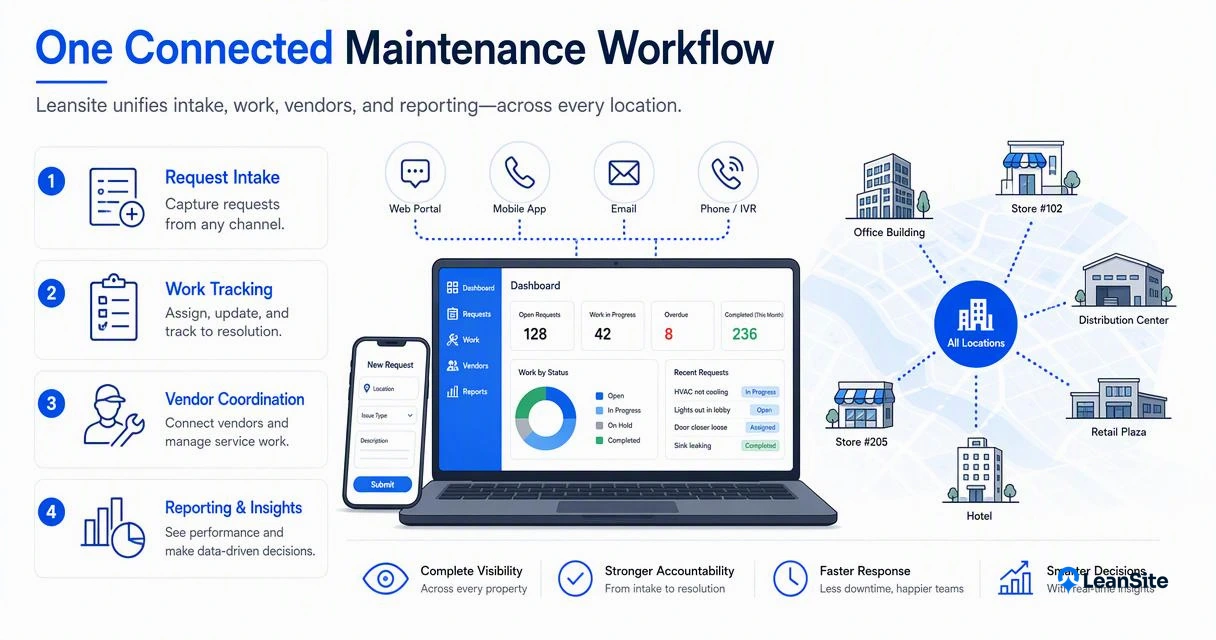
A submitted maintenance request isn't a completed repair. Maintenance request software for tenants and facility teams needs to connect the person reporting an issue with the people responsible for resolving it. For commercial properties and multi-location operations, that means linking intake, assignment, updates, and completion evidence. Leansite belongs in that evaluation for teams exploring AI-assisted facilities management.
Table of Contents
What is maintenance request software?
Maintenance request software is a shared system for reporting building problems, assigning responsibility, tracking repairs, and recording completion. Tenants use it to submit issues and receive updates; facility teams use it to organize work. Its value comes from connecting those activities without exposing internal operational information to every requester.
Maintenance request: A report of a building issue that needs assessment or action.
Work order: An assigned job with instructions, an owner, and a record of completed work.
CMMS: A computerized maintenance management system used to organize maintenance work and related records.
A request and a work order aren't interchangeable. A tenant might report a warm office; the resulting job might involve inspecting an HVAC unit that serves several suites. Keeping both records connected preserves the tenant's context while giving technicians specific instructions.
The tenant needs a clear status update. The technician needs an actionable job. A useful system supports both views.
For background on disconnected intake channels, the guide to email and spreadsheet maintenance workflows explains the operational context.
Which software category fits the property?
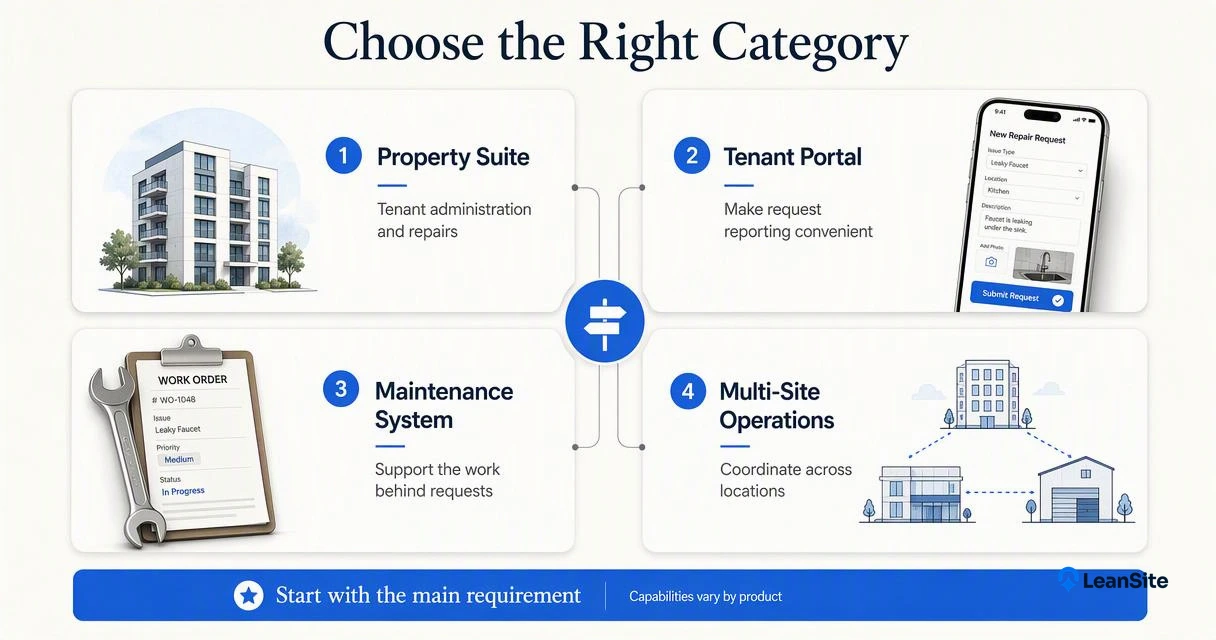
The best software category depends on whether the main requirement is tenant administration, maintenance execution, or coordination across multiple sites. A tenant portal can make reporting convenient, while a maintenance-focused system supports the work behind each request. The buying decision should start with that distinction.
Tenant portals versus maintenance operations tools
These categories represent buying priorities, not guarantees that every product includes every capability.
| Category | Primary fit | Evaluation priority |
|---|---|---|
| Property management suite | Owners combining tenant administration and repairs | Request handling alongside leasing and accounting |
| Maintenance-focused CMMS | Teams managing technicians, assets, and recurring work | Work orders, asset history, and scheduling |
| Multi-site facilities platform | Operators coordinating buildings and external vendors | Site-level routing, approvals, and portfolio reporting |
Who should pick which: A landlord centered on leases and rent collection should evaluate property management suites first. A facilities director responsible for equipment and technician workloads should start with maintenance-focused tools. Enterprise operations teams should prioritize location controls and consistent vendor workflows.
Mixed portfolios may need connected systems rather than one application doing everything. The multi-location facilities management guide provides a broader framework for that decision.
Request demonstrations using the same repair scenario across shortlisted products. Comparable inputs make differences in workflow easier to spot.
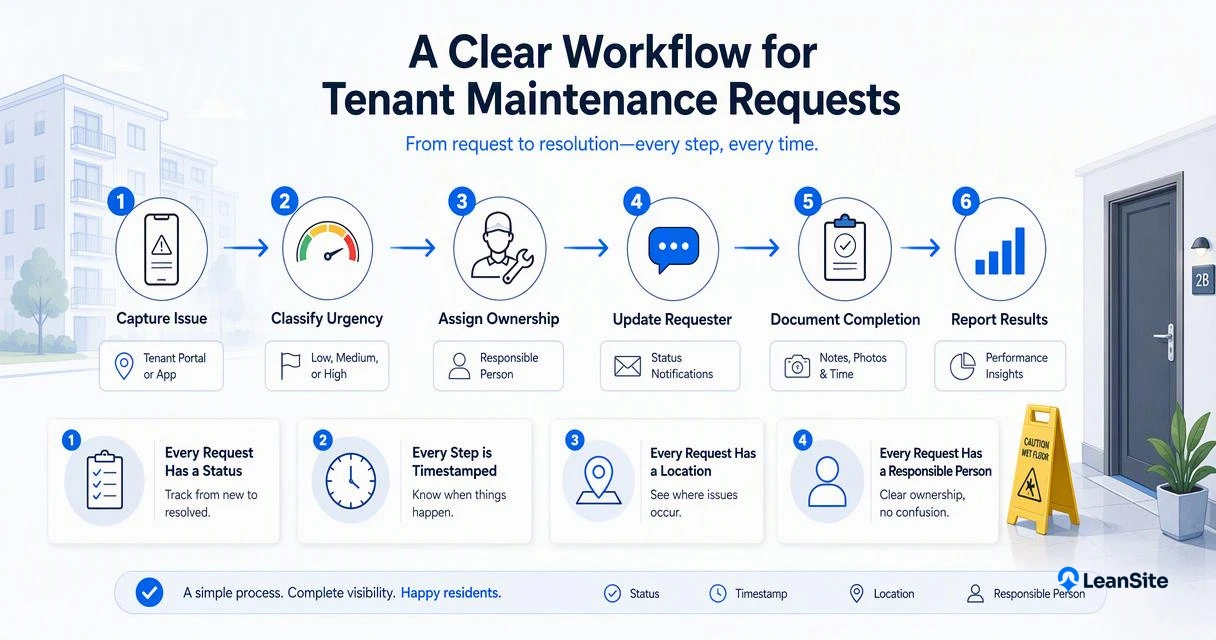
How should tenant requests become completed repairs?
- Capture the location, issue, photos, and access details.
- Assess urgency using documented safety and service rules.
- Assign a technician or approved vendor.
- Share relevant progress updates with the requester.
- Record labor, materials, and completion evidence.
- Review the repair and close the request with a clear outcome.
Information and permissions worth testing
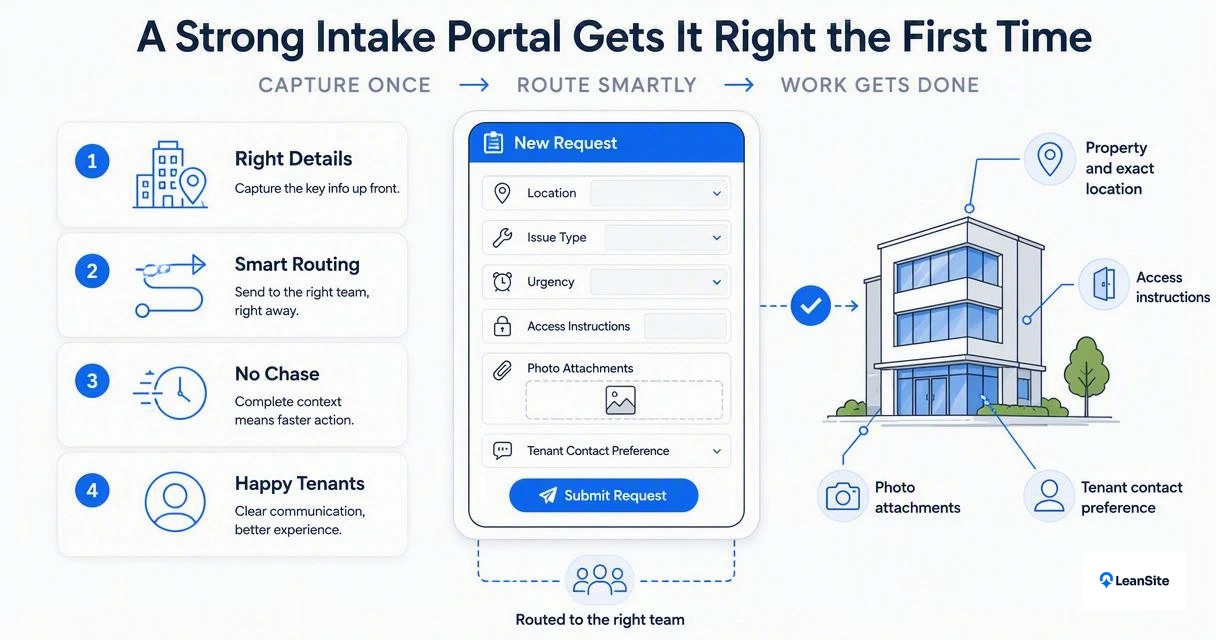
A useful intake form asks enough questions to support action without turning a simple report into paperwork. For an illustrative leaking-ceiling request, the form could capture the suite, affected room, active water flow, and a photo.
- Tenant access: Submission, relevant updates, and access arrangements.
- Technician access: Instructions, asset details, notes, and completion records.
- Vendor access: Assigned work, approved scope, and supporting documents.
- Manager access: Priorities, spending approvals, workload, and reporting.
Emergency instructions should appear before submission when immediate action is necessary. Routine queues shouldn't replace the property's emergency contact process.
Vendor coordination also needs a defined handoff: who accepts the job, who approves changes, and what evidence supports payment. The guide to vendor dispatch and maintenance automation covers that operational layer.
An in-house maintenance workflow example
An AppFolio tutorial provides a product-specific example of an in-house maintenance technician workflow. It can support evaluation discussions, but a demonstration should still use the property's actual roles and approval requirements.
How Leansite handles this
Leansite presents its facilities management approach around AI assistance, including the built-in assistant Vera. That makes it relevant to teams evaluating how assistance fits into maintenance coordination. Its published introduction to Vera provides context for a focused demonstration.
A practical 2026 demonstration checklist
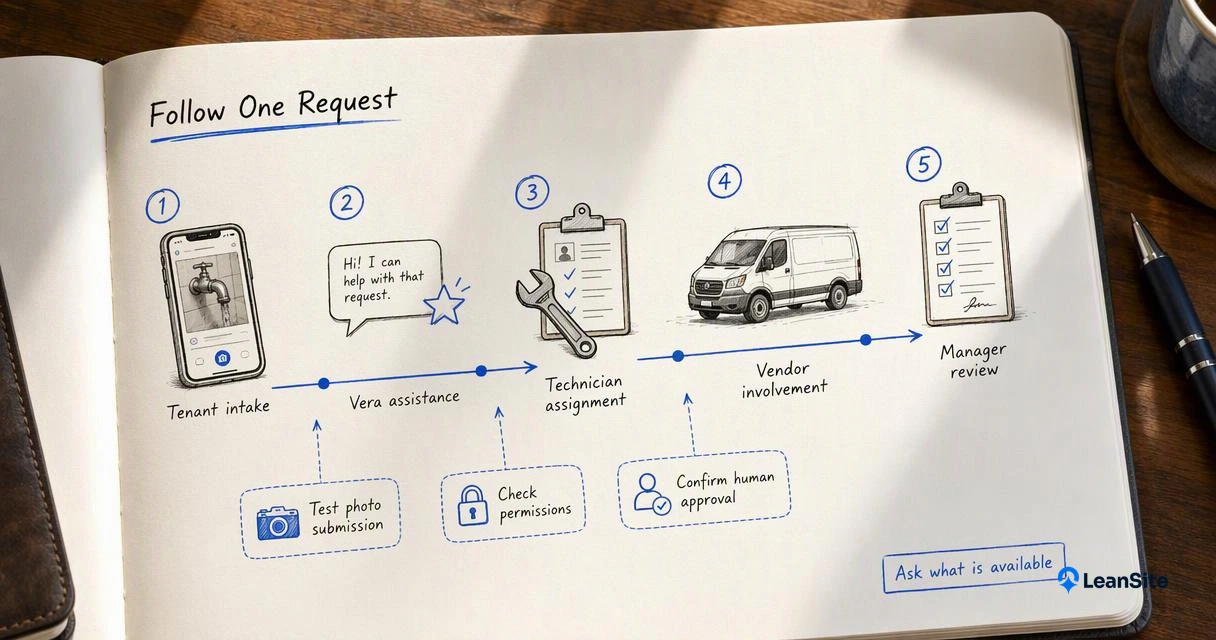
A useful demonstration follows one request from tenant intake through technician assignment, vendor involvement, and manager review. The evaluation should establish which capabilities are available, how permissions work, and where human approval remains necessary.
- Test a tenant submission with a photo and access window.
- Check how staff assign ownership and update status.
- Inspect vendor handoffs and spending approval steps.
- Review completion evidence and location-level reporting.
Record the steps required and any manual transfers. A short pilot should include both routine jobs and requests needing approval, with named staff responsible for reviewing the results.
For 2027 planning, AI-assisted triage is a sensible evaluation topic, not a reason to remove oversight. Safety priorities, tenant information, and spending decisions need clear controls. The guide to AI facility management software offers related reading.
Conclusion
Choose a workflow, then validate the software
Select maintenance request software for tenants and facility teams through a small, documented pilot. Use real requests, separate user roles, and measurable acceptance criteria. Teams considering Leansite can visit getleansite.com and request a walkthrough covering tenant intake, maintenance ownership, vendor coordination, and completion review.
Demi Oloyede
Leansite
Frequently Asked Questions
Do tenants need to install an app?
Tenants don't necessarily need an app; submission options depend on the product. Buyers should check whether a browser form, portal, or mobile application supports the intended users. The practical test is whether a tenant can report an issue and receive updates without staff entering the same information again.
Can tenants see internal maintenance notes?
Tenant visibility should be controlled by permissions, not assumed from a product's interface. Buyers should test requester accounts separately from technician and manager accounts. Internal notes, costs, vendor details, and other tenants' requests should remain restricted unless an authorized manager deliberately shares information relevant to the reported issue.
Can one system support outside vendors?
A single system can support vendor coordination when its workflow accommodates external users or structured handoffs. The evaluation should confirm assignment acceptance, access instructions, scope approval, completion evidence, and invoice handling. A vendor receiving an email notification alone doesn't establish that the full repair and payment process is connected.
Which metrics should facility managers track?
Facility managers should track acknowledgment time, completion time, open-request age, repeat issues, and cost by site or asset. Priority levels should be reviewed separately so emergencies aren't mixed with routine work. Establishing a baseline before rollout helps teams judge whether the selected workflow improves service and operational visibility.
More from the blog
- parts reservations
Best Spare Parts Inventory Software for Facilities in 2026
Compare facilities inventory options by storeroom workflow, equipment links, reservations, purchasing, and stock sharing across buildings.
- facilities software comparison
CAFM vs IWMS: Scope, Integrations, and Selection Guide
Compare CAFM and IWMS across maintenance, space, leases, capital planning, and integrations, with a practical decision guide for facilities teams.
- vendor dispatch
Maintenance Automation: A Practical Guide for Facilities in 2026
Learn how to automate maintenance scheduling, vendor dispatch, and approvals, with practical rollout steps and metrics for multi-site facilities.