What Are Facilities? A Practical Guide to Commercial Operations
TL;DR
Commercial facilities include buildings, equipment, shared spaces, and services that support business operations. Effective management starts with clear ownership, an asset register, and consistent work orders; portfolio teams also need comparable costs and service records across locations.
Facilities are the buildings, equipment, spaces, and supporting services that allow a business to operate safely and reliably. A commercial property isn't just its address or floor plan. Heating, lighting, plumbing, cleaning, access control, and maintenance coordination all affect how the site works. For property owners and operations teams, the practical question is how these parts connect, who owns each responsibility, and what evidence shows the building is performing.
Table of Contents
What do commercial facilities include?
Commercial facilities include physical premises, building systems, operational equipment, shared amenities, and services that support the site's intended use. Their scope depends on the business: an office needs usable workspaces, while a restaurant also needs food-service equipment, ventilation, and cleaning routines suited to its operations.
Facility management: The coordination of people, places, and processes to keep a built environment functional.
Facility maintenance: The inspection, servicing, and repair work that keeps buildings and equipment operating.
Asset register: A structured record of equipment, its location, condition, ownership, and service history.
Building systems, accountable teams, and routine tasks
The following responsibilities are typical examples; leases, service contracts, and local requirements determine actual ownership.
| System or service | Typical responsible team | Typical maintenance tasks |
|---|---|---|
| Heating, ventilation, and air conditioning | Maintenance team and HVAC contractor | Filter changes, inspections, control checks |
| Electrical and lighting | Building operations and qualified electricians | Lighting checks, fault investigation, scheduled inspections |
| Plumbing and drainage | Maintenance team and plumbing contractor | Leak checks, drain servicing, fixture repairs |
| Fire and life safety | Site management and specialist contractors | Scheduled testing, inspection records, corrective work |
| Cleaning and waste | Cleaning contractor and site supervisor | Cleaning schedules, waste collection, quality checks |
| Doors and access control | Security team and specialist vendors | Hardware checks, access reviews, service calls |
Production machinery may sit with another department, but shared utilities still need coordinated ownership. A tenant's equipment and a landlord's building systems shouldn't be treated as interchangeable responsibilities.
How should teams organize maintenance work?
Teams should organize maintenance work through a shared process that assigns ownership and records each job from request to completion:
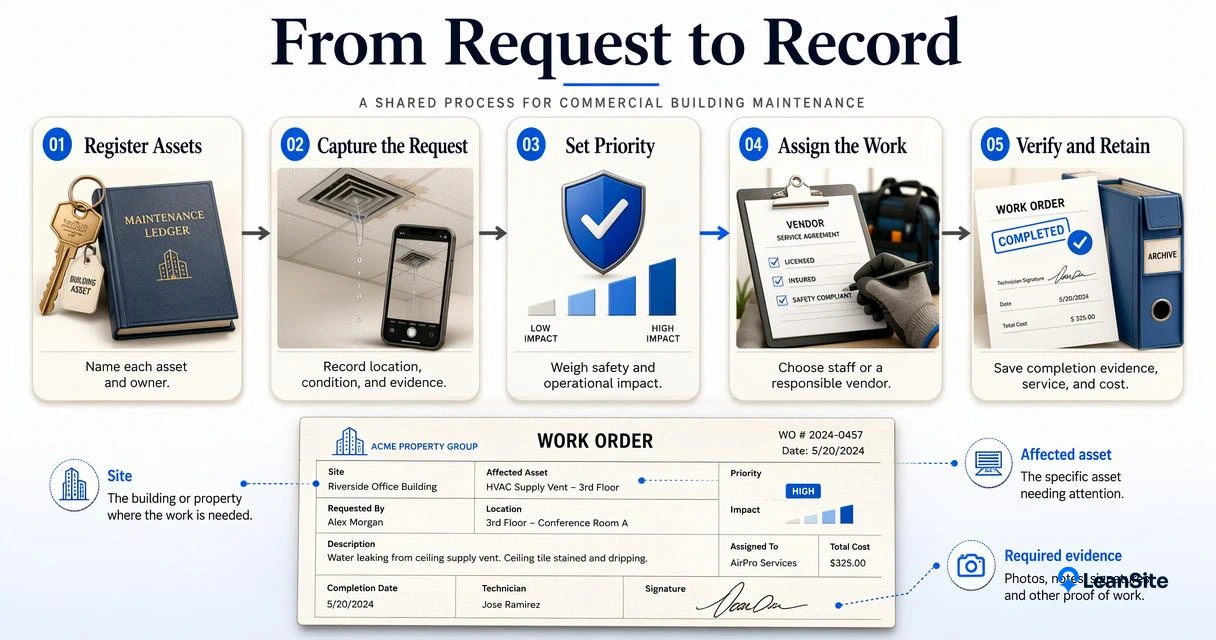
- Register assets and responsible parties.
- Capture requests with location and evidence.
- Prioritize by safety and operational impact.
- Assign staff or vendors.
- Verify completion.
- Retain service and cost records.
Make every handoff explicit
A useful work order identifies the site, affected asset, reported condition, priority, assigned party, and required completion evidence. For example, an air-conditioning request should name the unit and affected area, rather than simply report that a building feels warm.
Vendor coordination also needs approval boundaries. The person scheduling attendance may not have authority to approve replacement equipment or additional labor. Recording those limits helps the contractor route a decision to the right person.
For distributed portfolios, the guide to multi-location management software provides related reading on organizing work across sites.
A completed task becomes useful operational evidence when its record identifies what changed, who performed the work, and how completion was verified.
Match schedules to the operating environment
Service timing should reflect equipment guidance, usage, access restrictions, and applicable inspection requirements. A restaurant kitchen and an office lobby need different routines, even when both belong to the same portfolio.
The 2026 restaurant-chain management guide explores that sector-specific context. Standard processes should make local requirements visible, not erase them.
Which metrics reveal building performance?
Building performance metrics should connect service delivery, asset reliability, and operating costs rather than count completed jobs alone. A balanced review tracks response time, restoration time, scheduled-work completion, repeat repairs, and spending by asset or location. Each measure needs a consistent definition before sites can be compared fairly.
Choose measures that support decisions
- Response time: Elapsed time between receiving a request and acknowledging or attending it, with the chosen definition stated clearly.
- Restoration time: Time until the affected service becomes available again.
- Scheduled-work completion: Planned tasks completed within the agreed reporting period.
- Repeat repairs: Recurring work on the same asset or fault.
- Asset spending: Labor, parts, and contractor charges linked to specific equipment.
A short response time doesn't prove a repair lasted. Likewise, a higher maintenance bill may reflect planned replacement work rather than poor performance. Owners should review costs alongside service history and operating conditions.
The guide to work-order transparency for campuses offers related reading on making job status visible to stakeholders.
How Leansite supports operational coordination
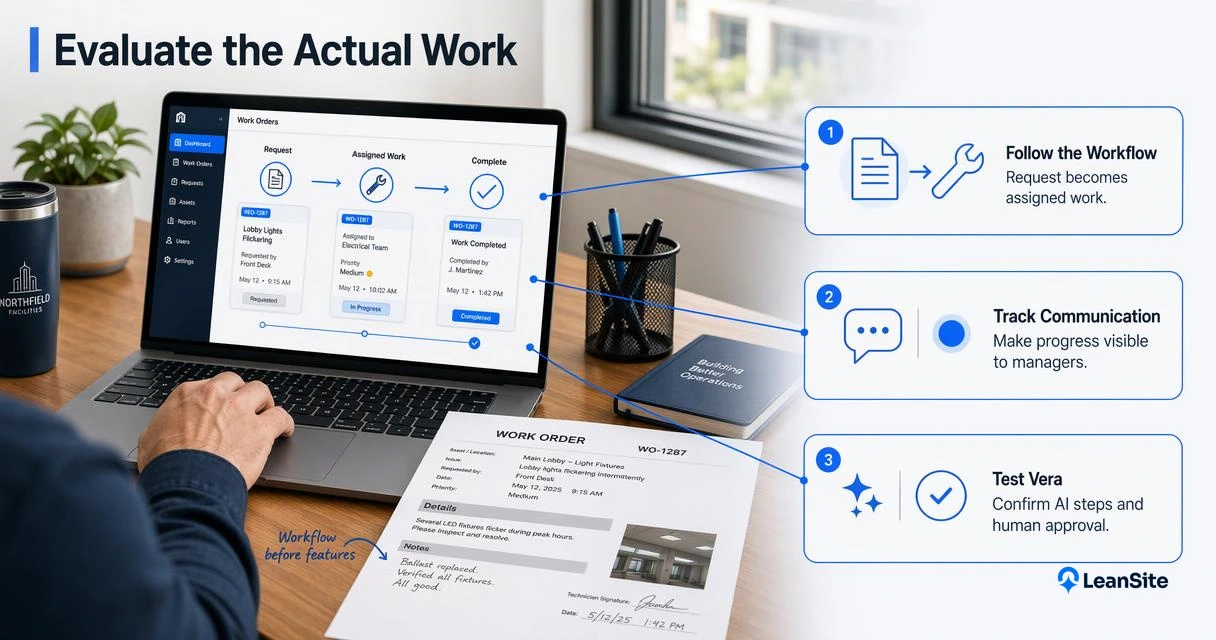
Leansite is a relevant option for teams evaluating software-supported maintenance coordination. A useful assessment starts with an actual operating workflow: how a request becomes assigned work, how progress is communicated, and how completion evidence reaches managers. Product selection should follow that workflow rather than a feature count.
Evaluate the platform through a real service scenario
The Leansite platform's published introduction to Vera, its AI assistant, provides a starting point for exploring AI-supported work. A demonstration should show which steps the assistant handles and which remain subject to human approval.
A practical evaluation can follow three checkpoints:
- Submit a sample request with an asset and location.
- Review assignment, status visibility, and approval steps.
- Inspect the completed record and available reporting.
This approach gives purchasing teams concrete evidence of fit.
What to assess before 2027 planning
AI-assisted workflows deserve testing against clear acceptance criteria: accurate asset references, traceable actions, and defined approval boundaries. Autonomous operation shouldn't be assumed from an AI label.
The guide to AI facility management software provides related reading for teams planning their next software review. Clean records remain valuable regardless of which automation features a team adopts.
Conclusion
Start a facilities review with one site: map its systems, confirm responsibility, and trace a maintenance request through completion. Then identify the reporting needed for portfolio decisions. Teams evaluating Leansite can visit getleansite.com and use that same service scenario to assess operational fit.
Demi Oloyede
Leansite
Frequently Asked Questions
Does facility management include cleaning?
Facility management commonly includes coordinating cleaning, even when an outside contractor performs the work. The management role covers scope, scheduling, access, and quality checks. Cleaning teams handle service delivery, while site managers confirm that the agreed standard matches occupancy, business activity, and any applicable hygiene requirements.
Who pays for repairs in a leased building?
Repair costs depend on the lease, service agreements, and applicable law. A landlord may cover some structural or shared systems, while a tenant covers certain internal equipment or services. Responsibility should be confirmed before authorizing work; a maintenance platform can record the agreement but cannot determine contractual liability.
Does every commercial site need management software?
Not every commercial site needs a dedicated platform immediately. A small operation may manage work through a consistent shared register and documented procedures. Software becomes worth evaluating when request volume, vendor coordination, approval steps, or multiple locations make status and service history harder to maintain through simpler tools.
More from the blog
- commercial property maintenance
Facilio vs MaintainX: A Practical Buyer’s Guide for 2026
Compare Facilio and MaintainX through portfolio oversight, technician workflows, integrations, and implementation. Use a practical demo scorecard.
- facility inspection software
Warehouse Facility Maintenance Software: A 2026 Buyer’s Guide
Compare warehouse maintenance software by dock-door uptime, building inspections, contractor coordination, and clear repair ownership.
- covered assets
Facility Maintenance Service Contract Scope of Work: A Practical Guide
Define covered assets, service schedules, exclusions, acceptance criteria, and change approvals with practical maintenance contract clauses.