UpKeep vs MaintainX: A Practical CMMS Comparison for 2026

TL;DR
UpKeep deserves a close look for asset-centered maintenance, while MaintainX belongs on the shortlist for frontline maintenance workflows. The strongest choice depends on a live workflow test and a written cost breakdown covering technicians, vendors, reporting, and rollout.
UpKeep vs MaintainX is a workflow decision before it's a software decision. Facility managers need more than a digital task list: they need clear ownership, usable maintenance records, and visibility across buildings. Both products belong in a CMMS evaluation, but a convincing demo doesn't establish operational fit.
CMMS: A computerized maintenance management system organizes maintenance work, asset records, and recurring service schedules.
For commercial-property teams considering a broader shortlist, Leansite also merits a workflow demonstration. The useful comparison starts with actual maintenance jobs, not the longest feature checklist.
Table of Contents
UpKeep vs MaintainX: What deserves comparison?
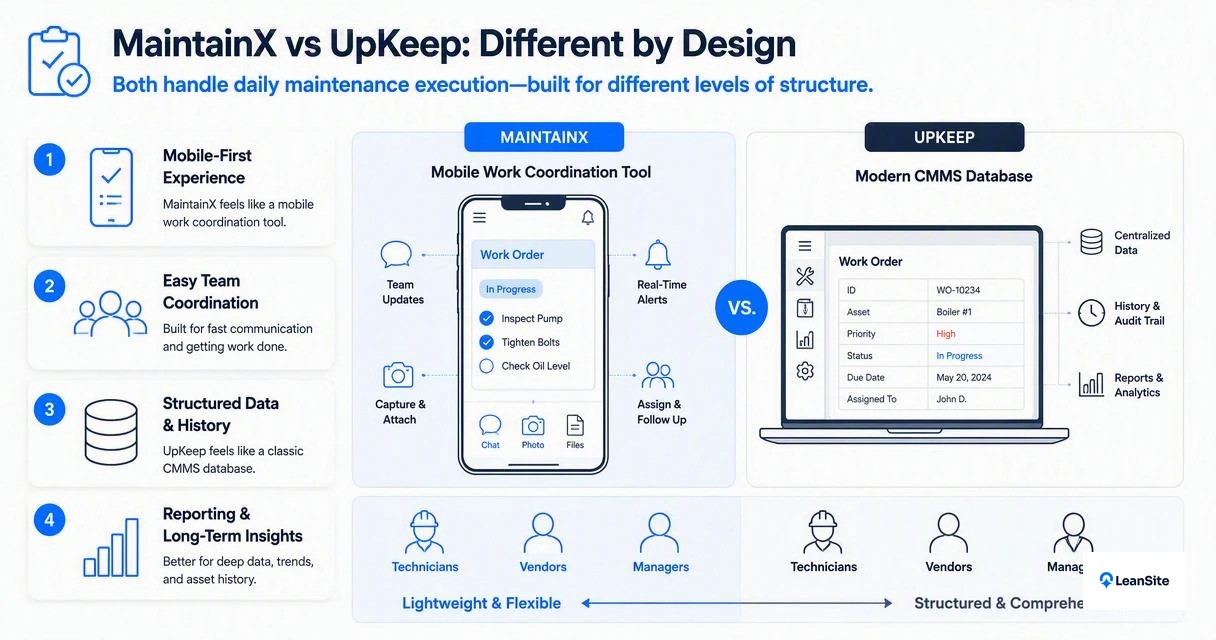
UpKeep and MaintainX should be compared through asset history, work execution, reporting, and access requirements rather than product labels alone. UpKeep Asset Operations Platform has an asset-centered positioning, while MaintainX is presented as a CMMS for facilities and manufacturers in the review below. Those starting points guide evaluation; they don't establish a universal winner.
Side-by-side evaluation priorities
The Gartner Peer Insights UpKeep listing provides another research starting point. Its inclusion among MaintainX alternatives supports comparing the products, not assuming that either fits every property portfolio.
| Evaluation area | UpKeep demonstration | MaintainX demonstration |
|---|---|---|
| Asset records | Trace one asset from service request to repair history | Run the same asset-history test |
| Technician workflow | Complete a job from a phone | Complete the identical job from a phone |
| Preventive maintenance | Show scheduling, assignment, and completion | Show the same recurring service cycle |
| Vendor coordination | Demonstrate external access and approvals | Verify equivalent access and approvals |
| Portfolio reporting | Compare properties using consistent categories | Reproduce the same cross-property report |
These are demonstration requirements, not claims that every capability is included in every subscription. Each vendor should identify the applicable plan, configuration, and access rules.
MaintainX workflow video
The MaintainX CMMS Review for Facilities and Manufacturers offers a visual introduction. A review can clarify screen flow, but a facility-specific demonstration should determine fit.
How should teams compare CMMS costs in 2026?
- Compare CMMS costs using written 2026 quotes for the same operating scope.
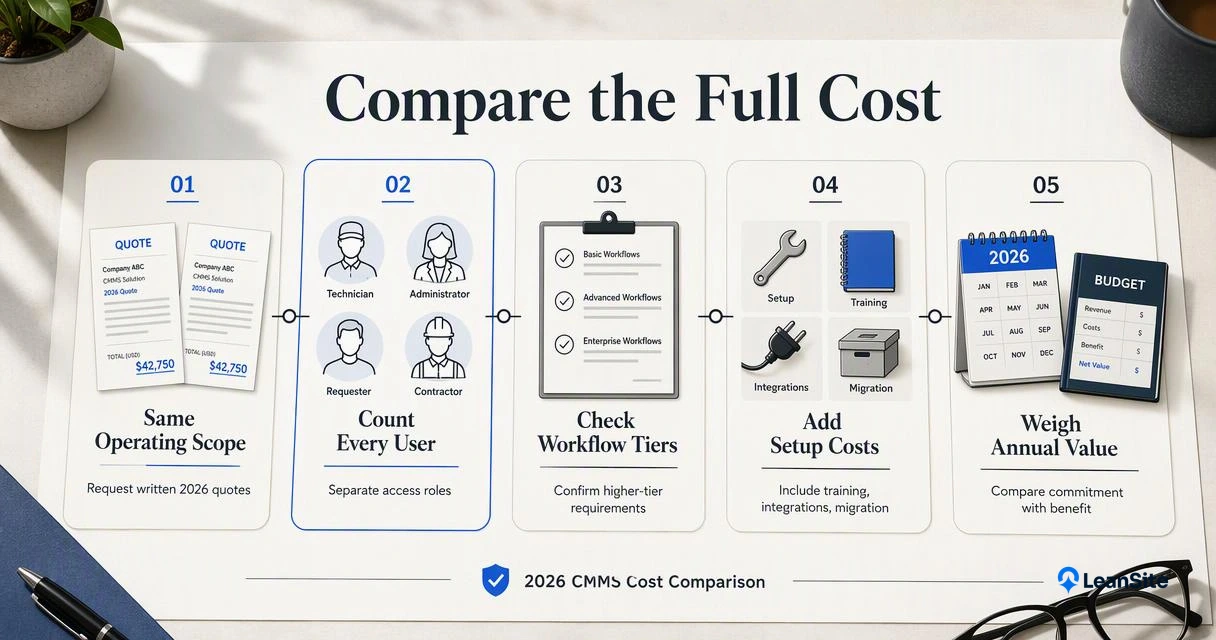
- Count technicians, administrators, requesters, and external vendors separately.
- Confirm which workflows require higher subscription tiers.
- Add setup, training, integrations, and data migration.
- Compare the resulting annual commitment with the budget and expected operational benefit.
Price the complete operating model
A subscription figure means little without an access model. A property owner viewing reports, a technician closing repairs, and a contractor receiving assignments may need different permissions. Quotes should explain how each role affects billing and which users can work across locations.
- Seats: Identify paid roles and any minimum commitments.
- Configuration: Separate included setup from paid implementation work.
- Connections: Confirm accounting, identity, and other integration requirements.
- Renewal: Document contract length, renewal terms, and expansion pricing.
For an illustrative portfolio with 12 properties and 18 technicians, both vendors should quote the same locations, roles, and workflows. These numbers describe a buying scenario, not a published benchmark.
Connect costs to measurable outcomes
A useful business case tracks administrative time, overdue preventive work, and repeat repairs against an existing baseline. Savings should come from measured pilot results rather than vendor promises. Finance teams should also distinguish subscription spending from the labor required to maintain clean records.
The meaningful price comparison is the cost of running the agreed workflow, not the smallest number on a pricing page.
Who should pick UpKeep or MaintainX?
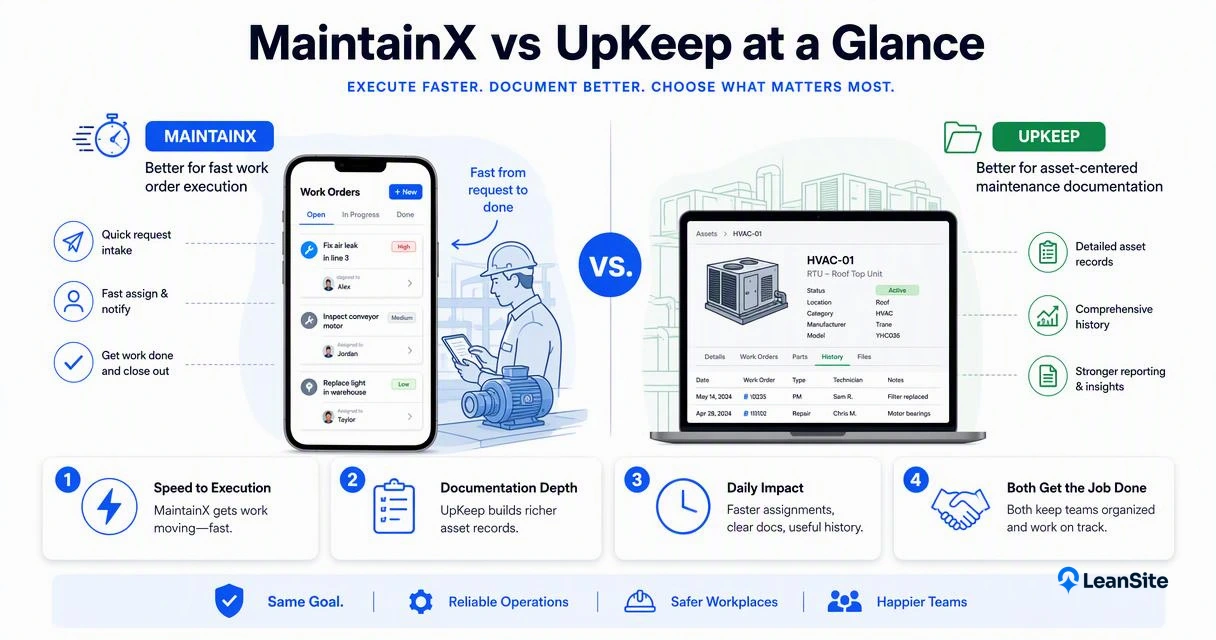
Asset-centered teams should put UpKeep through the deepest equipment-history test, while teams prioritizing frontline execution should put MaintainX through the deepest technician-workflow test. Neither emphasis guarantees a better result. Commercial portfolios should choose the system that makes their own maintenance process clear, repeatable, and easy to supervise.
Match the shortlist to operational priorities
- Facility managers: Prioritize assignment clarity, recurring work, and completion evidence.
- Property owners: Prioritize property-level spending and understandable asset histories.
- Enterprise operations teams: Prioritize consistent categories, permissions, and portfolio reporting.
- Vendor coordinators: Prioritize dispatch, approval handoffs, and documentation for payment.
An asset-heavy site might test a rooftop HVAC unit with several previous repairs. A service-heavy portfolio might test a contractor visit spanning dispatch, access instructions, completion photos, approval, and invoice handoff. The same scenario should run in both systems.
Run a pilot with visible acceptance criteria
A short pilot should involve the people who will enter and approve work, not just software buyers. A technician completes a mobile repair, a manager schedules recurring service, and an owner reviews a property report. Observers record completion time, clarification requests, and missing information.
Before the pilot starts, the team should agree on what a successful result looks like. A documented scorecard makes the final decision easier to explain to operations, finance, and leadership. It also gives the selected vendor a clear implementation brief.
How Leansite handles this evaluation
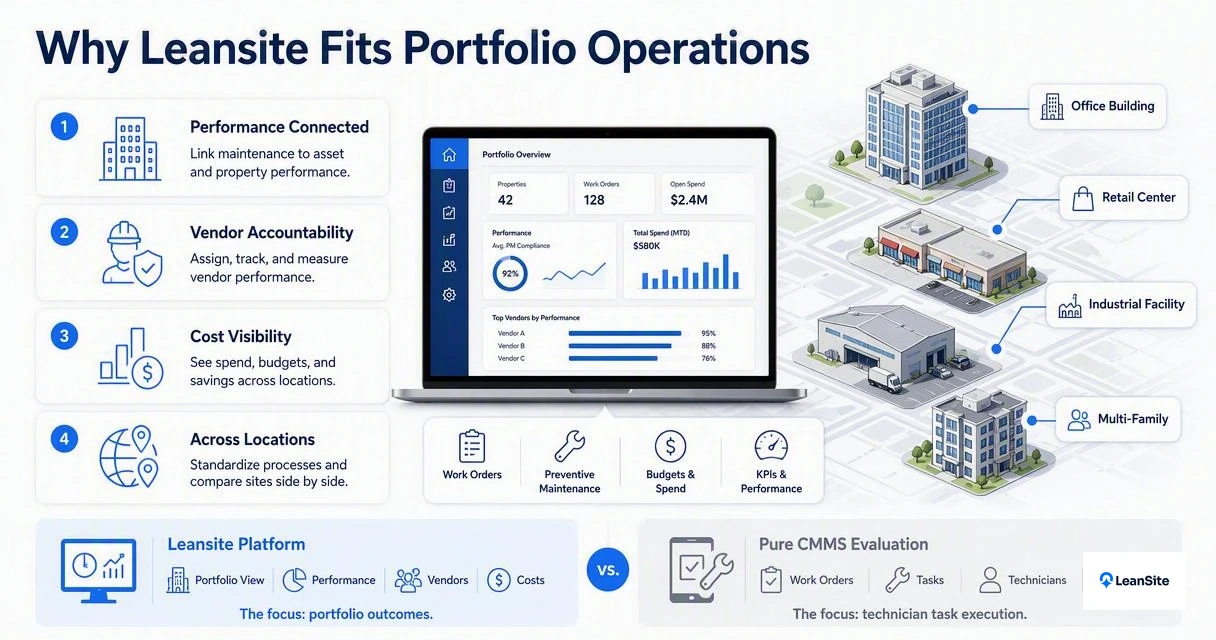
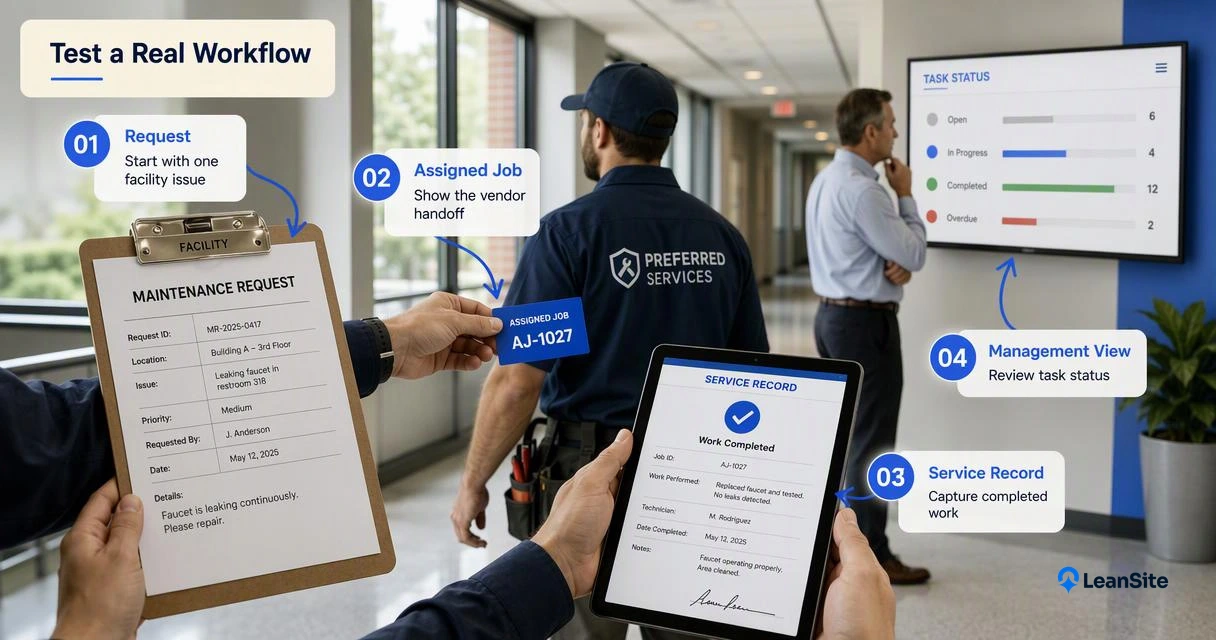
The Leansite platform belongs in a commercial-maintenance evaluation centered on facility operations, task tracking, and vendor coordination. A focused demonstration should show how the proposed setup supports those requirements. Evaluation should stay specific: one request, one assigned job, one completed service record, and one management view.
Build a broader, evidence-based shortlist
The comparison with UpKeep and comparison with MaintainX provide focused follow-up reading. Teams considering additional options can also consult this MaintainX alternatives guide.
The most productive demonstration follows a real commercial service request from creation through review. That gives stakeholders a shared basis for discussing workflow fit, access, and rollout.
Conclusion
The next step in an UpKeep vs MaintainX decision is a shared pilot brief and comparable written quotes. Facility teams considering Leansite can visit getleansite.com to request a demonstration built around an actual service request. The winning platform should prove its fit before the portfolio commits.
Demi Oloyede
Leansite
Frequently Asked Questions
Is UpKeep better than MaintainX for commercial properties?
UpKeep isn't automatically better than MaintainX for commercial properties. The answer depends on asset complexity, technician workflows, reporting needs, and contractor participation. A fair comparison uses identical service scenarios and written subscription scopes. Property teams should favor demonstrated fit over broad claims about which product serves an industry better.
How should preventive maintenance be tested?
Preventive maintenance should be tested through a complete recurring service cycle. Each vendor should schedule a task, assign responsibility, capture completion evidence, and show how the next occurrence is handled. Managers should also inspect overdue-work visibility and the asset record rather than accepting a calendar screenshot as sufficient proof.
What should teams verify about external vendors?
Teams should verify how external vendors receive assignments, access job details, submit evidence, and participate in approvals. Billing and permissions should be confirmed separately. A contractor account shouldn't expose unrelated property information, and completion documentation should support the organization's invoice review process without assuming that payment processing is included.
More from the blog
- parts reservations
Best Spare Parts Inventory Software for Facilities in 2026
Compare facilities inventory options by storeroom workflow, equipment links, reservations, purchasing, and stock sharing across buildings.
- facilities software comparison
CAFM vs IWMS: Scope, Integrations, and Selection Guide
Compare CAFM and IWMS across maintenance, space, leases, capital planning, and integrations, with a practical decision guide for facilities teams.
- vendor dispatch
Maintenance Automation: A Practical Guide for Facilities in 2026
Learn how to automate maintenance scheduling, vendor dispatch, and approvals, with practical rollout steps and metrics for multi-site facilities.