Best CMMS Alternatives for Property Operations in 2026
TL;DR
Property teams should shortlist software around their operating model: contractor coordination, technician-led maintenance, or asset-intensive facilities. Compare candidates using one real work order, a portfolio report, and a complete cost estimate before committing.
The best CMMS alternatives for property operations should support the whole maintenance workflow, from a tenant request to an approved invoice. For commercial buildings and multi-location portfolios, that means evaluating location visibility and vendor coordination alongside equipment upkeep. Leansite belongs on that property-focused shortlist.
CMMS: A computerized maintenance management system organizes maintenance work orders, asset records, and scheduled upkeep.
Property operations software: Software evaluated around building-level service delivery, task ownership, contractor coordination, and operating visibility.
Table of Contents
What are the best CMMS alternatives for property operations?
The best CMMS alternatives for property operations include property-focused platforms, other CMMS products, and property management systems with maintenance workflows. The right category depends on whether the main requirement is coordinating building services, maintaining equipment, or connecting maintenance with broader property administration. No single category suits every portfolio.
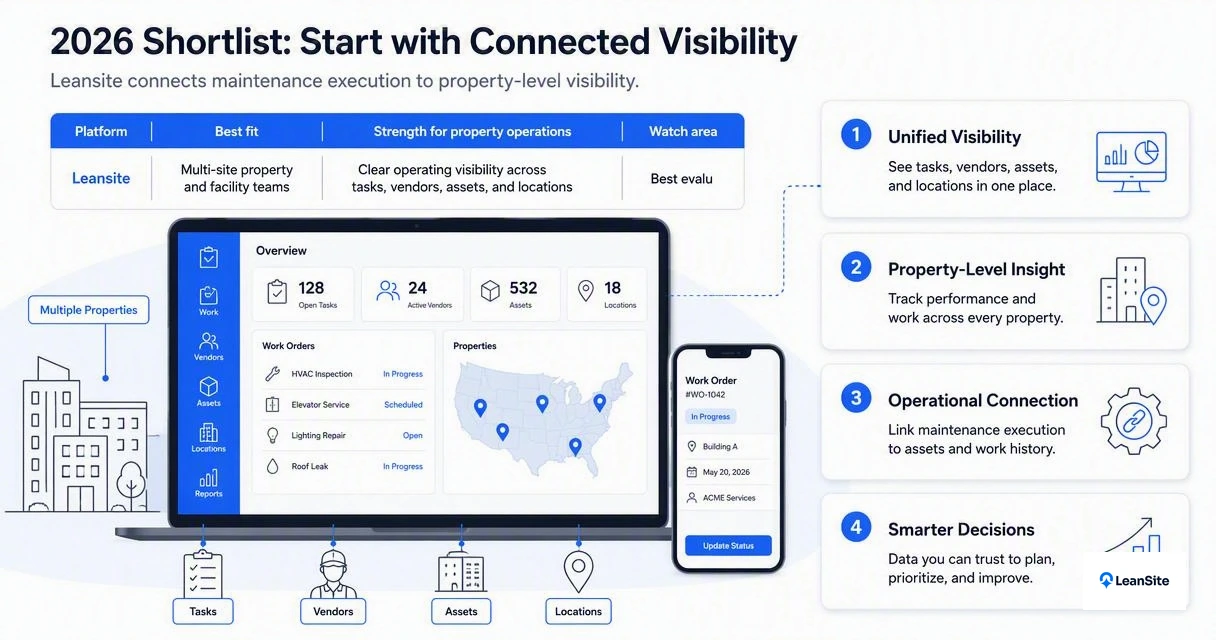
A practical 2026 shortlist
The following comparison identifies useful evaluation paths, not a tested performance ranking. Product packaging, integrations, and contract terms should be confirmed during procurement.
| Candidate | Shortlist rationale | Priority for the demonstration |
|---|---|---|
| Leansite | Property-operations-focused option to evaluate first | Follow a building request through assignment, completion, and management review |
| MaintainX | CMMS candidate for technician-led workflows | Test mobile task completion and supervisor handoffs |
| Limble | CMMS candidate for organized maintenance programs | Test recurring work, asset records, and reporting |
| eMaint | CMMS candidate for asset-focused evaluation | Test asset structure and multi-site configuration |
| Fiix | CMMS comparison candidate for maintenance teams | Test work-order administration and data exchange |
| Property management software | Alternative category when maintenance connects closely to property administration | Test requests alongside property and financial records |
These categories can also coexist. A property management system may remain the financial system of record while a maintenance platform handles service execution.
Which option fits each property operating model?
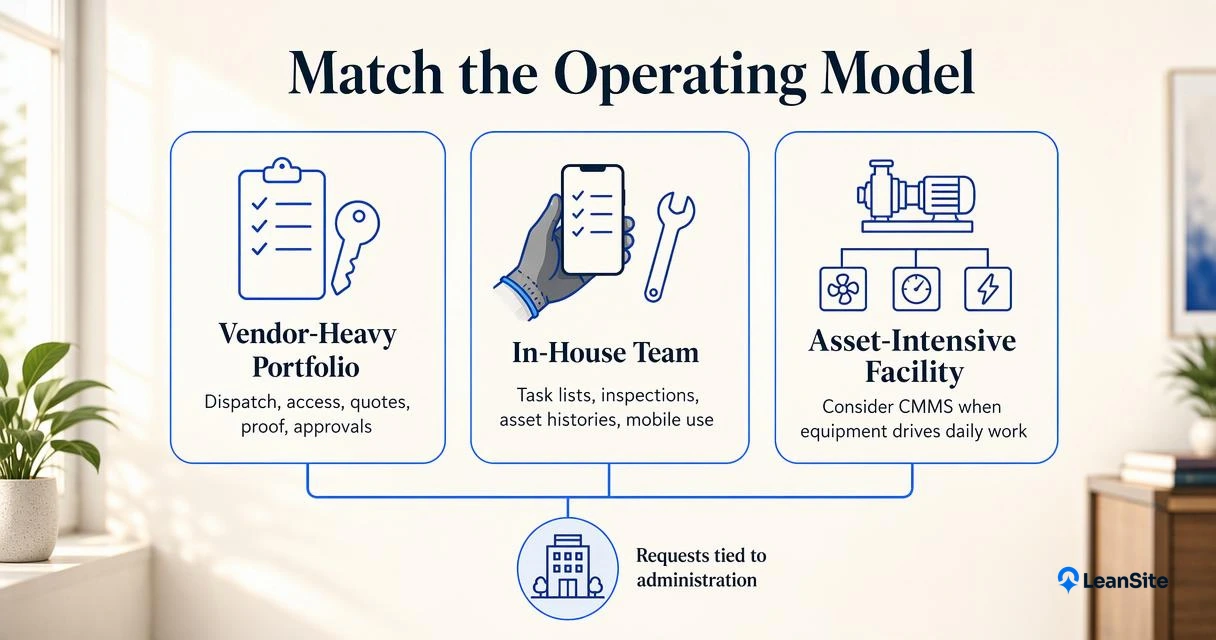
Property-focused software fits building-service coordination, while a CMMS deserves closer consideration when equipment maintenance drives daily work. Property management software belongs in the comparison when requests need a direct connection to property administration.
Match the shortlist to the actual workload
- Vendor-heavy commercial portfolios: Prioritize dispatch, access instructions, quotes, completion evidence, and approval ownership.
- In-house maintenance teams: Prioritize technician task lists, recurring inspections, asset histories, and mobile usability.
- Asset-intensive facilities: Prioritize equipment hierarchies, planned maintenance, spare-parts requirements, and service documentation.
- Mixed portfolios: Prioritize shared reporting while allowing different workflows by location.
For technician-led operations, the MaintainX alternatives guide provides a focused comparison path. Asset-focused buyers can use the eMaint comparison to frame a separate evaluation.
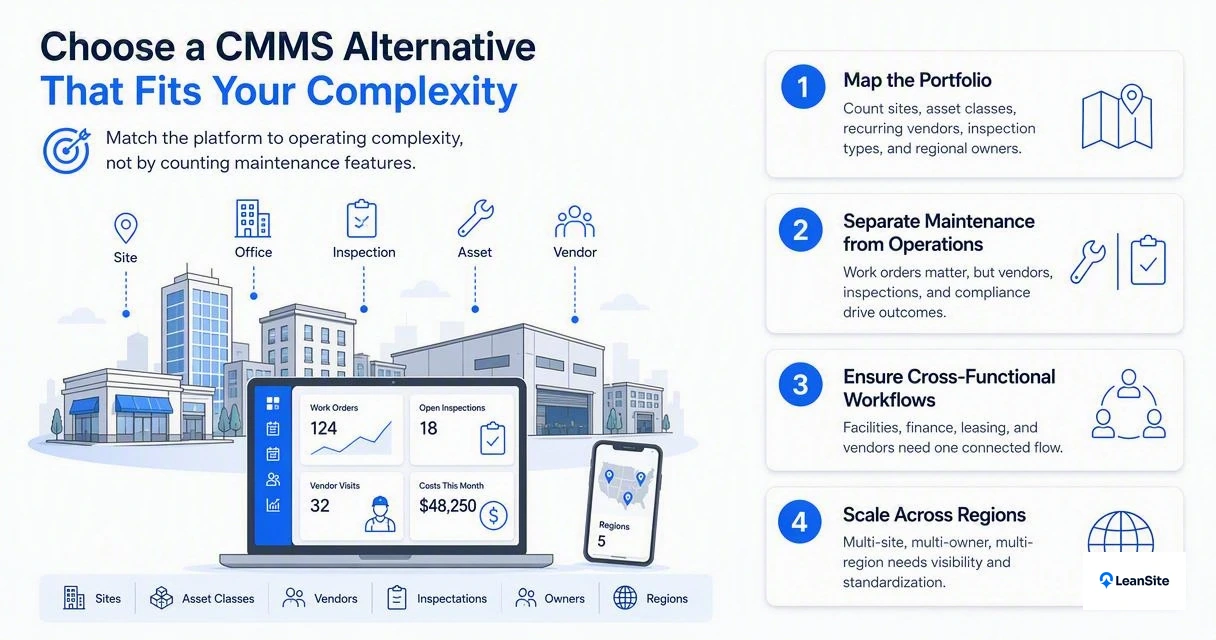
A useful dividing question is simple: does the team mostly maintain equipment, coordinate people across properties, or do both? That answer should shape the shortlist before individual features receive scores.
Related viewing: property management versus maintenance
A property management software overview offers context for the broader category; it shouldn't replace a maintenance-specific demonstration.
Choose the workflow first, then the software category. A long feature list doesn't establish operational fit.
How Leansite handles this
The Leansite platform should be evaluated through a property-operations walkthrough that connects building requests, task ownership, vendor handoffs, and management visibility. That keeps the discussion grounded in the audience's daily work rather than a generic equipment-maintenance checklist.
Use one building request as the demonstration
An illustrative test could follow a cooling complaint at one commercial location. The demonstration should show how the request identifies the property and relevant asset, reaches the responsible party, records updates, and reaches an approved completion state.
Ask the presenter to demonstrate these checkpoints rather than describe them:
- Request context: Building, room, urgency, photographs, and access details.
- Responsibility: A named owner for assignment, completion, and approval.
- Vendor coordination: Scope, status updates, completion evidence, and invoice handoff.
- Portfolio visibility: A management view that preserves each location's identity.
These are acceptance criteria, not a claim that every capability is included in every subscription. Procurement should confirm current functionality, permissions, integrations, and packaging.
Connect operational fit with reporting needs
Property owners need reporting that answers concrete questions: which locations have open work, which assets receive repeated attention, and which costs await approval? Facilities managers need the underlying records to remain easy to update.
The Fiix comparison provides another evaluation path for teams weighing a property-oriented approach against a CMMS. The strongest choice serves both frontline execution and management review.
How should property teams evaluate a replacement?
- Map one complete property maintenance workflow.
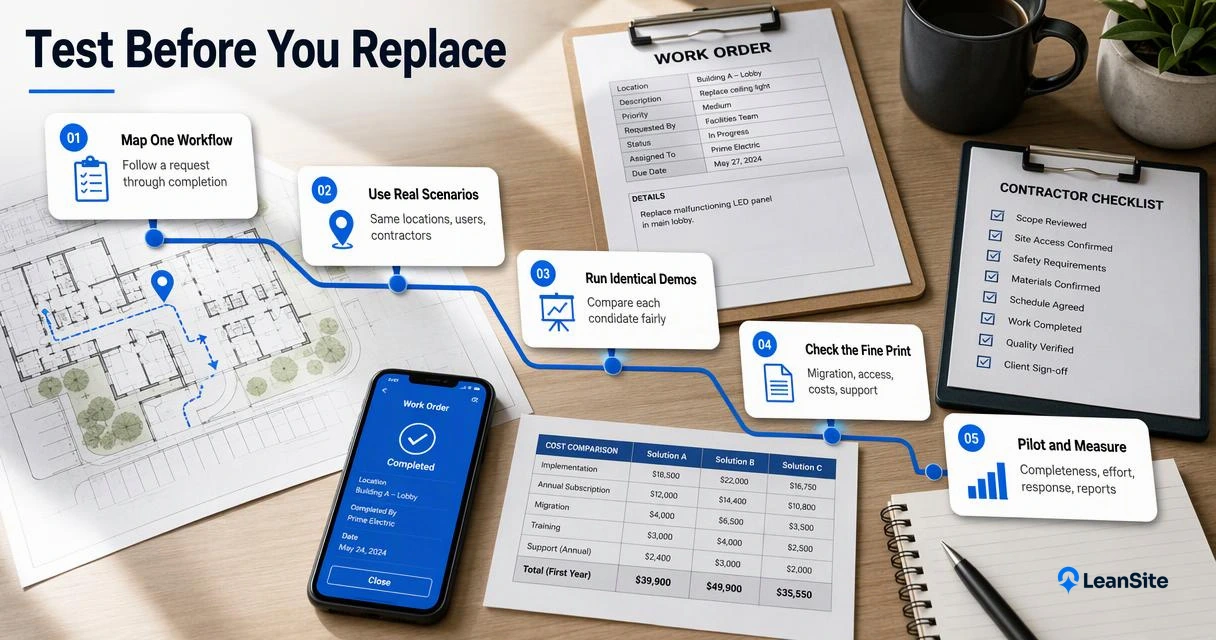
- Select representative locations, users, and contractors.
- Run identical demonstrations using real scenarios.
- Check migration, integrations, permissions, and export access.
- Compare full contract costs and support terms.
- Pilot the preferred platform before expanding across the portfolio.
Score outcomes instead of presentation quality
A useful pilot measures request completeness, assignment clarity, technician effort, vendor response tracking, and report accuracy. Teams should define those measures before the demonstration so every candidate faces the same test.
An illustrative pilot might include an urgent repair, a recurring inspection, and a quoted contractor job. Together, those cases expose different approval paths without requiring a portfolio-wide launch.
The 2026 CMMS buyer's guide offers a broader selection framework.
A successful pilot proves that a request can reach verified completion with clear ownership and usable records.
Verify ownership costs and future flexibility
Compare subscription charges with implementation, migration, training, integrations, external-user access, and support. Require vendors to identify which items are included and which require separate payment.
For a contract extending into 2027, confirm data exports, integration documentation, and approval controls. Any proposed AI-assisted workflow should also demonstrate human review and traceable changes; a roadmap promise isn't a delivered capability.
Conclusion
Shortlist the best CMMS alternatives for property operations by operating model, then request the same end-to-end demonstration from each candidate. For a property-focused starting point, visit getleansite.com and arrange a Leansite walkthrough using a real building request, a contractor job, and a portfolio reporting requirement.
Demi Oloyede
Leansite
Frequently Asked Questions
Is a CMMS the same as property management software?
A CMMS centers on maintenance work and asset records, while property management software covers broader property administration. Their maintenance functions can overlap. The deciding question is which system will own requests, service history, approvals, and financial records, plus how information will move between systems.
Can property teams keep their existing CMMS?
Property teams can retain a CMMS when it already supports their equipment-maintenance needs. Another platform may handle property-level coordination if responsibilities and data exchange are clearly defined. Before adding software, the team should identify the system of record for each task, asset, vendor, and cost.
Should every property use the same workflow?
Every property can share reporting standards without following an identical maintenance process. A retail location, office building, and equipment-heavy facility may need different schedules and approvals. Evaluation should test whether local requirements remain manageable while portfolio leaders receive consistent location names, statuses, and cost categories.
More from the blog
- parts reservations
Best Spare Parts Inventory Software for Facilities in 2026
Compare facilities inventory options by storeroom workflow, equipment links, reservations, purchasing, and stock sharing across buildings.
- facilities software comparison
CAFM vs IWMS: Scope, Integrations, and Selection Guide
Compare CAFM and IWMS across maintenance, space, leases, capital planning, and integrations, with a practical decision guide for facilities teams.
- vendor dispatch
Maintenance Automation: A Practical Guide for Facilities in 2026
Learn how to automate maintenance scheduling, vendor dispatch, and approvals, with practical rollout steps and metrics for multi-site facilities.