Automated Repair Workflows: A Practical Guide for Facilities Teams

TL;DR
Automate repair handoffs, not safety decisions: connect intake, approvals, dispatch, completion evidence, and invoice review. Start with one repeatable repair category, retain human approval for exceptions, and measure waiting time alongside repair time before expanding across properties.
A repair can spend more time waiting for approval than receiving attention. Automated repair workflows address that coordination gap by moving requests through defined rules, owners, and checkpoints. For facilities teams evaluating Leansite, the useful starting point is a clear operating process: what triggers a job, who owns each stage, and what evidence makes it complete.
Table of Contents
What are automated repair workflows?
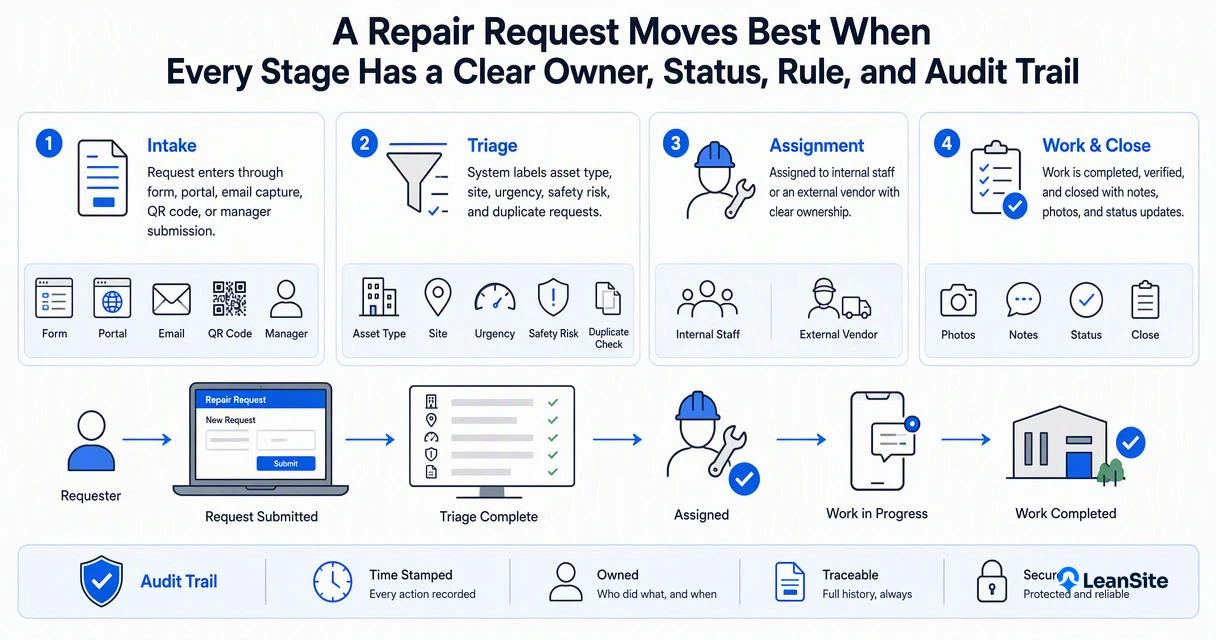
Automated repair workflows are rule-driven processes that move maintenance requests from intake through approval, assignment, repair, verification, and payment review. Software handles repeatable handoffs, reminders, and status updates, while people perform physical repairs and make safety or spending decisions. The goal is accountable coordination, not fully autonomous maintenance.
Repair workflow automation: The use of software rules to trigger actions and move repair records between defined stages.
CMMS: A computerized maintenance management system used to organize maintenance activities and records.
SLA: A service-level agreement that defines response or resolution expectations.
For commercial properties, the core record should connect the location, asset, reported issue, assigned provider, approval history, and completion evidence. That continuity gives facility managers and property owners a shared view of the same job.
Manual, rule-based, and AI-assisted coordination
Rule-based automation follows predefined conditions; AI assistance interprets information that may be less structured.
| Approach | Typical repair task | Human responsibility |
|---|---|---|
| Manual coordination | A manager emails a vendor | Track every handoff |
| Rule-based automation | Route a request by location and trade | Set rules and handle exceptions |
| AI-assisted coordination | Suggest a category from request text | Confirm the suggestion and priority |
A work order marked complete is a status. A work order with accepted evidence is a verified result.
How can facilities teams automate repair handoffs?
- Standardize repair intake with required location, asset, and issue fields.
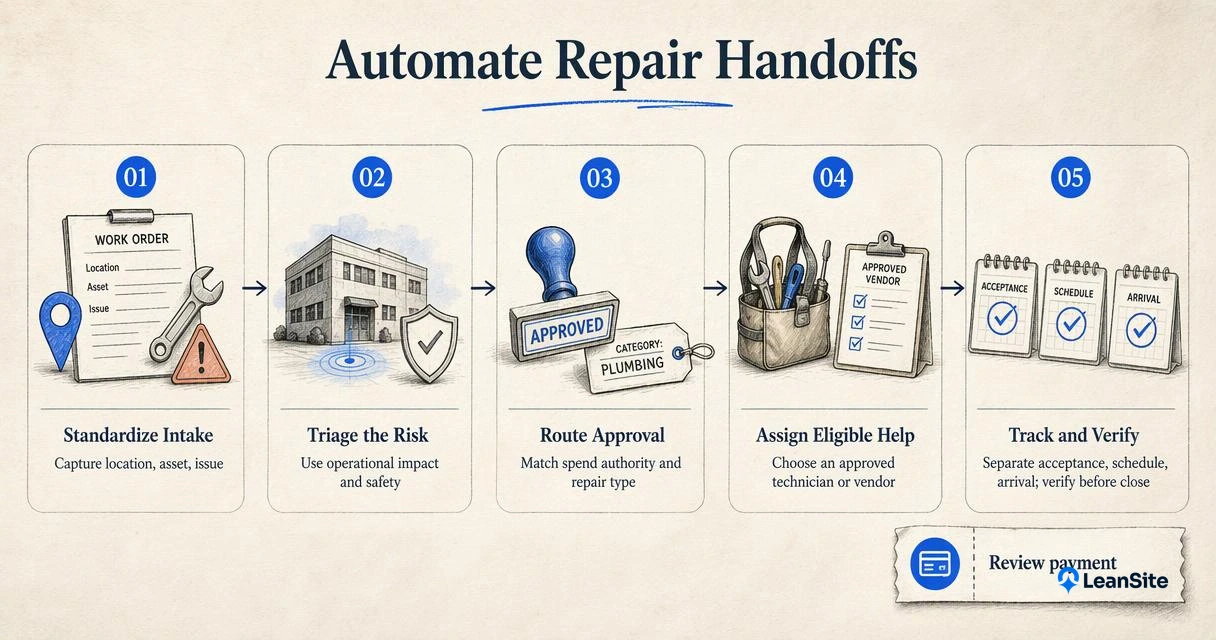
- Define priority using operational impact and safety criteria.
- Route approvals by spending authority and repair category.
- Assign approved work to an eligible technician or vendor.
- Track acceptance, scheduling, and arrival as separate stages.
- Verify completion before closing the job and reviewing payment.
Build stages around real operational decisions
Useful stages represent a decision or handoff, rather than a vague label. A practical sequence is Submitted → Triaged → Awaiting approval → Assigned → Scheduled → In progress → Verification → Closed.
Each stage needs an owner, an entry condition, and an exit condition. For example, assignment should require an approved scope; closure should require accepted completion evidence. Separate timestamps reveal whether work is waiting on authorization, availability, parts, or inspection.
A hypothetical rooftop HVAC repair illustrates the pattern. Intake captures the building, unit identifier, symptoms, and photos. A manager confirms priority, approves the estimate, and routes the work to an eligible HVAC provider. After service, the reviewer checks the service report and operating condition before accepting the invoice.
Set exceptions before enabling automatic actions
Exception rules keep routine routing separate from decisions requiring judgment.
- Escalate safety-related reports to a designated person.
- Require approval when an estimate exceeds spending authority.
- Pause dispatch when access instructions or scope details are missing.
- Send disputed completion evidence back for review.
Automatic reminders should follow the responsible stage owner. Sending every update to every stakeholder creates noise rather than accountability.
How Leansite fits the repair process
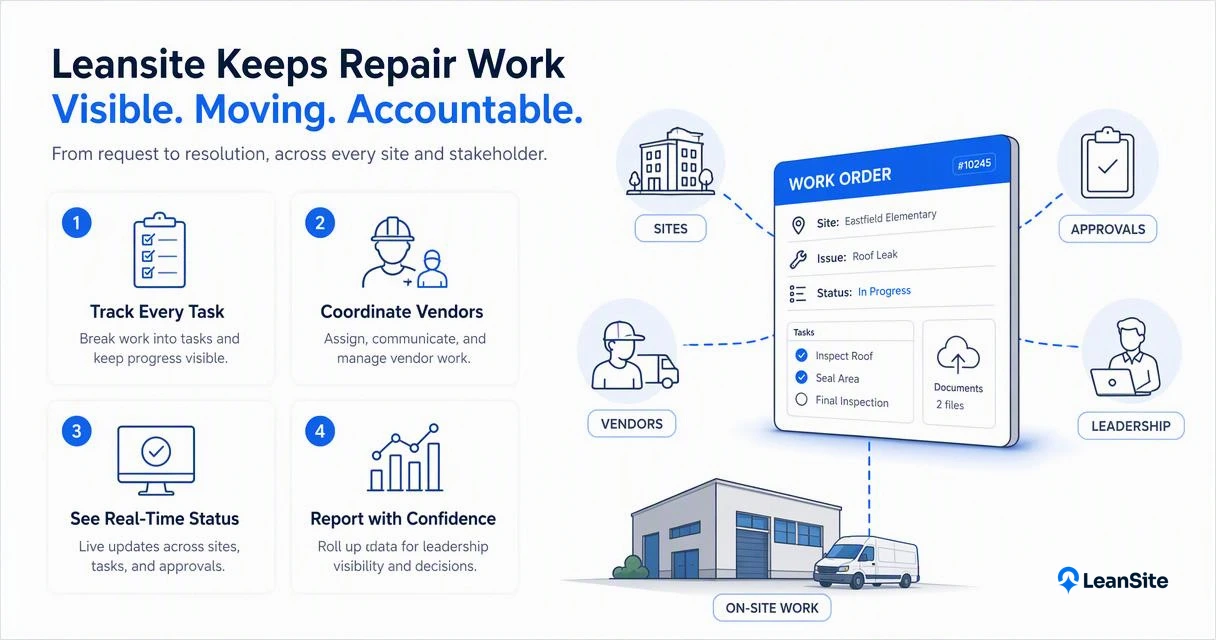
Leansite is a relevant option for facilities teams evaluating software to support repair coordination across commercial properties. A useful evaluation follows one representative job from request through approved completion, with facility managers, operations leaders, and vendor coordinators reviewing their respective handoffs.
Use a real repair scenario for the walkthrough
A workflow walkthrough should establish how the proposed setup supports the organization's operating rules.
- Facility managers: Review ownership, approvals, status visibility, and escalation paths.
- Property owners: Review asset history, approved spending, and completion records.
- Vendor coordinators: Review assignment details, access instructions, and service documentation.
The Leansite platform evaluation can use the same HVAC example described above, including an estimate revision and a completion review. Specific functions, integrations, and configuration options should be confirmed during the walkthrough rather than assumed from the workflow design.
For portfolio teams, a shared process can combine central reporting with local approval authority. A review at getleansite.com can begin with a sample work order, an approval matrix, and the desired completion checklist.
Which metrics show whether automation works?
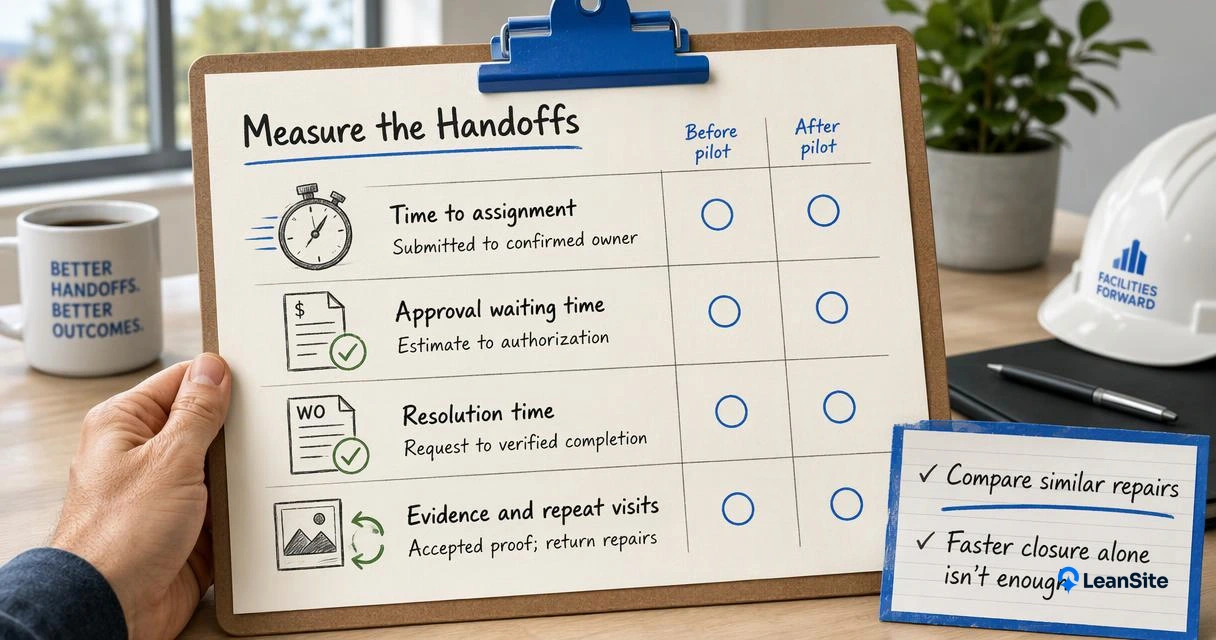
Repair automation works when handoffs become more accountable and waiting time becomes visible without weakening completion checks. Facilities teams should compare similar repair categories before and after a pilot, tracking elapsed time, approvals, accepted evidence, and repeat visits. Faster closure alone doesn't establish better maintenance performance.
Track delay, quality, and cost separately
A small scorecard makes a pilot easier to assess.
- Time to assignment: Request submission to confirmed ownership.
- Approval waiting time: Estimate submission to authorization.
- Resolution time: Request submission to verified completion.
- Repeat visits: Return work associated with the same issue.
- Invoice variance: Difference between authorized and billed amounts.
Emergency repairs, planned work, and parts-dependent jobs should be reviewed separately. Otherwise, a change in job mix can look like a change in performance.
What should facilities teams expect in 2027?
A practical 2027 planning priority is explainable AI assistance rather than autonomous repair decisions. Request classification and suggested routing are sensible areas to evaluate, provided reviewers can see the reason for a recommendation and correct it. The 2023 review of explainable artificial intelligence provides background on model interpretability, not evidence of facilities-specific savings.
Related video: repair-shop workflow handoffs
The following repair-shop video offers an adjacent operational perspective; facilities teams should adapt its ideas to building assets and approval policies.
Conclusion
Start automated repair workflows with one repair category and a documented approval path. Assign stage owners, define completion evidence, and review pilot results before expanding. For a concrete evaluation, schedule a Leansite walkthrough using a real work order and the team's approval matrix.
Demi Oloyede
Leansite
Frequently Asked Questions
Does repair automation replace maintenance technicians?
Repair automation generally coordinates work rather than replacing physical maintenance. Technicians still diagnose faults, perform repairs, and confirm operating conditions. Software can route requests, prompt approvals, and collect records. Safety decisions, uncertain diagnoses, and acceptance of completed work should remain with appropriately qualified people under the organization's operating procedures.
Can facilities teams automate workflows without replacing a CMMS?
An existing CMMS may support workflow configuration or connections to other systems, depending on its capabilities. Evaluation should cover available triggers, data exchange, permissions, and which system owns the final work order. A pilot should confirm that updates stay consistent rather than creating separate, conflicting records for the same repair.
Which repair category should be automated first?
The strongest starting point is a repeatable category with clear intake requirements, predictable approvals, and measurable completion evidence. Routine lighting repairs can provide a manageable example where local conditions permit. Emergency or technically uncertain work is a less suitable first pilot because its decisions and exceptions are harder to standardize.
More from the blog
- parts reservations
Best Spare Parts Inventory Software for Facilities in 2026
Compare facilities inventory options by storeroom workflow, equipment links, reservations, purchasing, and stock sharing across buildings.
- facilities software comparison
CAFM vs IWMS: Scope, Integrations, and Selection Guide
Compare CAFM and IWMS across maintenance, space, leases, capital planning, and integrations, with a practical decision guide for facilities teams.
- vendor dispatch
Maintenance Automation: A Practical Guide for Facilities in 2026
Learn how to automate maintenance scheduling, vendor dispatch, and approvals, with practical rollout steps and metrics for multi-site facilities.