TL;DR
"Maintenance required" signals that an asset needs attention, not necessarily that it has failed. Facility teams should identify the trigger, check safety and compliance requirements, then assign and document the appropriate service or repair.
A maintenance reminder and a dangerous equipment fault can both demand attention, but they don't deserve the same response. The maintenance required meaning depends on what triggered the message: elapsed time, operating hours, a measured condition, or a specific defect. For facility managers and property owners, the useful question isn't just what the alert says. The team needs to establish urgency, ownership, and evidence of completion.
Table of Contents
What does maintenance required mean?
Maintenance required means an asset needs inspection, servicing, or another maintenance action based on its schedule, condition, or operating requirements. The message alone doesn't establish that equipment has failed. In facilities, teams must check the underlying trigger, manufacturer instructions, and applicable obligations before deciding whether the task requires immediate action.
Maintenance: Functional checks, servicing, repair, or replacement needed to keep equipment, building infrastructure, and supporting utilities working, consistent with the technical definition of maintenance).
Maintenance trigger: A date, usage threshold, observation, or measurement that prompts a task.
Required repair: Corrective work addressing an identified defect or loss of function.
A reminder identifies a need for attention; the asset's condition and obligations determine the response.
Maintenance alerts, repairs, compliance, and prevention
A maintenance alert communicates a trigger, while a repair, compliance task, or preventive action describes the work that follows. These categories can overlap: a scheduled inspection may satisfy a compliance obligation and uncover a defect that needs a separate repair.
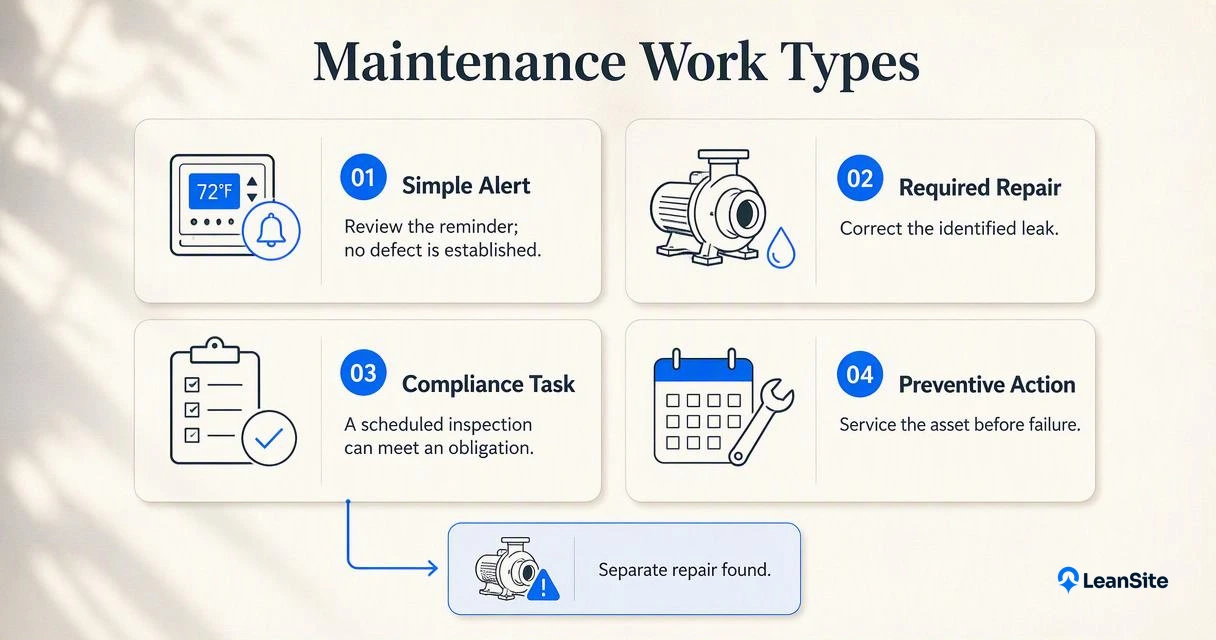
Four task types and their practical meaning
| Task type | What it means | Facility example | Initial response |
|---|---|---|---|
| Simple maintenance alert | A notification needs review; a defect isn't established | Service reminder on an HVAC controller | Check the manual and service history |
| Required repair | An identified problem needs correction | A leaking pump seal | Assess consequences and arrange corrective work |
| Compliance task | Work or evidence is required by an applicable obligation | An inspection required by local rules | Verify scope, deadline, and qualification requirements |
| Preventive maintenance trigger | A planned service threshold has been reached | Lubrication due after specified operating hours | Schedule the manufacturer-directed task |
An HVAC filter reminder, for example, may reflect a timer rather than measured airflow. A technician should establish which kind of trigger the controller uses before interpreting the message as evidence of a blocked filter.
A documented defect calls for a different conversation: what function is affected, what consequences could follow, and what controls are needed? A 2024 paper on degradation diagnosis addresses model interpretability in that field; its topic highlights the distinction between a notification and a diagnosis.
Scheduled triggers belong in a repeatable process. A preventive maintenance ticket flow connects the trigger to an assigned task and completion record.
How should teams prioritize required maintenance?
- Identify the maintenance trigger and affected asset.
- Check for immediate safety concerns or critical service disruption.
- Verify applicable inspection, contractual, and compliance deadlines.
- Assess asset condition, operational importance, and available backup.
- Assign an owner, action, and due date.
- Verify completion and retain supporting evidence.
A facility-focused decision tree
The priority follows the consequences, not the wording on the screen.
- Immediate danger or unsafe condition? Follow the site's emergency procedure and approved isolation rules; involve qualified personnel.
- Critical service affected? Escalate according to operational impact and available redundancy.
- Binding deadline approaching? Confirm the obligation and arrange qualified work within the required window.
- Routine service due without concerning symptoms? Schedule it against the asset's approved maintenance plan.
- Trigger unclear? Obtain the manual, service history, or technician assessment before selecting a response.
Illustrative example: a filter reminder on one comfort-cooling unit may fit a planned visit. A refrigeration temperature excursion affecting stored goods needs faster assessment. Neither decision should rely on the phrase "maintenance required" alone.
Budget-based deferrals need documented reasoning and approval. The cost of deferred maintenance provides useful background for that decision.
The minimum record for a defensible decision
A useful work order connects the original trigger to the action taken and its verified result. Record:
- Asset ID, location, timestamp, and exact alert text.
- Observations, readings, photos, and relevant service history.
- Priority rationale, responsible person, vendor, and due date.
- Work performed, parts used, labor, cost, and verification.
For portfolios, consistent asset identifiers and status definitions support maintenance visibility across multiple locations.
How Leansite fits the maintenance workflow
Leansite is a facility-maintenance software option to evaluate against the alert-to-completion workflow described here. A practical assessment should follow one task from its original trigger through assignment, vendor coordination, completion evidence, and cost review.
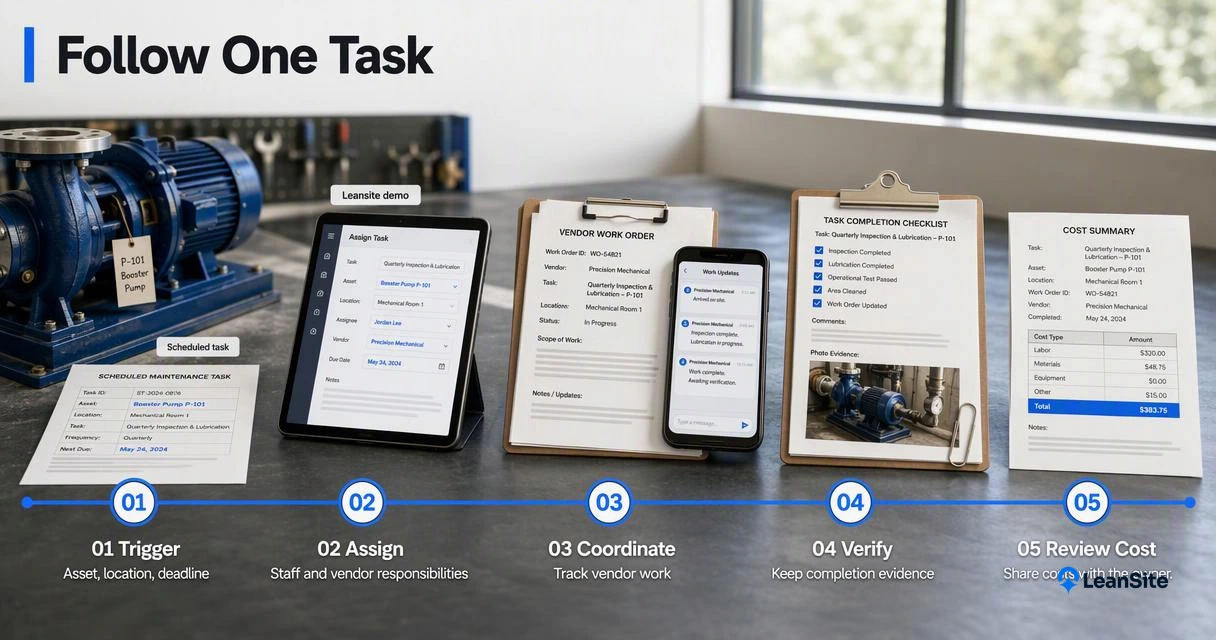
A focused evaluation for facility teams
Start with a scheduled task on a clearly identified asset. During a Leansite demonstration, ask for the workflow to show:
- How the asset, location, trigger, and deadline are recorded.
- How staff and vendor responsibilities are assigned.
- How completion evidence and costs reach the property owner.
These are evaluation criteria, not assumptions about a particular software configuration. The 2026 facility maintenance software guide offers broader selection context.
Teams coordinating outside contractors can also review vendor dispatch workflows. A clear handoff should state the asset, approved scope, access arrangements, and completion requirements.
Conclusion
The practical maintenance required meaning is a call to classify, prioritize, and document the next action. Select one recurring facility task and test its complete workflow with Leansite. Facility teams can visit getleansite.com to discuss that example, including assignment, vendor handoff, and completion evidence.