TL;DR
NTE sets the maximum authorized cost for a maintenance job, not its guaranteed price. Effective controls define included charges, require approval before additional spending, and match invoices against the latest approved limit.
A maintenance spending limit only works when the vendor and approver agree on what it covers. The NTE meaning in facility maintenance is not to exceed: a ceiling on authorized charges for a defined job. For facility managers and property owners, that ceiling connects dispatch, repair decisions, and payment approval. Clear scope matters just as much as the dollar amount.
Table of Contents
What does NTE mean on a maintenance work order?
NTE on a maintenance work order means not to exceed, the maximum amount authorized for the specified work without further approval. It tells a vendor how much spending is permitted, but doesn't automatically make that amount payable. Actual charges still depend on completed work, agreed rates, and the applicable contract.
Not-to-exceed amount: An authorized spending ceiling tied to a defined service scope and approval process.
For an illustrative $500 plumbing authorization, a supported $380 invoice remains $380. A projected $650 repair requires a revised authorization before the additional work proceeds, unless an agreed emergency provision applies.
The work order should state whether the ceiling includes labor, parts, travel, dispatch fees, taxes, and after-hours charges. Silence leaves room for different interpretations.
NTE versus estimates and fixed prices
These pricing terms serve different purposes; their effect depends on the agreement.
| Pricing term | Main purpose | Payment expectation |
|---|---|---|
| NTE amount | Limits authorized spending | Supported actual charges within the approved ceiling |
| Estimate | Forecasts likely cost | May change as scope becomes clearer |
| Fixed-price quote | Sets a price for defined work | Agreed price, subject to scope changes |
An NTE is spending permission, not permission to invoice the full ceiling.
For broader workflow context, the guide to multi-location facilities management software covers the system surrounding individual work orders.
When should facility teams use an NTE amount?
Facility teams should use an NTE amount when a vendor needs permission to diagnose or complete work before the final cost is known. Common applications include service calls, minor repairs, and emergency stabilization. Fully scoped replacements may suit fixed-price quotes better, while routine contracted services should follow their agreed pricing.
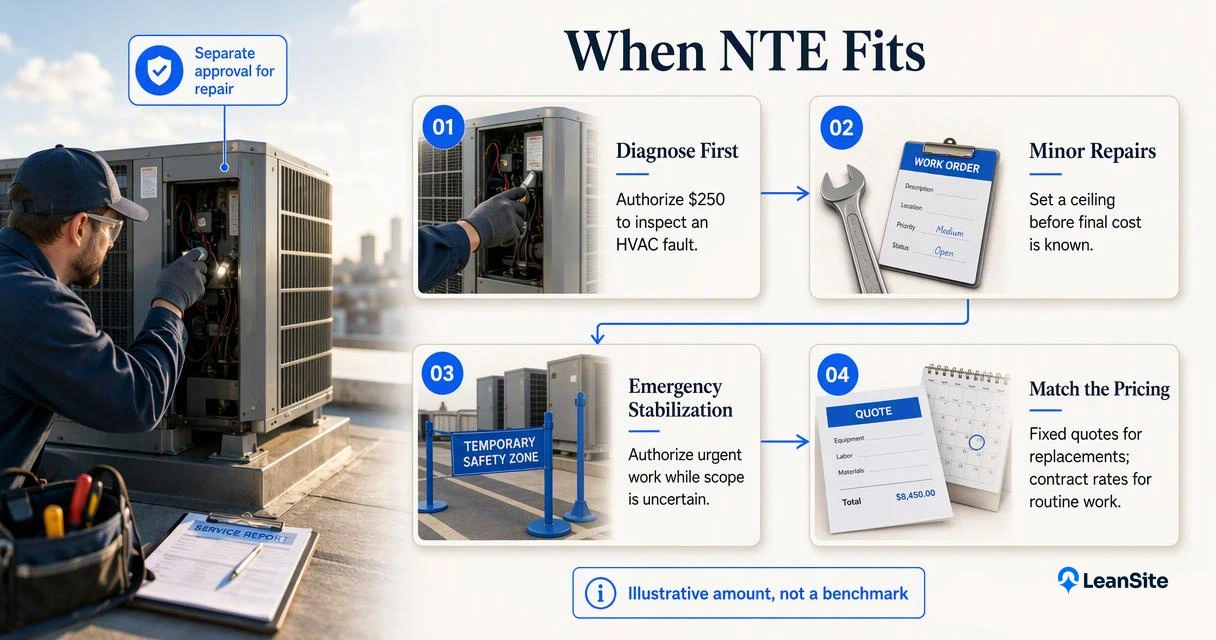
Match authorization to the job stage
A diagnostic visit and a complete repair deserve separate spending decisions when the fault is unknown. The following amounts are illustrative, not industry benchmarks.
- Diagnosis: Authorize $250 to inspect an HVAC fault and provide findings.
- Minor repair: Permit up to $500 for a door closer replacement within a stated scope.
- Emergency stabilization: Allow $750 to isolate a leak and secure the area, with restoration approved separately.
Food-service locations may need separate rules for refrigeration, plumbing, and kitchen equipment. Those priorities fit the operating context covered in facilities management for restaurant chains.
Build limits from actual job requirements
Managers should base ceilings on contracted rates, expected hours, parts allowances, travel, and site access. A remote overnight visit has different cost drivers from a scheduled local inspection.
Set limits by trade, urgency, and location rather than applying one amount everywhere. Review recurring repairs for planned intervention; predictive maintenance and facility uptime provides a related planning angle.
How should NTE exceptions and invoices be approved?
- Record the original scope, ceiling, and included charges before dispatch.
- Require the vendor to report findings and the proposed total before exceeding authorization.
- Route the request to an authorized approver.
- Save the revised amount, reason, approver, and timestamp.
- Match the invoice against the latest approved scope and ceiling.
Require evidence before raising the ceiling
An exception request should explain what changed, why the original authorization no longer covers the work, and what the revised total includes. Photos, diagnostic notes, and an itemized quote help the approver distinguish necessary work from optional additions.
For example, a $400 electrical call might reveal a damaged component requiring an $850 total. Approval should identify $850 as the new total ceiling, not ambiguously authorize another $850.
Emergency policies should name who can authorize stabilization, define spending boundaries, and require prompt documentation. Safety procedures remain separate from financial permission.
Verify charges before payment
An invoice below the ceiling still needs review. Check quantities, rates, completion evidence, and excluded charges. An invoice above it should enter exception review rather than receive automatic approval or rejection without checking the contract and authorization history.
Portfolio teams also need a consistent record across sites. Practices for managing maintenance without losing visibility support that shared oversight.
How Leansite handles this
Leansite is a relevant option for facilities teams evaluating how to connect maintenance coordination with spending oversight. For an NTE workflow, the practical evaluation should follow a complete job from dispatch through invoice review. That makes the approval requirements concrete and gives stakeholders a common demonstration script.
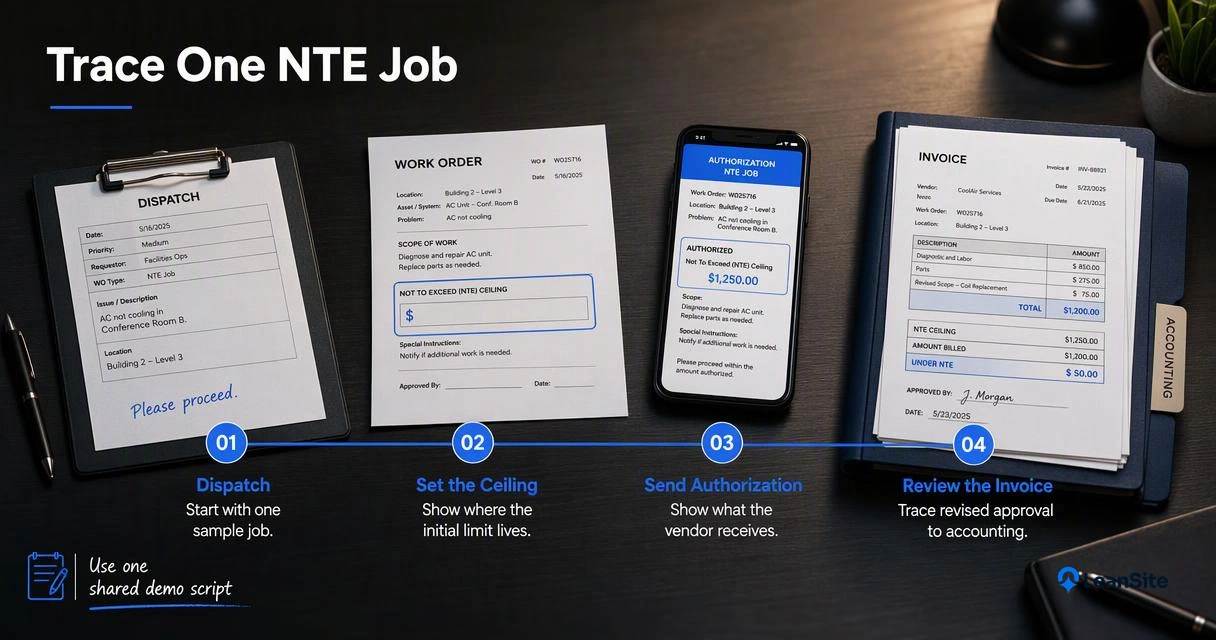
Use a complete work-order demonstration
A useful software demonstration should show where the initial ceiling lives, how vendors receive it, and how revised authorization reaches accounting. The 2026 multi-site maintenance software buying guide offers related selection context.
- Create a sample job with a $500 ceiling and explicit scope.
- Request a revised $700 total with supporting evidence.
- Trace approval through completion and invoice review.
Teams evaluating the Leansite platform should confirm which controls are native, configurable, or handled through integrations. The acceptance criterion is a traceable authorization record, not merely a field containing a dollar amount.
Conclusion
Start with one trade and one location: define included charges, assign approval authority, and test a complete invoice review. For a workflow discussion, contact Leansite through getleansite.com with a sample work order and the required spending rules.