TL;DR
Integrated platforms suit portfolios that need shared work orders, vendor coordination, and consistent reporting. Point solutions suit narrower needs; selection should follow an end-to-end workflow pilot and a total-cost comparison, not a feature count.
A maintenance request isn't finished when a ticket closes; its cost, repair history, and vendor documentation still matter. The facility management platform vs point solutions decision comes down to whether those records should live together or move between separate tools. For teams evaluating connected operations, Leansite belongs on the shortlist. The strongest choice follows the actual workflow, not the longest feature list.
Table of Contents
What separates a facilities platform from point solutions?
A facility management platform connects multiple facilities workflows through shared records, while point solutions focus on individual tasks such as ticketing, inspections, or messaging. The practical difference is how information moves from request to dispatch, completion, approval, and reporting, rather than how many applications appear on a dashboard.
Facility management: Coordinated management of buildings, sites, workplaces, and supporting services that keep them functional, safe, and effective.
Integrated platform: A connected system supporting multiple workflows around common facility, asset, job, and vendor records.
Point solution: A specialized application addressing a narrower operational need.
Side-by-side workflow comparison
| Workflow | Integrated platform approach | Separate-tool approach |
|---|---|---|
| Work orders | Requests and completion records share context | Ticketing app manages individual jobs |
| Spreadsheets | Structured records support repeatable reporting | Flexible sheets support local tracking |
| Vendor lists | Contacts connect to jobs and locations | Directories store contact details separately |
| Messaging | Conversations can attach to job records | Email or chat handles communication |
| Inspections | Findings can connect to follow-up work | Inspection app captures checklists and evidence |
| Reporting | Shared fields support portfolio views | Reports combine exports from several tools |
These are architectural patterns, not guaranteed features. A platform deserves the label only when its modules exchange usable data. Separate tools can also work well when integrations preserve ownership, status, and identifiers.
The useful distinction is connected work, not one login versus several.
Who should pick which approach?
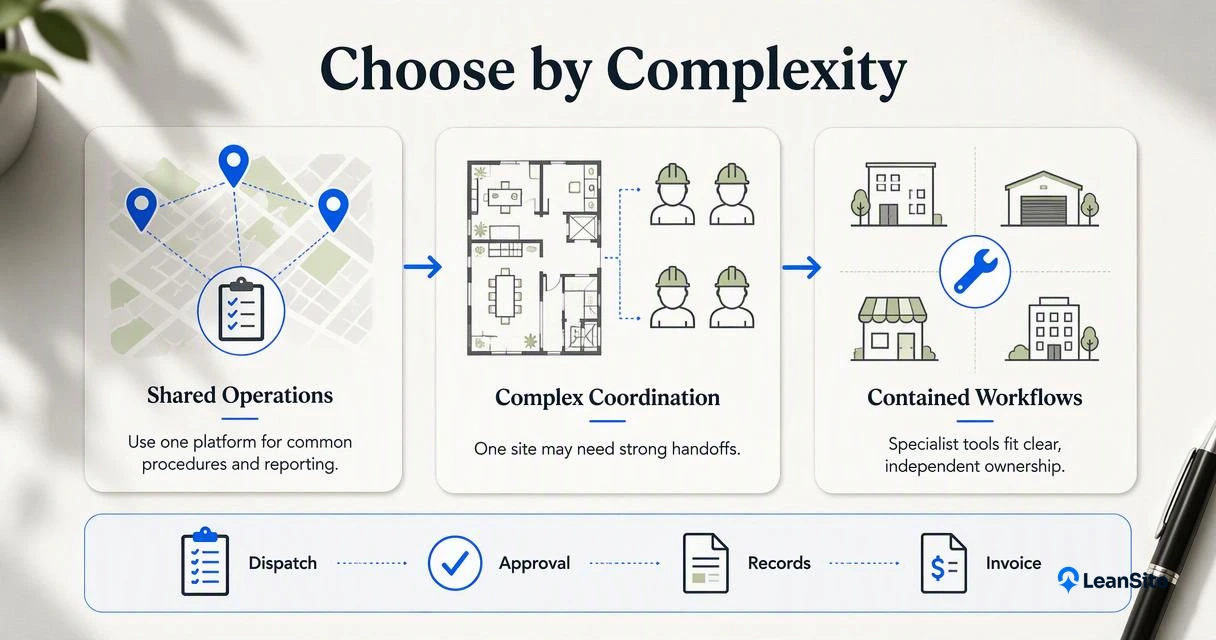
Integrated platforms generally fit operations with repeated cross-team handoffs, while point solutions fit contained workflows with clear ownership. Portfolio size matters, but complexity matters more: a single building with specialized equipment and many contractors can need stronger coordination than several straightforward locations.
Four buying signals that matter
- Portfolio size: Favor a platform when locations need shared procedures, permissions, and comparable results. Favor specialist tools when sites operate independently.
- Vendor volume: Favor integration when dispatch, approvals, documentation, and invoices involve multiple parties. A directory may suffice for a small, stable contractor group.
- Reporting needs: Favor shared records when owners need spend by asset, site, or vendor. Separate tools can suit local reports with limited consolidation.
- Operational complexity: Favor connected workflows when inspections trigger repairs, repairs require approval, and completion feeds financial reporting.
The multi-location facilities software guide provides broader context for portfolio-wide standardization.
Compare total cost, not subscription price
A fair comparison includes subscriptions, implementation, integrations, administration, training, and reporting labor. Using illustrative assumptions, three managers spending two hours each week reconciling exports create six weekly hours of coordination work. That isn't a benchmark; it's a calculation buyers can replace with observed figures.
A hybrid model can retain a specialist inspection tool while using a central platform for requests and reporting. The work-order platform comparison supports evaluation of that central workflow.
How Leansite handles this
Leansite offers a facility-management software option with an embedded AI assistant, Vera, giving buyers a concrete product to assess alongside a collection of separate tools. The platform overview is the starting point for reviewing product scope against operational requirements.
Evaluate the assistant inside the workflow
The published Vera introduction identifies the assistant as built into the facilities software. A useful demonstration should show how assistance relates to an actual maintenance process, rather than treating AI as a separate buying category.
Buyers can ask the product team to demonstrate:
- A request tied to the correct location and asset.
- Vendor coordination with clear responsibility.
- Completion evidence feeding a management report.
Those are acceptance criteria, not claims that every capability is included. A representative demonstration helps establish the right package and configuration.
How should teams test the buying decision?
Teams should test the buying decision by running the same maintenance scenario through both approaches and measuring the work required to complete it.
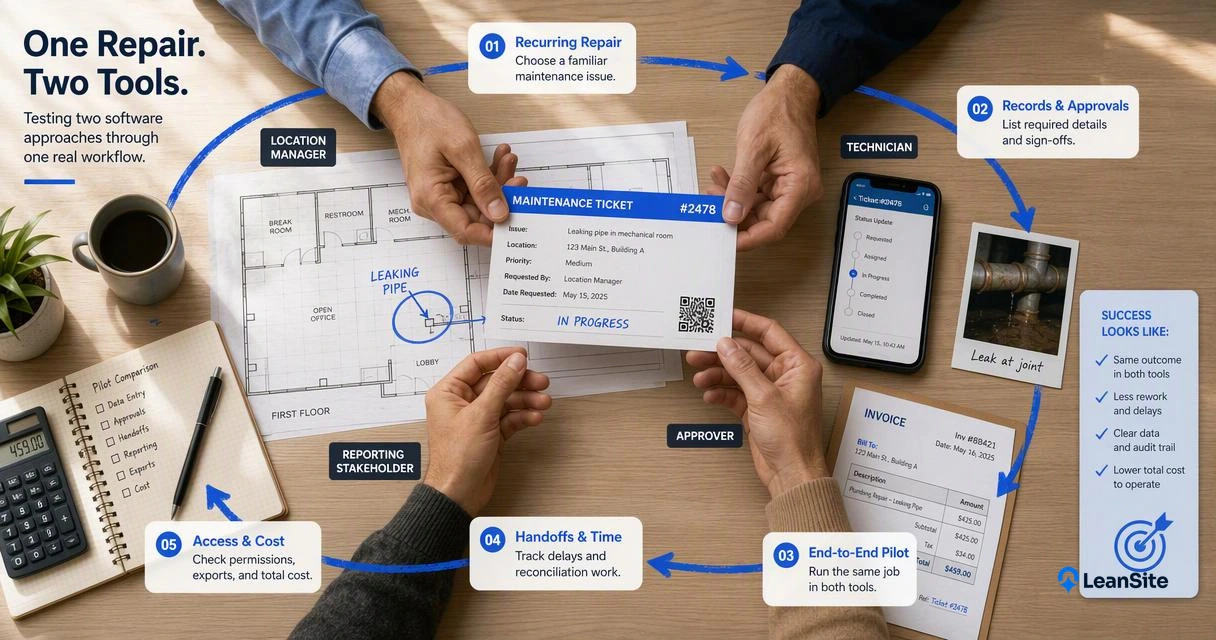
- Select a recurring repair scenario.
- Map required records and approvals.
- Run an end-to-end pilot.
- Measure handoffs and reconciliation.
- Confirm permissions, exports, and total cost.
Make the pilot realistic
A useful pilot includes a location manager, technician or contractor, approver, and reporting stakeholder. Each participant should complete the actual steps, including attachments, status changes, and invoice matching where relevant.
Record elapsed time, duplicate entries, unresolved handoffs, and report preparation time. Check mobile access and connectivity conditions at participating sites. Establish a baseline before testing so improvements have a credible reference.
A platform earns its place when the whole job becomes easier to trace, not merely easier to open.
What matters for AI-assisted operations in 2027
AI evaluation should focus on traceable actions and human approval, rather than predictions about autonomous maintenance. The AI facilities software guide offers related reading on this product category.
For future purchases, require clear answers about which records an assistant can access, which actions need approval, and how activity is logged. These controls belong in acceptance criteria alongside everyday usability.
Frequently asked buying questions
These questions address common uncertainties about replacing existing tools, choosing a platform, and supporting vendors.
Is a CMMS the same as an integrated facilities platform?
A computerized maintenance management system, or CMMS, typically centers on maintenance tasks, assets, and preventive schedules. A facilities platform may cover a broader operating scope, but product labels aren't standardized. Buyers should compare demonstrated workflows, data connections, and included modules instead of assuming that one category automatically covers another.
Does a platform need to replace every existing tool?
A platform doesn't need to replace every existing tool. Accounting software, building controls, or specialist inspection applications may remain appropriate. The key requirement is a clear system of record for each process and dependable information exchange. Replacement makes sense when overlapping tools add administration without providing a distinct operational benefit.
How should vendor access affect software selection?
Vendor access should reflect the contractor's actual responsibilities, such as accepting jobs, submitting evidence, or providing invoices. Buyers should test permissions and access methods during the pilot, including whether occasional contractors need accounts. Internal reporting can remain consistent even when different vendors use different approved submission methods.
Conclusion
The facility management platform vs point solutions decision should end with evidence from a real workflow. Facilities leaders should choose a representative repair, establish baseline effort, and compare completion records and reporting outputs. For a product-specific next step, request a Leansite demonstration through getleansite.com using that same scenario and written acceptance criteria.