TL;DR
Compare software quotes using the same users, locations, assets, and contract term. Include setup, integrations, support, and internal rollout hours in the budget, then test how each quote changes as the portfolio grows.
The cheapest subscription isn't always the cheapest system to run. Facility management software pricing depends on what gets counted, which features are included, and how the platform supports daily operations.
For facility leaders evaluating options such as Leansite, a useful comparison starts with a shared scope: properties, technicians, vendors, assets, and required workflows.
Facility management software: Software that helps teams coordinate building maintenance, work orders, asset records, and related operations.
Total cost of ownership (TCO): The full cost of buying, implementing, operating, and eventually replacing a system over a defined period.
Table of Contents
How does facility management software pricing work?
Facility management software pricing works by charging against a defined unit, such as users, locations, assets, or vendors, or through a negotiated enterprise contract. Buyers should identify that unit first, then check feature tiers, minimum commitments, and billing terms. A low unit price means little without the expected quantity.
Five pricing models and their budget drivers
| Model | What drives the bill | Best-fit situation | Contract question |
|---|---|---|---|
| Per user | Number of billable accounts | A stable maintenance team | Are requesters and contractors billable? |
| Per location | Number of covered sites | Repeatable multi-site operations | How are campuses and buildings counted? |
| Per asset | Number of tracked assets | Asset-focused maintenance programs | Do inactive assets count? |
| Per vendor | Vendor accounts or participation | Contractor-heavy operations | Is billing tied to accounts or activity? |
| Enterprise contract | Negotiated scope and service level | Large portfolios with shared requirements | What triggers a contract adjustment? |
A product may combine these models. For example, a location-based contract could also limit administrator accounts or charge separately for advanced reporting.
Portfolio buyers can use the multi-location facilities management guide to define site-level requirements before requesting quotes. Consistent definitions make expansion costs easier to compare.
What hidden costs belong in the software budget?
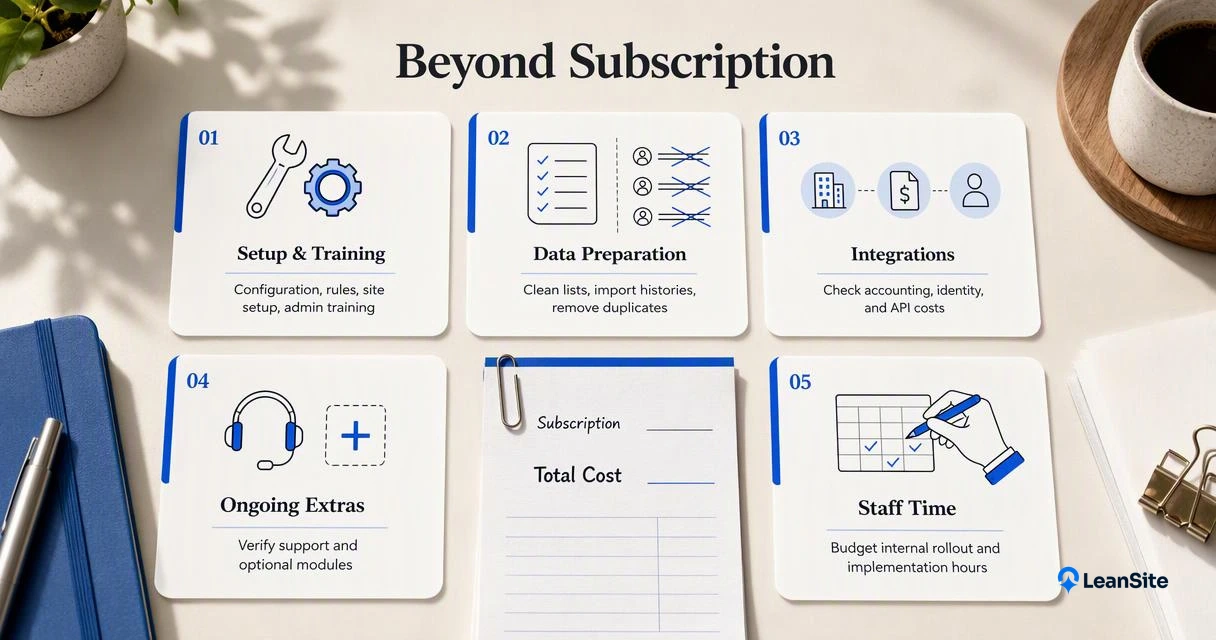
Hidden software costs belong in the budget whenever deployment or ongoing use requires spending beyond the subscription. Common items to verify include setup, data migration, integrations, training, support, and optional modules. Internal staff time also matters, even when a vendor describes implementation as included in the purchase.
Separate launch costs from recurring charges
- Implementation: Configuration, approval rules, site setup, and administrator training.
- Data preparation: Cleaning asset lists, importing histories, and removing duplicate records.
- Integrations: Accounting connections, identity management, API access, and connector maintenance.
- Field access: Mobile features, offline capabilities, devices, and connectivity requirements.
- Service levels: Support hours, response commitments, and dedicated account assistance.
- Commercial terms: Minimum seats, overages, renewal increases, and export or transition charges.
Facilities with weak coverage should examine the cost of poor connectivity alongside mobile requirements. An offline workflow deserves a practical test, not just a checkbox.
Vendor coordination needs its own review. Ask whether dispatch, contractor access, invoice handling, and payment-related services are included, separately priced, or outside the platform's scope.
A useful quote separates one-time charges, recurring charges, usage-based charges, and the customer's implementation responsibilities.
How can facility leaders compare total ownership cost?
- Define identical requirements for every software quote.
- Count billable users, sites, assets, and vendors.
- Add setup, integrations, training, and internal labor.
- Model the same contract period and growth scenario.
- Test required workflows before approval.
- Request a written breakdown of inclusions, exclusions, renewal terms, and expansion charges.
Build a comparable cost worksheet
Use this planning formula: TCO = subscription + implementation + add-ons + internal labor + transition costs, calculated over the chosen period. Keep estimated operational benefits separate so projected savings don't hide cash commitments.
Consider an illustrative budgeting example, not a market benchmark: 20 paid users at an assumed $40 per month equal $9,600 annually. Adding assumed setup of $3,000 and 40 internal hours valued at $50 adds $5,000. First-year ownership cost becomes $14,600 before other charges.
The example shows why a subscription-only comparison can mislead. For workflow evaluation, the facilities ticket management guide provides a related starting point.
Pricing checklist for approval
- Confirm account types and the definition of each billable unit.
- Record included features and separately quoted modules.
- Assign owners and hours to rollout tasks.
- Price today's portfolio and a realistic expansion scenario.
- Document billing frequency, contract length, and renewal rules.
- Agree on data access and export arrangements.
A strong pilot follows a request from submission through assignment, completion, approval, and reporting. That produces a concrete scope for procurement and a shared acceptance standard for operations.
How Leansite handles this
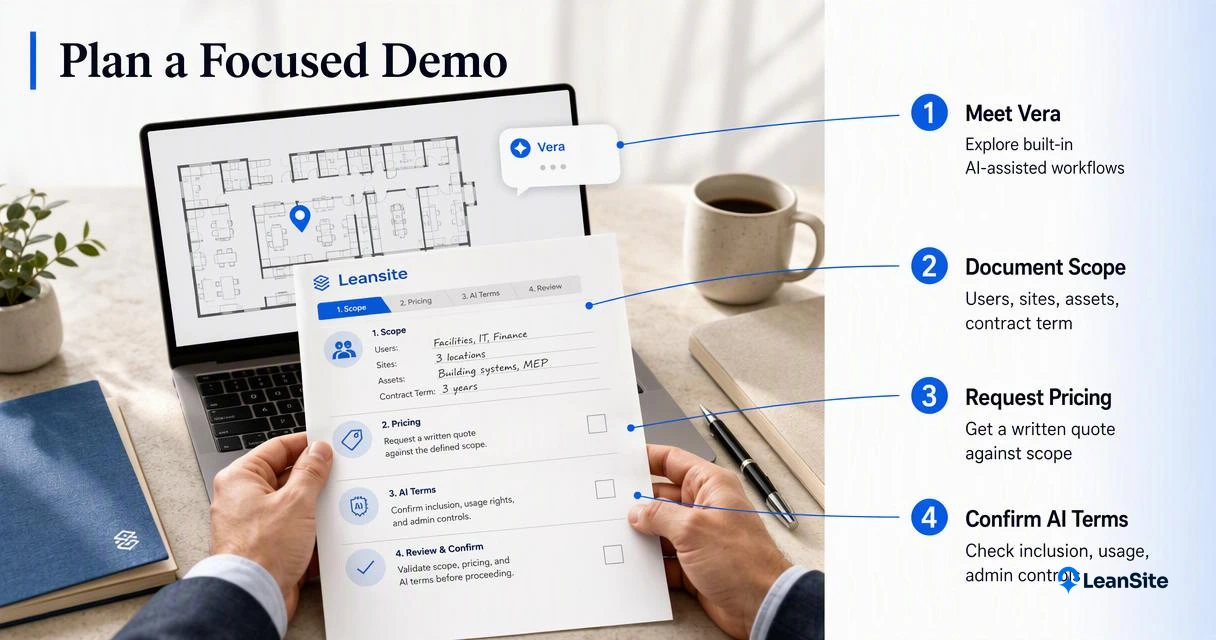
The Leansite platform gives facility teams a product-specific starting point for evaluating AI-assisted operations alongside their purchasing requirements. Its published material introduces Vera as a built-in AI assistant; buyers can use that information to define a focused demonstration and request pricing against a documented scope.
Scope AI assistance before requesting a quote
The Vera assistant introduction supports a discussion about assisted workflows. The broader AI facility management software guide adds context for evaluation.
For 2026 purchases, request written details on AI inclusion, usage allowances, administrative controls, and any separately priced capabilities. These are evaluation questions, not claims about this product's billing model. A demo tied to actual facility tasks is more useful than a general feature tour.
Watch a facilities software evaluation overview
Use the overview to develop demonstration questions; confirm current prices and contract terms directly with each supplier.
Conclusion
Next step: request a scope-based quote. Facility management software pricing becomes easier to judge when every supplier prices the same requirements. Teams considering Leansite can visit getleansite.com with their site count, account roles, workflow needs, and rollout schedule, then request a demonstration and written cost breakdown.