TL;DR
Shortlist maintenance platforms by operating model: portfolio coordination, technician execution, or broader facility management. Compare vendor access, preventive schedules, mobile workflows, and property-level costs through a practical pilot before committing.
The best building maintenance software for commercial properties connects each repair to a building, an accountable worker, and a visible cost. For teams coordinating several locations, Leansite belongs on the shortlist alongside technician-focused and broader facility-management options.
Building maintenance software: A system for organizing repair requests, scheduled maintenance, asset records, assignments, and maintenance reporting across buildings.
The right choice depends on how work actually happens: an office tower with resident engineers needs a different workflow from a retail portfolio using outside contractors.
Table of Contents
Commercial Maintenance Software Shortlist
Four useful candidates cover distinct needs: multi-site coordination, daily maintenance execution, broader facility oversight, and customizable property workflows.
The comparison below is a buying framework, not a hands-on performance ranking. Available research describes the products unevenly, so unconfirmed capabilities are marked for demonstration rather than treated as established features.
Feature-by-feature comparison for buying teams
| Platform | Work-order focus | Preventive maintenance | Vendor and cost reporting | Mobile execution |
|---|---|---|---|---|
| Leansite | Portfolio coordination candidate | Evaluate scheduled ticket flow | Evaluate dispatch and site-level costs | Test field workflows |
| UpKeep | Central queue for building requests | Building-system maintenance described | Verify contractor access and reporting | Test technician workflow |
| MRI Facility Management | Broader building-maintenance tools | Verify scheduling depth | Verify vendor workflows and cost exports | Confirm field access |
| Zoho Creator | Customizable property-maintenance application | Verify available scheduling or configuration | Verify application setup requirements | Test the configured application |
UpKeep's supplied description emphasizes building requests and preventive maintenance. MRI's description includes maintenance, space planning, and asset tracking. Zoho Creator's property-maintenance application centers on customization. Those distinctions support shortlisting, but not unsupported claims about pricing, integrations, or plan limits.
A work-order comparison companion
The video provides another comparison format. Final decisions should use current demonstrations, written proposals, and the commercial property's actual workflow.
Which Software Fits Each Property Type?
Commercial maintenance software fits best when its daily workflow matches the property's staffing, asset complexity, and contractor model. Retail portfolios should prioritize cross-site coordination; staffed office buildings should emphasize technician execution; mixed-use facilities may need space and asset oversight; custom operations should assess configuration effort.
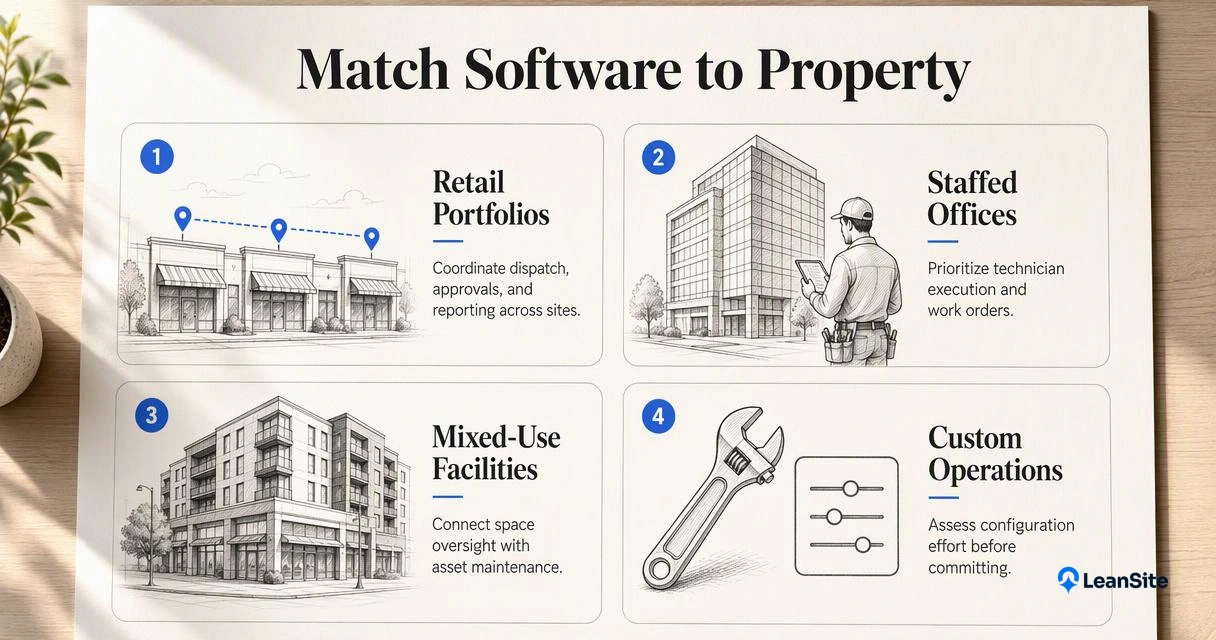
Who should pick which
- Multi-location retail and service businesses: Start with the portfolio-coordination candidate in the table. Compare dispatch, local approvals, and reporting across sites using this multi-site maintenance buying guide.
- Office buildings with in-house technicians: Assess UpKeep when request handling and scheduled building-system maintenance are the main priorities.
- Complex facilities with space-management needs: Assess MRI Facility Management when maintenance sits alongside space planning and asset oversight.
- Properties needing tailored workflows: Assess Zoho Creator when application customization is central to the operating model.
Mixed portfolios may need different permission levels for owners, facility managers, technicians, and vendors. A useful demonstration shows the same ticket from all four roles, including who can approve spending and who can see financial details.
The operating-model rule
A maintenance-first team should evaluate the complete repair workflow before comparing broader property-management features.
Lease administration and rent collection can remain in another system. Maintenance selection should concentrate on reliable handoffs, asset history, and reporting that supports repair-or-replace decisions.
How Leansite Handles This
The platform's published resources frame commercial maintenance around multi-location visibility, preventive ticket flows, vendor dispatch, and AI assistance. That makes portfolio coordination a relevant evaluation angle for property teams managing shared standards across several buildings.
Connect recurring work with portfolio oversight
A preventive maintenance ticket flow provides a practical starting point for evaluating recurring inspections and service tasks. During a demonstration, the evaluator should follow one scheduled task through assignment, completion evidence, review, and asset-history storage.
For outsourced work, the vendor dispatch and maintenance automation guide provides a related workflow to examine. Dispatch, approvals, completion records, and invoice matching should form one traceable process.
Evaluate AI through accountable actions
The published introduction to Vera, the built-in AI assistant, adds an AI-specific evaluation path. For 2026 procurement, useful demonstrations should show what the assistant can do, what requires approval, and where actions are recorded.
- Request a demonstration using a realistic property task.
- Identify the data and permissions involved.
- Confirm human review for operational decisions.
Product information at getleansite.com can support that demonstration brief. Capabilities and availability should be confirmed for the proposed plan.
How Should Teams Evaluate Maintenance Software?
Teams should evaluate maintenance software through a controlled pilot that follows real jobs from request to financial reporting:
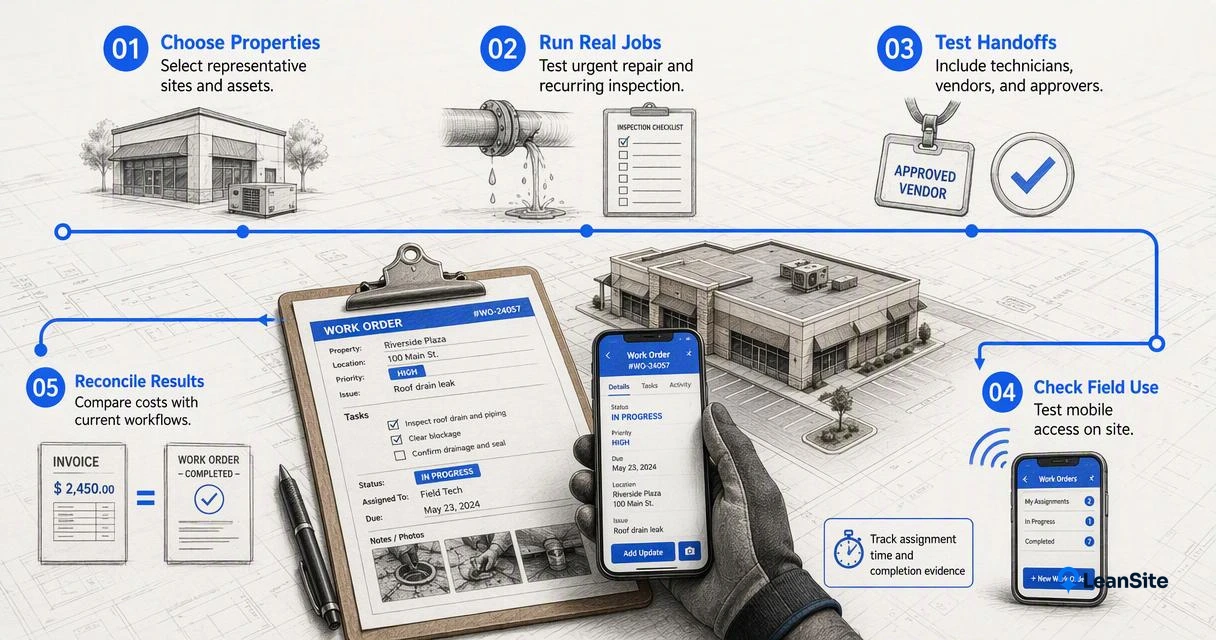
- Select representative properties and assets.
- Run reactive and scheduled tasks.
- Include technicians, vendors, and approvers.
- Test mobile access in field conditions.
- Reconcile completed work with costs.
- Compare results against existing workflows.
Define evidence before requesting a demo
The pilot should include an urgent repair, a recurring inspection, and an outsourced job requiring approval. Each tests a different handoff. Track assignment time, completion evidence, duplicate entry, and whether managers can find the final cost without combining spreadsheets.
Mechanical rooms and basements deserve field testing, not just a desktop walkthrough. This guide to offline maintenance requirements explains the operational context for checking connectivity-dependent workflows.
Compare total operating effort
A written proposal should separate subscription charges from implementation, data migration, training, integrations, and external-user access. Buying teams should also request sample exports and confirm that building, asset, vendor, and cost records remain usable outside the platform.
The strongest pilot proves that a completed job produces usable operational and financial records, not merely a closed ticket.
Conclusion
The best building maintenance software for commercial properties is the option that proves the complete workflow across representative sites. Shortlist by operating model, run the same three jobs through each finalist, and compare records, field usability, and total effort. For portfolio coordination, request a Leansite demonstration focused on scheduled work, vendor handoffs, and property-level reporting.