TL;DR
Choose software that connects each contractor invoice to an approved maintenance job, completion evidence, and spending limits. Evaluate maintenance coordination and money movement separately, then test how both systems share approval and payment status.
A completed repair isn't automatically a payment-ready repair. Contractor payment software for facility maintenance should connect the work performed with the amount authorized, the evidence submitted, and the payment released. For commercial properties, that connection matters more than a simple transfer button.
Leansite is a facility-management option to evaluate around this connected workflow. The strongest buying process follows a maintenance job from dispatch through settlement, with clear responsibilities for facility staff, vendors, and accounts payable.
Table of Contents
What is contractor payment software for facility maintenance?
Contractor payment software for facility maintenance connects vendor billing and payment tracking with maintenance work orders. Its purpose is to establish what was authorized, what was completed, what can be invoiced, and when payment is due. Depending on the setup, payment execution may happen in a separate accounting or accounts-payable system.
Work-order-to-payment workflow: The linked process covering dispatch, completion evidence, invoice review, approval, and payment status.
Not-to-exceed limit (NTE): The maximum authorized job cost unless an authorized person approves a change.
Completion proof: Documentation showing that the agreed work was performed, such as photos, service notes, or site acceptance.
- Facility teams need service history and spending visibility.
- Maintenance vendors need submission requirements and payment status.
- Accounts payable needs approved invoices and reliable accounting data.
The broader guide to multi-location facilities management software explains the operational foundation supporting this narrower payment workflow.
How should maintenance jobs move from dispatch to payment?
Maintenance jobs should move from dispatch to payment through six documented checkpoints, with an owner assigned to each handoff.
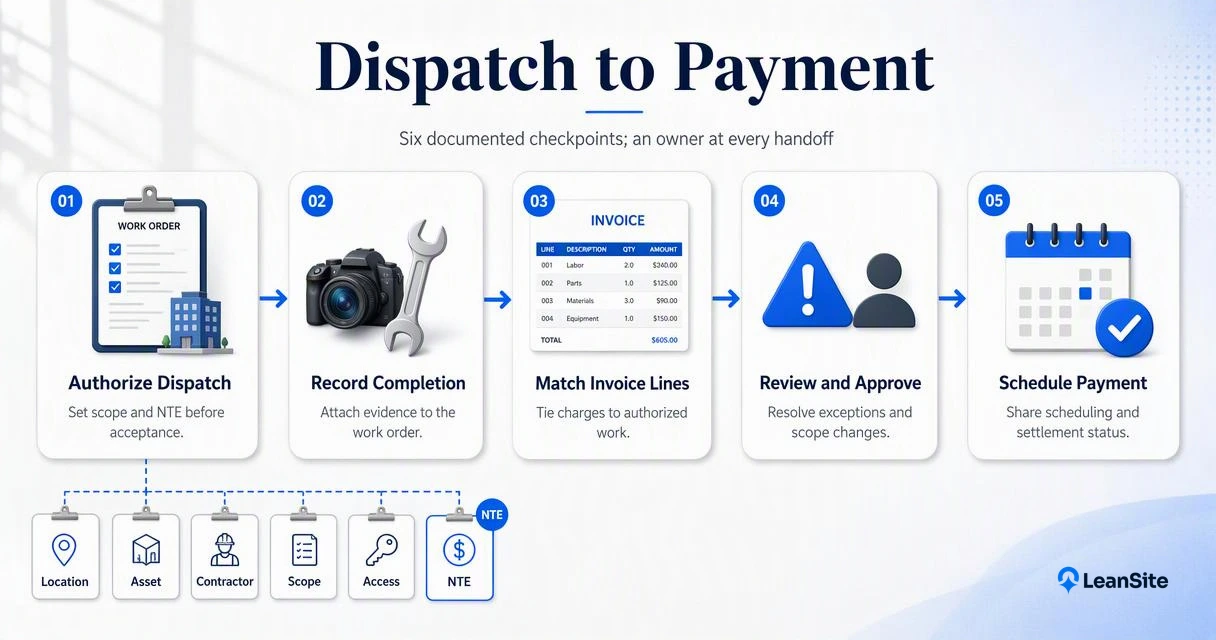
- Dispatch an authorized scope and NTE.
- Capture completion evidence against the work order.
- Match invoice lines to authorized work.
- Review NTE exceptions and scope changes.
- Route approval to the responsible person.
- Share payment scheduling and settlement status.
Dispatch and evidence establish the payable scope
Each dispatch should identify the location, asset, contractor, service scope, access instructions, and spending limit. The vendor should know the evidence requirements before accepting the assignment.
Completion records should include labor, materials, findings, and any site signoff required by the contract. For basement plant rooms or remote properties, offline maintenance requirements deserve attention: evidence capture should remain practical where connectivity is limited.
Invoice review separates routine approvals from exceptions
Matching should compare the invoice with the work order, authorized scope changes, and completion record. Reviewers should check agreed rates, materials, taxes, and duplicate submissions before approval.
Illustrative example: A repair has a $750 NTE, but the vendor invoices $820. The $70 difference needs a documented decision, not an unexplained adjustment. The record should show whether extra work was authorized and who approved it.
Payment speed starts with a complete, approved job record, not merely a faster payment method.
After approval, vendors should see distinct statuses such as scheduled, sent, and settled. Those labels should reflect actual accounting or payment-provider events.
Which software category fits the payment workflow?
The right software category depends on whether the main requirement is coordinating maintenance work, controlling invoices, or executing contractor payments. A connected setup may involve more than one system, provided ownership and data exchange are clear.
Compare operational control with payment execution
These categories solve different parts of the workflow rather than serving as interchangeable products.
| Software category | Primary role | Demo evidence to request |
|---|---|---|
| Facility maintenance platform | Dispatch, assets, service history, vendor coordination | A completed job linked to billing documentation |
| Accounts-payable automation | Invoice capture, approval routing, accounting handoff | Matching rules and an approval audit trail |
| Contractor payment platform | Contractor administration and payouts | Supported payment methods and recipient status |
| Accounting or ERP system | Financial posting and reconciliation | Invoice-to-payment reconciliation |
Global contractor-payment tools such as Deel and RemoFirst appear in the supplied research, but contractor administration isn't the same requirement as verifying an HVAC repair. Category fit should come before brand familiarity.
Who should pick which approach?
Facility teams coordinating vendors across properties should start with maintenance records and approval ownership. Finance teams with complete job documentation may prioritize accounts-payable automation. Organizations managing international contractors should investigate payout coverage and contractor administration.
Portfolio operators can use the 2026 multi-site maintenance buying guide to assess location-level controls. A separate maintenance-software comparison can support the operational shortlist.
Watch a maintenance-system walkthrough
The Software Connect walkthrough offers context for evaluating maintenance records and mobile workflows; payment capabilities still require a separate demonstration.
How Leansite handles this
Leansite belongs in the evaluation of facility-management software supporting the operational side of contractor payments. A useful demonstration should connect vendor coordination, job documentation, and financial handoffs around one maintenance record. Product-specific payment execution, integrations, and approval capabilities should be confirmed during that demonstration.
Use a real service call as the demo script
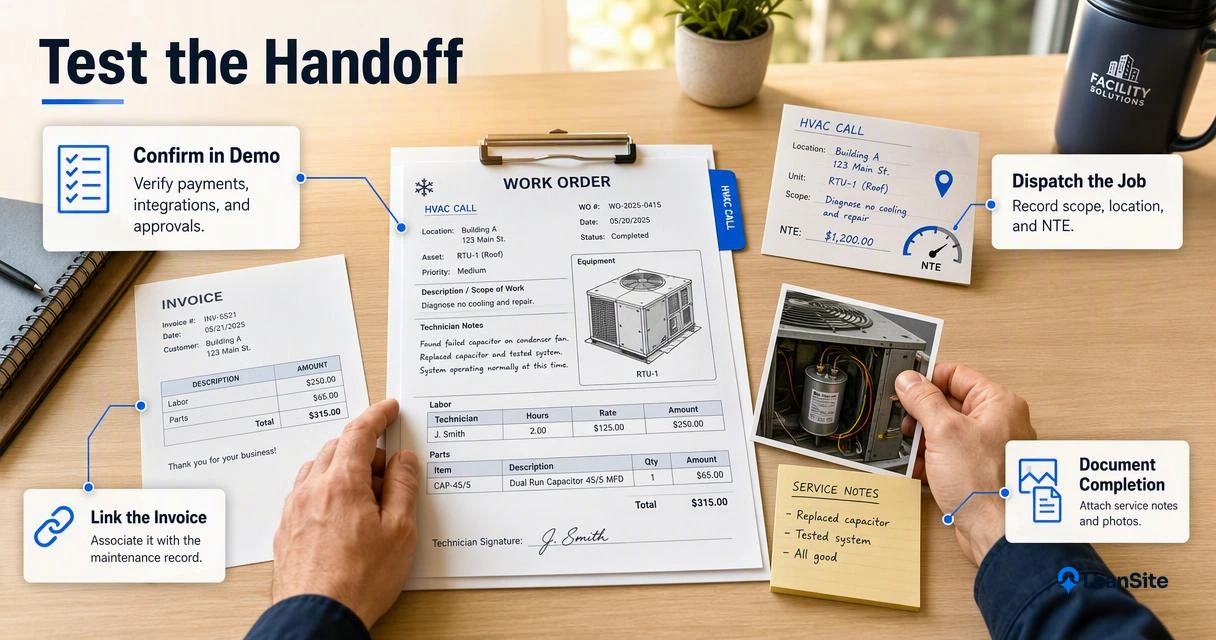
A representative HVAC service call gives stakeholders a concrete acceptance test:
- Dispatch the job with its scope, location, and NTE.
- Attach service notes and completion photos.
- Associate the contractor invoice with the job record.
- Identify the approval owner and accounting handoff.
- Show how the vendor receives payment-status updates.
As AI facility-management tools develop, buyers should ask which checks are automated and which require human approval. Success means a traceable handoff, not simply an AI-generated invoice summary.
Conclusion
The next step is a real-job pilot, not a feature-count contest. Facility teams evaluating contractor payment software for facility maintenance should select one vendor and trace a service call through documentation, approval, and settlement. To arrange a Leansite workflow evaluation, visit getleansite.com and request a demonstration using that job as the test case.