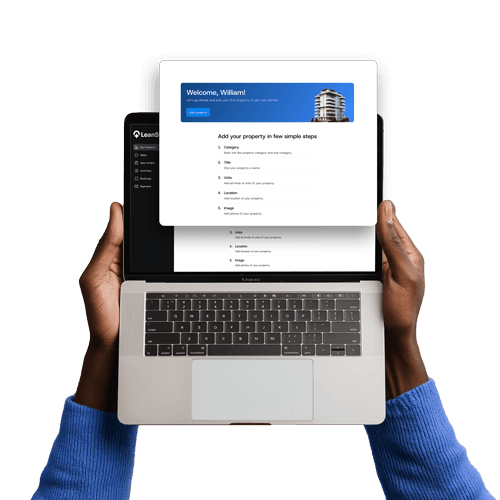
TL;DR
Maintenance teams should standardize request intake, ownership, status updates, and quality checks before configuring software. Start with one site and one vendor workflow, then expand using backlog age, repair history, and verified completion as controls.
A maintenance ticket isn't finished when a technician stops working; it's finished when the repair is verified and the record explains what happened. A team software process for maintenance teams connects those steps across facility managers, technicians, vendors, and property owners. For teams evaluating Leansite, that shared workflow provides a practical starting point for product discussions.
Maintenance team software process: A repeatable set of rules for capturing, assigning, completing, checking, and reporting facility work in a shared system.
Table of Contents
What is a team software process for maintenance teams?
A team software process for maintenance teams is an operating workflow that gives every request a consistent path from intake to verified completion. It adapts ideas such as defined roles, planning, measurement, and quality checks to physical assets and facility services, rather than treating maintenance as software development.
The formal Team Software Process (TSP) belongs to software engineering and works alongside the Personal Software Process (PSP). Historical software-engineering discussion of TSP and PSP concerns that original context, not building repairs. Similarly, software maintenance means modifying software after delivery, not maintaining equipment.
The facility version needs practical controls, not a copied engineering methodology:
-
Shared intake: One record for each issue, regardless of reporting channel.
-
Defined ownership: One accountable coordinator, plus the assigned worker.
-
Quality gate: Evidence and acceptance criteria before closure.
For broader system planning, the multi-location facilities management guide provides related context. This narrower workflow keeps attention on daily execution, including work postponed for budget approval.
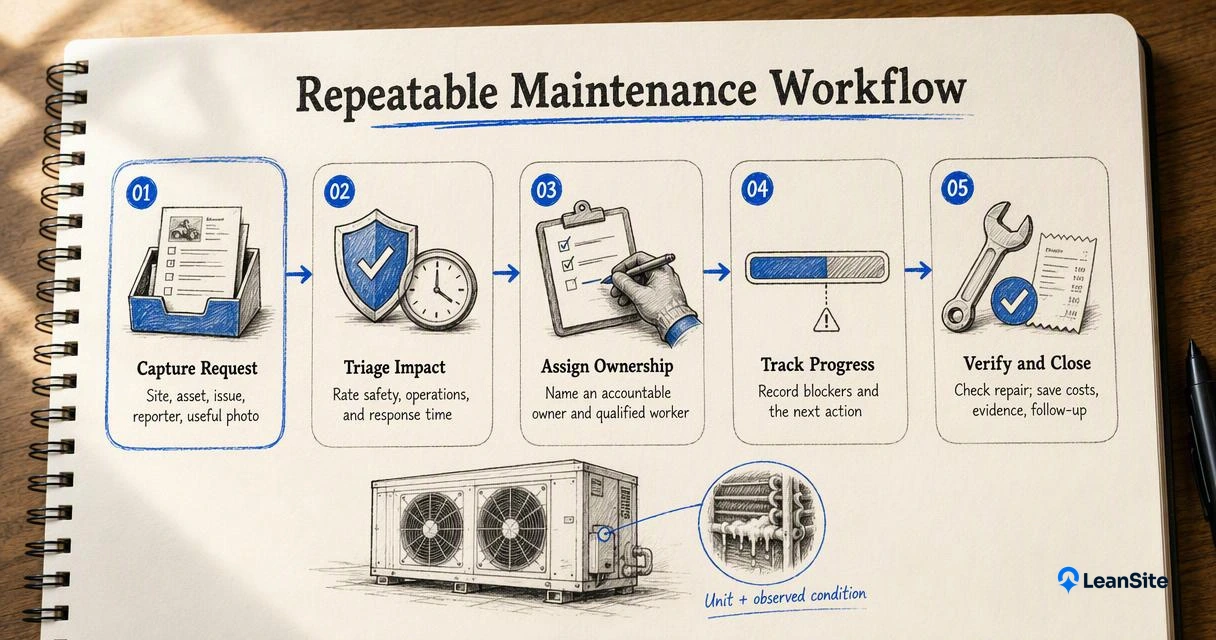
How can maintenance teams build a repeatable workflow?
-
Capture each maintenance request in one shared queue.
-
Triage safety, operational impact, and required response time.
-
Assign an accountable owner and a qualified worker.
-
Record progress, blockers, and the next action.
-
Verify the repair against a defined acceptance checklist.
-
Close the record with costs, evidence, and follow-up requirements.
Make intake useful enough for dispatch
Require a site, asset or location, issue description, reporter, and photo when useful. A refrigeration request should identify the unit and observed condition, not simply say "equipment broken." Safety-related requests should follow the site's emergency procedure rather than wait for routine triage.
Teams moving from scattered messages can use this explanation of email and spreadsheet maintenance workflows to identify which existing channels need consolidation.
Give every waiting state a next action
Use explicit statuses such as New, Assigned, In progress, Waiting for parts, Awaiting approval, and Ready for verification. Each waiting record needs a responsible person, reason, and review date.
In an illustrative three-site retail operation, an HVAC repair awaiting a compressor stays assigned to the coordinator. The vendor owns the parts update; the manager owns approval. For related implementation detail, review vendor dispatch for multi-site teams.
A status should explain what happens next, not merely describe where work stopped.
Which roles and checks keep work accountable?
Maintenance accountability depends on separating request reporting, work coordination, repair execution, and final acceptance, even when one employee fills multiple roles. A small team can combine responsibilities, but every ticket still needs an owner and an acceptance rule.
Responsibilities across managers, technicians, and vendors
|
Role |
Main responsibility |
Required handoff |
|---|---|---|
|
Site requester |
Describe the issue and provide access details |
Location and observed condition |
|
Maintenance coordinator |
Set priority, assign work, resolve blockers |
Scope, deadline, approval limits |
|
Technician or vendor |
Perform authorized work and document results |
Repair notes, evidence, costs |
|
Verifier |
Check the agreed acceptance criteria |
Accepted result or rework reason |
|
Portfolio manager |
Review spending and recurring issues |
Budget or replacement decision |
Match verification to risk and track useful measures
A lamp replacement might need a completion photo. A refrigeration repair might need a recorded temperature check against the site's operating requirement. Regulated or safety-critical work requires the applicable qualified inspection and records; a software checkbox doesn't replace them.
Review these measures weekly:
-
Backlog age by priority: Shows whether urgent work is progressing.
-
Waiting time by reason: Separates approval delays from parts delays.
-
Repeat repairs by asset: Supports repair-versus-replacement decisions.
-
Actual cost against approval: Gives owners a spending trail.
Compare similar assets and sites rather than ranking unlike workloads. This guide to maintenance visibility across locations extends that reporting approach.
A supporting lesson on team coordination
This general team-building resource complements the workflow; facility-specific dispatch and acceptance rules still need local definition.
How Leansite handles this
The Leansite platform is a relevant option to evaluate against a defined maintenance workflow, with a demonstration centered on actual requests, role handoffs, and completion evidence. The supplied product information doesn't establish individual capabilities, so each requirement should be confirmed during evaluation.
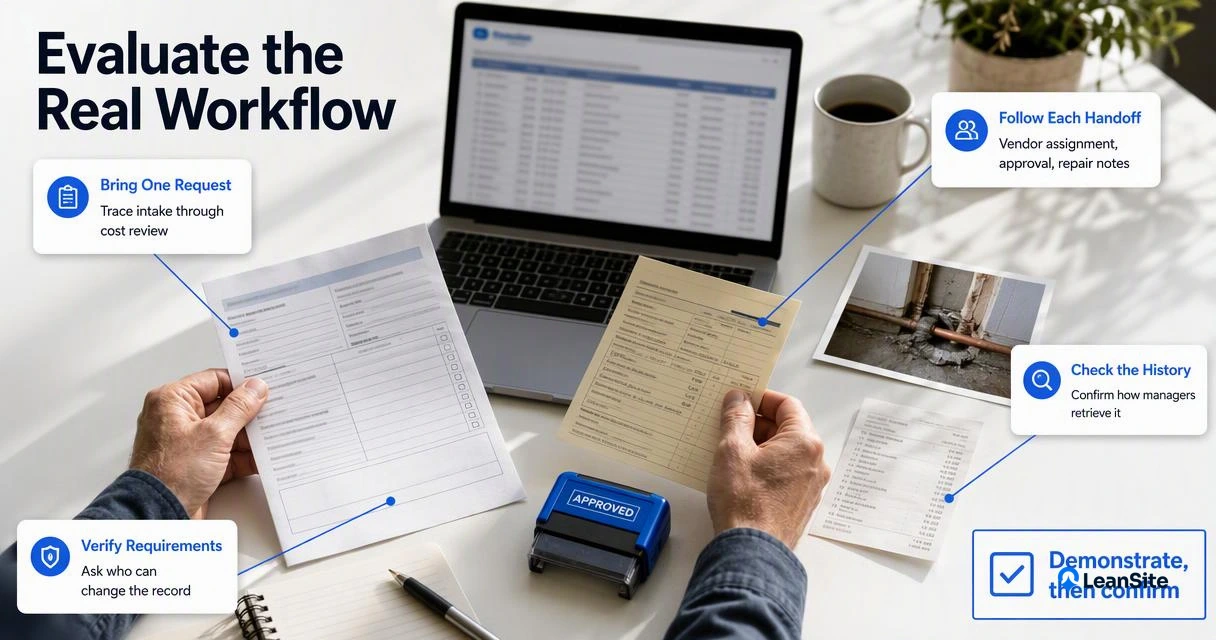
Use one realistic ticket as the acceptance test
A facilities director can bring an example covering intake, vendor assignment, approval, repair notes, verification, and cost review. Ask for each handoff to be demonstrated, including who can change the record and how managers retrieve its history.
The 2026 multi-site maintenance software buying guide offers related selection context.
-
Test manager, technician, and vendor participation separately.
-
Confirm access controls, exports, and mobile requirements.
-
Agree on a small pilot and measurable acceptance criteria.
The strongest buying test follows a complete job, not an isolated feature.
Maintenance workflow FAQ
These maintenance workflow questions clarify how much structure to introduce, how vendors participate, and how deferred work remains visible.
Does a small maintenance team need formal TSP training?
A small facility maintenance team doesn't need formal software-engineering TSP training to adopt shared intake, clear ownership, and verification. A short operating procedure is usually a better starting point. Training should focus on priority rules, status definitions, required job evidence, and who approves closure, with examples drawn from actual facility work.
How should outside vendors update maintenance records?
Outside vendors should update the assigned job through an agreed channel that preserves the maintenance record. Required updates include scheduling, access needs, changed scope, parts delays, completion evidence, and charges. If direct system access isn't available, the coordinator should capture those updates and maintain responsibility for approvals and final acceptance.
How should teams handle deferred maintenance?
Deferred maintenance should remain an open, reviewable record with a reason, risk assessment, interim control, responsible manager, and next review date. Budget deferral isn't completion. Linking postponed work to its asset and estimated cost helps portfolio leaders compare priorities while preserving the original request history and later approval decisions.
Conclusion
A useful team software process for maintenance teams starts with one shared queue and a clear definition of finished work. Pilot the process at one location, review waiting jobs weekly, and expand after handoffs are consistent. Schedule a Leansite workflow demonstration through getleansite.com with one real maintenance ticket and the proposed acceptance checklist.