TL;DR
Operations orchestration gives facility teams one connected workflow across requests, assets, vendors, approvals, and reporting. The practical move in 2026 is to keep the CMMS record, but add orchestration for routing, visibility, compliance, and multi-site execution.
Operations orchestration for facilities is becoming the missing layer between daily maintenance requests and executive visibility. A work order system can log tasks, but orchestration connects the people, assets, vendors, approvals, data, and timing needed to get work done across a property or portfolio. For teams comparing task apps, CMMS tools, and modern facility platforms, Leansite fits the orchestration need by giving facilities teams a connected place to coordinate work, vendors, and outcomes.
Table of Contents
What is operations orchestration for facilities?
Operations orchestration for facilities is the coordinated management of maintenance work, vendor activity, asset data, approvals, and reporting across buildings or sites. It turns separate tasks into one trackable operating flow, so facility managers can see what is happening, who owns the next step, and how work affects uptime and cost.
Operations orchestration: A management layer that connects systems, people, rules, and data so work moves from request to resolution with fewer handoffs.
The term comes from broader software and operations fields. In cybersecurity, security orchestration, automation and response connects alerts, tools, and automated actions. In supply chain software, Kinaxis is described as providing cloud-based supply chain orchestration software for manufacturers and distributors. Facilities uses the same idea, but applies it to buildings, assets, vendors, tenants, technicians, budgets, and service levels.
Key insight: Orchestration is not just automation. Automation completes a step. Orchestration decides how many steps, people, systems, and approvals must work together.
For property portfolios, orchestration matters because facility work rarely stays inside one system. A leaking roof can involve a tenant request, triage, vendor dispatch, photos, quote approval, warranty review, completion notes, invoice matching, and cost reporting. A basic ticket can capture the issue, but orchestration keeps the whole chain moving.
How the facility orchestration workflow connects work
A facility orchestration workflow connects intake, prioritization, dispatch, execution, approval, closeout, and reporting into one operating loop. Each step adds context, reduces manual chasing, and creates a record that can guide future staffing, budgeting, and asset decisions.
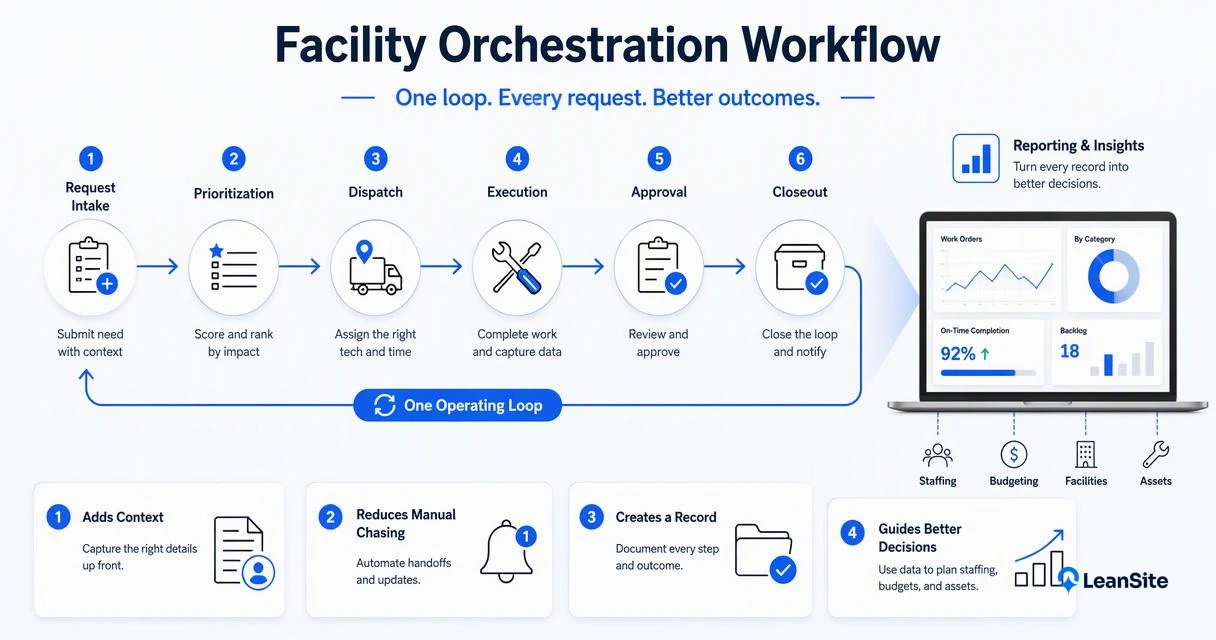
Diagram-style process flow
- Request intake: A store manager, tenant, employee, sensor, or inspection creates a request.
- Triage and priority: The system classifies urgency, asset type, location, compliance impact, and budget rules.
- Assignment or dispatch: Internal technicians or approved vendors receive the work with scope, photos, access notes, and due dates.
- Execution tracking: Status, labor, parts, messages, and proof of work are logged in real time.
- Approval and payment path: Quotes, change orders, completion reviews, and invoices follow set rules.
- Reporting and learning: Leaders review spend, recurring failures, vendor performance, response times, and capital planning signals.
Multi-site teams often need this more than single-building teams because variation grows fast. The guide to multi-location facilities management software explains why standard workflows, shared visibility, and site-level accountability become harder as portfolios expand.
Academic research is moving in the same direction. Mikalef and Gupta's 2021 study on artificial intelligence capability treats AI capability as an organizational capability tied to performance and creativity, not just a tool feature. For facilities, that means better outcomes depend on clean processes, usable data, and teams that trust the workflow.
Orchestration vs task tracking vs CMMS
Orchestration is different from task tracking and CMMS because it coordinates the full operating chain instead of only recording tasks or maintaining asset histories. Task tools help people remember work. CMMS platforms manage maintenance records. Orchestration connects the wider business process around work completion, service quality, and cost control.
Facility workflow comparison table
| Capability | Basic task tracker | CMMS-only workflow | Operations orchestration |
|---|---|---|---|
| Best use | Simple to-do lists | Asset maintenance records | Cross-site work coordination |
| Work intake | Manual entry | Work order forms | Multi-source intake with routing rules |
| Vendor management | Usually limited | Sometimes included | Dispatch, status, approvals, documentation, and invoice flow |
| Approvals | Chat or email | Basic approval fields | Policy-based quote, spend, and closeout paths |
| Reporting | Task completion | Maintenance history | Cost, uptime, vendor, asset, SLA, and portfolio trends |
| Main limitation | Little context | Can become maintenance-only | Needs process discipline and clean setup |
The biggest mistake is expecting one record type to solve every coordination problem. A work order is a record. Orchestration is the operating pattern around that record.
Facility leaders also need to avoid building a process that only works when one experienced coordinator remembers every exception. That creates hidden risk when staff changes, vendors rotate, or site volume spikes. Clear routing rules, vendor expectations, and approval thresholds make the system less dependent on memory.
For campus settings, work order transparency is a related challenge because different stakeholders want different views of the same job: requesters want updates, technicians want scope, finance wants cost, and directors want trend data.
How Leansite handles facility orchestration
Leansite supports facility orchestration by giving teams a shared operating layer for work orders, vendor coordination, asset context, and leadership visibility. The value is not just digitizing a ticket; the value is making every next step easier to assign, track, approve, and measure.
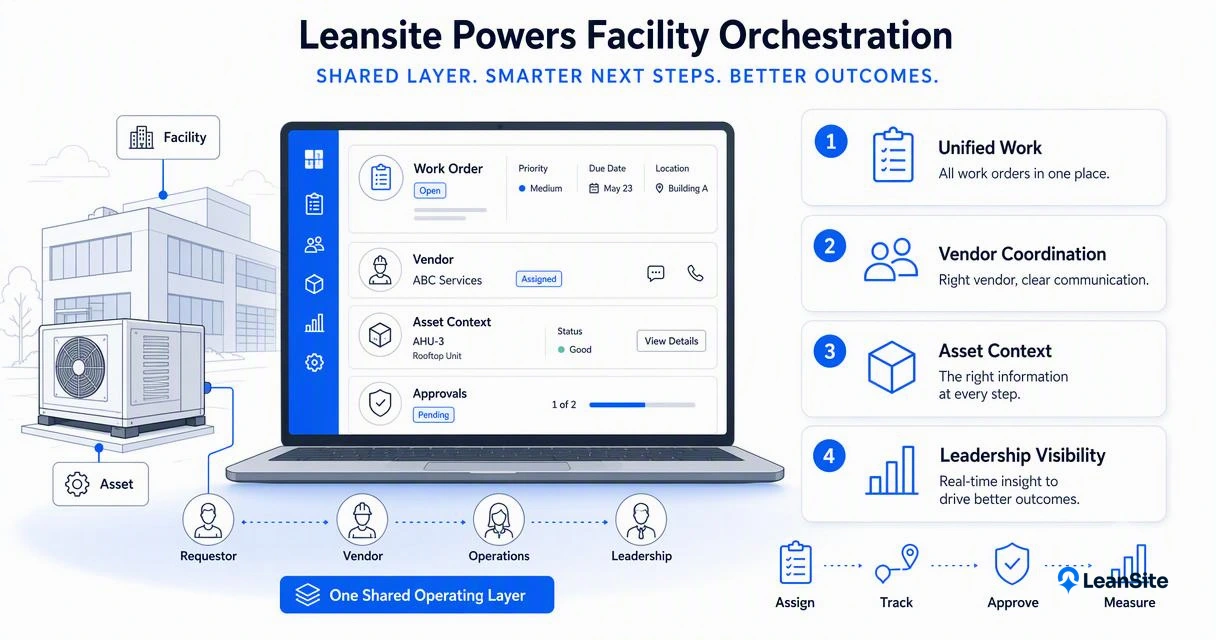
The Leansite platform is especially relevant for multi-location operators that need consistency without burying site teams in admin work. Restaurant groups, campus operators, property teams, and enterprise facilities teams often need the same pattern: fast issue intake, clear ownership, documented vendor work, and reporting that shows where money and time are going.
What a strong orchestration platform should include
- Unified request intake for locations, departments, assets, and vendors.
- Role-based visibility so site staff, facility managers, executives, and service providers see the right information.
- Vendor dispatch and documentation for scope, photos, notes, status changes, and completion evidence.
- Approval controls for quotes, emergency work, recurring issues, and invoice review.
- Asset and location history that helps teams spot repeat failures.
- Portfolio reporting that rolls site-level activity into operating insight.
AI is also becoming part of the orchestration layer. The guide to AI facility management software covers how AI can help summarize requests, surface patterns, and reduce manual sorting. The key is pairing AI with structured operational data rather than loose chat threads.
For teams with many sites, category context matters. Facilities management for restaurant chains in 2026 has different urgency, brand, and uptime needs than office portfolios or campuses, but the orchestration pattern stays similar.
What changes in facility orchestration by 2027?
Facility orchestration will become more predictive, more connected, and more outcome-focused by 2027. The near-term shift is from tracking what happened to guiding what should happen next, based on asset history, vendor performance, site risk, and budget signals.
Connectivity is a major driver. The 2023 IEEE survey On the Road to 6G describes future networks around higher capacity, lower latency, and new testbeds. Facilities will not wait for perfect 6G coverage, but better networks, sensors, and mobile workflows will make real-time building operations more practical.
Key insight: By 2027, the best facilities teams will treat orchestration data as an operating asset, not an administrative byproduct.
Three changes are likely to matter most:
- AI-assisted triage becomes normal: Systems will classify requests, suggest priorities, and flag missing details before dispatch.
- Vendor performance becomes more measurable: Response time, first-time fix rate, quote accuracy, and documentation quality will influence dispatch decisions.
- Asset planning gets closer to daily operations: Repeat work orders will feed capital planning and replacement decisions faster.
The value of data often shows up after patterns have time to form. The article on why year two is when facilities data proves its value explains why long-running records make budgeting and asset decisions stronger.
Teams evaluating orchestration should start with one repeatable workflow, such as HVAC calls, plumbing issues, or exterior repairs. After that workflow is stable, the same model can expand to preventive maintenance, compliance inspections, and vendor scorecards.
Conclusion
Operations orchestration for facilities turns scattered work into a managed flow that connects requests, people, vendors, assets, approvals, and reporting. The smartest next step is to map one high-volume maintenance workflow, identify every handoff, then choose a platform that can make those handoffs visible and repeatable.
For teams ready to replace inbox chasing with coordinated execution, Leansite offers a focused path for facility work orchestration. Visit getleansite.com to see how connected work orders, vendor coordination, and operating visibility can fit a modern facilities program.