A boiler fails on the coldest week of the year. It's not a surprise to anyone who checks the maintenance log, it hasn't had a scheduled inspection in fourteen months, buried under a backlog of reactive tickets that always felt more urgent in the moment.
If that sounds familiar, facilities and operations leaders managing multiple locations often reach for multi-site work order management software after outgrowing a basic ticketing tool. But the more useful comparison isn't platform versus platform, it's preventive work order management versus reactive ticketing as two different operating models. Understanding the difference matters more than any single feature list, because it determines whether a multi-property team spends its time preventing problems or constantly responding to them.
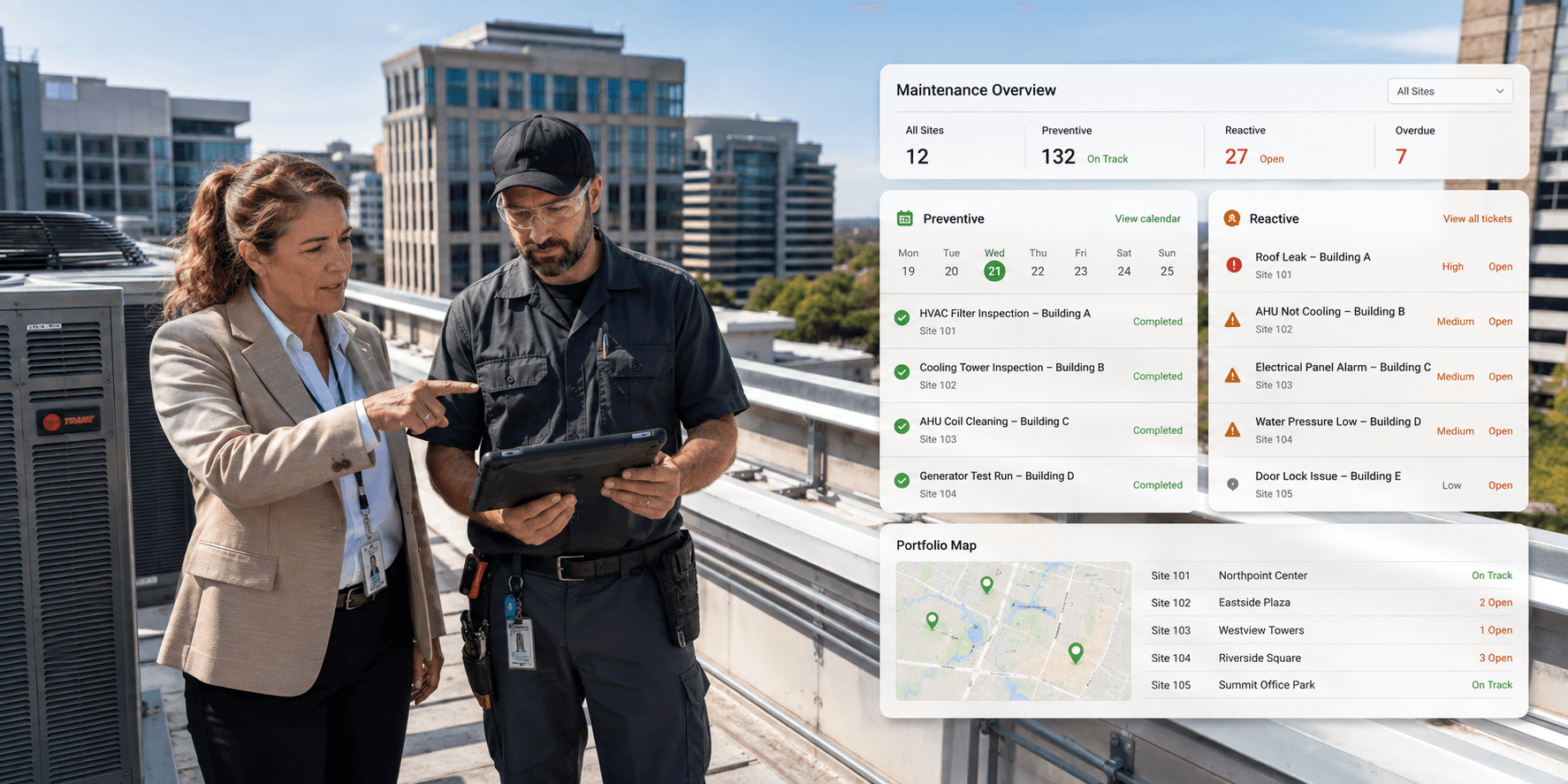
Quick answer: A ticketing system built purely around reactive requests logs and routes problems after they happen, which is necessary but leaves a team firefighting as the portfolio grows. Preventive work order management adds a separate, recurring track, scheduled maintenance triggered by date, usage, or asset condition, running alongside reactive tickets rather than replacing them. Most multi-site operations need both working together, not one instead of the other.
What Does Reactive Ticketing Actually Optimize For?
A ticket management system built around reactive requests is optimized to log and route problems after they happen, a broken fixture, a leak, a complaint. That's genuinely useful and necessary, not every issue can be prevented. But when reactive ticketing is the entire system, a facilities team spends most of its time responding to what already went wrong, with little structure for catching problems before they become tickets in the first place.
This model tends to work fine at a small scale, but it strains as a portfolio grows. More properties mean more reactive volume, and without a preventive layer, the team's time increasingly goes to firefighting rather than maintenance planning.
What Does Preventive Work Order Management Add?
Preventive work order management builds scheduled maintenance directly into the same system as reactive tickets, but on its own track, recurring tasks triggered by date, usage, or asset condition rather than a submitted complaint. The goal isn't to eliminate reactive tickets entirely, it's to catch enough issues early that reactive volume drops over time. A recurring work order that's set up once on a fixed interval, whether that's monthly HVAC checks or quarterly fire safety inspections, and then generates every future occurrence automatically, is what that separate track actually looks like day to day rather than in theory.
For multi-property operations, this shows up in a few concrete ways:
-
Fewer emergency repairs. Equipment that gets serviced on schedule fails less often at the worst possible time, reducing the reactive load a team has to absorb. The stakes of a missed inspection are not small. MaintainX's 2024 State of Industrial Maintenance survey of more than 1,165 maintenance professionals found unplanned downtime costs an average of about $25,000 per hour, and a boiler failure in January is exactly the kind of emergency a preventive schedule is designed to prevent.
-
Lower repair costs over time. Preventive maintenance generally costs less than emergency repair, and the gap widens the longer a piece of equipment goes without scheduled attention. The U.S. Department of Energy's Federal Energy Management Program estimates that a functional preventive maintenance program saves roughly 12% to 18%, on average, compared to a reactive-only approach.
-
Better capital planning. A preventive system generates the maintenance and cost history needed to make repair-versus-replace decisions with actual data instead of guesswork. A per-asset record with its own auto-populated work order history, sorted newest first, is what turns that maintenance pattern into something a facilities team can actually point to rather than recall from memory.
-
Improved work order transparency. When preventive tasks are visible on their own schedule, leadership can see planned maintenance load alongside reactive ticket volume, instead of only seeing the reactive side of the picture. A single view that rolls completion rate, budget adherence, vendor reliability, and team efficiency into one per-location score is a reasonable way to make both sides of that picture visible in the same place.
Why Do Multi-Site Portfolios Feel This Difference the Most?
The gap between reactive-only ticketing and a real preventive system becomes more visible as a portfolio grows, for a simple reason: reactive volume scales roughly with the number of properties, while preventive maintenance scales with the number of assets, and a well-run preventive program tends to slow the growth of reactive tickets even as the portfolio expands. Operators managing many smaller, similar sites, self-storage facility tools are a clear example, often feel this most acutely, since gates, climate units, and access systems across dozens of unstaffed locations benefit heavily from scheduled attention that a purely reactive system has no mechanism to provide. Look for a batch tool that can push the same recurring maintenance schedule to every selected property at once, since setting up preventive coverage site by site across dozens of small locations is its own version of the same scaling problem. We cover this specific case in more depth in Best Work Order Management Software for Self-Storage.
How Do the Leading Platforms Handle This Split?
MaintainX and ServiceChannel are two of the platforms most frequently discussed across multi-site work order and ticketing comparisons. MaintainX handles preventive maintenance scheduling reasonably well for single-site use, though its reactive-to-preventive balance and multi-site reporting can require more manual oversight as a portfolio grows. ServiceChannel is strong on vendor dispatch for reactive repairs at enterprise scale, but its preventive maintenance capabilities are secondary to its vendor coordination focus, and its cost and complexity can exceed what a mid-sized operator needs. We look at that vendor dispatch side specifically in Vendor Dispatch and Predictive Maintenance Automation for Multi-Site Teams.
Where LeanSite AI Fits
LeanSite AI, the platform this article's publisher builds, treats preventive and reactive work as two connected tracks within the same facility management software, rather than favoring one over the other, according to its own published feature set. Reactive tickets get routed and escalated automatically through threshold alerts and preferred vendor cascades, while preventive tasks run on their own recurring schedule and feed the same portfolio-wide reporting. As with any vendor's description of its own product, that's worth confirming directly against a trial or demo. We walk through how to actually design that split in How to Build a Preventive Maintenance Ticket Flow.
See Both Tracks Working Together
The best way to judge whether a platform actually connects preventive and reactive work, rather than treating them as separate tools, is to see it applied to a real portfolio. Book a LeanSite AI demo to walk through your own mix of scheduled and reactive maintenance.
FAQ: Preventive Work Orders vs Reactive Ticketing
Should a multi-site facilities team choose preventive or reactive systems? Most teams need both. Reactive ticketing handles unavoidable issues, while preventive maintenance reduces how often those issues happen in the first place. The question isn't which to choose, but whether a platform supports both well.
Why does reactive-only ticketing become harder to manage as a portfolio grows? Reactive ticket volume tends to scale directly with the number of properties, and without a preventive layer reducing failures upstream, a growing portfolio means a growing, unmanaged reactive workload.
How does preventive maintenance improve work order transparency? It gives leadership visibility into planned maintenance work alongside reactive ticket volume, rather than only seeing the reactive side, which makes it easier to judge whether a facilities team is ahead of problems or constantly behind them.
The real question for a growing multi-site operation isn't which ticketing tool logs requests fastest. It's whether the system in place is reducing how many requests show up in the first place.
Written by Pelumi Akinwande, Operations Content Lead at LeanSite, who works directly with multi-site facilities and property operations teams evaluating work order software. Connect on LinkedIn.