TL;DR
Keep finance, procurement, and accounting records in ERP; use dedicated maintenance workflows when scheduling, dispatch, and vendor coordination need more depth. Select software by testing a complete repair-to-payment workflow, then establish shared identifiers and clear data ownership before connecting systems.
An approved repair invoice doesn't prove that a building's equipment is working. Enterprise resource planning for facilities management connects spending, purchasing, and asset records, but daily maintenance also needs clear ownership of requests, dispatch, and completion. For organizations assessing that operational layer, Leansite is a facility-management option to evaluate alongside existing business systems.
Table of Contents
What is enterprise resource planning for facilities management?
Enterprise resource planning for facilities management is the use of integrated business software to manage facility-related finances, procurement, resources, and asset records. ERP connects maintenance spending with organizational controls, while the depth of scheduling, work-order, and vendor functions depends on the selected product, modules, and configuration.
ERP: Enterprise resource planning integrates an organization's main business processes through software and shared information.
CMMS: A computerized maintenance management system organizes maintenance work, equipment histories, and preventive schedules.
Facility operations software: Software that coordinates building-service requests, tasks, vendors, and operational visibility across locations.
The records finance and facilities need to share
ERP supports the business side of a repair: budget checks, purchase orders, supplier records, invoice approval, and accounting. Facilities teams add the operational context: which asset failed, who attended, what changed, and whether service was restored.
An accounting asset record may track acquisition cost and depreciation. A maintenance record may track inspections, parts, failures, and warranty details. Shared asset identifiers connect those views without treating them as interchangeable.
ERP explains the financial transaction; maintenance records explain the work behind it.
ERP fundamentals in video
This Tamil-language explainer provides background on ERP before evaluating facility-specific workflows.
ERP vs. CMMS vs. facility operations software
ERP, CMMS, and facility operations software serve different primary needs, although individual products can overlap substantially.
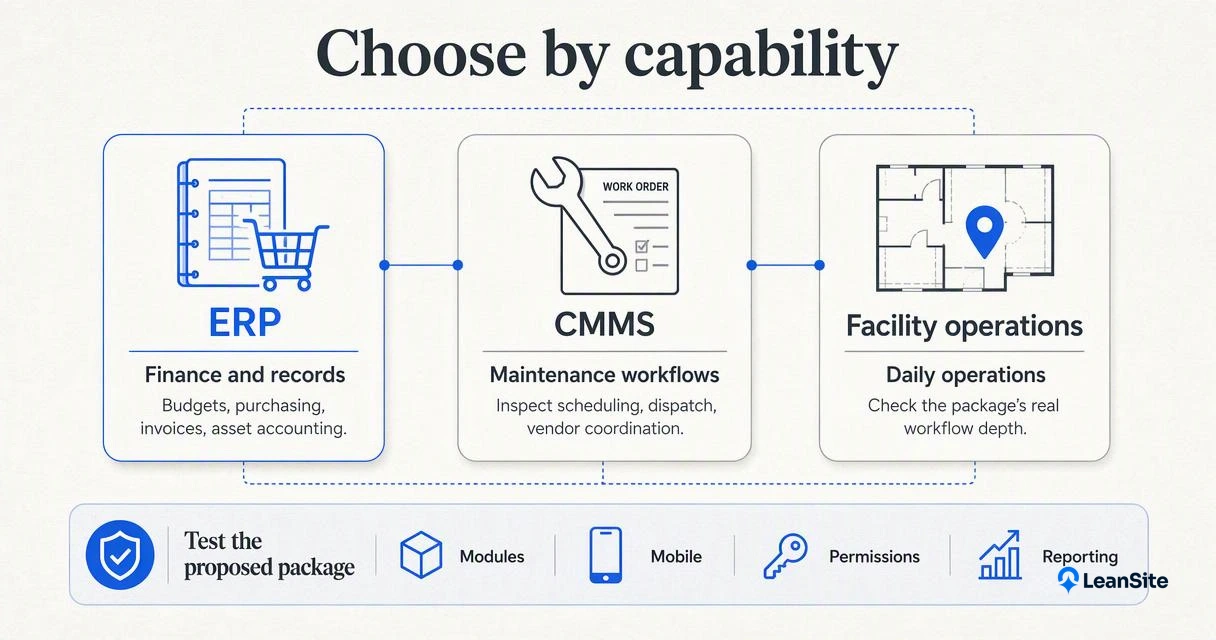
Software labels aren't enough. Buyers should inspect the actual modules, mobile experience, permissions, and reporting available in the proposed package. A suite with a capable maintenance module may satisfy both accounting and operational requirements.
Primary responsibilities across three software categories
| Category | Primary responsibility | Facility-management use | Selection test |
|---|---|---|---|
| ERP | Finance, procurement, business records | Budgets, purchasing, invoice controls, asset accounting | Can spending be traced to a location and asset? |
| CMMS | Maintenance execution | Preventive schedules, equipment history, parts, work orders | Can technicians document and close work efficiently? |
| Facility operations software | Building-service coordination | Requests, vendor dispatch, service targets, portfolio visibility | Can managers track responsibility and progress across sites? |
Who should pick which approach?
- ERP-led: Organizations whose existing maintenance module meets field requirements and whose main priority is financial control.
- CMMS-led: Teams focused on equipment reliability, preventive tasks, spare parts, and technician records.
- Operations-led: Portfolios where location requests, external vendors, and service coordination drive daily work.
Multi-location teams can use this guide to portfolio facilities software to examine location-level requirements. Detailed facilities ticket-management guidance helps assess request intake and assignment.
How should ERP connect to maintenance workflows?
- Map the maintenance-to-payment workflow before selecting ERP connections.
- Assign an owner to each shared data field.
- Match location, asset, vendor, and purchase-order identifiers.
- Define approval thresholds and service milestones.
- Test one complete repair across both systems.
- Expand only after reconciliation and exception handling work.
A rooftop HVAC repair from request to payment
Consider a rooftop HVAC failure at a retail location. The operations workflow records the affected unit, priority, assigned contractor, and completion evidence. ERP handles purchasing authorization, the supplier invoice, and the approved expense allocation.
A useful connection carries the work-order reference into the financial record and returns invoice status to authorized operations staff. That exchange requires agreed identifiers, permissions, and integration capabilities; matching product categories doesn't guarantee compatibility.
Acceptance checks before a portfolio rollout
- Ownership: Identify which system controls supplier details, asset identifiers, and payment status.
- Service timing: Separate response deadlines from resolution deadlines for each service-level agreement, or SLA.
- Evidence: Require completion notes, relevant photos, and approval before financial handoff.
- Exceptions: Assign responsibility for duplicates, rejected invoices, and failed transfers.
Field access deserves its own test. The operational cost of poor connectivity provides useful context for evaluating mobile workflows under real site conditions.
How Leansite handles the facility operations layer
Leansite belongs in the evaluation of facility-focused workflows alongside an ERP, with attention to daily task visibility and coordination rather than accounting replacement.
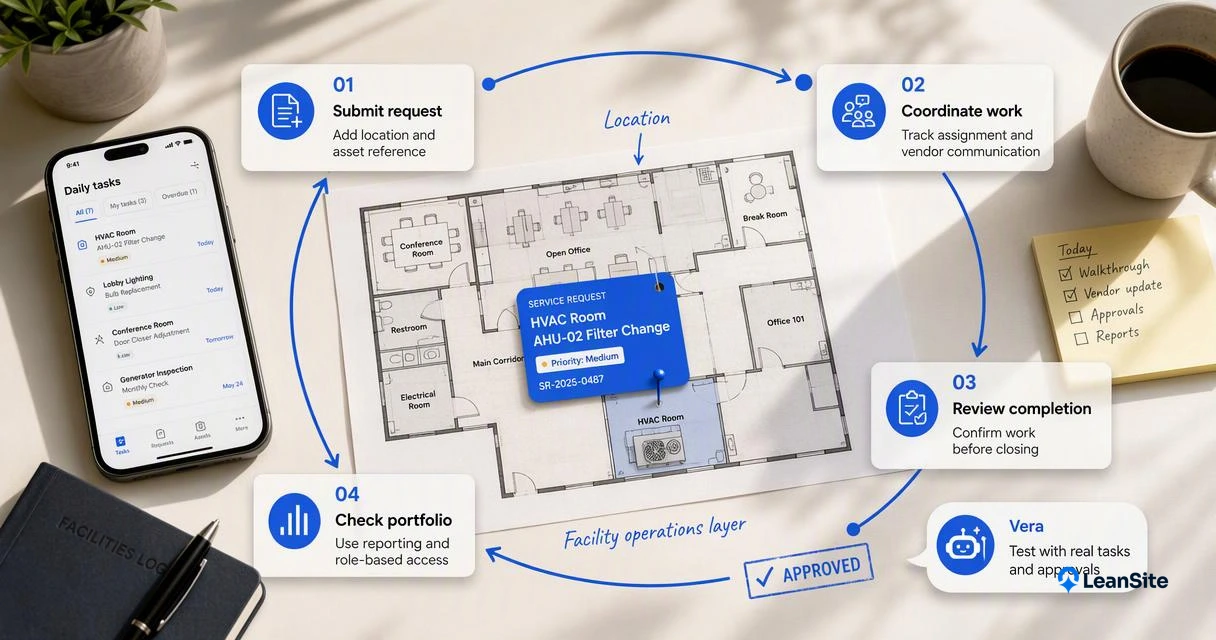
The site's introduction to Vera, its built-in AI assistant, gives buyers a specific feature to investigate. A product walkthrough should demonstrate how assistance fits the organization's actual tasks, roles, and approval requirements.
A practical demonstration brief
- Submit a service request with a location and asset reference.
- Follow assignment, vendor communication, and completion review.
- Inspect portfolio reporting and role-based access.
- Confirm available ERP connections, supported fields, and implementation responsibilities.
A walkthrough should use a realistic repair scenario, not just dashboard screenshots. Product and integration details should be confirmed directly before purchase.
The next priority for AI-assisted facilities workflows
For 2027 planning, auditability should accompany interest in AI-assisted work. Buyers should require clear records of suggested actions, human approvals, and resulting changes. The AI facility-management software guide offers educational follow-up; evaluations should focus on verified capabilities rather than promised autonomy.
A useful AI workflow keeps accountability visible, especially when actions affect contractors, spending, or equipment availability.
Conclusion
A practical enterprise resource planning for facilities management plan starts with one repair, one location, and a clear financial handoff. Facilities and finance leaders should document that workflow, assign record owners, and define pilot success criteria. To assess the operational layer with Leansite, visit getleansite.com and request a walkthrough using that same repair scenario.