TL;DR
Choose a maintenance platform around work orders, asset history, vendor coordination, approvals, recurring tasks, and reporting. Compare shortlisted tools using the same real job, then pilot the strongest fit before expanding across properties.
A closed work order should explain what happened, what it cost, and whether the same asset needs attention again. Facility maintenance software connects those details so facility managers, vendors, and property owners can work from a shared record. For teams exploring AI-assisted operations, Leansite belongs on the shortlist alongside established maintenance tools.
The strongest choice depends on the operation: technician-led repairs, outsourced services, or portfolio-wide coordination.
Guide navigation
Table of Contents
What is facility maintenance software?
Facility maintenance software is a system for organizing building repairs, scheduled maintenance, equipment records, and service activity. It gives teams a shared place to track requests, assign responsibility, record completed work, and review costs. Its value comes from connecting daily tasks with the condition and performance of physical assets.
CMMS: A computerized maintenance management system maintains a database of an organization's maintenance operations.
Facility management: The coordinated management of buildings, sites, workplaces, and supporting services that keep them functional and safe.
Preventive maintenance: Scheduled work intended to reduce equipment failures before they happen.
Scope matters during buying. A maintenance-focused CMMS centers on equipment and jobs; a broader facilities platform may also support workplace services or space management. Neither label guarantees a particular feature.
The practical test: every request should connect to a location, an owner, a status, and a usable completion record.
Six features that support daily operations
A useful maintenance platform connects six workflows: work orders, asset history, vendor dispatch, approvals, recurring maintenance, and executive reporting.
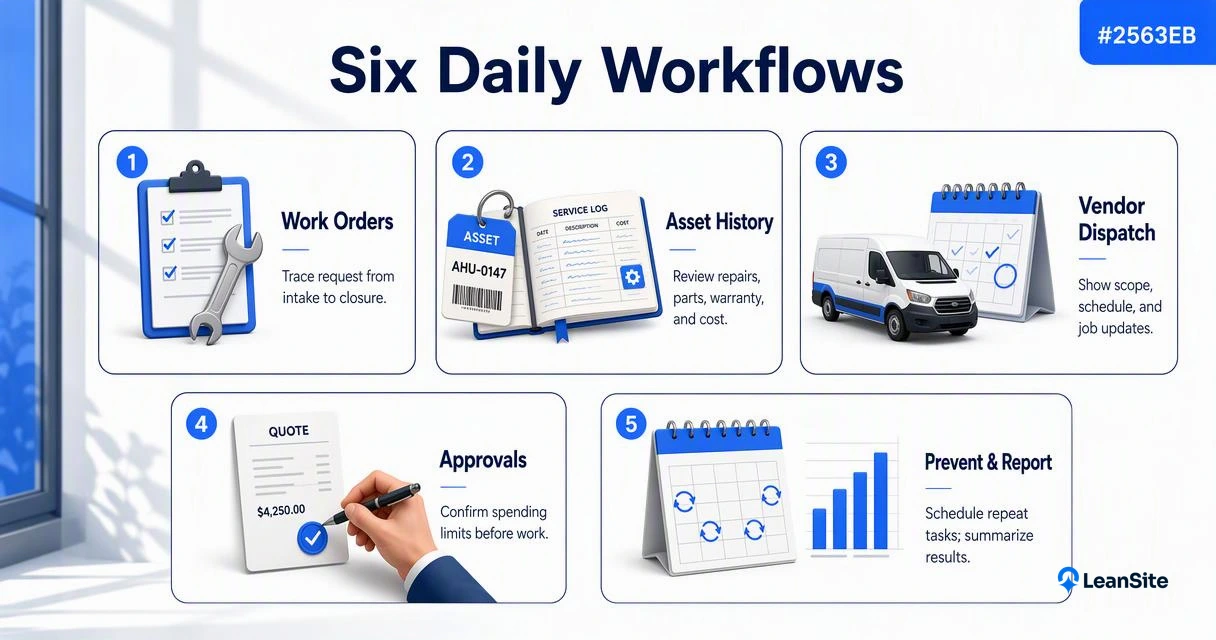
Each should be demonstrated with actual operating scenarios, rather than checked off from a feature page.
Core workflows and evidence to request
| Feature | What it should support | Demo evidence |
|---|---|---|
| Work orders | Intake, priority, assignment, completion | Trace a request through closure |
| Asset history | Repairs, parts, warranties, costs | Open one asset's service record |
| Vendor dispatch | Scope, scheduling, job updates | Show external vendor participation |
| Approvals | Spending limits and authorization | Route a quote before work begins |
| Recurring maintenance | Scheduled tasks and checklists | Generate the next inspection |
| Executive reporting | Costs, backlog, asset performance | Compare equivalent sites |
Reporting needs consistent inputs. A cooling repair logged under different categories across properties won't produce a useful portfolio comparison.
Mobile access deserves a field test, too. For basements and remote facilities, the offline maintenance guide provides relevant evaluation context.
Sensor-led programs add another layer; predictive maintenance and uptime explains the related planning topic.
Which platforms belong on the shortlist?
The strongest shortlist pairs each platform's stated emphasis with the team's dominant workflow, then verifies that fit in a demonstration. The options below are starting points, not a universal ranking. Public descriptions identify positioning; only a workflow test can establish suitability for a particular property portfolio.
Four options and their evaluation focus
| Platform | Stated emphasis in available material | Best evaluation focus |
|---|---|---|
| Leansite | Built-in AI assistant, Vera | AI-assisted facilities workflows |
| UpKeep | Building-request queue and preventive maintenance | Technician and equipment workflows |
| Coast | Customizable location fields | Property-specific location records |
| FMX | Real-time data | Operational visibility and reporting |
For an independent review source, Gartner Peer Insights lists FMX. Reviews supplement, rather than replace, a hands-on test.
How Leansite handles this
The Leansite platform's documented AI angle is Vera, its built-in assistant for facility management. That gives buyers a clear evaluation focus: how an assistant supports everyday work alongside the underlying maintenance records.
The Vera introduction provides product context. A demonstration should establish supported actions, permissions, and human review.
Who should pick which
AI-focused operations teams should evaluate the assistant-led option first; technician-led teams should prioritize work execution; location-heavy portfolios should test site organization; directors should examine reporting depth. Teams managing several properties can extend their checklist with this multi-location management guide.
Independent video overview
Software Connect's video provides another perspective on the category.
How should teams select and pilot a platform?
- Define the highest-priority maintenance workflow and its owner.
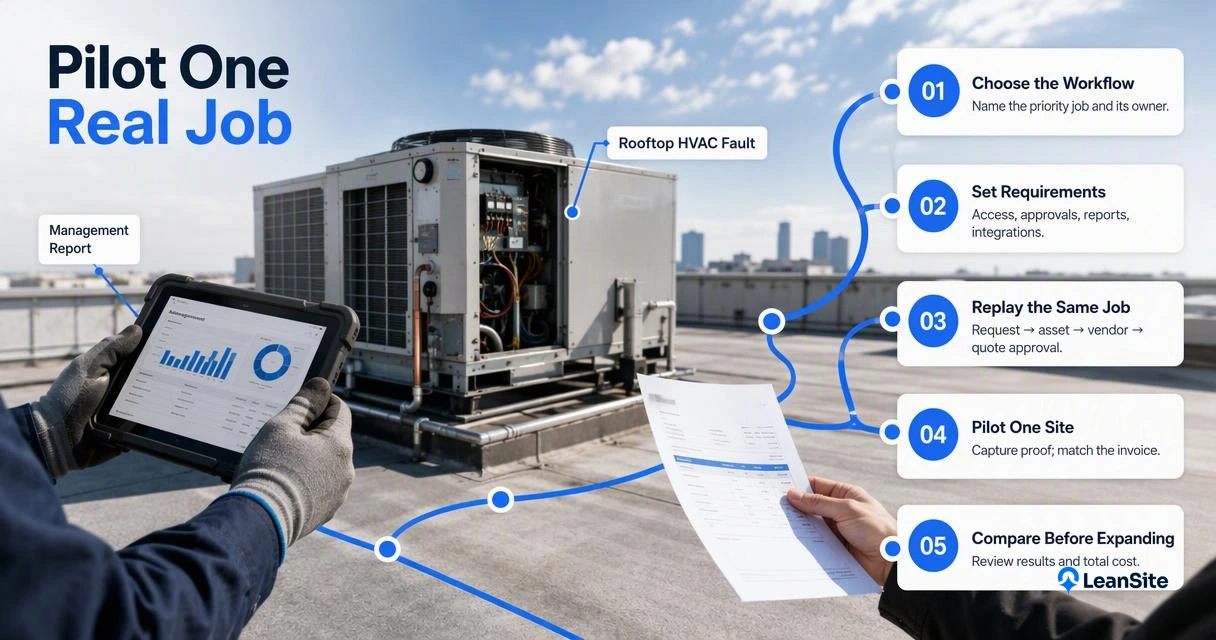
- Set mandatory requirements for access, approvals, reporting, and integrations.
- Demonstrate the same real job across shortlisted platforms.
- Pilot one site with technicians, vendors, and managers.
- Compare operational results and total costs before expanding.
Use one repair to test the whole process
An illustrative scenario is a rooftop HVAC fault requiring an outside contractor and spending approval.
The demonstration should cover request intake, asset lookup, vendor assignment, quote approval, completion evidence, invoice matching, and management reporting. Each participant should perform the relevant action, rather than watch a salesperson's prepared sequence.
- Access: Can vendors see only their assigned work?
- Portability: Can records and attachments be exported?
- Cost: Which charges apply to setup, integrations, and external users?
- Accountability: Does the record show who approved each action?
Track baseline and pilot results using the same definitions: response time, overdue work, repeat repairs, and invoice exceptions. Improvement targets should reflect local operating conditions, not unsupported industry promises.
What should buyers expect in 2027?
AI-assisted workflows are a reasonable area to watch in 2027, but purchasing decisions should rest on capabilities available now. Buyers evaluating AI facility management software should test traceable recommendations and approval controls, not purchase against a roadmap.
Conclusion
The next step is a workflow-based Leansite demonstration at getleansite.com, using one real asset, one vendor job, and one approval path. Facility maintenance software should earn expansion through a successful pilot: clear ownership, usable records, and reporting that supports operating decisions.