TL;DR
Multi-site teams need one operating system for work orders, assets, vendors, alerts, and KPIs. The strongest platforms reduce location-to-location variation with templates, routing rules, mobile updates, and portfolio dashboards.
A 20-site operation can look organized on paper while every location runs maintenance differently. Multi-location facility management software: a centralized platform that helps facility teams manage work orders, assets, vendors, inspections, preventive maintenance, and reporting across several buildings or business locations. For teams comparing modern options, Leansite fits the 2026 shift toward simpler dispatching, faster field updates, and clearer portfolio visibility.
Table of Contents
What is multi-location facility management software?
Multi-location facility management software is a shared operations platform for managing maintenance activity across stores, offices, campuses, warehouses, self-storage sites, restaurants, and commercial properties. It connects local requests with central oversight, so teams can track the same workflows, categories, vendors, priorities, and performance metrics at every site.
Energy and facility management software is commonly described as an enterprise-wide platform for technical building data, combining ideas from EMS, CAFM, and enterprise asset systems. Multi-site platforms build on that model with location hierarchies, mobile work orders, vendor routing, preventive schedules, and KPI dashboards.
Multi-site facility software works best when it turns scattered local decisions into repeatable portfolio standards.
Core terminology for multi-site teams
Work order: a trackable maintenance task with status, priority, location, assignee, photos, notes, and completion history.
Asset: a maintainable item such as HVAC equipment, doors, lifts, refrigeration units, lighting, plumbing, or life-safety systems.
Location hierarchy: the structure that groups properties by region, brand, district, campus, building, floor, room, or unit.
Vendor routing: automated assignment of jobs to approved service providers based on trade, location, contract, availability, or cost rules.
Why multi-site operations need one system
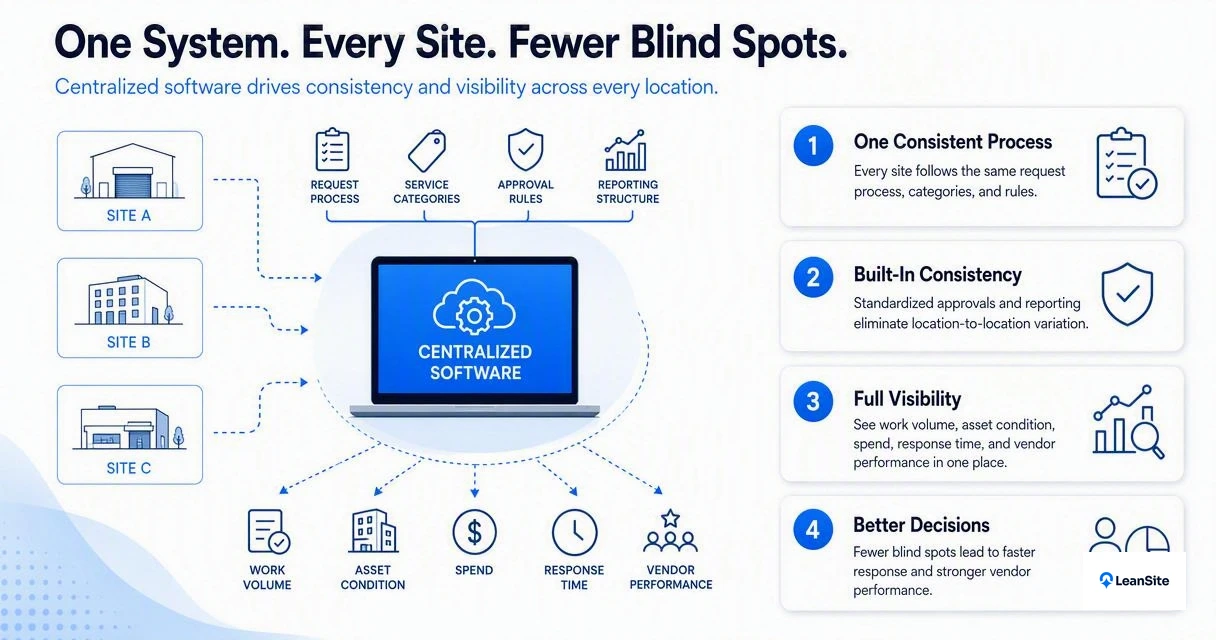
Centralized software reduces variation between locations by giving every site the same request process, service categories, approval rules, and reporting structure. The main business case is not just fewer spreadsheets; it is fewer blind spots across work volume, asset condition, spend, response time, and vendor performance.
Competitor pages in this SERP consistently focus on features such as work orders, dashboards, vendor accountability, and mobile reporting. The missing layer is operating discipline: templates, routing logic, escalation rules, and KPI definitions must be standardized before the dashboard becomes useful.
"Any organization that designs a system (defined broadly) will produce a design whose structure is a copy of the organization's communication structure.", Melvin E. Conway, How Do Committees Invent?
That idea matters in facilities. If every region communicates differently, the software will expose the inconsistency instead of fixing it. A stronger setup starts with common workflows, then uses software to enforce them.
Common failure points in multi-location maintenance
-
Local teams use different priority labels for the same problem.
-
Vendors receive incomplete details, causing repeat visits.
-
Preventive maintenance schedules live in separate calendars.
-
Executives see total spend but not cost per asset or location.
-
Photos, invoices, and completion notes sit in email threads.
-
Offline or weak connectivity delays field updates, a topic covered in more depth in the hidden cost of poor connectivity in facilities management.
Which features matter most in 2026?
The most important 2026 features are centralized work orders, reusable templates, automated alerts, vendor routing, asset history, mobile updates, and KPI reporting by location. Enterprise teams should judge each feature by how well it reduces manual follow-up and makes every site operate from the same playbook.
The Leansite platform is designed around that practical operating model: create requests, assign work, track vendors, and see progress without forcing field teams into a heavy legacy system. Teams researching the category can also compare options in top work order platforms for multi-site facilities.
Feature comparison for distributed facilities
|
Capability |
What it controls |
Why it matters across locations |
|---|---|---|
|
Central dashboard |
Open work, overdue tasks, spend, vendor activity |
Gives leaders one portfolio view |
|
Work order templates |
Required fields, categories, priorities |
Makes request quality consistent |
|
Automated alerts |
SLA breaches, urgent issues, status changes |
Cuts manual chasing |
|
Vendor routing |
Trade, geography, approval rules |
Sends jobs to the right provider faster |
|
Asset records |
Service history, photos, warranties |
Supports repair-versus-replace decisions |
|
Mobile updates |
Photos, notes, signatures, completion |
Improves field accuracy |
|
KPI reporting |
Response time, completion time, backlog, cost |
Shows which locations need help |
Workflow checklist for implementation
-
Map locations, regions, brands, and property types.
-
Standardize request categories and priority levels.
-
Build templates for recurring trades and asset types.
-
Add approved vendors with service areas and rules.
-
Set alerts for urgent work and SLA exceptions.
-
Review dashboards weekly by region and property.
-
Use monthly KPI reviews to adjust staffing, vendors, and preventive schedules.
For a deeper category view, see the complete guide to multi-location facilities management software.
Useful video for teams moving from spreadsheets
Spreadsheets can help a small team organize parts or assets, but they break down when several sites need approvals, mobile photos, vendor dispatching, and audit trails. That transition point is usually when a dedicated facilities platform becomes easier to manage than another shared workbook.
How Leansite handles multi-site workflows
Leansite helps multi-location teams bring requests, work orders, vendors, and reporting into one cleaner workflow. The strongest fit is an operation that needs less email, faster dispatching, and consistent execution across stores, offices, or commercial properties without adding unnecessary system complexity.
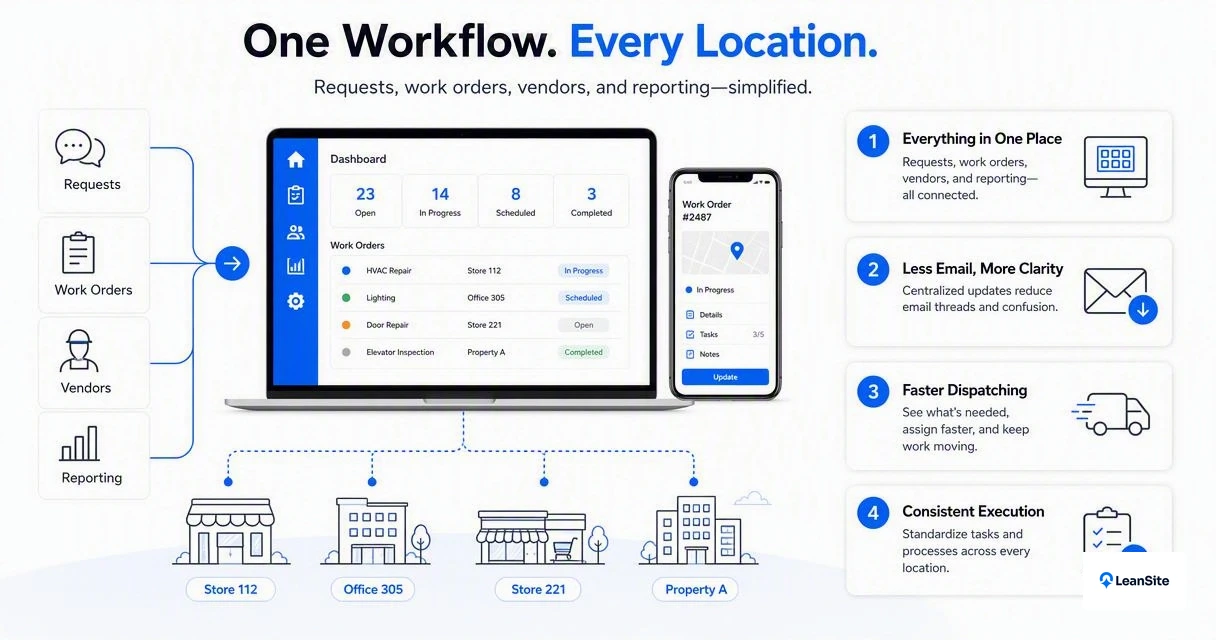
With Leansite, teams can structure locations, track open work, route tasks, and keep maintenance details visible from request through completion. For operators evaluating automation and AI-assisted support, the related guide to AI facility management software explains where modern tools are heading.
getleansite.com is a useful next stop for teams that want a clearer look at the platform and its fit for multi-site maintenance operations.
Who should prioritize which platform style?
|
Team profile |
Better fit |
Main reason |
|---|---|---|
|
Retail or restaurant chains |
Lightweight work order and vendor routing platform |
Fast issue intake and dispatching across many similar sites |
|
Large campuses |
Asset-heavy CMMS or campus work order system |
More complex building zones, shops, and preventive work |
|
Commercial property portfolios |
Centralized facilities platform with KPI reporting |
Owner visibility into spend, vendors, and uptime |
|
Self-storage operators |
Site-based maintenance and ticket tracking |
Many small locations with recurring access, gate, and unit issues |
Campus teams can compare dedicated options in best work order software for campus facilities in 2026. Ticket-heavy operations can also review best facilities ticket management system for 2026.
What should teams expect next?
The next wave of facility software will connect mobile work, sensor data, vendor performance, and AI assistance more tightly. Research on integrated sensing and communications for 6G points toward networks that combine communication and sensing functions, which could support richer building monitoring over time, according to IEEE research on 6G integrated sensing and communications.
Digital environments are also getting more attention. A 2022 research agenda on metaverse applications notes emerging opportunities and challenges for practice and policy, which matters as digital twins and remote building views become more common in facility planning, maintenance, and training, as discussed in the International Journal of Information Management.
In practical terms, 2026 teams should prepare for:
-
AI assistants that summarize work order history and suggest next actions.
-
More automated alerts from sensors, meters, and connected assets.
-
Better vendor scorecards tied to response time, cost, and completion quality.
-
Portfolio benchmarks that compare similar locations side by side.
-
Cleaner mobile experiences for technicians and store-level staff.
The near-term win is not futuristic technology. The win is building clean data habits now, so automation has something reliable to work with later.
FAQ
Common questions about multi-site facility systems usually center on scope, setup, integrations, and value.
What is the difference between CMMS and facility management software?
A CMMS usually focuses on maintenance work orders, preventive maintenance, and asset history. Facility management software can cover a broader operating scope, including vendors, locations, inspections, tickets, compliance workflows, and reporting. Many modern platforms blend both categories, especially for distributed commercial operations.
How long does implementation take across multiple locations?
Implementation time depends on location count, asset data quality, vendor complexity, and workflow standardization. A focused rollout often starts with core request types, priority levels, location setup, and vendor rules before adding deeper asset tracking or preventive maintenance schedules.
Which KPIs matter most for multi-location facilities?
The most useful KPIs include open work orders, overdue work, average response time, average completion time, cost by location, cost by trade, repeat issues, preventive completion rate, and vendor performance. Consistent definitions matter more than a long dashboard.
Can small regional teams use this type of software?
Yes. A team with several properties can benefit if work is being tracked through calls, texts, spreadsheets, or email. The value increases when the same problems repeat across locations and managers need one place to see status, cost, and accountability.
Conclusion
The right multi-location facility management software gives every location the same maintenance playbook while giving leadership a clear view of work, vendors, assets, and costs. The next step is simple: list the top five recurring maintenance workflows, define the required fields for each, then review how Leansite can turn those workflows into trackable, repeatable operations. For product details, visit getleansite.com.