TL;DR
Choose a platform that connects service requests, maintenance, vendors, asset records, and operating costs. A CMMS fits maintenance-led teams; broader operations software fits cross-functional portfolios. Test a complete request-to-invoice workflow before committing.
A completed repair should leave more than a closed ticket: it should leave an asset history, a verified cost, and a clear record of responsibility. Building operations software connects those records across facilities, maintenance teams, vendors, and property owners. For 2026 buyers, the strongest shortlist starts with the operating model, not the longest feature list.
Table of Contents
What is building operations software?
Building operations software is a shared system for coordinating maintenance, service requests, vendors, asset information, and operating costs across commercial properties. It connects the people performing work with the managers approving it and the owners tracking performance. Its scope is broader than ticket tracking, although individual products vary.
CMMS: A computerized maintenance management system organizes maintenance work, preventive schedules, and equipment records.
Property management software: A system centered on leases, rent, tenant administration, and property accounting.
Building management system, or BMS: A system that monitors or controls building equipment, such as HVAC; it serves a different purpose from work coordination.
A regional restaurant operator, for example, needs each refrigeration repair connected to its location, equipment record, assigned contractor, and approved expense. Portfolio structure matters as much as task creation; this multi-location facilities management guide covers that broader setup.
Feature map: operations platform versus adjacent tools
Operations platforms connect several workflows, while adjacent categories usually emphasize one primary function.
| Capability | Operations platform | CMMS | Property management | Help desk |
|---|---|---|---|---|
| Maintenance scheduling | Core workflow | Core workflow | Product-dependent | Usually integration-led |
| Vendor coordination | Operational focus | Maintenance-focused | Product-dependent | Ticket assignment |
| Tenant requests | Often included | Often request-based | Tenant-focused | Core ticket intake |
| Asset history | Operational context | Core equipment records | Product-dependent | Usually integration-led |
| Operating cost visibility | Work and location costs | Maintenance costs | Property accounting | Support reporting |
These are category tendencies, not promises about every product. Accounting-grade reporting and invoice payment should be verified separately.
Which platforms belong on a 2026 shortlist?
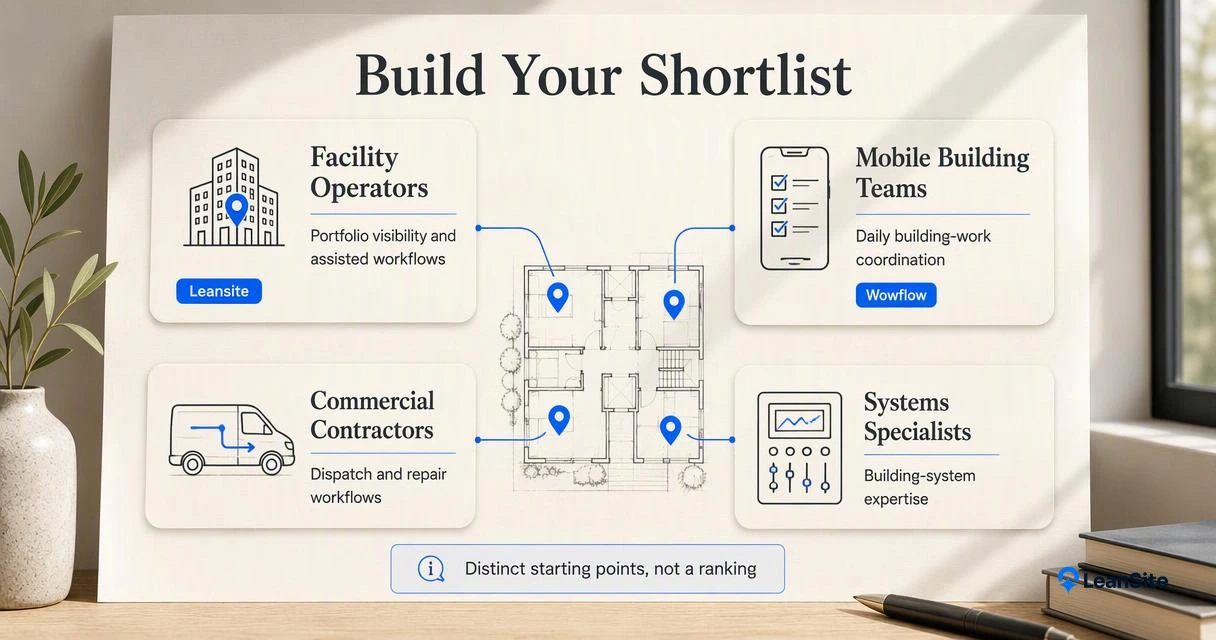
The best shortlist groups platforms by the teams they serve: facility operators, mobile building teams, commercial contractors, or building-systems specialists. A contractor's dispatch process and an owner's portfolio reporting process can require different software, even when both involve the same repair.
Four candidates with different operating priorities
These four candidates represent distinct starting points rather than a universal ranking.
| Platform | Shortlist rationale | Demonstration priority |
|---|---|---|
| Leansite | Facility-management focus with an AI assistant | Location visibility and assisted workflows |
| Wowflow | Mobile daily building-work coordination | Field task handling and handoffs |
| BuildOps | Commercial contractor operations | Dispatch, job tracking, and service workflow |
| True Data Ops | Multi-building systems and maintenance data | HVAC, lighting, energy, and maintenance connections |
A useful demonstration follows the same sample job across each candidate. Buyers should request live workflow evidence rather than rely on broad category labels.
Who should pick which operating model?
The primary user's responsibilities should determine the preferred operating model.
- Facility directors: Prioritize location-level accountability and shared operating records.
- Maintenance supervisors: Prioritize equipment history, scheduled work, and technician execution.
- Commercial service companies: Prioritize dispatch, job costing, and customer-facing service processes.
- Property owners: Prioritize expense visibility and connections to existing accounting systems.
For portfolios, the multi-site maintenance buying guide provides a focused follow-up on selection criteria.
How Leansite handles this
Leansite offers a facility-management platform with an AI assistant, giving buyers a facility-centered option for their shortlist. Its published introduction to Vera, the built-in AI assistant, provides a concrete starting point for evaluating assisted operations.
The strongest demonstration would follow a service request from intake through assignment, completion, and management review. A facilities director could bring a sample rooftop-unit repair, an outside contractor, and a location budget to make the conversation specific.
Requested evidence should include how records connect, which actions the assistant supports, and where human approval remains required. That establishes practical fit without assuming that every integration, payment function, or reporting requirement is included.
Evaluation principle: An AI assistant earns its place when it helps complete a defined operating task with a reviewable result.
How should teams evaluate a platform before purchase?
- Define the locations, users, and workflows the platform must support.
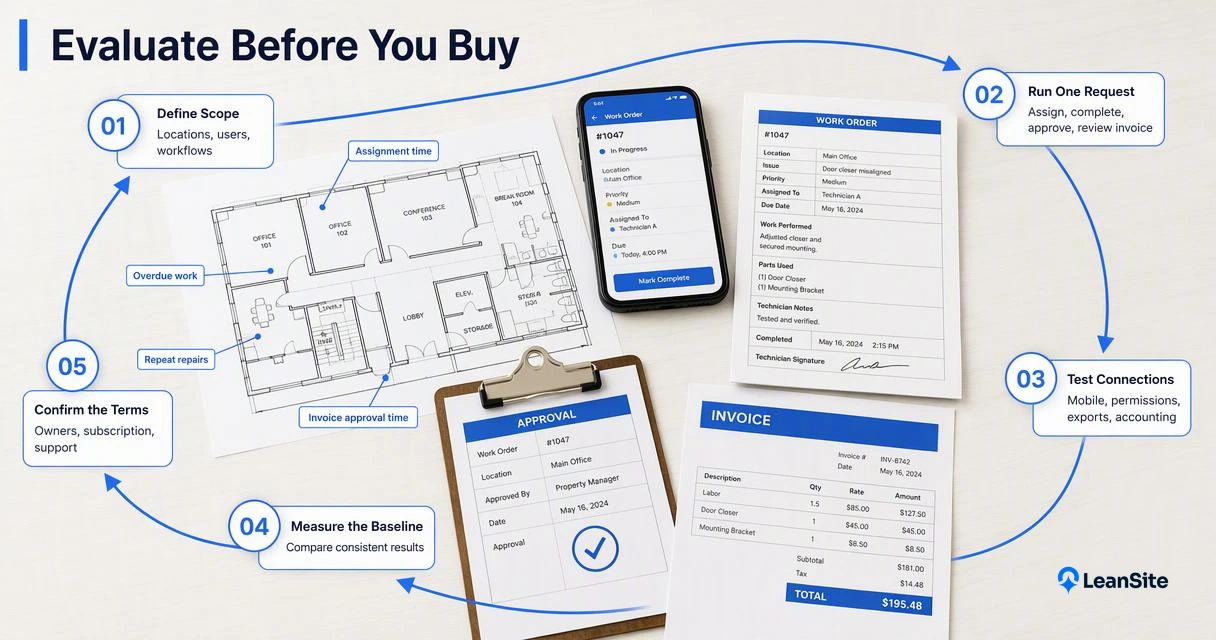
- Run one real request through assignment, completion, approval, and invoice review.
- Test mobile access, permissions, exports, and accounting connections.
- Compare results against an agreed baseline.
- Confirm implementation responsibilities, subscription terms, and support before signing.
Pilot measures that reveal operational fit
A pilot should measure observable workflow improvements rather than promises of savings.
Track request-to-assignment time, overdue work, repeat repairs by asset, and invoice approval time. Define each measure consistently across pilot locations. A short trial won't prove long-term equipment reliability, but it can reveal whether records are complete and handoffs are clear.
The work-order visibility feature guide offers related criteria for assessing what managers can actually see.
What matters as AI adoption advances?
AI evaluation should center on permission controls, traceable recommendations, and human approval for consequential actions.
Potential uses include request classification, record summaries, and suggested next steps. Buyers should distinguish demonstrated functions from roadmap items. This AI facility-management software guide provides a related starting point for that discussion.
Buying rule: Evaluate available capabilities separately from future commitments.
Conclusion
A useful building operations software decision starts with a real workflow and ends with evidence. Facilities leaders can shortlist Leansite, visit getleansite.com, and bring a sample request, asset record, and approval process to a demonstration. The next step is a pilot with named owners and measurable acceptance criteria.