A regional manager needs a Monday morning snapshot of open work orders across 15 properties. Getting it means emailing 15 property managers and waiting for replies. By Wednesday, half the picture is already outdated, and one of those "open" tickets has been sitting untouched for three weeks.
If that sounds familiar, the problem usually is not effort. It is that work order management software was never built, or set up, to close the eight gaps below.
Quick answer: Work order management software fails multi-site operators when intake, categorization, visibility, vendor tracking, and asset history are not connected in one system. Facilities that rely on paper, email, or spreadsheets typically close fewer than half of work orders on schedule, while centralized systems with automated status tracking are built to close on-time rates closer to 90 percent. Reactive maintenance also costs 3 to 5 times more than the same work done as planned preventive maintenance, according to the U.S. Department of Energy. This guide breaks down the eight most common gaps in multi-site work order management, why they get worse as a portfolio grows, and what a system needs to close each one for good.
What Is Work Order Management Software?
Work order management software, often called a CMMS (computerized maintenance management system), is the platform facility teams use to log, assign, track, and close maintenance requests, from a leaking faucet to a scheduled HVAC inspection. For a single site, a shared inbox or spreadsheet can function adequately. For multi-site management, where dozens or hundreds of locations need consistent intake, categorization, and reporting, the software becomes the operational backbone of the business rather than an optional tool.
The global CMMS software market was valued at roughly USD 1.3 to 1.4 billion in 2025 and is projected to grow at a 9 to 11 percent compound annual rate through 2030, according to market research from Mordor Intelligence and Research and Markets. That growth is driven largely by AI and IoT adoption in facility operations. If you are evaluating options, our CMMS buyer's guide walks through how to compare platforms feature by feature.
Most portfolios notice these gaps once they are managing more than four or five properties with different staffing levels or vendor relationships. Below that, informal processes can mask the gaps a growing portfolio eventually exposes.
1. Why Does Fragmented Intake Across Locations Cause the Most Problems?
Fragmented intake is the root cause behind most other breakdowns in multi-site work order management. When each site logs requests differently, by email, phone, or paper, there is no consistent record across the portfolio, and every downstream process, from categorization to reporting, becomes unreliable.
What it looks like in practice: A retail chain with 40 stores has store managers logging issues in whatever tool is convenient: texts to a regional manager, sticky notes, a shared spreadsheet nobody updates consistently. Corporate has no reliable count of open requests at any given time.
What closes it: A single intake path, one portal, one mobile app, one phone number, used identically at every site, regardless of whether the work is handled by an internal team, an external service provider, or a preferred vendor. A batch tool that pushes the same intake template to every selected property in a single action, the way LeanSite AI's Bulk Work Orders does, closes this specific gap directly, instead of relying on every site to adopt the same habit independently. For more on why this gap persists, see why most multi-site maintenance teams still rely on email and spreadsheets.
2. Why Does Inconsistent Categorization Break Portfolio Reporting?
When one location tags an issue "plumbing" and another tags the identical problem "leak," portfolio-wide reporting becomes unreliable and duplicate tickets slip through undetected, even when both properties think they are following the same process. A standardized taxonomy across every site is what makes property maintenance data trustworthy at scale, rather than an approximation built from mismatched tags.
What it looks like in practice: A facilities director benchmarking HVAC spend across 25 properties finds that "HVAC," "heating," "AC repair," and "climate control" are all used for the same trade category, making it impossible to compare costs or frequency accurately.
What closes it: A shared taxonomy of trade and service categories built directly into the request-creation flow, so the person logging the ticket selects from a defined list instead of typing free text. Enforced Type and Class fields on every asset record prevent this drift at the system level, rather than depending on every site remembering the same convention. This is the same principle behind standardized asset types and classes covered in gap 7: structure at the point of entry protects the data everywhere downstream.
3. Why Do Manual Handoffs Between Teams Cause Tickets to Disappear?
A request that moves from front desk to manager to technician by word of mouth loses context, and often disappears entirely, at any point along the way. Without a system record of the handoff itself, there is nothing to show where or why a ticket stalled.
What it looks like in practice: A property manager takes a call about a broken elevator, writes a note for the maintenance supervisor, who is out that day. The note sits on a desk for 48 hours before anyone acts on it.
What closes it: A defined status lifecycle, assigned, in progress, completed, that the system tracks and moves automatically, rather than relying on a person remembering to notify the next party. When status changes are logged automatically instead of communicated informally, nothing depends on someone being available to pass the message along. Manual handoffs are one of several causes behind why maintenance tickets get lost, worth a closer read if this gap sounds familiar.
4. Why Can't Leadership See Portfolio-Wide Work Order Data?
If leadership needs a separate login or a phone call to check status at each property, the software is not providing real centralized work order management. It is just distributing the same fragmented visibility across more screens. A related industry pattern: a Cisco-cited survey found that 81 percent of senior business leaders said their organization's data was scattered across silos, the same condition that blocks cross-site visibility in facilities operations.
What it looks like in practice: A regional operations VP for a multi-family housing portfolio needs a Monday morning snapshot of open work orders across 15 buildings. Getting it means emailing 15 property managers and waiting for replies. By Wednesday, half the picture is already outdated.
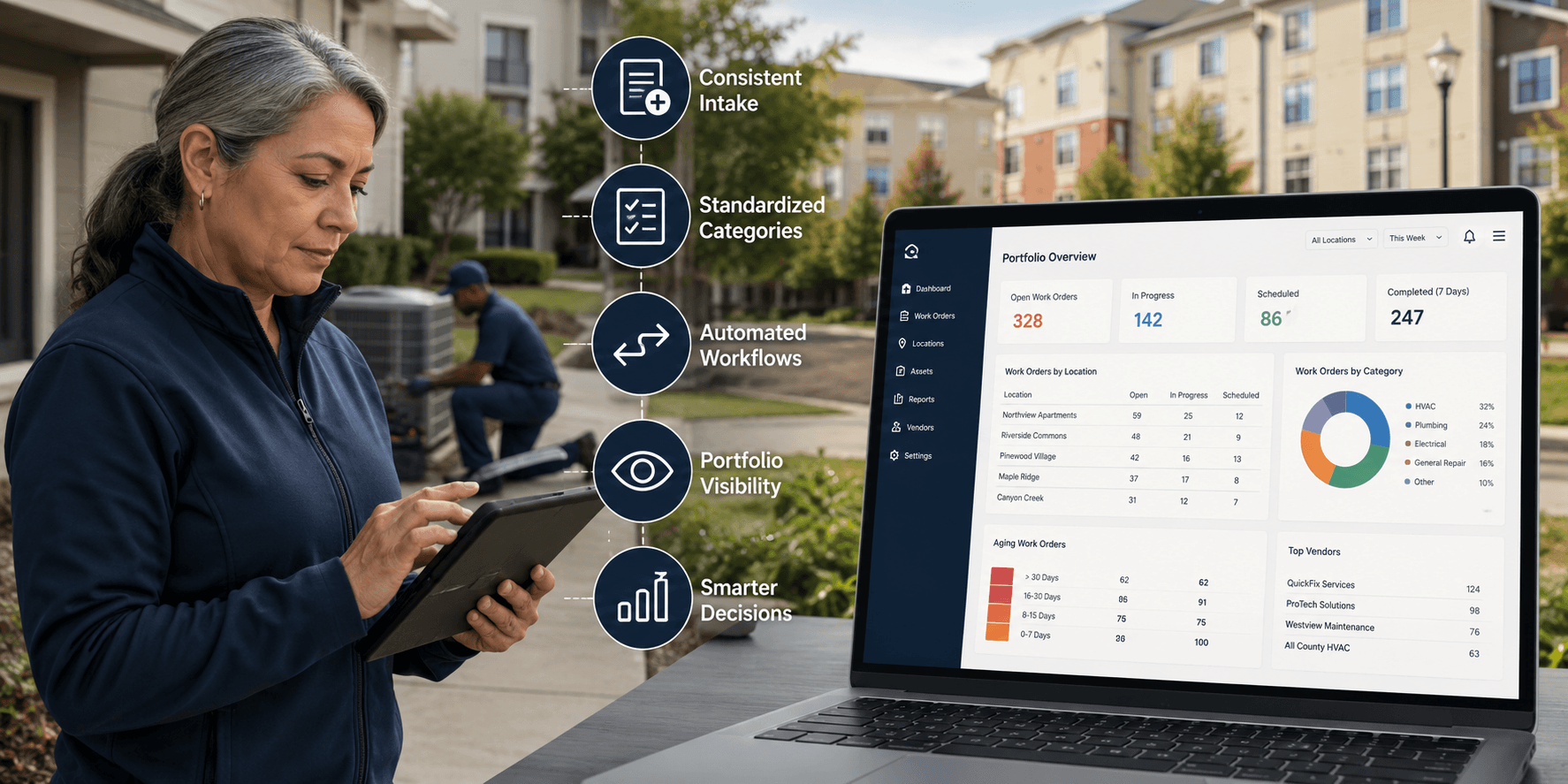
What closes it: A property-level view that rolls up into a portfolio-level view: at-a-glance counts of open, in-progress, scheduled, and recently completed work orders per site. A Portfolio Health Score built from completion rate, budget adherence, vendor reliability, and team efficiency, with a per-location ranking, is what that dashboard should actually deliver, not a login per site. For portfolios that regularly need the same work order pushed across many properties at once, such as seasonal HVAC checks or compliance sweeps, see how to manage maintenance across multiple locations without losing visibility.
The consequences of poor visibility compound at scale. The U.S. Government Accountability Office found that deferred maintenance and repair backlogs across federal buildings more than doubled, from roughly 171 billion dollars in fiscal year 2017 to about 370 billion dollars in fiscal year 2024, a trend significant enough that GAO added building condition to its 2025 High-Risk List. That figure describes a government-scale portfolio, but it illustrates what happens to any organization when maintenance backlog is not visible and addressed early. See the hidden cost of deferred maintenance for a closer look at how backlog erodes budgets over time.
5. Why Does Silent Ticket Aging Go Unnoticed?
Tickets that stall do not fail loudly. Without a built-in threshold that flags aging requests automatically, a stalled ticket sits quietly until a tenant complaint or a manual audit happens to catch it. Facilities management guidance from IFMA and BOMA generally recommends keeping a maintenance backlog to about 2 to 4 weeks of available technician labor; beyond that window, aging tickets start to represent real risk to occupant safety and comfort.
What it looks like in practice: A tenant reports a leaking pipe. The ticket is assigned but the vendor never confirms a start date. Three weeks later, the tenant calls again, now with water damage, and only then does anyone realize the ticket had been sitting untouched.
What closes it: Threshold trigger alerts scoped by priority and location turn "someone should notice this" into a rule the system enforces on its own, rather than something a manager has to remember to check. Ticket age is one of several facility maintenance KPIs worth tracking alongside backlog and vendor performance.
6. Why Does Vendor Coordination Outside the System Hurt Work Order Transparency?
When vendor dispatch and invoicing happen through separate email threads, there is no way to trace cost or performance data back to the original ticket. This is one of the least visible causes of work order transparency failures, since nobody can trace vendor performance or cost history back to the ticket that triggered it. Facility management services outsourcing is common at scale: Grand View Research reports the outsourced segment represents about 61.5 percent of the global facility management services market, and 66.5 percent among large enterprises specifically.
What it looks like in practice: A facilities team hires the same HVAC vendor across 12 properties but has no consolidated view of how much they have spent with that vendor, how many jobs were completed on time, or when the vendor last serviced a given piece of equipment. That information exists, scattered across a dozen email inboxes and invoice folders.
What closes it: A dedicated vendor record on every asset, tracking which vendors have serviced it, how many jobs each has completed, and total amount spent, keeps that trail visible on the same record instead of scattered across inboxes. Preferred vendor lists tied to specific properties also mean routing a new request to a known, reliable vendor takes two clicks instead of a round of phone calls. We cover this specific gap in more depth in vendor dispatch and predictive maintenance automation for multi-site teams.
7. Why Does the Lack of Asset-Level History Hide Repeat Failures?
Without ticket history tied to a specific unit or piece of equipment, recurring issues get treated as new problems every time instead of a pattern worth acting on for maintenance tracking and capital planning. This particularly affects operators with many small, similar sites, including self-storage facilities, retail locations, and multi-family properties.
What it looks like in practice: A rooftop chiller has failed three times in eight months, but each repair was logged as a standalone work order with no connection to the others. Nobody notices the pattern until the unit fails a fourth time and a technician finally asks whether this has happened before.
What closes it: A per-asset Work Orders tab that auto-populates the complete maintenance history, sorted newest first, turns that pattern into something visible rather than something someone has to remember. An asset inventory tracking each piece of equipment with its own ID, type, class, location, purchase date, warranty, and expected lifespan is what turns a repair-versus-replace decision from a guess into a data-backed call. Facilities that lean on predictive and preventive maintenance data see the payoff: McKinsey's research on manufacturing analytics found that predictive maintenance typically reduces machine downtime by 30 to 50 percent and increases machine life by 20 to 40 percent. The U.S. Department of Energy separately estimates that preventive maintenance programs cost 12 to 18 percent less to run than reactive approaches.
For portfolios with large existing inventories, the ability to bulk-import hundreds of assets via CSV, rather than entering them one at a time, is what makes this practical to adopt rather than a project that never gets finished.
8. Why Does Status Never Reaching the Requester Cause Complaints?
Even a completed repair feels unresolved if the person who submitted it never hears back. Automated status updates, assigned, in progress, resolved, close the loop without requiring a phone call to check in. Their absence is one of the most common sources of complaints about facility operations, even when the underlying work was completed on time. Maintenance response is consistently the top driver of resident and tenant satisfaction: a 2024 MIT Center for Real Estate study of more than 104,000 tenant responses across nearly 2,900 office buildings found that each one-point increase in tenant satisfaction, on a 5-point scale, corresponded to an 8.6 percent higher likelihood of lease renewal.
What it looks like in practice: A tenant submits a maintenance request through a portal. The work is completed within 24 hours, but the tenant never receives confirmation. Three days later, they call to ask if anyone is coming. The work was already done.
What closes it: Notifications that fire automatically at each stage of the work order lifecycle, so the requester does not have to ask. This matters just as much on the field side: when a technician's arrival, pause, resume, and departure are all logged and reported without extra steps, both the requester and the facility manager get a real-time record of what happened and when.
Why Does This Look Different by Property Type?
The specific pattern behind these gaps often depends on the kind of portfolio you are managing.
Self-storage portfolios manage many small, largely unstaffed sites, where the challenge is less about requester volume and more about visibility into gates, access systems, and climate units with no on-site staff to catch what the software misses. The Self Storage Association represents an industry of more than 50,000 facilities in the United States, with roughly 52,301 individual facilities operating as of 2024 and total rentable inventory exceeding 2 billion square feet nationwide. A 2026 operator survey from Storage Commander found that 24 percent of self-storage operators named staffing shortages and retention as their top operational challenge in 2025, second only to occupancy. With few or no staff on-site to notice a recurring gate malfunction or repeated lighting failure, asset-tied maintenance history is often the only way a pattern gets caught before it becomes a liability. See our guide to the best work order management software for self-storage.
Higher education and campus facilities deal with high requester turnover, since students and staff submit requests across dozens of buildings, which makes standardized, low-effort intake especially important. There is no time to train a rotating population on a complicated system. We go deeper on this in best work order software for campus facilities in 2026.
Multi-family residential portfolios need a closed feedback loop for tenant-submitted requests. A resident who never hears back is more likely to escalate a complaint than one who receives an automatic status update.
Retail chains rely on standardized categorization especially heavily, since corporate teams are often benchmarking maintenance spend across stores with near-identical footprints and equipment.
Restaurant groups face the same categorization and vendor-tracking gaps as retail, compounded by tight uptime windows on kitchen equipment. See top work order platforms for restaurant groups in 2026.
Franchise and branch networks need vendor performance and cost history tracked across the whole network, not just one branch, to make preferred-vendor decisions data-driven instead of anecdotal.
How Does LeanSite AI Compare to MaintainX and Limble for Multi-Site Portfolios?
MaintainX and Limble are two of the platforms most frequently discussed for multi-site work order management. Both are capable in the right context. But if you are evaluating a MaintainX alternative or a Limble alternative for a portfolio with real vendor and reporting complexity, each tends to show the software-side gaps above most clearly once you grow past a handful of properties.
|
Capability |
MaintainX |
Limble |
LeanSite AI |
|---|---|---|---|
|
Best fit |
Fast, mobile-first deployment |
Preventive maintenance workflows |
Multi-site portfolios with vendor and reporting complexity |
|
Centralized cross-property dashboard |
Per-location view, limited roll-up |
Roll-up reporting on higher tiers |
Portfolio Health Score with per-location ranking |
|
Automated aging-ticket escalation |
Basic notification rules |
Rule-based, PM-focused |
Threshold alerts scoped by priority and location |
|
Vendor cost and performance tracking on the ticket |
Limited |
Limited |
Dedicated vendor record per asset |
|
Asset-level ticket history |
Available |
Available |
Auto-populated Work Orders tab per asset |
|
Bulk work order creation across properties |
Limited |
Limited |
Bulk Work Orders across a filtered property set |
This is not a claim that MaintainX or Limble are poor tools. They are not. It is that the specific software gaps described above are what to check for as a portfolio scales past a handful of properties, regardless of which platform you are evaluating. LeanSite AI was built to close these specific software-side gaps directly, which is worth weighing if the pattern above sounds familiar.
Manual Process vs. Dedicated Work Order Management Software
|
Capability |
Spreadsheets, Email, Phone |
Single-Site Tools |
Multi-Site Work Order Software |
|---|---|---|---|
|
Intake consistency across sites |
Low, varies by site |
Works at one site, breaks at scale |
Consistent by design |
|
Portfolio-wide reporting |
Manual aggregation, error-prone |
Not built for multiple properties |
Built-in rollup dashboards |
|
Vendor cost and performance history |
Scattered across inboxes |
Sometimes tracked, not centralized |
Centralized per vendor, per asset |
|
Asset-level maintenance history |
Rarely tracked |
Sometimes, manually |
Automatic, tied to every work order |
|
Escalation on aging tickets |
Depends on someone noticing |
Basic status only |
Filterable by age and status |
|
Setup effort for 50-plus locations |
Low upfront, high ongoing cost |
Moderate, does not scale well |
Higher upfront, scales cleanly |
What to Look For in Work Order Management Software
-
Centralized intake used the same way at every location
-
Standardized categories that make reporting reliable across the portfolio
-
Automated status tracking that removes reliance on manual handoffs and surfaces aging tickets
-
A single dashboard, property-level and portfolio-level, that gives leadership real visibility without site-by-site calls
-
Vendor tracking inside the same system as the original request, including cost and performance history
-
Asset-level history tied to specific units or equipment, with maintenance records that build automatically
-
Automatic status updates for the people who submitted the request
-
Bulk creation tools for portfolios that regularly need to push the same work across many properties at once
See These Gaps Closed in Practice
The fastest way to know which of these gaps actually apply to your own portfolio is to walk through them against a real system. Book a LeanSite AI demo to see how intake, categorization, escalation, and vendor tracking connect in practice.
FAQ: Work Order Software Gaps in Multi-Site Portfolios
What is the most common reason multi-site teams lose track of work orders? Fragmented intake. When locations use different methods to log requests, there is no consistent record to build reporting or accountability on top of. Every other gap on this list becomes harder to fix without solving intake first.
Why does vendor coordination matter for work order transparency? Because outsourced repairs often happen outside the ticketing system entirely, cost history and vendor performance never get tied back to the original request. That creates a blind spot in reporting and makes it difficult to know whether a vendor relationship is worth keeping.
How many properties does a portfolio need before these gaps typically appear? Most teams notice the pattern once they are managing more than four or five properties with different staffing levels or vendor relationships. Below that, informal processes and spreadsheets can mask the gaps that a growing portfolio eventually exposes.
Is work order management software the same thing as a CMMS? Largely, yes. A CMMS, or computerized maintenance management system, is a specific term for software that manages maintenance work orders, assets, and preventive schedules. Work order management software is a broader, more commonly searched term that covers the same core functionality.
Does asset tracking actually reduce ticket volume, or does it just organize existing tickets better? Both, over time. Asset-level history does not prevent the first failure, but it makes the second and third failure visible as a pattern rather than a coincidence, which is what lets a team move from reactive repairs to proactive replacement decisions before a piece of equipment fails again.
What is the difference between a regular work order and an asset-based work order? A regular work order is tied to a property but not to any specific piece of equipment, useful for general maintenance, cleaning, or inspections. An asset-based work order is linked to both the property and a specific asset, which means the completed work automatically becomes part of that asset's maintenance history. Both work order types coexist in the same system without one replacing the other.
How much does reactive maintenance cost compared to preventive maintenance? The U.S. Department of Energy estimates reactive maintenance costs 3 to 5 times more than the same work performed as planned preventive maintenance, and that preventive maintenance programs run 12 to 18 percent cheaper overall than reactive approaches.
Is LeanSite AI a MaintainX or Limble alternative for multi-site portfolios? For portfolios where vendor cost tracking, cross-property reporting, and asset-level history are the main pain points, LeanSite AI is built specifically to address those gaps at scale. For simpler, single-location or purely mobile-first deployments, MaintainX or Limble may already cover what you need. See the comparison above for where each platform fits best.
Closing these eight gaps is not about adding more tools. It is about making sure intake, routing, vendor coordination, asset history, and reporting all operate as one connected system instead of a patchwork of workarounds. That is the design principle behind LeanSite's approach to facility operations, and it is the exact list of gaps this guide started with.
Written by Pelumi Akinwande, Operations Content Lead at LeanSite, who works directly with multi-site facilities and property operations teams evaluating work order software. Connect on LinkedIn.