TL;DR
Reactive maintenance works for low-risk, low-cost failures, while preventive maintenance protects high-value assets, uptime, and safety. Facility teams usually need a mixed model: rank assets by risk, schedule recurring work for core systems, and keep reactive work for minor items.
Reactive vs preventive maintenance in facilities is not a theory debate; it decides whether a building runs on planned work or emergency calls. Maintenance: the functional checking, servicing, repairing, or replacing of equipment, building infrastructure, and supporting utilities so assets keep working as intended. The strongest facility programs use both models, then track every job in one work order system. Leansite helps maintenance teams organize reactive tickets, recurring preventive tasks, vendors, and status updates without losing visibility across locations.
Table of Contents
What is reactive vs preventive maintenance in facilities?
Reactive vs preventive maintenance in facilities compares two ways to care for building assets: fixing equipment after failure versus servicing it on a planned schedule before failure. Reactive work handles urgent breakdowns. Preventive work uses inspections, cleaning, lubrication, filter changes, testing, and recurring tasks to reduce unplanned downtime.
Reactive maintenance: repair work triggered by a failure, complaint, alarm, inspection finding, or tenant request after an asset has already stopped working or degraded.
Preventive maintenance: planned work performed by time, usage, season, code requirement, or manufacturer guidance to keep an asset reliable.
"An Ounce of Prevention is worth a Pound of Cure." - Benjamin Franklin, Founders Online
That quote fits facilities because small scheduled tasks often protect expensive systems. A belt replacement, coil cleaning, roof drain inspection, or fire door check rarely feels urgent until ignored work becomes an outage, leak, comfort complaint, or failed inspection.
Common examples in commercial buildings
-
Reactive: dispatching an HVAC contractor after a rooftop unit stops cooling during store hours.
-
Reactive: replacing a broken door closer after a security issue is reported.
-
Preventive: changing air filters on a monthly or quarterly schedule.
-
Preventive: testing emergency lighting before an annual life-safety inspection.
-
Preventive: cleaning grease traps or roof drains before seasonal demand.
Facilities that still depend on paper tickets or scattered messages can lose the maintenance history needed to spot repeat failures. The reasons are often practical, not careless, as explained in why maintenance teams still use paper work orders.
How do reactive and preventive maintenance compare?
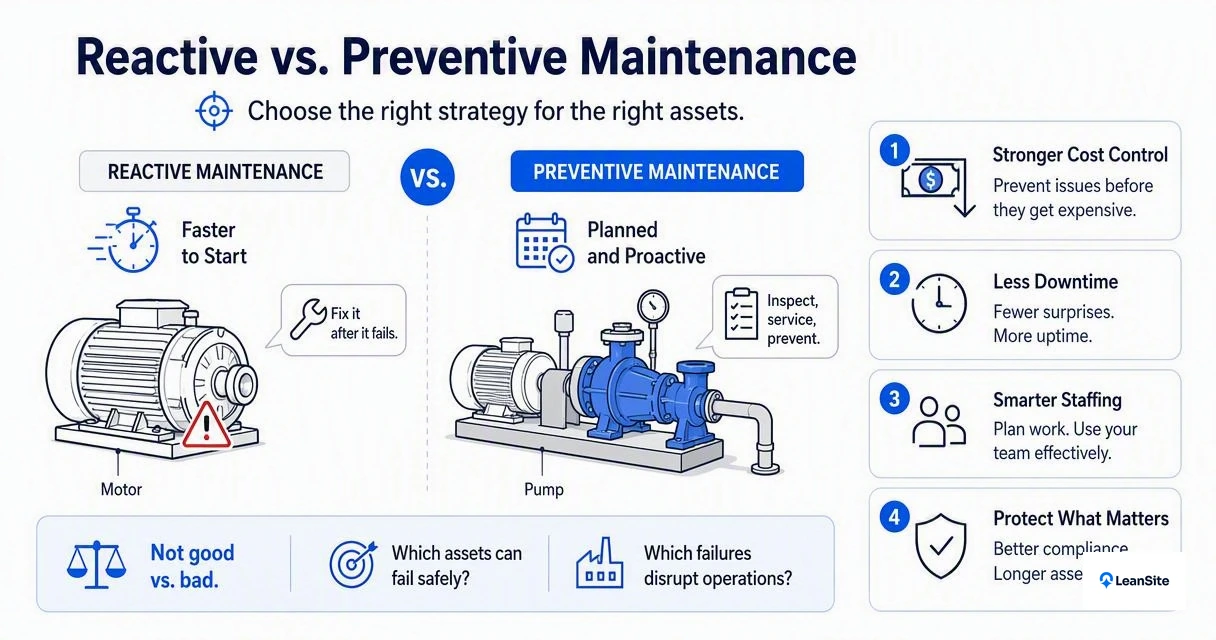
Reactive maintenance is faster to start, but preventive maintenance gives stronger control over cost, downtime, staffing, compliance, and asset life. The best comparison is not "good versus bad." The better question is which assets can fail safely and which failures disrupt operations.
Side-by-side comparison for facility leaders
|
Factor |
Reactive maintenance |
Preventive maintenance |
Facility impact |
|---|---|---|---|
|
Trigger |
Failure, complaint, alarm, emergency |
Calendar, meter, season, checklist |
Preventive work is easier to plan |
|
Cost pattern |
Unpredictable repair spend |
Budgeted labor and parts |
Finance teams get cleaner forecasts |
|
Downtime |
Often unplanned |
Usually scheduled |
Occupants see fewer surprises |
|
Staffing |
Interrupt-driven dispatch |
Planned technician routes |
Supervisors can balance workloads |
|
Vendor use |
Emergency calls and rush fees |
Scheduled service windows |
Vendor coordination improves |
|
Asset life |
Failure can stress connected parts |
Regular care reduces wear |
Capital replacement can be delayed |
|
Data quality |
Often incomplete if rushed |
Repeatable task records |
Asset decisions become easier |
Cost risk grows when reactive work becomes the default for assets tied to revenue, safety, comfort, or compliance. Deferred work can also create a hidden backlog, making the article on the hidden cost of deferred maintenance a useful follow-up for budget planning.
Reactive work should be a response option, not the operating model for every asset.
When does each maintenance model fit commercial buildings?
Reactive maintenance fits low-risk items, while preventive maintenance fits assets where failure affects safety, operations, revenue, tenant experience, or compliance. A balanced program keeps the urgency where it belongs and avoids scheduling low-value work that creates noise.
Best-fit use cases for each model
Use reactive maintenance for:
-
Cosmetic defects that do not create safety or brand issues.
-
Low-cost assets with easy replacement paths.
-
Nonessential fixtures where failure causes minor inconvenience.
-
One-off tenant requests that do not signal a recurring asset problem.
Use preventive maintenance for:
-
HVAC, refrigeration, electrical, plumbing, elevators, roofing, and life-safety systems.
-
Assets with manufacturer service requirements or code inspection needs.
-
Equipment that causes business interruption when down.
-
Systems with long lead-time parts or limited vendor availability.
-
Locations where failure affects many occupants or customers.
A grocery store, campus, hospital, restaurant group, or national retailer may accept a reactive light bulb replacement. The same facility should not treat refrigeration, air handling, fire alarms, or roof drainage as casual break-fix work.
Programs ready to move beyond calendar schedules can study predictive maintenance for facility uptime, where sensor data, inspections, and asset history help predict likely failures before standard intervals.
How can facilities move from reactive repairs to preventive schedules?
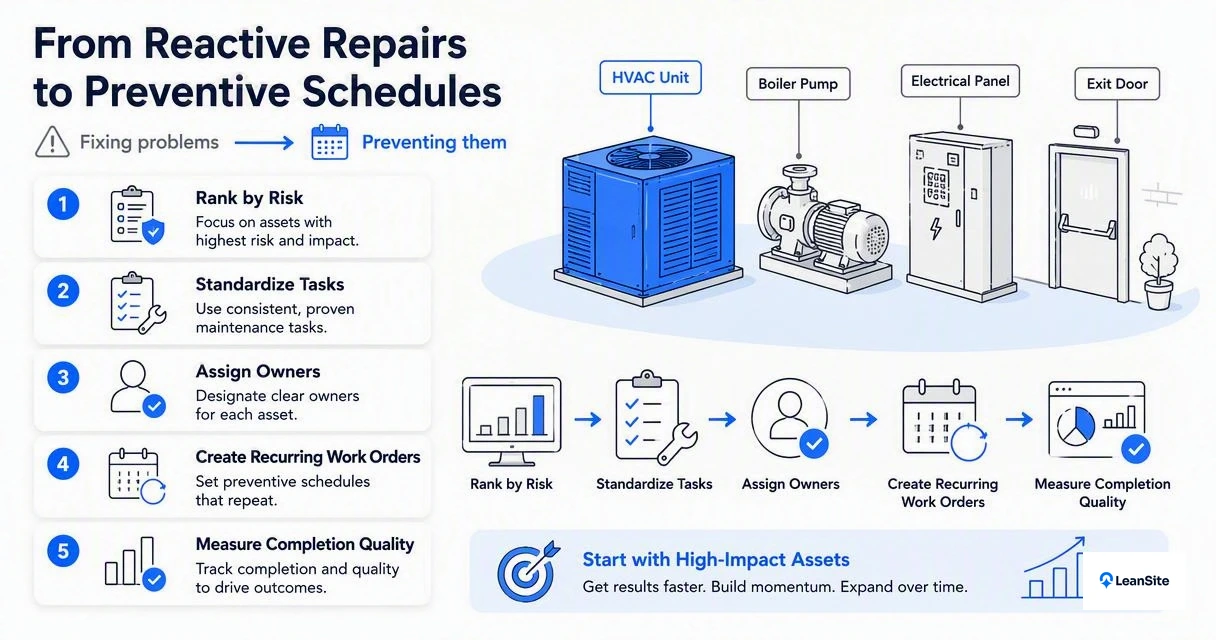
Facilities can move from reactive repairs to preventive schedules by ranking assets by risk, standardizing tasks, assigning owners, creating recurring work orders, and measuring completion quality. The change works best when teams start with high-impact assets instead of trying to schedule everything at once.
Five-step transition plan for high-risk assets
-
List critical assets. Start with HVAC units, fire-life-safety systems, refrigeration, elevators, roofs, generators, pumps, and electrical panels.
-
Score risk. Rank each asset by downtime impact, safety risk, repair cost, age, warranty, part availability, and tenant impact.
-
Build task templates. Create checklists for inspections, readings, cleaning, lubrication, tests, photos, and pass-fail notes.
-
Schedule recurring work. Set frequencies by manufacturer guidance, season, compliance need, or observed failure patterns.
-
Review outcomes monthly. Compare emergency tickets, repeat failures, overdue tasks, vendor response, and total spend.
A practical ticket flow matters because preventive work fails when tasks are vague. The guide on building a preventive maintenance ticket flow shows how recurring work can move from schedule to assignment to closeout without extra admin drag.
The Leansite platform fits this transition by giving facility teams one place to track incoming repair requests, scheduled PMs, vendor dispatch, notes, photos, and completion status. For multi-location operators comparing systems, work order systems for multi-site facilities explains what to look for before standardizing across a portfolio.
"In God we trust; all others must bring data." - W. Edwards Deming, The W. Edwards Deming Institute
Maintenance data does not need to be fancy at first. Completion rate, overdue work, mean time to respond, repeat repairs, and asset-level spend give facility directors enough evidence to tune schedules and justify budget.
How Leansite supports daily execution
With Leansite, teams can separate emergency requests from scheduled work while keeping both visible to managers, technicians, vendors, and property stakeholders. That matters because preventive maintenance is not just a calendar; it is a repeatable workflow with ownership, documentation, and closeout.
For teams cleaning up dispatch and technician handoffs, fast facility work order workflows can help define the process before software settings are finalized. More information is available at getleansite.com.
FAQ
Is preventive maintenance always cheaper than reactive maintenance?
Preventive maintenance is not always cheaper for every item. A low-cost, noncritical asset may be fine to replace after failure. Preventive work usually becomes more cost-effective for assets that affect uptime, safety, energy use, customer experience, or compliance. The goal is lower total risk, not scheduling work for everything.
What percentage of maintenance should be preventive?
No universal percentage was provided in the research data, and facilities should avoid copying a generic benchmark without context. A better target is asset-based: high-risk systems should have planned tasks, while low-risk items can stay reactive. Teams can then track emergency work trends and adjust the balance.
What is the biggest mistake in switching to preventive maintenance?
The biggest mistake is creating too many recurring tasks without clear asset priority, labor capacity, or closeout standards. That creates overdue work and weak trust in the schedule. A better approach starts with critical assets, simple checklists, realistic frequencies, and monthly review of results.
How does predictive maintenance fit with preventive maintenance?
Predictive maintenance builds on preventive maintenance by using condition data, inspections, sensors, or performance trends to decide when service is needed. Preventive work follows a planned interval. Predictive work adjusts that interval based on evidence, making it useful for expensive equipment with measurable operating patterns.
Conclusion
Reactive vs preventive maintenance in facilities works best as a balanced decision, not a slogan. Keep reactive work for low-risk issues, move critical assets onto schedules, and measure whether emergency calls, downtime, and repeat repairs drop over time. Facility teams ready to tighten that workflow can map the top 20 assets, create recurring tasks, assign owners, and visit getleansite.com to see how Leansite helps turn that plan into daily execution.