TL;DR
ESG compliance software helps facility teams turn daily maintenance, energy, waste, vendor, and inspection activity into audit-ready records. The best fit connects work orders, asset data, and reporting evidence so operators can cut manual spreadsheet work and show how buildings perform across locations.
Facility ESG reporting is no longer just a finance or sustainability task; building operations now create much of the evidence. ESG compliance software for facility management tracks environmental, social, and governance data tied to properties, assets, vendors, inspections, work orders, and corrective actions. ESG compliance software: software that helps organizations collect, verify, organize, and report ESG evidence for internal controls, audits, regulations, investors, and customers. For facility teams, Leansite fits this work by connecting maintenance execution with documentation, so operating activity does not disappear into email threads, paper forms, or one-off spreadsheets.
Table of Contents
What is ESG compliance software for facility management?
ESG compliance software for facility management is a system that captures building-level operating data and turns it into structured evidence for ESG reporting, audits, and performance reviews. It usually connects maintenance tasks, asset records, vendor activity, inspections, utility data, and issue resolution into one traceable record.
The term ESG covers environmental, social, and governance factors. In facilities, that means the physical proof behind energy use, emissions sources, water, waste, safety checks, accessibility work, contractor compliance, and approval history.
Academic research keeps pointing to the same issue: ESG reporting is hard when source data sits across disconnected systems. A 2024 paper in Sustainability describes ESG reporting challenges across data quality, standardization, and broader sustainable development goals (Chopra, Senadheera, and Dissanayake, 2024).
"Once climate change becomes a defining issue for financial stability, it may already be too late.", Mark Carney, Bank of England speech
For facilities leaders, the practical point is simple: delayed data becomes expensive data. A missed leak inspection, incomplete repair note, or undocumented vendor visit can become a reporting gap later.
What ESG data should facility teams capture?
Facility teams should capture ESG data that proves how buildings operate, how risks are controlled, and how corrective work gets completed. The useful records usually come from everyday workflows, not separate annual surveys.
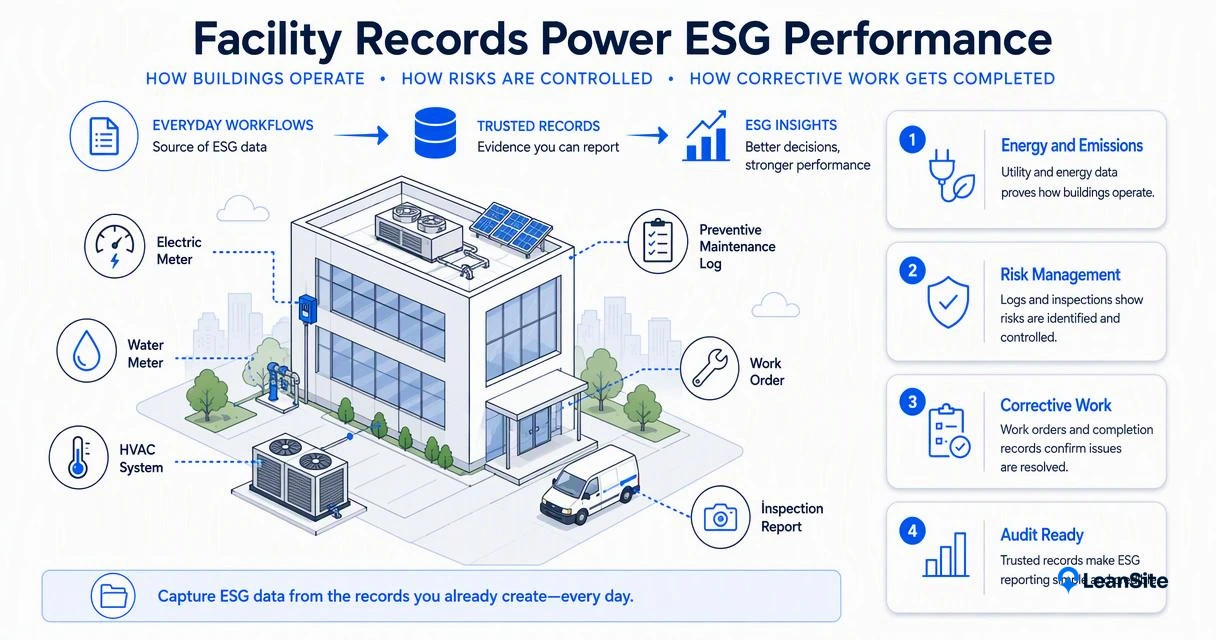
Facility ESG data map
| ESG area | Facility records to capture | Why it matters |
|---|---|---|
| Energy and emissions | Utility readings, HVAC runtime, refrigerant events, generator fuel, meter notes | Supports building performance reviews and emissions estimates |
| Water | Meter readings, leaks, irrigation issues, plumbing repairs | Shows conservation efforts and unresolved loss |
| Waste | Hauler records, recycling pickups, hazardous waste documentation | Helps prove diversion and proper disposal |
| Maintenance | Work orders, preventive maintenance, asset history, photos | Links ESG outcomes to real tasks |
| Safety and social | Inspections, incident follow-up, accessibility repairs, indoor air quality work | Documents occupant and worker conditions |
| Governance | Approvals, policies, vendor insurance, audit trail, timestamps | Proves control, accountability, and review |
Scope 1, Scope 2, and Scope 3 language often appears in ESG programs. Facility teams usually influence all three: onsite fuel and refrigerants, purchased electricity, and contractor or waste-related activity.
Good software should make those records easy to collect while work happens. For multi-site operators, a deeper guide to multi-location facilities management software explains why standard workflows matter when hundreds of sites report into one operating model.
Key insight: Facility ESG data becomes stronger when it is captured at the asset, site, vendor, and work-order level instead of rebuilt at quarter-end.
How does facility software automate ESG compliance workflows?
Facility software automates ESG workflows by turning inspections, service requests, approvals, vendor updates, and corrective actions into structured records with timestamps, owners, and supporting evidence. The goal is not more reporting work; the goal is cleaner operating data.
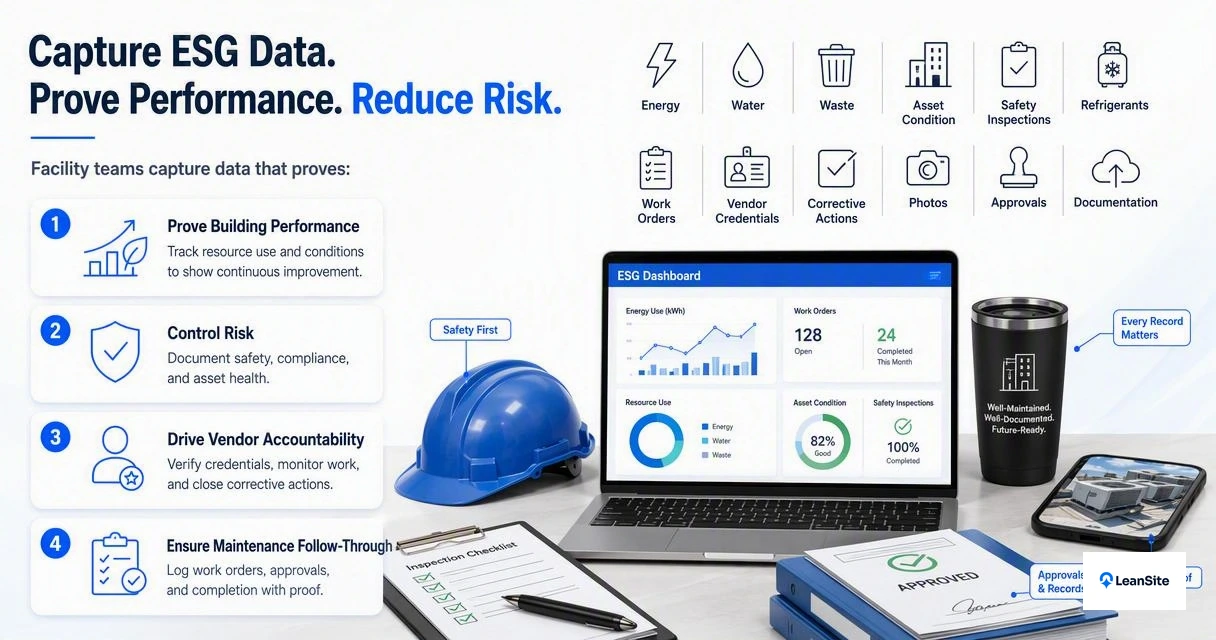
ESG workflow automation steps
- Create standard request types: Tag energy, water, waste, safety, accessibility, and compliance work consistently.
- Assign owners automatically: Route issues to internal teams or approved vendors by site, asset, or priority.
- Attach evidence at the source: Store photos, invoices, readings, checklists, and completion notes on the job record.
- Track preventive maintenance: Link ESG-related assets, such as HVAC, lighting, refrigeration, and meters, to recurring tasks.
- Escalate exceptions: Flag overdue inspections, repeated failures, missing documentation, or unresolved environmental issues.
- Export audit records: Give sustainability, finance, and compliance teams clean data without rebuilding history manually.
Artificial intelligence is becoming part of this workflow. AI can summarize work-order history, spot repeated asset failures, and classify service requests faster. For a broader view of where this is heading, see AI facility management software.
A related 2022 study in Technological Forecasting and Social Change links governance mechanisms, Industry 4.0, and circular economy decision-making, reinforcing the idea that digital operations data can support sustainability investment choices (Alkaraan, Elmarzouky, and Hussainey, 2022).
Where Leansite fits the ESG workflow
The Leansite platform supports ESG documentation by keeping facilities tickets, work orders, vendor coordination, and task status in one operating record. That matters when a facilities director needs to prove what happened, when it happened, who handled it, and what evidence was attached.
For distributed operations, Leansite can help standardize task tracking across locations without forcing each site to invent its own reporting habits. More product details are available at getleansite.com.
How should buyers compare ESG facility tools in 2026?
Buyers should compare ESG facility tools by how well they connect reporting requirements to daily operations. A strong platform should reduce duplicate entry, preserve evidence, and make compliance work visible across properties.
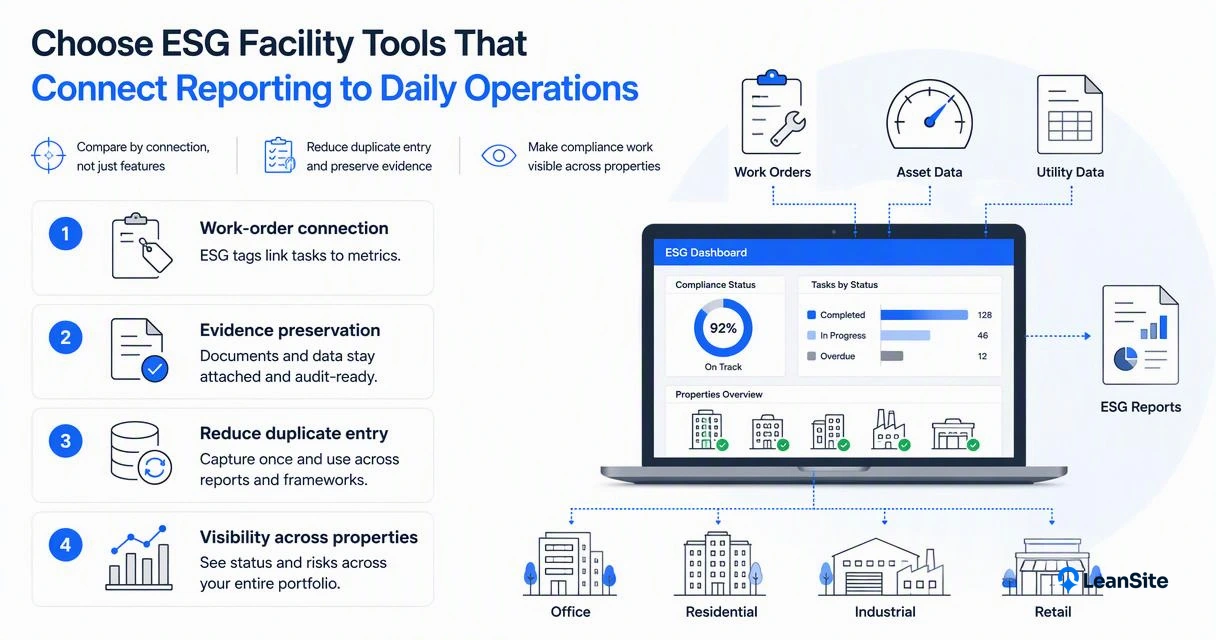
ESG software buying checklist
| Buying factor | What to look for | Facility impact |
|---|---|---|
| Work-order connection | ESG tags, asset links, photos, notes, completion proof | Turns repairs into usable evidence |
| Multi-site controls | Standard templates, permissions, location rollups | Reduces inconsistent site reporting |
| Vendor tracking | Dispatch, insurance records, invoices, service history | Improves contractor accountability |
| Audit trail | Time stamps, status changes, approvals, attachments | Supports internal review and audits |
| Reporting exports | Clean CSV, dashboards, summaries, filters | Helps finance and sustainability teams |
| Mobile access | Field updates, offline tolerance, photo capture | Captures proof while work happens |
Some ESG platforms focus mainly on enterprise sustainability reporting. Others focus on building operations. Facility leaders should be careful with tools that look strong in board-level dashboards but weak in field execution.
That does not mean a reporting suite and a facility platform cannot work together. In many organizations, the facility system becomes the source of operational truth, while the ESG reporting suite handles disclosure formatting.
Common selection priorities include:
- Ease of field adoption: technicians and vendors can update records quickly.
- Clean asset hierarchy: equipment, rooms, buildings, and sites stay organized.
- Proof capture: photos, checklists, and invoices live with the work.
- Exception reporting: overdue tasks and repeated failures surface early.
- Integration path: exports or APIs support finance, sustainability, and analytics tools.
For teams replacing shared inboxes or spreadsheets, the comparison should start with work execution. This guide to the best facilities ticket management system for 2026 covers the ticketing side that ESG programs often overlook.
What should facilities expect from ESG tools in 2027?
Facilities should expect ESG tools in 2027 to become more automated, more evidence-driven, and more connected to asset performance. Manual surveys will not disappear, but they will carry less weight when stronger operational records are available.
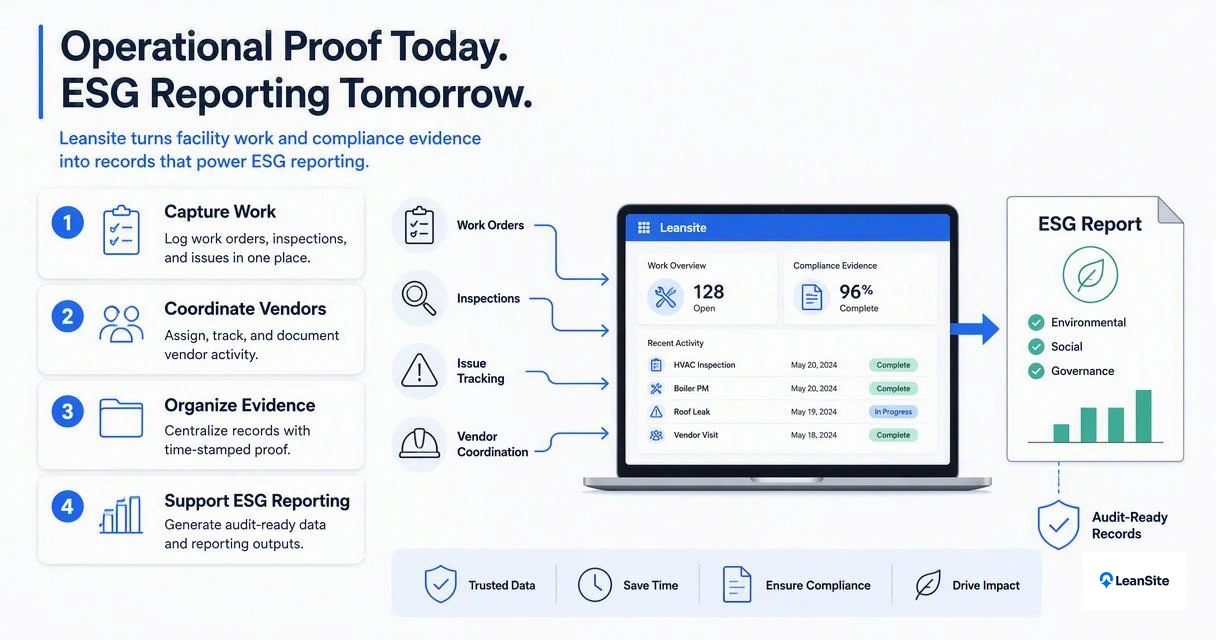
Regulation and customer pressure will keep pushing for better data lineage. The strongest facility programs will show not only the final ESG metric, but also the work orders, inspections, vendor actions, and approvals behind it.
Likely 2027 software capabilities
- AI-assisted evidence review: systems flag missing photos, vague notes, or incomplete closeout fields.
- Predictive ESG maintenance: asset history helps prioritize repairs that affect energy, water, comfort, or safety.
- Vendor ESG scorecards: contractor responsiveness, documentation quality, and compliance records become easier to compare.
- Portfolio benchmarks: operators compare sites by repeated issues, preventive completion, utility-linked work, and cost trends.
- Natural-language reporting: managers ask questions about compliance status and receive summarized answers.
AI assistants will matter most when they sit inside the work system, not beside it. For example, Vera, the AI assistant built into Leansite, is relevant because facility ESG questions often start with messy operational history.
Specialized sectors will also keep raising the bar. Restaurant chains, airports, campuses, and self-storage portfolios all have different inspection cadences, vendor models, and risk profiles. Related reading on facilities management for restaurant chains shows how multi-site operating discipline affects compliance outcomes.
Key insight: By 2027, ESG software will be judged less by dashboard polish and more by whether it can prove the field work behind each claim.
Conclusion
ESG compliance software for facility management works best when it connects sustainability reporting to the daily reality of buildings: repairs, inspections, assets, vendors, photos, approvals, and follow-up. The next practical step is to map current ESG data sources, identify gaps in work-order evidence, and standardize the fields that every site must capture. Facility teams that want that operating record in one place can evaluate Leansite and visit getleansite.com to see how maintenance, vendor coordination, and documentation fit together.