TL;DR
A maintenance team needs both contractual ownership and usable access to its records. Before signing or renewing, test an export that includes attachments, asset relationships, and audit history, then document fees, retention, and access after cancellation.
An ownership clause doesn't guarantee a usable maintenance history. CMMS data ownership matters because years of repairs, inspections, invoices, and equipment records help facilities teams make replacement decisions and coordinate vendors.
Computerized maintenance management system (CMMS): Software that maintains a database of information about an organization's maintenance operations.
For facilities teams evaluating Leansite, portability belongs alongside task tracking and operational visibility in the buying conversation. In 2026, the useful question isn't just who owns the records. It's whether those records remain complete, understandable, and accessible outside the application.
Table of Contents
What does CMMS data ownership actually mean?
CMMS data ownership means the rights an organization holds over its maintenance records, as defined by applicable agreements and law. Practical control also requires access to those records in usable formats. A contract can recognize ownership while leaving export scope, delivery timing, and post-cancellation access unclear.
Contractual ownership: The agreement's allocation of rights over customer records.
Data portability: The ability to move records into another system while preserving their meaning and relationships.
Three distinct layers of data control
Ownership, access, and portability answer different procurement questions.
| Layer | Question to resolve | Evidence to request |
|---|---|---|
| Ownership | Who holds rights over customer records? | Contract language defining customer data |
| Access | Who can retrieve records, and when? | Permissions and cancellation terms |
| Portability | Can another system use the records? | Sample export and field documentation |
Maintenance history becomes more useful when teams can connect recurring failures with earlier repairs and costs. The article on why facilities data proves its value in year two provides related background.
Ownership protects rights; portability preserves operational usefulness.
Which data rights belong in a CMMS contract?
A CMMS contract should define the exportable records, delivery formats, charges, API permissions, retention periods, and access available after cancellation. The scope should include attachments, asset relationships, and audit history, not just work-order summaries. Each requirement should have an accountable provider contact and a clear delivery deadline.
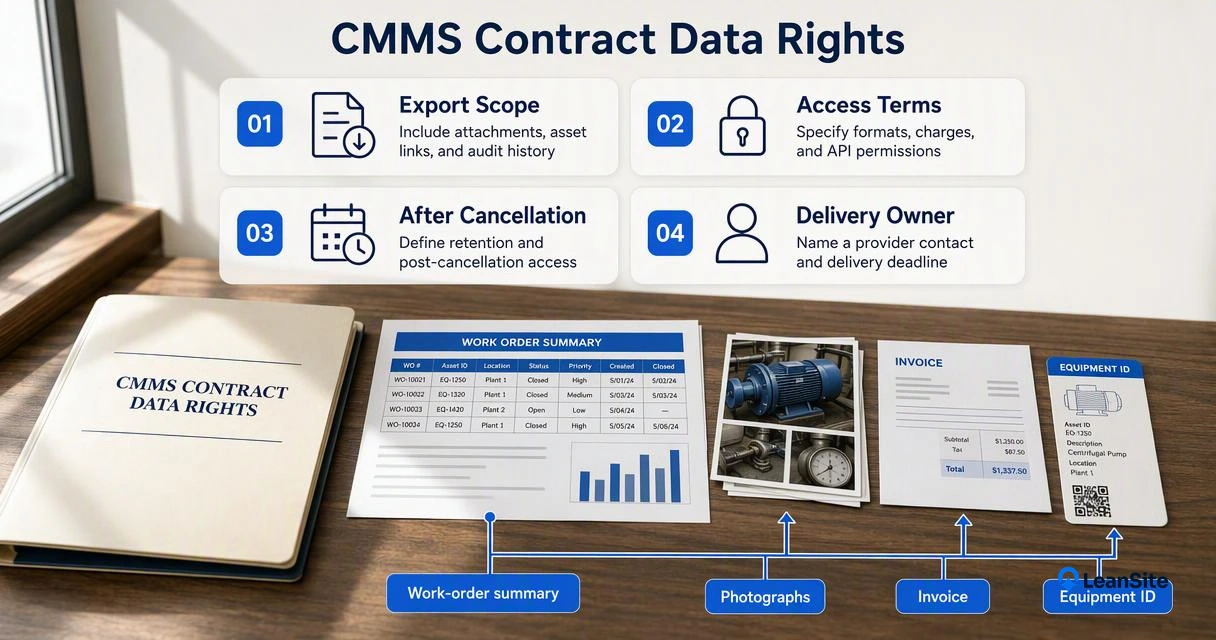
A statement such as "customer owns customer data" needs supporting detail. A work-order spreadsheet may contain completion dates without the photographs, invoices, or equipment identifiers needed to explain the work.
Seven requirements to confirm in writing
The procurement checklist should cover the records and conditions needed to reconstruct maintenance history.
- Attachments: Include photographs, manuals, inspection documents, and invoices, with filenames and links to their associated records.
- Asset relationships: Preserve stable identifiers connecting locations, equipment, parent assets, work orders, parts, and vendors.
- Audit history: Specify whether exports include available changes, timestamps, status transitions, and the identities of record editors.
- Export fees: State charges for standard exports, custom extraction, attachment delivery, and migration assistance, including any approved limits.
- API access: Confirm plan eligibility, permissions, rate limits, documentation, and which record types the API exposes.
- Retention: Define how long active records, deleted records, and backups remain, plus deletion timing and available confirmation.
- Access after cancellation: Set the retrieval window, administrator permissions, read-only availability, and final export delivery process.
Contracts should also address permitted provider use of customer data, including analytics or AI-related processing. Those rights are separate from export rights and deserve their own review.
The 2026 CMMS buyer's guide offers a broader framework for incorporating these questions into software selection.
How can facilities teams test a usable export?
Facilities teams can test a usable CMMS export through five checks:
- Select an asset with a complete maintenance history.
- Export its records and attachments.
- Match identifiers across the delivered files.
- Rebuild the asset's repair timeline outside the application.
- Record gaps, delivery time, and charges before approving the agreement.
Reconstruct one real maintenance case
A rooftop HVAC unit makes a useful test case because its history can connect inspections, emergency repairs, contractor invoices, and replacement recommendations. The export should allow a reviewer to follow those connections without relying on the original application's screens.
File format alone doesn't establish completeness. A CSV file can hold work-order fields, while a separate attachment folder carries photographs and invoices. A field dictionary should explain identifiers, dates, statuses, and custom fields.
- Check whether timestamps include time-zone information.
- Confirm that invoice files match the correct work orders.
- Compare exported record counts with the selected source records.
- Open a sample of attachments and verify their associations.
An API can support recurring transfers, but it shouldn't be assumed to expose every field or attachment. For automated readings, verify that equipment identifiers, measurement units, and timestamps remain interpretable after transfer.
How Leansite handles this
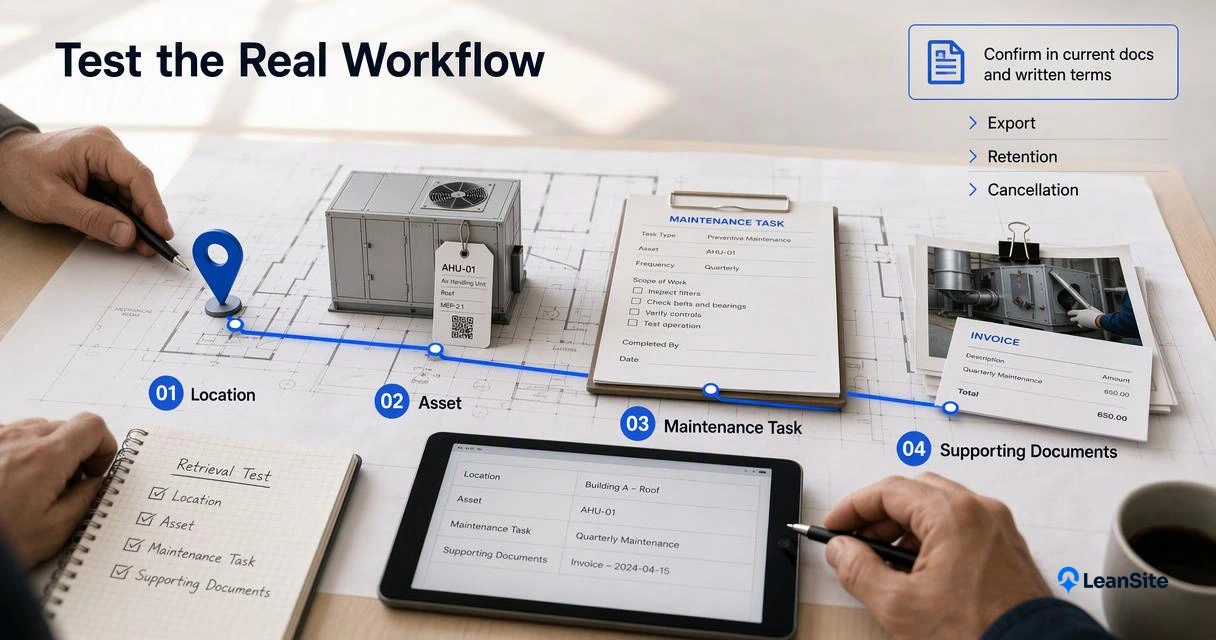
A Leansite evaluation should turn data requirements into a documented demonstration using the facilities team's actual workflow. The available research doesn't establish specific export, retention, or cancellation capabilities, so those details need confirmation through current product documentation and written terms.
A practical agenda for a product demonstration
A useful demonstration connects a location, an asset, a maintenance task, and its supporting documents, then shows how those records can be retrieved. That gives facility managers, property owners, and vendor coordinators a shared basis for assessing continuity.
- Provide a representative maintenance case before the demonstration.
- Request the sample files and an explanation of their structure.
- Record confirmed capabilities and contractual commitments separately.
Teams comparing shortlisted platforms can use the Fiix comparison and eMaint comparison for product context. Apply the same export test to every candidate rather than treating a feature label as proof of portability.
Conclusion
Protecting CMMS data ownership starts with evidence: a written checklist, a sample export, and a reconstruction test. Before the next renewal, facilities teams should assign responsibility for those checks. For a Leansite evaluation, visit getleansite.com and request a demonstration that includes record retrieval alongside the maintenance workflow.