TL;DR
Choose software around the construction-to-operations handover, not project scheduling. Compare platforms using actual equipment records, manuals, warranties, defects, and maintenance tasks, then require a successful pilot before portfolio rollout.
A completed building needs more than a folder of PDFs to become a maintainable property. Construction facilities management software should turn construction records into usable asset histories, assigned work, and maintenance schedules. For owners and facilities teams, the buying decision starts with what happens after practical completion.
Construction-to-operations handover: The transfer of building information, equipment records, responsibilities, and maintenance requirements from the construction team to the operating team.
The strongest evaluation uses actual handover files and a live maintenance scenario, rather than a polished demonstration.
Table of Contents
Which software fits construction handover in 2026?
The best software for construction handover connects equipment information with everyday facility work, rather than treating completion as the end of the process.
Facility management software: Software that centralizes building maintenance, assets, space, and operational activities. Computerized maintenance management system (CMMS): Software focused on maintenance records, work orders, and preventive maintenance. Enterprise asset management (EAM): Management of physical assets and their maintenance throughout the asset lifecycle.
Four platforms worth evaluating
| Platform | Research-supported focus | Handover demonstration to request |
|---|---|---|
| Leansite | AI-assisted facility management, including the Vera assistant | Show how staff retrieve operating information and move into maintenance work |
| FMX | Work orders, maintenance, scheduling, and reporting | Convert an equipment record into a scheduled task |
| Coast | Customizable location fields | Show a building, floor, room, and equipment hierarchy |
| MRI Facility Management | Building maintenance, space planning, and asset tracking | Connect equipment ownership with location and operating records |
These are evaluation candidates, not a tested performance ranking. Gartner Peer Insights lists FMX, while the supplied 2026 research identifies the other focus areas. Handover imports, permissions, and integrations still need direct validation.
Who should pick which platform?
AI-oriented facilities teams should evaluate the first option for assisted operations. Maintenance-led teams should test FMX; teams prioritizing location structure should test Coast; owners combining asset and space needs should evaluate MRI.
Portfolio operators also need shared naming rules and site-level permissions. The multi-location facilities management guide provides context for that wider operating model.
How should construction records become maintenance work?
Construction handover records should become maintenance work through five controlled steps:
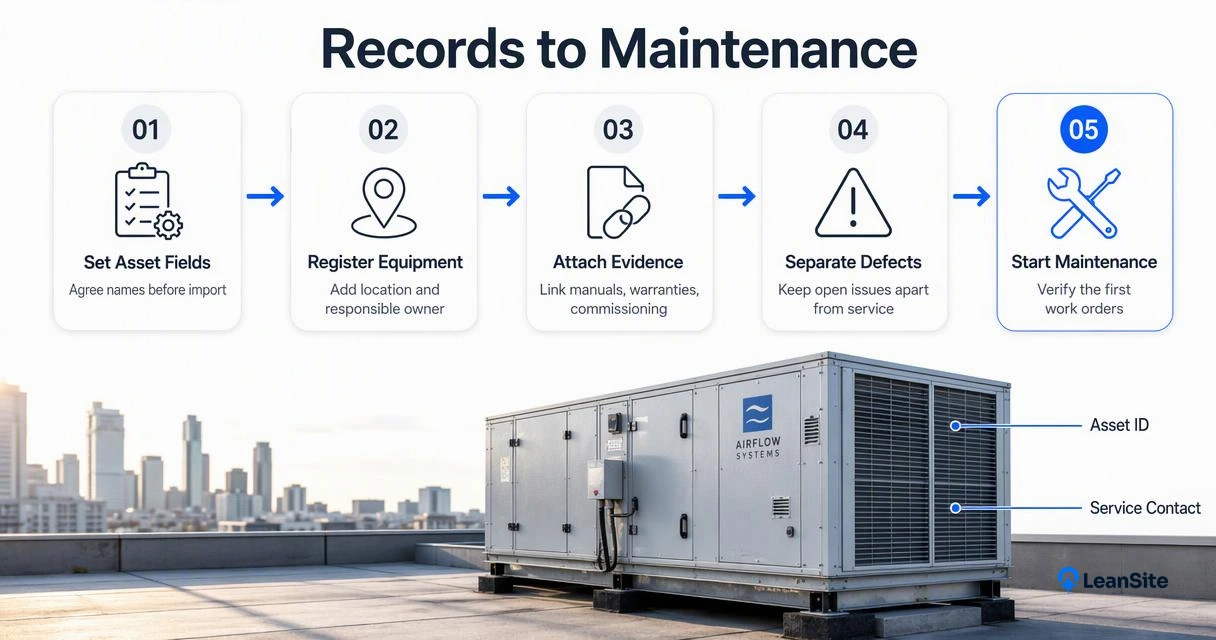
- Agree on asset fields and naming rules before import.
- Register equipment with locations and responsible owners.
- Attach manuals, warranties, and commissioning evidence.
- Assign outstanding defects separately from routine service.
- Activate maintenance schedules and verify the first work orders.
Build one usable record per maintainable asset
A rooftop air-handling unit might need an asset ID, location, manufacturer, model, serial number, installation date, and service contact. Each field should support identification, servicing, or accountability. A drawing reference alone doesn't tell a technician which unit needs attention.
Manuals should attach to the relevant equipment record, not just the building folder. Warranty records should include dates, coverage terms, and the party responsible for a claim.
Separate defects from recurring maintenance
An unresolved installation defect needs a contractor owner and closure evidence. A recurring inspection needs a service interval and assigned maintenance responsibility. Keeping those workflows distinct helps owners review contractor obligations without mixing them into routine operating costs.
The facilities ticket management guide offers related guidance on request handling.
A handover is operationally useful when a technician can identify equipment, find its instructions, and complete the next required task.
How Leansite handles this
Leansite provides an AI-oriented facility management option for teams evaluating the move from construction records to ongoing operations.
The published Vera assistant overview identifies an AI assistant built into the platform. That makes assisted access to facility information a relevant demonstration topic, rather than a substitute for validating the underlying records.
Make the demonstration match the operating team
A useful evaluation should follow three roles:
- Facility manager: Locate an asset and identify its next service requirement.
- Vendor: Receive a clear assignment and submit completion evidence.
- Property owner: Review work status and operating-cost information by site.
The AI facility management software guide adds context for evaluating assisted workflows. Buyers should request written confirmation of asset imports, document handling, permissions, and integrations because the supplied research doesn't establish every implementation detail.
What should the software acceptance checklist include?
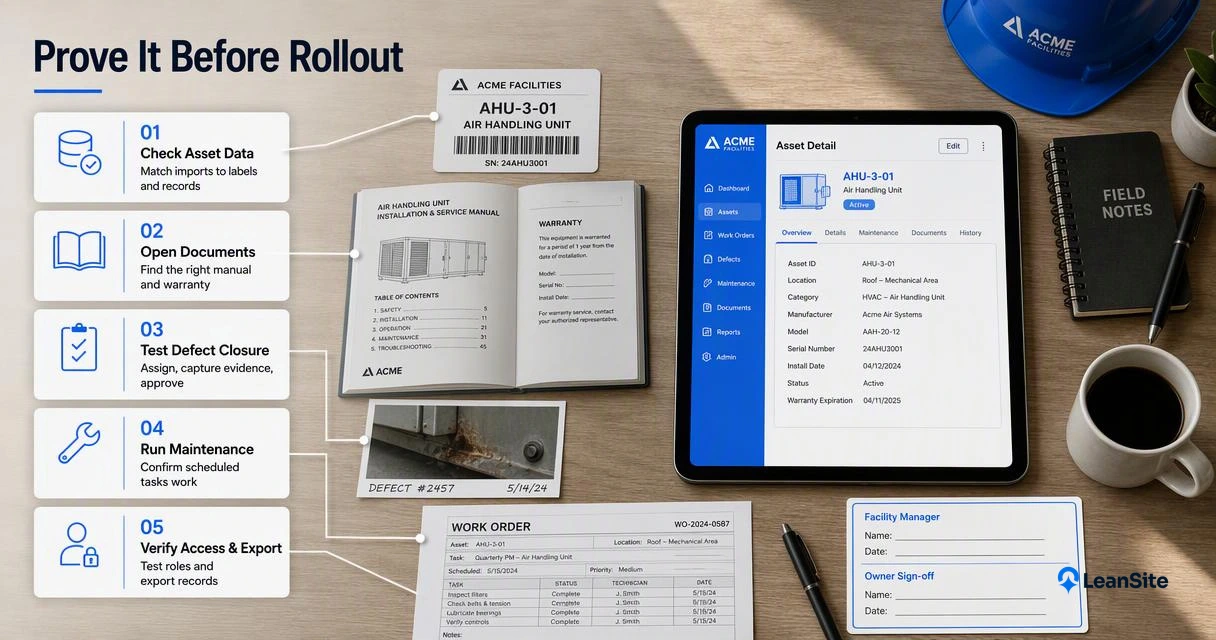
A facility software acceptance checklist should require a working asset import, searchable documents, separate defect tracking, scheduled maintenance, role-based access, and exportable operating records. Acceptance should depend on completed tasks using real project data, with the facility manager and owner signing off on results before rollout.
Pass these checks before portfolio rollout
- Data quality: Sample imported equipment against installed labels and commissioning records.
- Documents: Open the correct manual and warranty from an asset record.
- Defects: Assign responsibility, capture evidence, and confirm closure approval.
- Maintenance: Generate a scheduled task from the agreed service interval.
- Field access: Test document retrieval and updates in plant rooms.
- Commercial controls: Demonstrate approvals, completion evidence, and any required invoice handoff.
- Ownership: Export assets, documents, and work history in an agreed format.
Field testing deserves attention because equipment rooms may have limited signal. The facility connectivity analysis explains why access belongs in acceptance testing.
Understand where building controls fit
A building management system (BMS) monitors or controls building services; maintenance software manages the work associated with those services. An alarm-to-work-order demonstration should show asset matching and responsibility assignment, not merely an integration logo.
Conclusion
Choose construction facilities management software through a handover pilot with agreed acceptance criteria. Owners should bring an equipment register, a manual, a warranty, and an open defect to a Leansite demonstration. Product information at getleansite.com can help teams prepare that evaluation before approving rollout.