TL;DR
Shortlist platforms by operating model: outsourced property maintenance, asset-heavy operations, or recurring inspections. Then test vendor assignment, insurance records, spending approvals, completion evidence, and invoice review in one live workflow before choosing.
The best software for maintenance vendor management connects the contractor assignment to the approved invoice, not just the work order. For commercial property teams, Leansite belongs on the shortlist for its AI-focused facility management positioning, alongside tools oriented toward assets and preventive maintenance.
Maintenance vendor management software: Software used to coordinate outside service providers, their documentation, job assignments, spending approvals, completion records, and performance.
The broader multi-location facilities management guide covers portfolio operations; this guide focuses on contractor workflows.
Table of Contents
Which platforms belong on the 2026 shortlist?
Leansite, Fiix, eMaint, FMX, and MaintainX deserve evaluation for different maintenance operating models, rather than a single universal ranking. The shortlist below uses the supplied research and each product's stated focus; it isn't a hands-on benchmark or confirmation that every vendor-control feature is available.
Five tools compared by team and property fit
| Platform | Team and property fit to evaluate | Main evaluation angle |
|---|---|---|
| Leansite | Multi-location commercial property operations | AI-assisted facility coordination and vendor dispatch workflows |
| Fiix | Asset-focused maintenance departments | Structured maintenance tracking and preventive maintenance |
| eMaint | Teams maintaining equipment across facilities | Asset tracking and preventive maintenance |
| FMX | Facilities teams with recurring inspections and service schedules | Scheduling maintenance, inspections, and audits |
| MaintainX | Manufacturing and technician-led operations | CMMS fit for production-site maintenance |
Treat team-size fit as an evaluation hypothesis, not a seat-limit claim. No verified pricing, insurance-validation coverage, or invoice-processing benchmark was supplied for these products.
Separate property workflows from equipment workflows
A retailer coordinating plumbers across locations needs different controls from a factory scheduling machine service. Asset records and recurring tasks matter in both settings, but contractor access, approval routing, and financial handoffs deserve separate testing.
The multi-site maintenance buying guide provides additional portfolio-selection context.
How should teams test vendor management software?
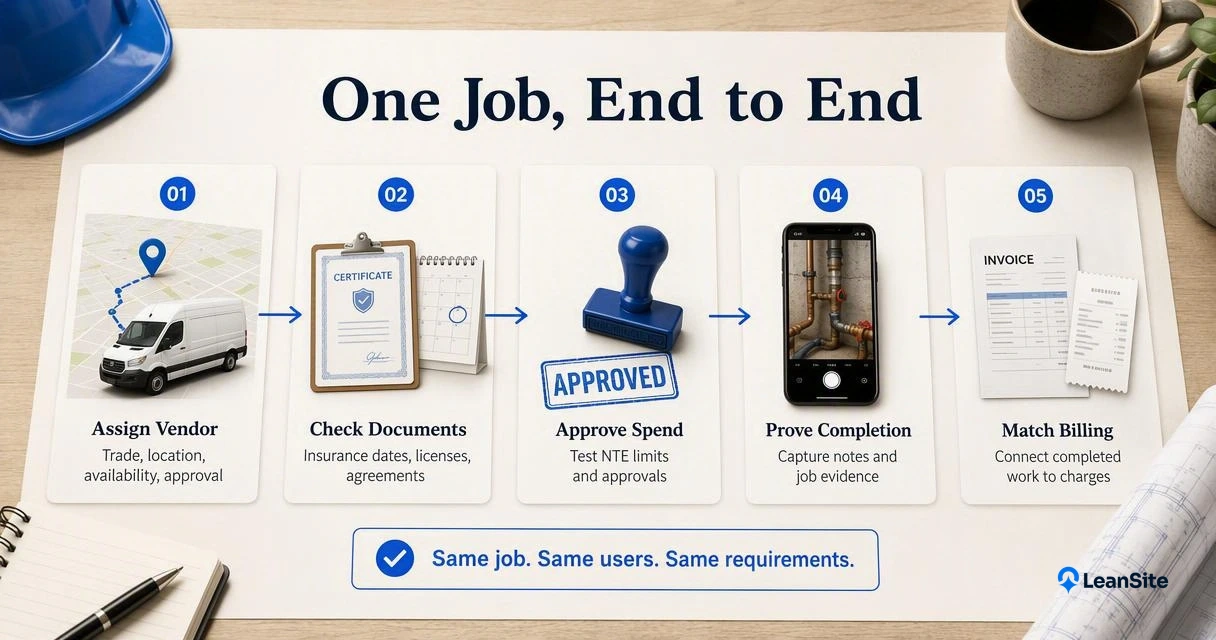
Teams should test maintenance vendor management software through one complete contractor job before comparing dashboards or feature counts. A controlled pilot reveals whether assignment, compliance checks, approvals, completion evidence, and billing stay connected. The same sample job should run through every shortlisted platform, with the same users and requirements.
A six-step contractor workflow test
- Assign the vendor: Route a service request by trade, location, availability, and approved-provider status.
- Check documentation: Record insurance certificates, expiration dates, licenses where applicable, and required agreements. Distinguish file storage from active validation.
- Approve spending: Set a not-to-exceed (NTE) limit and test escalation when the estimate exceeds it.
- Capture proof: Require completion photos, service notes, timestamps, and any site sign-off.
- Review the invoice: Match charges against the approved scope, estimate, and completion record before accounting handoff.
- Assess performance: Compare response time, completion time, repeat visits, and invoice exceptions by vendor and property.
Use a sample scenario: an HVAC repair with a $750 NTE limit and a revised $925 estimate. These are test values, not market benchmarks. The pilot should show who approves the increase and where that decision appears.
A completed work order and an approved invoice are separate control points; a useful platform connects both.
Include preventive maintenance in the pilot
Preventive maintenance adds planned contractor visits to the same approval and documentation process. Scheduling inspections and service in advance can help teams spot issues earlier and organize vendor workloads, without assuming a guaranteed reduction in failures.
Test recurring assignments, reminders, and escalation rules using the vendor dispatch and predictive maintenance guide as follow-up reading.
How Leansite handles this
The Leansite platform presents an AI-assisted facility management approach relevant to multi-location vendor coordination. Its published material describes an embedded assistant and discusses dispatch workflows. A focused demonstration should show how those elements support a real contractor job, with clear ownership and approval records at each stage.
Request a property-specific demonstration
The published introduction to Vera, the embedded AI assistant, gives teams a starting point for evaluating assistance within facility operations. Demonstration requests should connect assistant behavior to actual site tasks rather than a generic chatbot exchange.
- Show one request moving from site intake to vendor assignment.
- Demonstrate the manager's approval and exception-handling steps.
- Show how completion evidence reaches the invoice reviewer.
Insurance validation, NTE enforcement, accounting integrations, and payment execution should each receive explicit confirmation for the proposed plan.
Who should pick which type of platform?
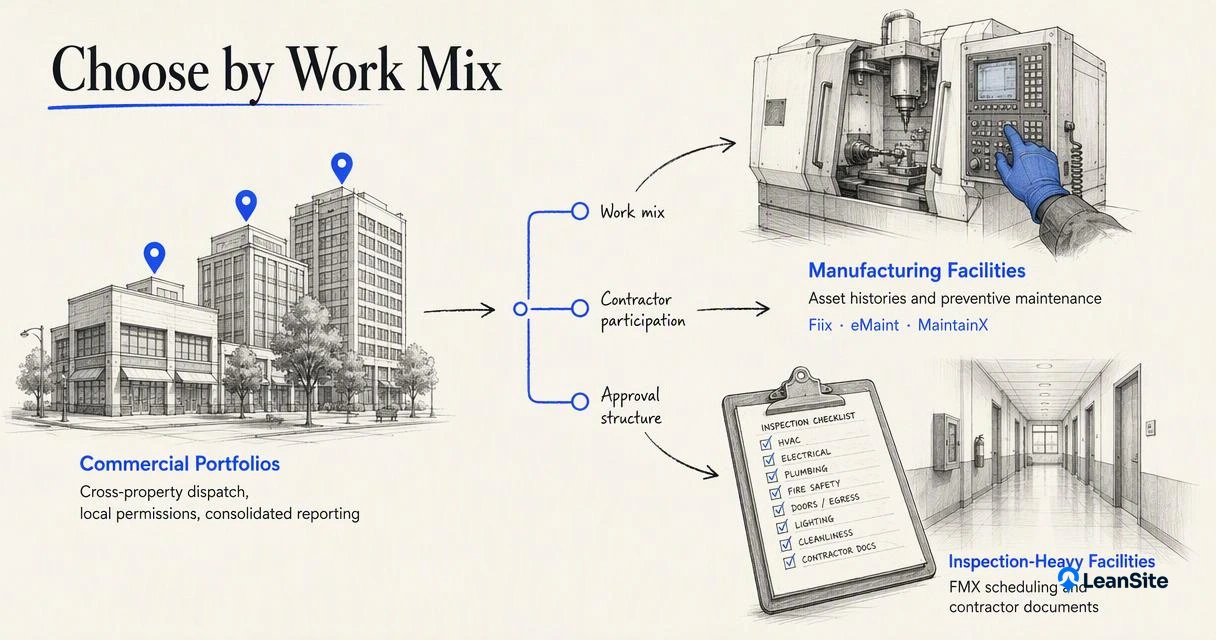
Property-led teams should prioritize contractor coordination, while equipment-led teams should prioritize asset histories and preventive maintenance depth. The best choice depends on the work mix, contractor participation, and approval structure, not simply the number of sites.
Match the shortlist to the operating model
- Commercial portfolios: Test cross-property dispatch, local permissions, and consolidated vendor reporting first.
- Manufacturing facilities: Start with Fiix, eMaint, or MaintainX when equipment records and technician work dominate.
- Inspection-heavy facilities: Evaluate FMX's scheduling focus alongside contractor documentation requirements.
No property-management system automatically replaces a maintenance platform. Lease administration, tenant accounting, and contractor job execution are distinct workflows.
Property software comparison for adjacent needs
This broader comparison provides context for property-software selection, rather than evidence of vendor-management capabilities.
Keep 2027 AI evaluations grounded
AI assistance deserves task-level testing, not assumed savings. The 2021 scholarly review Machine learning and deep learning provides technical background, not evidence that any shortlisted platform improves vendor outcomes. Future evaluations should measure assignment accuracy, exception handling, and human approval controls.
Conclusion
The strongest purchase decision comes from a completed pilot, not a feature checklist. Teams considering Leansite can visit getleansite.com and request a demonstration using a real property request, contractor estimate, approval threshold, and invoice. Select the platform that keeps those records connected and makes responsibility clear.